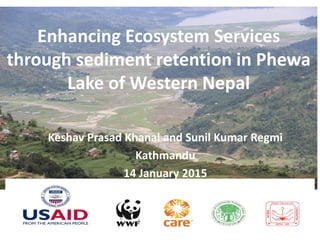
Enhancing Ecosystem Services
through sediment retention in Phewa
Lake of Western Nepal
Keshav Prasad Khanal and Sunil Kumar Regmi
Kathmandu
14 January 2015
Outline
• INTRODUCTION
• METHODS
• RESULTS AND DISCUSSION
• CONCLUSION
INTRODUCTION
• Phewa Lake is second largest lake of the country
• Phewa Lake and its sub watersheds contributing different
ecological services
• The Lake also contributes to the livelihoods in several ways
• The ES by the lake is valued at over US$43 million per year
• Sustainability of this benefit depends on the life of the lake
• Sedimentation is the major problem of the lake
• This paper aims to document the quantity of sediment
loads coming from sub watersheds and explores
possibilities for sediment retention in the upper
catchments through establishment of Payment of
Ecosystem Service (PES)
METHODS
The methodology adopted for the
study were:
1. desk review of wide range of
secondary information
2. focused groups discussion
3. Consultations with
stakeholders
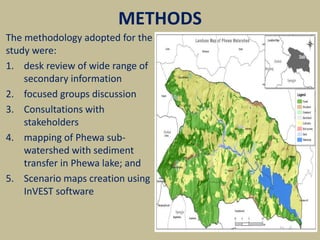
4. mapping of Phewa sub-
watershed with sediment
transfer in Phewa lake; and
5. Scenario maps creation using
InVEST software
RESULTS AND DISCUSSION
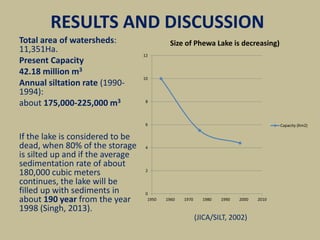
Total area of watersheds:
11,351Ha.
Present Capacity
42.18 million m3
Annual siltation rate (1990-
1994):
about 175,000-225,000 m3
If the lake is considered to be
dead, when 80% of the storage
is silted up and if the average
sedimentation rate of about
180,000 cubic meters
continues, the lake will be
filled up with sediments in
about 190 year from the year
1998 (Singh, 2013).
0
2
4
6
8
10
12
1950 1960 1970 1980 1990 2000 2010
Size of Phewa Lake is decreasing)
Capacity (Km2)
(JICA/SILT, 2002)
RESULTS AND DISCUSSION contd..
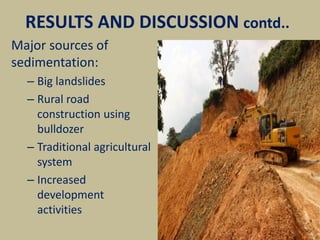
Major sources of
sedimentation:
– Big landslides
– Rural road
construction using
bulldozer
– Traditional agricultural
system
– Increased
development
activities
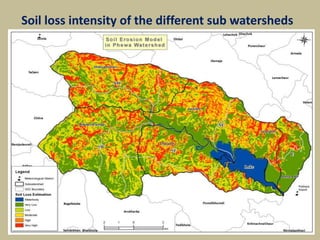
Soil loss intensity of the different sub watersheds
Sub-watersheds categorization based on
Sediment transfer
• Category 1: Sarankot, Kaskikot, and Dhikur
Pokhari VDCs
• Category 2: Eastern hill slope of Sarankot VDC,
Pokhara Municipality (Ward No. 2, 4, 5, 6, 7 & 8)
• Category 3: Bhadaure Tamagi, Chapakot and
Pumdi Bhumdi VDCs.
• immediate actions are required in category 1
– Major contributing factors: agricultural activities -
mono-cropping, cultivation in small terraces and
heavy tillage
Conclusion
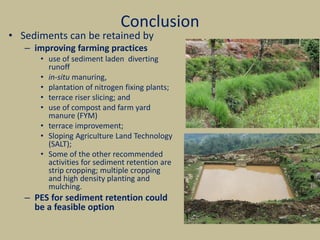
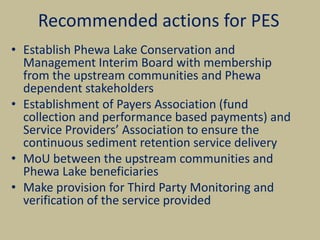
• Sediments can be retained by
– improving farming practices
• use of sediment laden diverting
runoff
• in-situ manuring,
• plantation of nitrogen fixing plants;
• terrace riser slicing; and
• use of compost and farm yard
manure (FYM)
• terrace improvement;
• Sloping Agriculture Land Technology
(SALT);
• Some of the other recommended
activities for sediment retention are
strip cropping; multiple cropping
and high density planting and
mulching.
– PES for sediment retention could
be a feasible option
Recommended actions for PES
• Establish Phewa Lake Conservation and
Management Interim Board with membership
from the upstream communities and Phewa
dependent stakeholders
• Establishment of Payers Association (fund
collection and performance based payments) and
Service Providers’ Association to ensure the
continuous sediment retention service delivery
• MoU between the upstream communities and
Phewa Lake beneficiaries
• Make provision for Third Party Monitoring and
verification of the service provided
Key messages
• Phewa Lake provides different Ecosystem Services and
the livelihoods for thousands of people around the
Lake.
• The lake is decreasing in area and depth due to heavy
sedimentation.
• Both the upstream communities and downstream Lake
dependent communities could get mutual benefit from
the PES; particularly sediment retention
• PES for sediment retention is feasible in Phewa
watershed through establishment of independent
Phewa Management Authority and other appropriate
institutions for the effective delivery of sediment
retention ES and payments against the performance of
the services.
Acknowledgements
• Local communities of Phewa catchments and ,
• Hotel Association- Pokhara, Nepal Toursim Board,
district government line agencies of Kaski district
and other stakeholders provided information.
• Mr. Gokarna Jung Thapa of WWF Nepal-
mapping the sub watershed based on sediment
load contribution to Phewa lake and projecting
the future scenario of sedimentation problem in
the lake using InVEST tool.
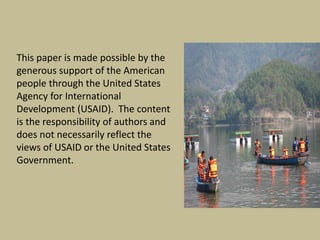
This paper is made possible by the
generous support of the American
people through the United States
Agency for International
Development (USAID). The content
is the responsibility of authors and
does not necessarily reflect the
views of USAID or the United States
Government.

Keshav prasad khanal

  • 1.
    Enhancing Ecosystem Services throughsediment retention in Phewa Lake of Western Nepal Keshav Prasad Khanal and Sunil Kumar Regmi Kathmandu 14 January 2015
  • 2.
    Outline • INTRODUCTION • METHODS •RESULTS AND DISCUSSION • CONCLUSION
  • 3.
    INTRODUCTION • Phewa Lakeis second largest lake of the country • Phewa Lake and its sub watersheds contributing different ecological services • The Lake also contributes to the livelihoods in several ways • The ES by the lake is valued at over US$43 million per year • Sustainability of this benefit depends on the life of the lake • Sedimentation is the major problem of the lake • This paper aims to document the quantity of sediment loads coming from sub watersheds and explores possibilities for sediment retention in the upper catchments through establishment of Payment of Ecosystem Service (PES)
  • 4.
    METHODS The methodology adoptedfor the study were: 1. desk review of wide range of secondary information 2. focused groups discussion 3. Consultations with stakeholders 4. mapping of Phewa sub- watershed with sediment transfer in Phewa lake; and 5. Scenario maps creation using InVEST software
  • 5.
    RESULTS AND DISCUSSION Totalarea of watersheds: 11,351Ha. Present Capacity 42.18 million m3 Annual siltation rate (1990- 1994): about 175,000-225,000 m3 If the lake is considered to be dead, when 80% of the storage is silted up and if the average sedimentation rate of about 180,000 cubic meters continues, the lake will be filled up with sediments in about 190 year from the year 1998 (Singh, 2013). 0 2 4 6 8 10 12 1950 1960 1970 1980 1990 2000 2010 Size of Phewa Lake is decreasing) Capacity (Km2) (JICA/SILT, 2002)
  • 6.
    RESULTS AND DISCUSSIONcontd.. Major sources of sedimentation: – Big landslides – Rural road construction using bulldozer – Traditional agricultural system – Increased development activities
  • 7.
    Soil loss intensityof the different sub watersheds
  • 8.
    Sub-watersheds categorization basedon Sediment transfer • Category 1: Sarankot, Kaskikot, and Dhikur Pokhari VDCs • Category 2: Eastern hill slope of Sarankot VDC, Pokhara Municipality (Ward No. 2, 4, 5, 6, 7 & 8) • Category 3: Bhadaure Tamagi, Chapakot and Pumdi Bhumdi VDCs. • immediate actions are required in category 1 – Major contributing factors: agricultural activities - mono-cropping, cultivation in small terraces and heavy tillage
  • 9.
    Conclusion • Sediments canbe retained by – improving farming practices • use of sediment laden diverting runoff • in-situ manuring, • plantation of nitrogen fixing plants; • terrace riser slicing; and • use of compost and farm yard manure (FYM) • terrace improvement; • Sloping Agriculture Land Technology (SALT); • Some of the other recommended activities for sediment retention are strip cropping; multiple cropping and high density planting and mulching. – PES for sediment retention could be a feasible option
  • 10.
    Recommended actions forPES • Establish Phewa Lake Conservation and Management Interim Board with membership from the upstream communities and Phewa dependent stakeholders • Establishment of Payers Association (fund collection and performance based payments) and Service Providers’ Association to ensure the continuous sediment retention service delivery • MoU between the upstream communities and Phewa Lake beneficiaries • Make provision for Third Party Monitoring and verification of the service provided
  • 11.
    Key messages • PhewaLake provides different Ecosystem Services and the livelihoods for thousands of people around the Lake. • The lake is decreasing in area and depth due to heavy sedimentation. • Both the upstream communities and downstream Lake dependent communities could get mutual benefit from the PES; particularly sediment retention • PES for sediment retention is feasible in Phewa watershed through establishment of independent Phewa Management Authority and other appropriate institutions for the effective delivery of sediment retention ES and payments against the performance of the services.
  • 12.
    Acknowledgements • Local communitiesof Phewa catchments and , • Hotel Association- Pokhara, Nepal Toursim Board, district government line agencies of Kaski district and other stakeholders provided information. • Mr. Gokarna Jung Thapa of WWF Nepal- mapping the sub watershed based on sediment load contribution to Phewa lake and projecting the future scenario of sedimentation problem in the lake using InVEST tool.
  • 13.
    This paper ismade possible by the generous support of the American people through the United States Agency for International Development (USAID). The content is the responsibility of authors and does not necessarily reflect the views of USAID or the United States Government.