Potentiality of Agroforestry Species to Climate
Change Mitigation through Carbon Sequestration
M.A. Hanif, M.S. Bari and Md. Abiar Rahman
Md. Abu Hanif
Assistant Professor
Department of Agroforestry and Environment
Hajee Mohammad Danesh Science and Technology University,
Dinajpur, Bangladesh
Outline
• Background
• Methodology
• Results
• Conclusions
• Recommendation
Role of CO2 in climate change
Relation to emission reductions i.e. carbon
credits
Role of agroforestry species/agroforestry system
to climate change
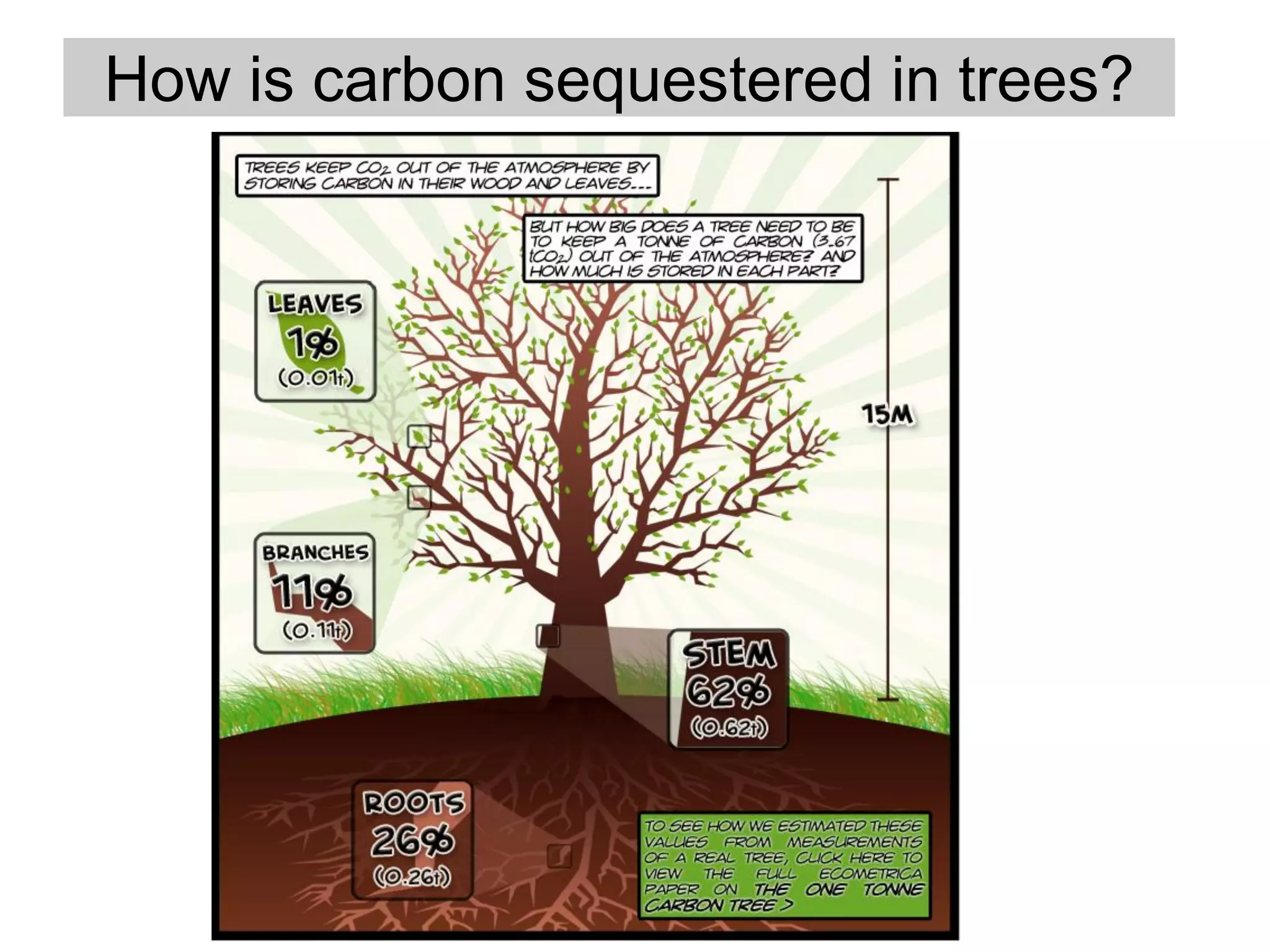
How is carbon sequestered in trees?
Contribution of different Greenhouse Gases to Global
Warming –the role of C
55
15
6
24
CO2
CH4
NO2
CFCs
What is the relation to emission reductions “carbon
credits”?
Carbon accounting = ATM
Actual Carbon Stock
minus
Reference Scenario Carbon Stock
$$$$$$$$$$$$$$$$$$$$
Experimental site
Agroforestry Research Farm, Hajee Mohammad Danesh Science
and Technology University, Bangladesh from 2011-2013.
Experimental Materials
Three agroforestry species –
Leucaena leucocephala
•fast growing multipurpose trees species and deciduous in
nature
•Fast growing multipurpose trees species and deciduous in
nature
Melia azedarach
•Fast growing multipurpose trees species and deciduous in
nature
Albizia lebbeck
Tree Plantation
Trees were planted earlier in 2007 from saplings collected from
the nursery of forest department, government of Bangladesh.
The trees was planted with a spacing of 3m × 3m (i.e. 1092
trees/ha)
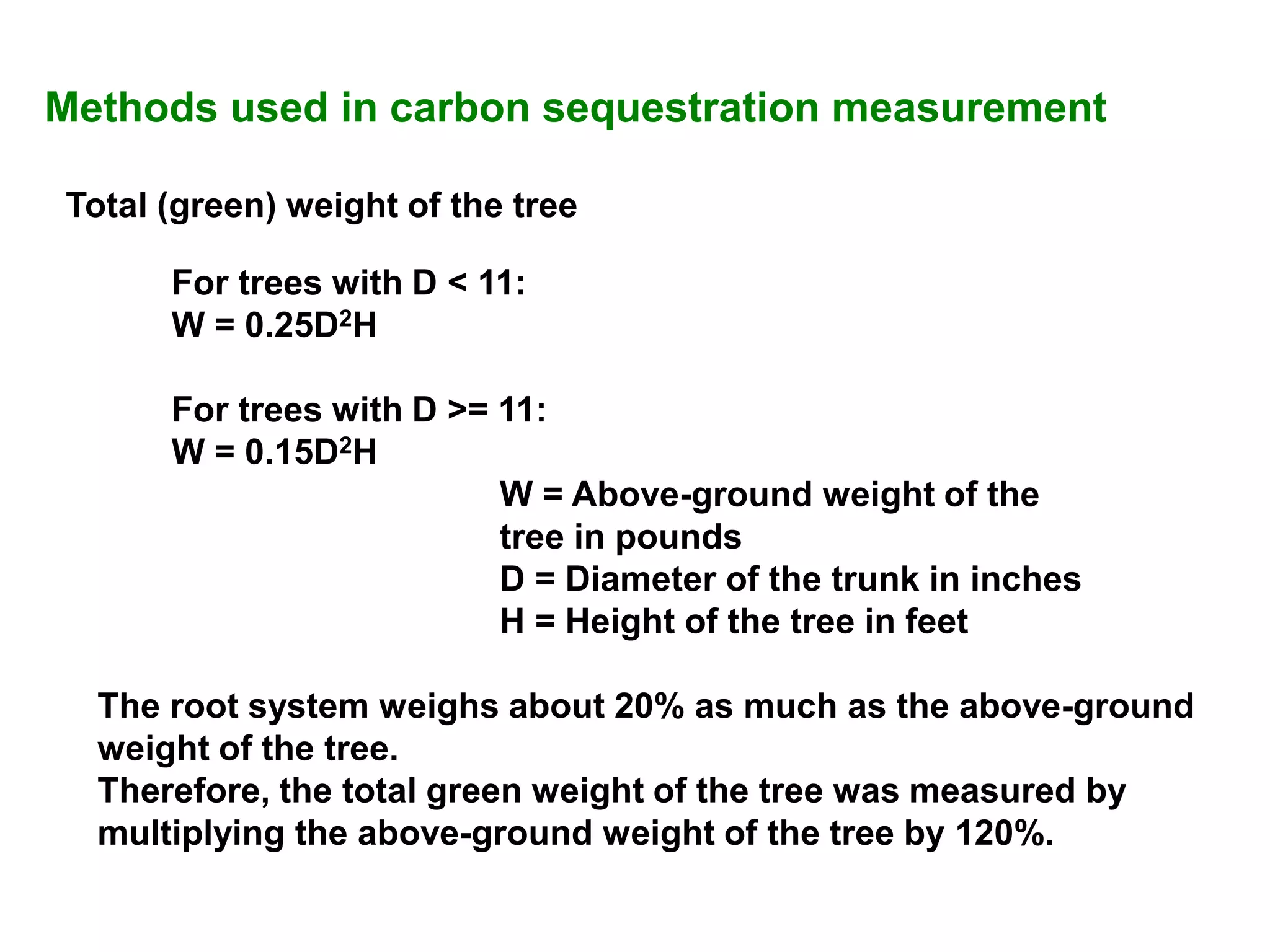
Methods used in carbon sequestration measurement
Total (green) weight of the tree
For trees with D < 11:
W = 0.25D2H
For trees with D >= 11:
W = 0.15D2H
W = Above-ground weight of the
tree in pounds
D = Diameter of the trunk in inches
H = Height of the tree in feet
The root system weighs about 20% as much as the above-ground
weight of the tree.
Therefore, the total green weight of the tree was measured by
multiplying the above-ground weight of the tree by 120%.
Methods used in carbon sequestration measurement
Dry weight of the tree
The average tree is 72.5% dry matter and 27.5% moisture. So,
the dry weight of the tree was determined by multiplying the
weight of the tree by 72.5% (DeWald et al. 2005) .
Weight of carbon in the tree
The average carbon content is generally 50% of the tree’s total
volume. Therefore, the weight of carbon in the tree was
measured by multiplying the dry weight of the tree by 50%
(Birdsey, 1992) .
Weight of carbon dioxide sequestered in the tree
Methods used in carbon sequestration measurement
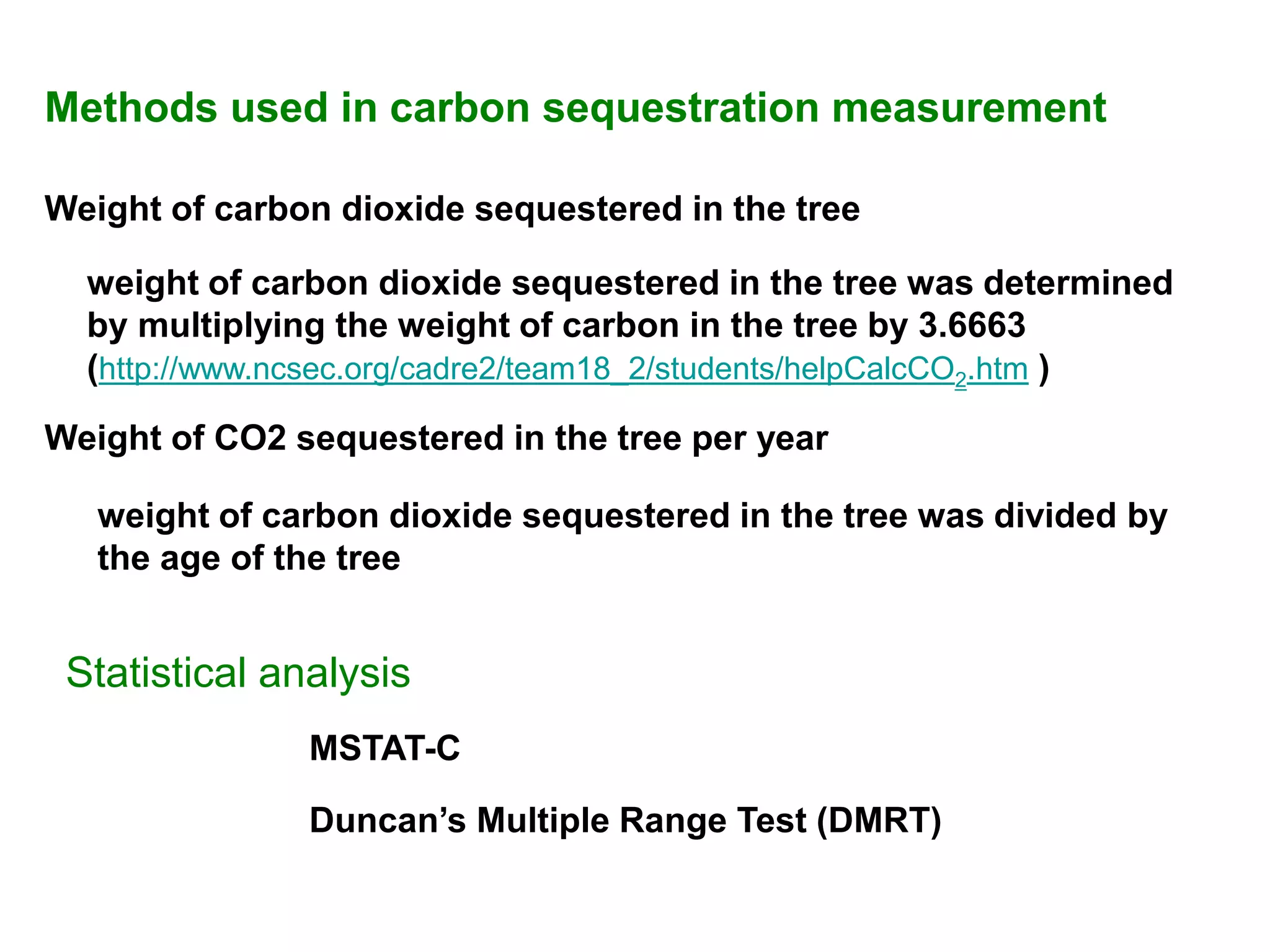
weight of carbon dioxide sequestered in the tree was determined
by multiplying the weight of carbon in the tree by 3.6663
(http://www.ncsec.org/cadre2/team18_2/students/helpCalcCO2.htm )
Weight of CO2 sequestered in the tree per year
weight of carbon dioxide sequestered in the tree was divided by
the age of the tree
Statistical analysis
MSTAT-C
Duncan’s Multiple Range Test (DMRT)
Table 1. Carbon sequestration by different agroforestry species at the
age of 5th year plantation in Dinajpur, Bangladesh
Agroforestry
species
Plant
height
(ft)
Diameter
(inch)
CO2 T-1Y-1
(Kg)
CO2 ha-1Y-1
(Mg)
L. Leucocephala 40.10 a 7.96 b 69.66 ab 76.07 ab
Melia azedarach 39.17 b 8.43 a 72.00 a 78.62 a
Albizia lebbeck 38.45 c 7.90 b 61.53 b 67.19 b
LSD (0.05) 0.613 0.143 8.80 8.80
CV (%) 0.69 0.80 5.73 5.73
Standard Deviation 0.87 0.27 0.56 0.56
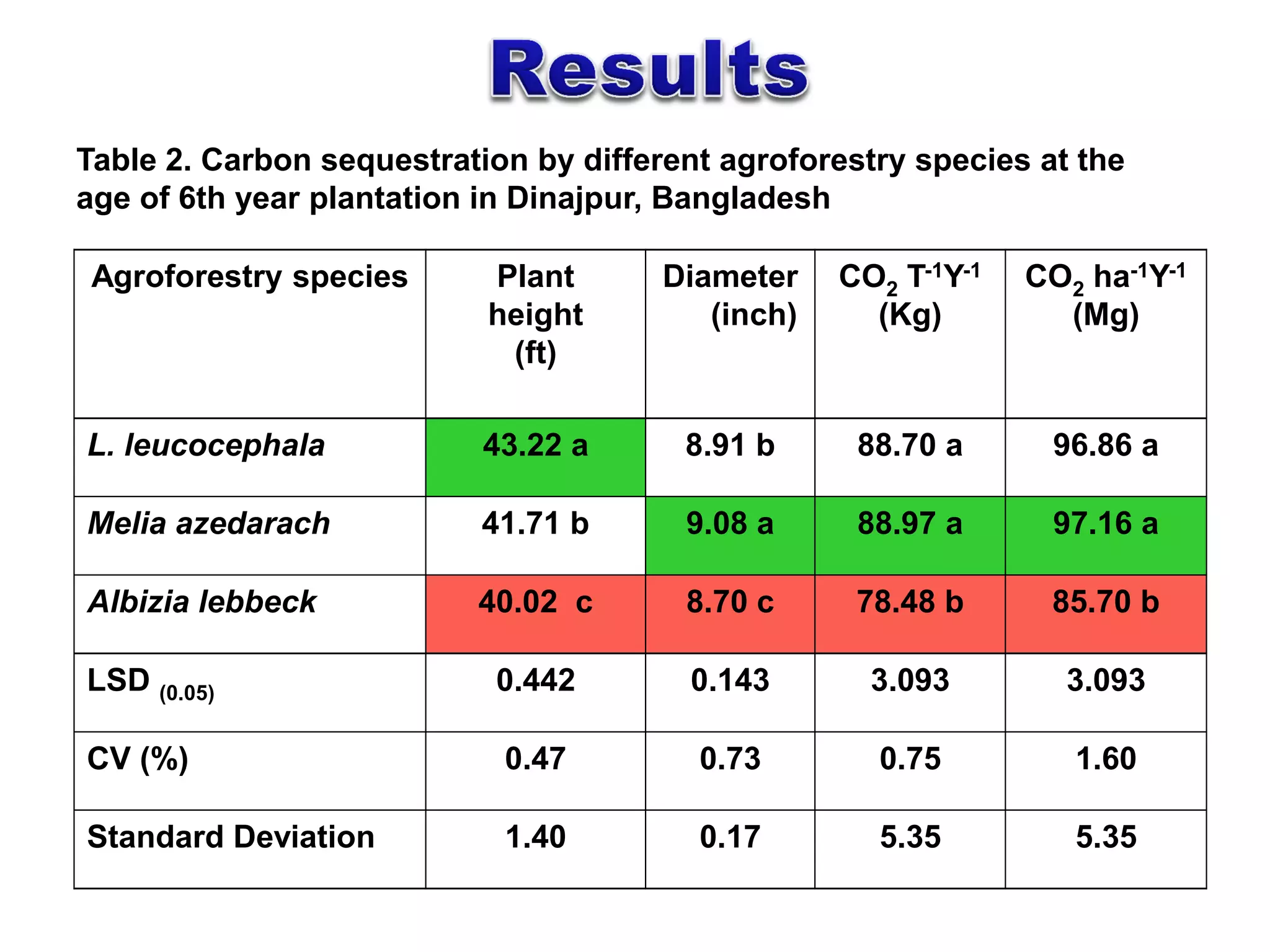
Table 2. Carbon sequestration by different agroforestry species at the
age of 6th year plantation in Dinajpur, Bangladesh
Agroforestry species Plant
height
(ft)
Diameter
(inch)
CO2 T-1Y-1
(Kg)
CO2 ha-1Y-1
(Mg)
L. leucocephala 43.22 a 8.91 b 88.70 a 96.86 a
Melia azedarach 41.71 b 9.08 a 88.97 a 97.16 a
Albizia lebbeck 40.02 c 8.70 c 78.48 b 85.70 b
LSD (0.05) 0.442 0.143 3.093 3.093
CV (%) 0.47 0.73 0.75 1.60
Standard Deviation 1.40 0.17 5.35 5.35
Table 3. Carbon sequestration by different agroforestry species at the
age of 7th year plantation in Dinajpur, Bangladesh
Agroforestry
species
Plant height
(ft)
Diameter
(inch)
CO2 T-1Y-1
(Kg)
CO2 ha-1Y-1
(Mg)
L. leucocephala 45.53 a 10.24 a 123.7 a 135 a
Melia azedarach 43.15 b 9.92 b 109.9 b 120 b
Albizia lebbeck 41.13 c 9.95 b 105.4 b 115 b
LSD (0.05) 1.133 0.176 4.744 4.744
CV (%) 0.37 0.77 0.78 1.86
Standard
Deviation
1.92 0.17 8.53 8.53
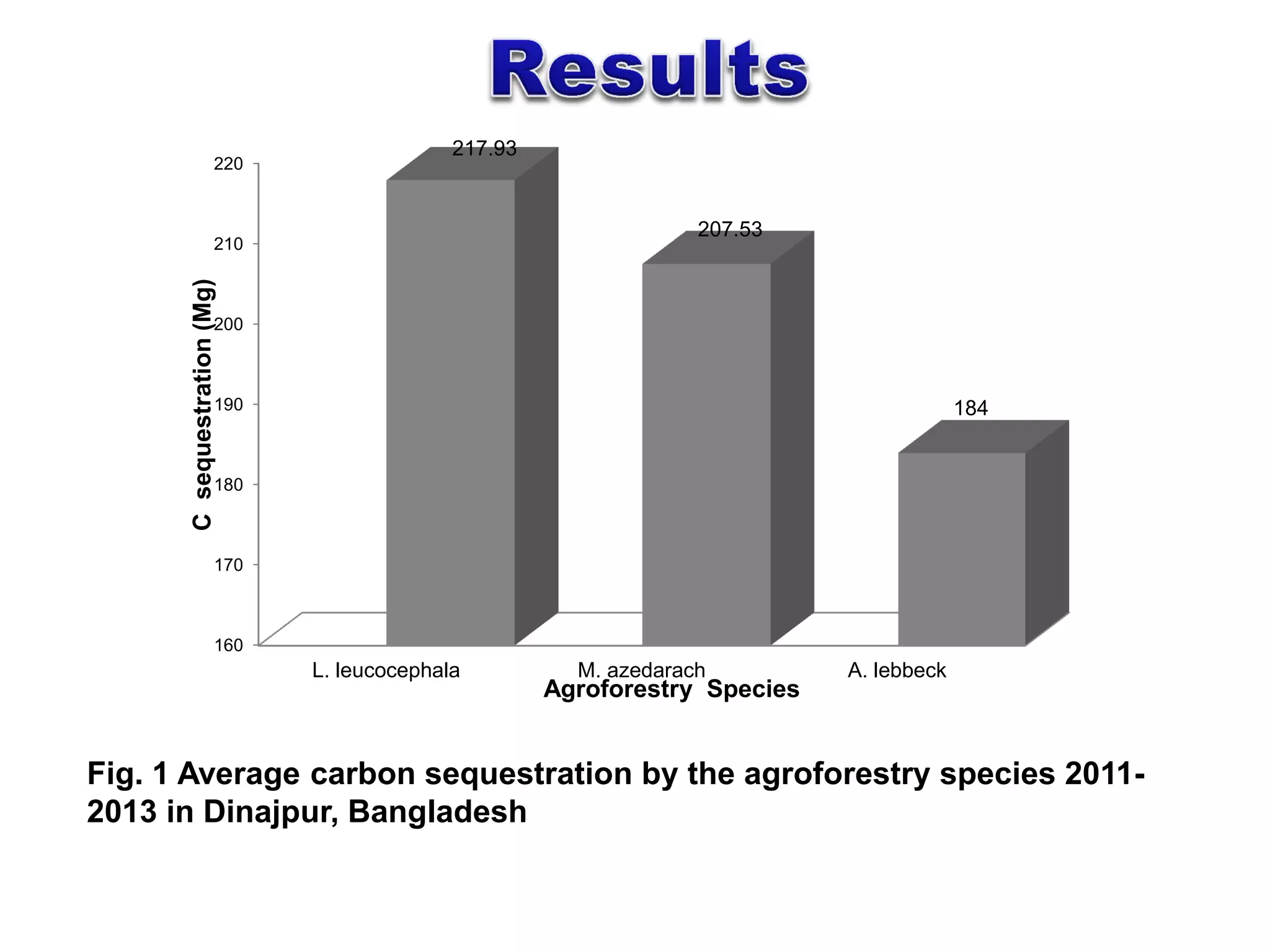
Fig. 1 Average carbon sequestration by the agroforestry species 2011-
2013 in Dinajpur, Bangladesh
160
170
180
190
200
210
220
L. leucocephala M. azedarach A. lebbeck
217.93
207.53
184
Csequestration(Mg)
Agroforestry Species
Potentiality to sequester carbon by agroforestry species in
tropical regions like Bangladesh is promising, as the tree is
an important carbon sink
Carbon sequestration potentiality and reducing carbon
dioxide emission helps to reduce the negative impact of
climate change
Leucaena leucocephala tree may be excellent options for
farmers to follow Agroforestry practices in their field
Government can also consider this tree in their plantation
program in order to mitigate climate change impacts
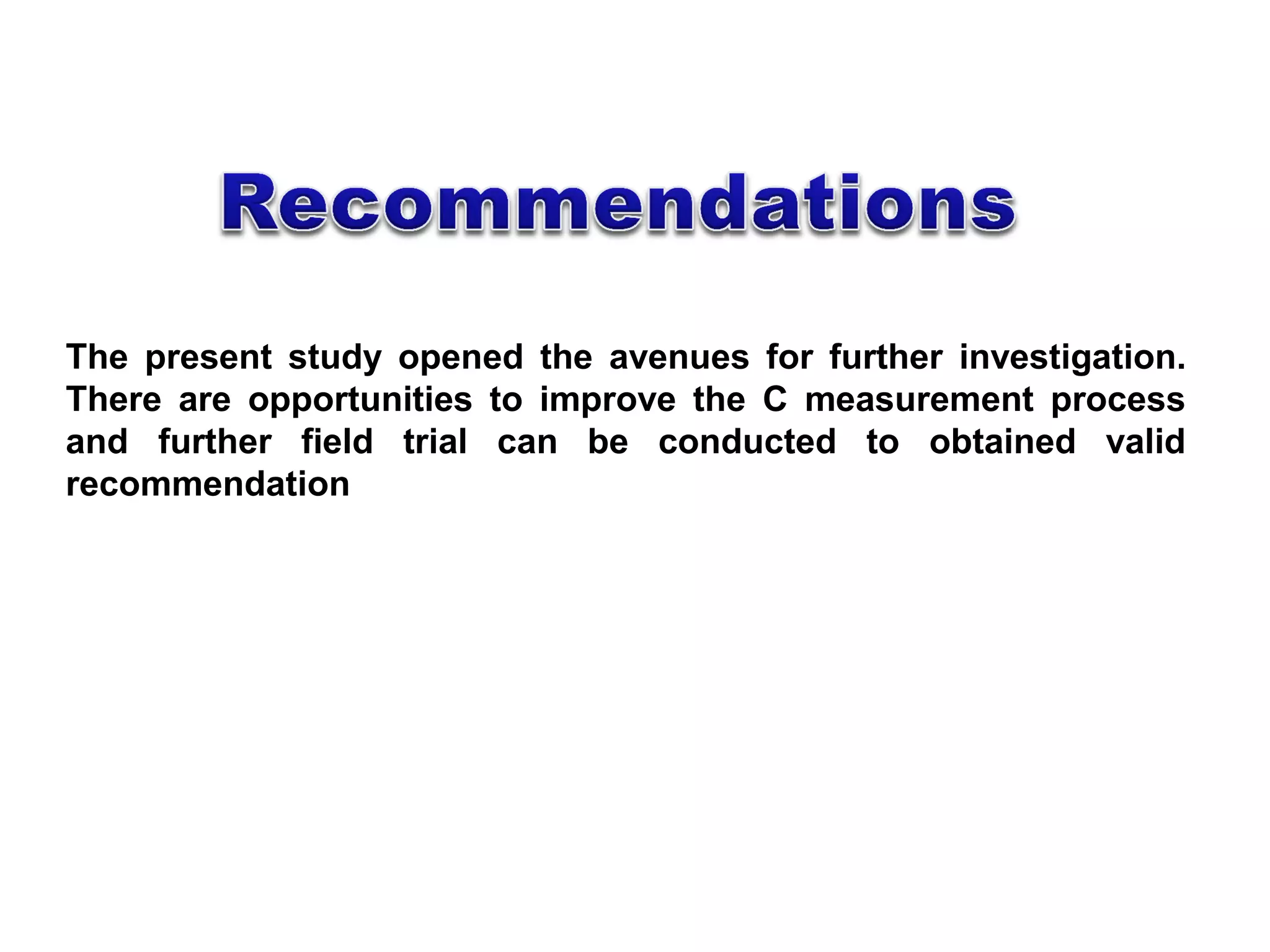
The present study opened the avenues for further investigation.
There are opportunities to improve the C measurement process
and further field trial can be conducted to obtained valid
recommendation
Md. abu hanif

Md. abu hanif

  • 1.
    Potentiality of AgroforestrySpecies to Climate Change Mitigation through Carbon Sequestration M.A. Hanif, M.S. Bari and Md. Abiar Rahman Md. Abu Hanif Assistant Professor Department of Agroforestry and Environment Hajee Mohammad Danesh Science and Technology University, Dinajpur, Bangladesh
  • 2.
    Outline • Background • Methodology •Results • Conclusions • Recommendation
  • 3.
    Role of CO2in climate change Relation to emission reductions i.e. carbon credits Role of agroforestry species/agroforestry system to climate change
  • 4.
    How is carbonsequestered in trees?
  • 5.
    Contribution of differentGreenhouse Gases to Global Warming –the role of C 55 15 6 24 CO2 CH4 NO2 CFCs
  • 6.
    What is therelation to emission reductions “carbon credits”? Carbon accounting = ATM Actual Carbon Stock minus Reference Scenario Carbon Stock $$$$$$$$$$$$$$$$$$$$
  • 7.
    Experimental site Agroforestry ResearchFarm, Hajee Mohammad Danesh Science and Technology University, Bangladesh from 2011-2013. Experimental Materials Three agroforestry species – Leucaena leucocephala •fast growing multipurpose trees species and deciduous in nature
  • 8.
    •Fast growing multipurposetrees species and deciduous in nature Melia azedarach •Fast growing multipurpose trees species and deciduous in nature Albizia lebbeck Tree Plantation Trees were planted earlier in 2007 from saplings collected from the nursery of forest department, government of Bangladesh. The trees was planted with a spacing of 3m × 3m (i.e. 1092 trees/ha)
  • 9.
    Methods used incarbon sequestration measurement Total (green) weight of the tree For trees with D < 11: W = 0.25D2H For trees with D >= 11: W = 0.15D2H W = Above-ground weight of the tree in pounds D = Diameter of the trunk in inches H = Height of the tree in feet The root system weighs about 20% as much as the above-ground weight of the tree. Therefore, the total green weight of the tree was measured by multiplying the above-ground weight of the tree by 120%.
  • 10.
    Methods used incarbon sequestration measurement Dry weight of the tree The average tree is 72.5% dry matter and 27.5% moisture. So, the dry weight of the tree was determined by multiplying the weight of the tree by 72.5% (DeWald et al. 2005) . Weight of carbon in the tree The average carbon content is generally 50% of the tree’s total volume. Therefore, the weight of carbon in the tree was measured by multiplying the dry weight of the tree by 50% (Birdsey, 1992) .
  • 11.
    Weight of carbondioxide sequestered in the tree Methods used in carbon sequestration measurement weight of carbon dioxide sequestered in the tree was determined by multiplying the weight of carbon in the tree by 3.6663 (http://www.ncsec.org/cadre2/team18_2/students/helpCalcCO2.htm ) Weight of CO2 sequestered in the tree per year weight of carbon dioxide sequestered in the tree was divided by the age of the tree Statistical analysis MSTAT-C Duncan’s Multiple Range Test (DMRT)
  • 12.
    Table 1. Carbonsequestration by different agroforestry species at the age of 5th year plantation in Dinajpur, Bangladesh Agroforestry species Plant height (ft) Diameter (inch) CO2 T-1Y-1 (Kg) CO2 ha-1Y-1 (Mg) L. Leucocephala 40.10 a 7.96 b 69.66 ab 76.07 ab Melia azedarach 39.17 b 8.43 a 72.00 a 78.62 a Albizia lebbeck 38.45 c 7.90 b 61.53 b 67.19 b LSD (0.05) 0.613 0.143 8.80 8.80 CV (%) 0.69 0.80 5.73 5.73 Standard Deviation 0.87 0.27 0.56 0.56
  • 13.
    Table 2. Carbonsequestration by different agroforestry species at the age of 6th year plantation in Dinajpur, Bangladesh Agroforestry species Plant height (ft) Diameter (inch) CO2 T-1Y-1 (Kg) CO2 ha-1Y-1 (Mg) L. leucocephala 43.22 a 8.91 b 88.70 a 96.86 a Melia azedarach 41.71 b 9.08 a 88.97 a 97.16 a Albizia lebbeck 40.02 c 8.70 c 78.48 b 85.70 b LSD (0.05) 0.442 0.143 3.093 3.093 CV (%) 0.47 0.73 0.75 1.60 Standard Deviation 1.40 0.17 5.35 5.35
  • 14.
    Table 3. Carbonsequestration by different agroforestry species at the age of 7th year plantation in Dinajpur, Bangladesh Agroforestry species Plant height (ft) Diameter (inch) CO2 T-1Y-1 (Kg) CO2 ha-1Y-1 (Mg) L. leucocephala 45.53 a 10.24 a 123.7 a 135 a Melia azedarach 43.15 b 9.92 b 109.9 b 120 b Albizia lebbeck 41.13 c 9.95 b 105.4 b 115 b LSD (0.05) 1.133 0.176 4.744 4.744 CV (%) 0.37 0.77 0.78 1.86 Standard Deviation 1.92 0.17 8.53 8.53
  • 15.
    Fig. 1 Averagecarbon sequestration by the agroforestry species 2011- 2013 in Dinajpur, Bangladesh 160 170 180 190 200 210 220 L. leucocephala M. azedarach A. lebbeck 217.93 207.53 184 Csequestration(Mg) Agroforestry Species
  • 16.
    Potentiality to sequestercarbon by agroforestry species in tropical regions like Bangladesh is promising, as the tree is an important carbon sink Carbon sequestration potentiality and reducing carbon dioxide emission helps to reduce the negative impact of climate change Leucaena leucocephala tree may be excellent options for farmers to follow Agroforestry practices in their field Government can also consider this tree in their plantation program in order to mitigate climate change impacts
  • 17.
    The present studyopened the avenues for further investigation. There are opportunities to improve the C measurement process and further field trial can be conducted to obtained valid recommendation