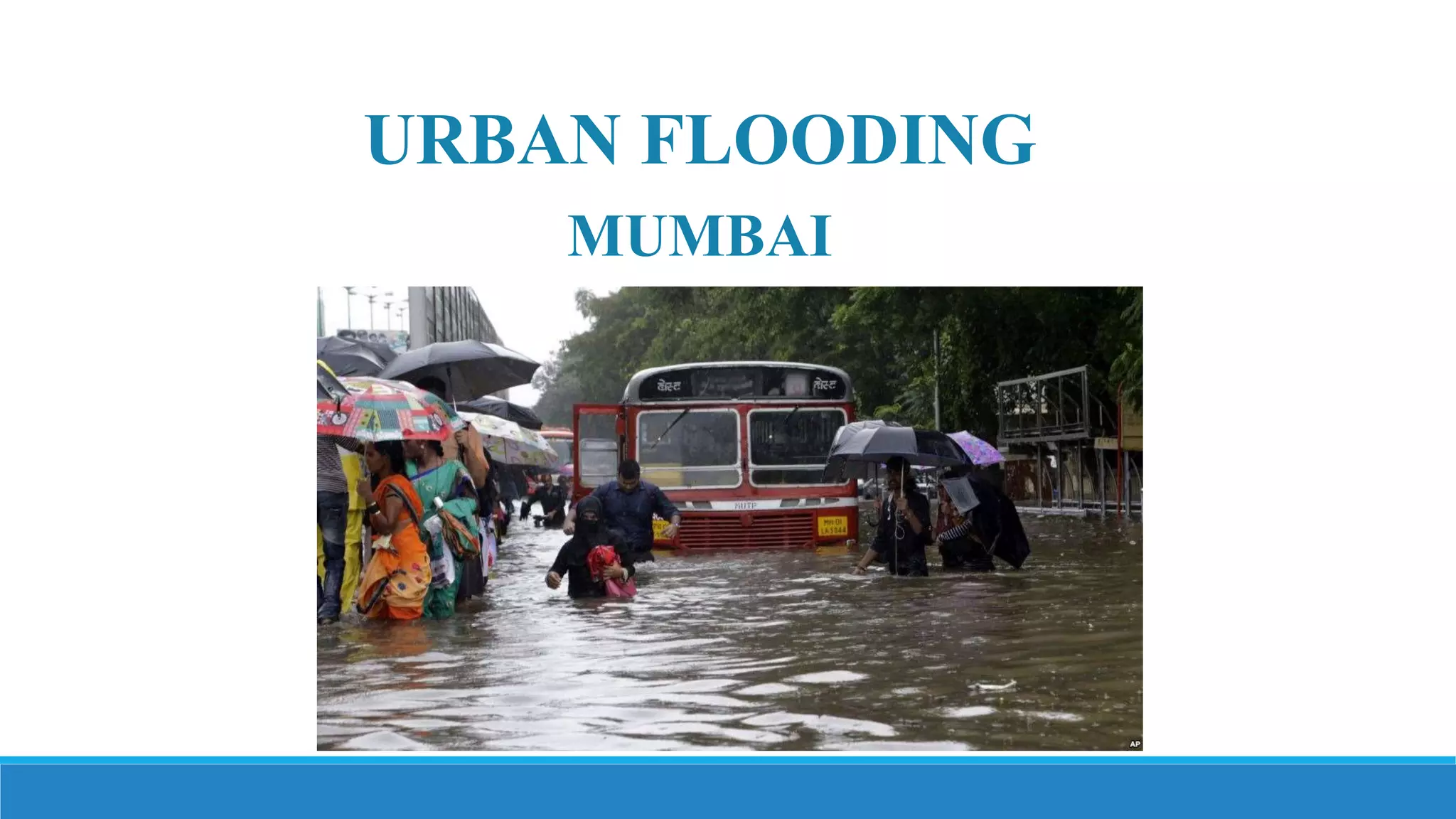
URBAN FLOODING
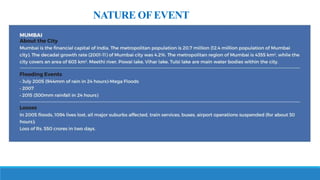
MUMBAI
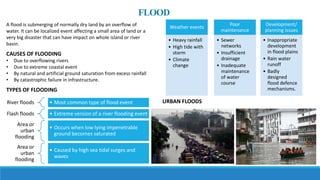
FLOOD
A flood is submerging of normally dry land by an overflow of
water. It can be localized event affecting a small area of land or a
very big disaster that can have impact on whole island or river
basin.
CAUSES OF FLOODING
• Due to overflowing rivers
• Due to extreme coastal event
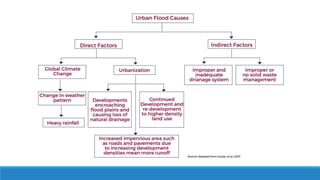
• By natural and artificial ground saturation from excess rainfall
• By catastrophic failure in infrastructure.
TYPES OF FLOODING
River floods • Most common type of flood event
Flash floods • Extreme version of a river flooding event
Area or
urban
flooding
• Occurs when low lying impenetrable
ground becomes saturated
Area or
urban
flooding
• Caused by high sea tidal surges and
waves
Weather events
• Heavy rainfall
• High tide with
storm
• Climate
change
Poor
maintenance
• Sewer
networks
• Insufficient
drainage
• Inadequate
maintenance
of water
course
Development/
planning issues
• Inappropriate
development
in flood plains
• Rain water
runoff
• Badly
designed
flood defence
mechanisms.
URBAN FLOODS
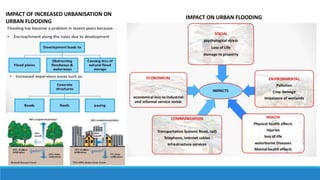
IMPACT OF INCREASED URBANISATION ON
URBAN FLOODING
IMPACT ON URBAN FLOODING
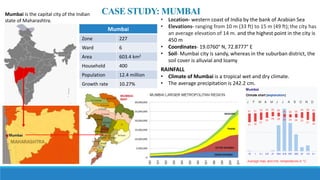
CASE STUDY: MUMBAIMumbai is the capital city of the Indian
state of Maharashtra.
Mumbai
Zone 227
Ward 6
Area 603.4 km2
Household 400
Population 12.4 million
Growth rate 10.27%
• Location- western coast of India by the bank of Arabian Sea
• Elevations- ranging from 10 m (33 ft) to 15 m (49 ft);the city has
an average elevation of 14 m. and the highest point in the city is
450 m
• Coordinates- 19.0760° N, 72.8777° E
• Soil- Mumbai city is sandy, whereas in the suburban district, the
soil cover is alluvial and loamy
RAINFALL
• Climate of Mumbai is a tropical wet and dry climate.
• The average precipitation is 242.2 cm.
NATURE OFEVENT
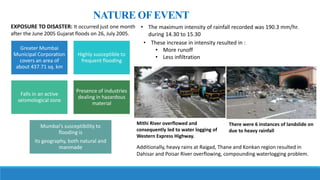
Greater Mumbai
Municipal Corporation
covers an area of
about 437.71 sq. km
Highly susceptible to
frequent flooding
Falls in an active
seismological zone
Presence of industries
dealing in hazardous
material
Mumbai’s susceptibility to
flooding is
its geography, both natural and
manmade
NATURE OFEVENT
EXPOSURE TO DISASTER: It occurred just one month
after the June 2005 Gujarat floods on 26, July 2005.
Mithi River overflowed and
consequently led to water logging of
Western Express Highway.
There were 6 instances of landslide on
due to heavy rainfall
Additionally, heavy rains at Raigad, Thane and Konkan region resulted in
Dahisar and Poisar River overflowing, compounding waterlogging problem.
• The maximum intensity of rainfall recorded was 190.3 mm/hr.
during 14.30 to 15.30
• These increase in intensity resulted in :
• More runoff
• Less infiltration
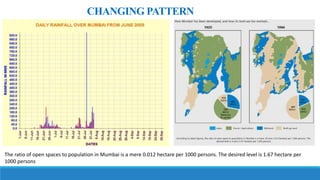
The ratio of open spaces to population in Mumbai is a mere 0.012 hectare per 1000 persons. The desired level is 1.67 hectare per
1000 persons
CHANGING PATTERN
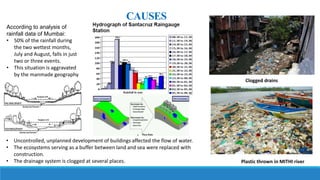
• Uncontrolled, unplanned development of buildings affected the flow of water.
• The ecosystems serving as a buffer between land and sea were replaced with
construction.
• The drainage system is clogged at several places.
Clogged drains
Plastic thrown in MITHI river
According to analysis of
rainfall data of Mumbai:
• 50% of the rainfall during
the two wettest months,
July and August, falls in just
two or three events.
• This situation is aggravated
by the manmade geography
CAUSES
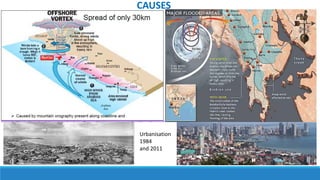
Urbanisation
1984
and 2011
CAUSES
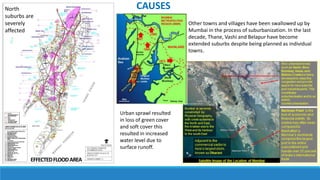
EFFECTEDFLOODAREA
North
suburbs are
severely
affected
Other towns and villages have been swallowed up by
Mumbai in the process of suburbanization. In the last
decade, Thane, Vashi and Belapur have become
extended suburbs despite being planned as individual
towns.
CAUSES
Urban sprawl resulted
in loss of green cover
and soft cover this
resulted in increased
water level due to
surface runoff.
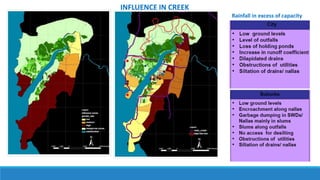
Rainfall in excess of capacity
INFLUENCE IN CREEK
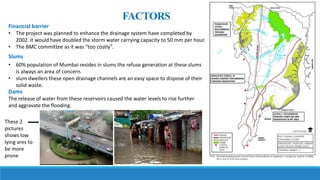
FACTORS
Financial barrier
• The project was planned to enhance the drainage system have completed by
2002. it would have doubled the storm water carrying capacity to 50 mm per hour.
• The BMC committee as it was “too costly”.
• 60% population of Mumbai resides in slums the refuse generation at these slums
is always an area of concern.
• slum dwellers these open drainage channels are an easy space to dispose of their
solid waste.
Slums
Dams
The release of water from these reservoirs caused the water levels to rise further
and aggravate the flooding.
These 2
pictures
shows low
lying ares to
be more
prone
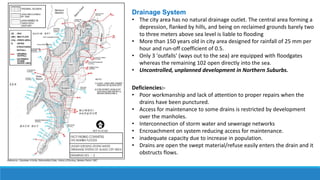
Drainage System
• The city area has no natural drainage outlet. The central area forming a
depression, flanked by hills, and being on reclaimed grounds barely two
to three meters above sea level is liable to flooding
• More than 150 years old in city area designed for rainfall of 25 mm per
hour and run-off coefficient of 0.5.
• Only 3 'outfalls' (ways out to the sea) are equipped with floodgates
whereas the remaining 102 open directly into the sea.
• Uncontrolled, unplanned development in Northern Suburbs.
Deficiencies:-
• Poor workmanship and lack of attention to proper repairs when the
drains have been punctured.
• Access for maintenance to some drains is restricted by development
over the manholes.
• Interconnection of storm water and sewerage networks
• Encroachment on system reducing access for maintenance.
• inadequate capacity due to increase in population.
• Drains are open the swept material/refuse easily enters the drain and it
obstructs flows.
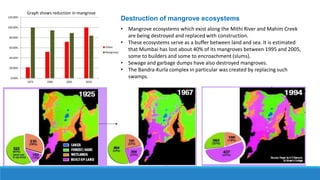
Destruction of mangrove ecosystems
• Mangrove ecosystems which exist along the Mithi River and Mahim Creek
are being destroyed and replaced with construction.
• These ecosystems serve as a buffer between land and sea. It is estimated
that Mumbai has lost about 40% of its mangroves between 1995 and 2005,
some to builders and some to encroachment (slums).
• Sewage and garbage dumps have also destroyed mangroves.
• The Bandra-Kurla complex in particular was created by replacing such
swamps.
Graph shows reduction in mangrove
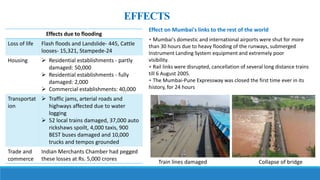
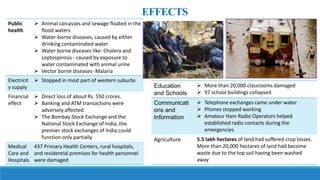
EFFECTS
Collapse of bridgeTrain lines damaged
Effect on Mumbai's links to the rest of the world
• Mumbai's domestic and international airports were shut for more
than 30 hours due to heavy flooding of the runways, submerged
Instrument Landing System equipment and extremely poor
visibility.
• Rail links were disrupted, cancellation of several long distance trains
till 6 August 2005.
• The Mumbai-Pune Expressway was closed the first time ever in its
history, for 24 hours
Effects due to flooding
Loss of life Flash floods and Landslide- 445, Cattle
looses- 15,321, Stampede-24
Housing  Residential establishments - partly
damaged: 50,000
 Residential establishments - fully
damaged: 2,000
 Commercial establishments: 40,000
Transportat
ion
 Traffic jams, arterial roads and
highways affected due to water
logging
 52 local trains damaged, 37,000 auto
rickshaws spoilt, 4,000 taxis, 900
BEST buses damaged and 10,000
trucks and tempos grounded
Trade and
commerce
Indian Merchants Chamber had pegged
these losses at Rs. 5,000 crores
Public
health
 Animal carcasses and sewage floated in the
flood waters
 Water-borne diseases, caused by either
drinking contaminated water
 Water borne diseases like- Cholera and
Leptospirosis - caused by exposure to
water contaminated with animal urine
 Vector borne diseases- Malaria
Electricit
y supply
 Stopped in most part of western suburbs
Financial
effect
 Direct loss of about Rs. 550 crores.
 Banking and ATM transactions were
adversely affected.
 The Bombay Stock Exchange and the
National Stock Exchange of India, the
premier stock exchanges of India could
function only partially
Medical
Care and
Hospitals
437 Primary Health Centers, rural hospitals,
and residential premises for health personnel
were damaged
EFFECTS
Education
and Schools
 More than 20,000 classrooms damaged
 97 school buildings collapsed
Communicati
ons and
Information
 Telephone exchanges came under water
 Phones stopped working
 Amateur Ham Radio Operators helped
established radio contacts during the
emergencies
Agriculture 5.5 lakh hectares of land had suffered crop losses.
More than 20,000 hectares of land had become
waste due to the top soil having been washed
away
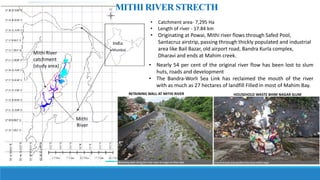
• Catchment area- 7,295 Ha
• Length of river - 17.84 km
• Originating at Powai, Mithi river flows through Safed Pool,
Santacruz airstrip, passing through thickly populated and industrial
area like Bail Bazar, old airport road, Bandra Kurla complex,
Dharavi and ends at Mahim creek.
MITHI RIVER STRECTH
• Nearly 54 per cent of the original river flow has been lost to slum
huts, roads and development
• The Bandra-Worli Sea Link has reclaimed the mouth of the river
with as much as 27 hectares of landfill Filled in most of Mahim Bay.
RETAINING WALL AT MITHI RIVER HOUSEHOLD WASTE BHIM NAGAR SLUM
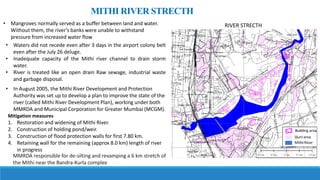
• Waters did not recede even after 3 days in the airport colony belt
even after the July 26 deluge.
• Inadequate capacity of the Mithi river channel to drain storm
water.
• River is treated like an open drain Raw sewage, industrial waste
and garbage disposal.
MITHI RIVER STRECTH
• Mangroves normally served as a buffer between land and water.
Without them, the river’s banks were unable to withstand
pressure from increased water flow
• In August 2005, the Mithi River Development and Protection
Authority was set up to develop a plan to improve the state of the
river (called Mithi River Development Plan), working under both
MMRDA and Municipal Corporation for Greater Mumbai (MCGM).
Mitigation measures
1. Restoration and widening of Mithi River.
2. Construction of holding pond/weir.
3. Construction of flood protection walls for first 7.80 km.
4. Retaining wall for the remaining (approx 8.0 km) length of river
in progress
MMRDA responsible for de-silting and revamping a 6 km stretch of
the Mithi near the Bandra-Kurla complex
RIVER STRECTH
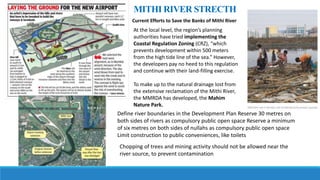
Current Efforts to Save the Banks of Mithi River
At the local level, the region’s planning
authorities have tried implementing the
Coastal Regulation Zoning (CRZ), “which
prevents development within 500 meters
from the high tide line of the sea.” However,
the developers pay no heed to this regulation
and continue with their land-filling exercise.
To make up to the natural drainage lost from
the extensive reclamation of the Mithi River,
the MMRDA has developed, the Mahim
Nature Park.
Define river boundaries in the Development Plan Reserve 30 metres on
both sides of rivers as compulsory public open space Reserve a minimum
of six metres on both sides of nullahs as compulsory public open space
Limit construction to public conveniences, like toilets
Chopping of trees and mining activity should not be allowed near the
river source, to prevent contamination
MITHI RIVER STRECTH
EXISTING STRATEGIES
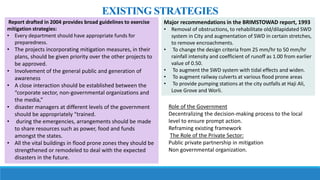
Report drafted in 2004 provides broad guidelines to exercise
mitigation strategies:
• Every department should have appropriate funds for
preparedness.
• The projects incorporating mitigation measures, in their
plans, should be given priority over the other projects to
be approved.
• Involvement of the general public and generation of
awareness
• A close interaction should be established between the
“corporate sector, non-governmental organizations and
the media,”
• disaster managers at different levels of the government
should be appropriately “trained.
• during the emergencies, arrangements should be made
to share resources such as power, food and funds
amongst the states.
• All the vital buildings in flood prone zones they should be
strengthened or remodeled to deal with the expected
disasters in the future.
Major recommendations in the BRIMSTOWAD report, 1993
• Removal of obstructions, to rehabilitate old/dilapidated SWD
system in City and augmentation of SWD in certain stretches,
to remove encroachments.
• To change the design criteria from 25 mm/hr to 50 mm/hr
rainfall intensity and coefficient of runoff as 1.00 from earlier
value of 0.50.
• To augment the SWD system with tidal effects and widen.
• To augment railway culverts at various flood prone areas
• To provide pumping stations at the city outfalls at Haji Ali,
Love Grove and Worli.
Role of the Government
Decentralizing the decision-making process to the local
level to ensure prompt action.
Reframing existing framework
The Role of the Private Sector:
Public private partnership in mitigation
Non governmental organization.
Improved infrastructure and transportation
• Pumping facilities and sewage sanitation
• Global warming
• Land for slum dwellers
Urban planning and management
Hydrological monitoring
• Sensing by radars
Topographical contours
• Evacuation routes & facilities
Disaster management plan
Evacuation of encroachers
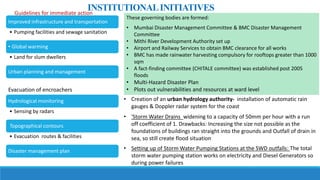
These governing bodies are formed:
• Mumbai Disaster Management Committee & BMC Disaster Management
Committee
• Mithi River Development Authority set up
• Airport and Railway Services to obtain BMC clearance for all works
• BMC has made rainwater harvesting compulsory for rooftops greater than 1000
sqm
• A fact-finding committee (CHITALE committee) was established post 2005
floods
• Multi-Hazard Disaster Plan
• Plots out vulnerabilities and resources at ward level
• Creation of an urban hydrology authority- installation of automatic rain
gauges & Doppler radar system for the coast
• 'Storm Water Drains widening to a capacity of 50mm per hour with a run
off coefficient of 1. Drawbacks: Increasing the size not possible as the
foundations of buildings ran straight into the grounds and Outfall of drain in
sea, so still create flood situation
• Setting up of Storm Water Pumping Stations at the SWD outfalls: The total
storm water pumping station works on electricity and Diesel Generators so
during power failures
INSTITUTIONALINITIATIVESGuidelines for immediate action
INITIALRELIEFMEASURES
Flood relief operations
• Free food grains were provided by the Government of Maharashtra [GOM] and
MCGM.
• About 5.5 lakh people were evacuated to safer places. About 1.94 lakh people
were in camps
A hygiene awareness campaign has been initiated by the government.
1. Disbursement of Family packs
2. Mobilization of two Indian Red Cross society’s [IRCS] National Disaster
Response Team [NDRT] members for logistics and relief support.
3. Deployment of Additional Mass Water Treatment Unit [TWAU]
Relief measures taken immediately
Clearing of Solid waste and debris
A total of 16307 carcasses were disposed of
including those of 15000 sheep and goats
Disinfection of open spaces and waste
collection
Mosquito control measures
Insecticide was sprayed and fogging operations
completed in 1174 vulnerable locations
Immediately after the outbreak of
leptospirosis took preventive measures for
water borne diseases
Provided healthcare services though 130
medical teams that have treated 3 lac patients
at their door steps through health camps and
outreach program
The Fire Brigade and the "Rescue Teams" of
MCGM undertook 282 rescue operations
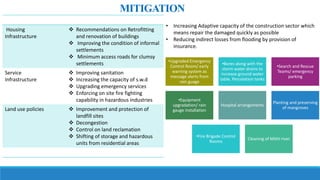
Housing
Infrastructure
 Recommendations on Retrofitting
and renovation of buildings
 Improving the condition of informal
settlements
 Minimum access roads for clumsy
settlements
Service
Infrastructure
 Improving sanitation
 Increasing the capacity of s.w.d
 Upgrading emergency services
 Enforcing on site fire fighting
capability in hazardous industries
Land use policies  Improvement and protection of
landfill sites
 Decongestion
 Control on land reclamation
 Shifting of storage and hazardous
units from residential areas
• Increasing Adaptive capacity of the construction sector which
means repair the damaged quickly as possible
• Reducing indirect losses from flooding by provision of
insurance.
MITIGATION
•Upgraded Emergency
Control Room/ early
warning system as
message alerts from
rain guage
•Bores along with the
storm water drains to
increase ground water
table, Percolation tanks
•Search and Rescue
Teams/ emergency
parking
•Equipment
upgradation/ rain
gauge installation
Hospital arrangements
Planting and preserving
of mangroves
•Fire Brigade Control
Rooms
Cleaning of Mithi river
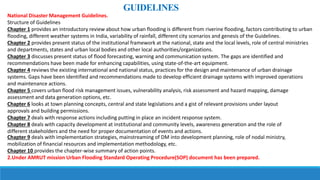
National Disaster Management Guidelines.
Structure of Guidelines
Chapter 1 provides an introductory review about how urban flooding is different from riverine flooding, factors contributing to urban
flooding, different weather systems in India, variability of rainfall, different city scenarios and genesis of the Guidelines.
Chapter 2 provides present status of the institutional framework at the national, state and the local levels, role of central ministries
and departments, states and urban local bodies and other local authorities/organizations.
Chapter 3 discusses present status of flood forecasting, warning and communication system. The gaps are identified and
recommendations have been made for enhancing capabilities, using state-of-the-art equipment.
Chapter 4 reviews the existing international and national status, practices for the design and maintenance of urban drainage
systems. Gaps have been identified and recommendations made to develop efficient drainage systems with improved operations
and maintenance actions.
Chapter 5 covers urban flood risk management issues, vulnerability analysis, risk assessment and hazard mapping, damage
assessment and data generation options, etc.
Chapter 6 looks at town planning concepts, central and state legislations and a gist of relevant provisions under layout
approvals and building permissions.
Chapter 7 deals with response actions including putting in place an incident response system.
Chapter 8 deals with capacity development at institutional and community levels, awareness generation and the role of
different stakeholders and the need for proper documentation of events and actions.
GUIDELINES
Chapter 9 deals with implementation strategies, mainstreaming of DM into development planning, role of nodal ministry,
mobilization of financial resources and implementation methodology, etc.
Chapter 10 provides the chapter-wise summary of action points.
2.Under AMRUT mission Urban Flooding Standard Operating Procedure(SOP) document has been prepared.

flood

  • 1.
  • 2.
    FLOOD A flood issubmerging of normally dry land by an overflow of water. It can be localized event affecting a small area of land or a very big disaster that can have impact on whole island or river basin. CAUSES OF FLOODING • Due to overflowing rivers • Due to extreme coastal event • By natural and artificial ground saturation from excess rainfall • By catastrophic failure in infrastructure. TYPES OF FLOODING River floods • Most common type of flood event Flash floods • Extreme version of a river flooding event Area or urban flooding • Occurs when low lying impenetrable ground becomes saturated Area or urban flooding • Caused by high sea tidal surges and waves Weather events • Heavy rainfall • High tide with storm • Climate change Poor maintenance • Sewer networks • Insufficient drainage • Inadequate maintenance of water course Development/ planning issues • Inappropriate development in flood plains • Rain water runoff • Badly designed flood defence mechanisms. URBAN FLOODS
  • 4.
    IMPACT OF INCREASEDURBANISATION ON URBAN FLOODING IMPACT ON URBAN FLOODING
  • 5.
    CASE STUDY: MUMBAIMumbaiis the capital city of the Indian state of Maharashtra. Mumbai Zone 227 Ward 6 Area 603.4 km2 Household 400 Population 12.4 million Growth rate 10.27% • Location- western coast of India by the bank of Arabian Sea • Elevations- ranging from 10 m (33 ft) to 15 m (49 ft);the city has an average elevation of 14 m. and the highest point in the city is 450 m • Coordinates- 19.0760° N, 72.8777° E • Soil- Mumbai city is sandy, whereas in the suburban district, the soil cover is alluvial and loamy RAINFALL • Climate of Mumbai is a tropical wet and dry climate. • The average precipitation is 242.2 cm.
  • 6.
  • 7.
    Greater Mumbai Municipal Corporation coversan area of about 437.71 sq. km Highly susceptible to frequent flooding Falls in an active seismological zone Presence of industries dealing in hazardous material Mumbai’s susceptibility to flooding is its geography, both natural and manmade NATURE OFEVENT EXPOSURE TO DISASTER: It occurred just one month after the June 2005 Gujarat floods on 26, July 2005. Mithi River overflowed and consequently led to water logging of Western Express Highway. There were 6 instances of landslide on due to heavy rainfall Additionally, heavy rains at Raigad, Thane and Konkan region resulted in Dahisar and Poisar River overflowing, compounding waterlogging problem. • The maximum intensity of rainfall recorded was 190.3 mm/hr. during 14.30 to 15.30 • These increase in intensity resulted in : • More runoff • Less infiltration
  • 8.
    The ratio ofopen spaces to population in Mumbai is a mere 0.012 hectare per 1000 persons. The desired level is 1.67 hectare per 1000 persons CHANGING PATTERN
  • 9.
    • Uncontrolled, unplanneddevelopment of buildings affected the flow of water. • The ecosystems serving as a buffer between land and sea were replaced with construction. • The drainage system is clogged at several places. Clogged drains Plastic thrown in MITHI river According to analysis of rainfall data of Mumbai: • 50% of the rainfall during the two wettest months, July and August, falls in just two or three events. • This situation is aggravated by the manmade geography CAUSES
  • 10.
  • 11.
    EFFECTEDFLOODAREA North suburbs are severely affected Other townsand villages have been swallowed up by Mumbai in the process of suburbanization. In the last decade, Thane, Vashi and Belapur have become extended suburbs despite being planned as individual towns. CAUSES Urban sprawl resulted in loss of green cover and soft cover this resulted in increased water level due to surface runoff.
  • 12.
    Rainfall in excessof capacity INFLUENCE IN CREEK
  • 13.
    FACTORS Financial barrier • Theproject was planned to enhance the drainage system have completed by 2002. it would have doubled the storm water carrying capacity to 50 mm per hour. • The BMC committee as it was “too costly”. • 60% population of Mumbai resides in slums the refuse generation at these slums is always an area of concern. • slum dwellers these open drainage channels are an easy space to dispose of their solid waste. Slums Dams The release of water from these reservoirs caused the water levels to rise further and aggravate the flooding. These 2 pictures shows low lying ares to be more prone
  • 14.
    Drainage System • Thecity area has no natural drainage outlet. The central area forming a depression, flanked by hills, and being on reclaimed grounds barely two to three meters above sea level is liable to flooding • More than 150 years old in city area designed for rainfall of 25 mm per hour and run-off coefficient of 0.5. • Only 3 'outfalls' (ways out to the sea) are equipped with floodgates whereas the remaining 102 open directly into the sea. • Uncontrolled, unplanned development in Northern Suburbs. Deficiencies:- • Poor workmanship and lack of attention to proper repairs when the drains have been punctured. • Access for maintenance to some drains is restricted by development over the manholes. • Interconnection of storm water and sewerage networks • Encroachment on system reducing access for maintenance. • inadequate capacity due to increase in population. • Drains are open the swept material/refuse easily enters the drain and it obstructs flows.
  • 15.
    Destruction of mangroveecosystems • Mangrove ecosystems which exist along the Mithi River and Mahim Creek are being destroyed and replaced with construction. • These ecosystems serve as a buffer between land and sea. It is estimated that Mumbai has lost about 40% of its mangroves between 1995 and 2005, some to builders and some to encroachment (slums). • Sewage and garbage dumps have also destroyed mangroves. • The Bandra-Kurla complex in particular was created by replacing such swamps. Graph shows reduction in mangrove
  • 16.
    EFFECTS Collapse of bridgeTrainlines damaged Effect on Mumbai's links to the rest of the world • Mumbai's domestic and international airports were shut for more than 30 hours due to heavy flooding of the runways, submerged Instrument Landing System equipment and extremely poor visibility. • Rail links were disrupted, cancellation of several long distance trains till 6 August 2005. • The Mumbai-Pune Expressway was closed the first time ever in its history, for 24 hours Effects due to flooding Loss of life Flash floods and Landslide- 445, Cattle looses- 15,321, Stampede-24 Housing  Residential establishments - partly damaged: 50,000  Residential establishments - fully damaged: 2,000  Commercial establishments: 40,000 Transportat ion  Traffic jams, arterial roads and highways affected due to water logging  52 local trains damaged, 37,000 auto rickshaws spoilt, 4,000 taxis, 900 BEST buses damaged and 10,000 trucks and tempos grounded Trade and commerce Indian Merchants Chamber had pegged these losses at Rs. 5,000 crores
  • 17.
    Public health  Animal carcassesand sewage floated in the flood waters  Water-borne diseases, caused by either drinking contaminated water  Water borne diseases like- Cholera and Leptospirosis - caused by exposure to water contaminated with animal urine  Vector borne diseases- Malaria Electricit y supply  Stopped in most part of western suburbs Financial effect  Direct loss of about Rs. 550 crores.  Banking and ATM transactions were adversely affected.  The Bombay Stock Exchange and the National Stock Exchange of India, the premier stock exchanges of India could function only partially Medical Care and Hospitals 437 Primary Health Centers, rural hospitals, and residential premises for health personnel were damaged EFFECTS Education and Schools  More than 20,000 classrooms damaged  97 school buildings collapsed Communicati ons and Information  Telephone exchanges came under water  Phones stopped working  Amateur Ham Radio Operators helped established radio contacts during the emergencies Agriculture 5.5 lakh hectares of land had suffered crop losses. More than 20,000 hectares of land had become waste due to the top soil having been washed away
  • 18.
    • Catchment area-7,295 Ha • Length of river - 17.84 km • Originating at Powai, Mithi river flows through Safed Pool, Santacruz airstrip, passing through thickly populated and industrial area like Bail Bazar, old airport road, Bandra Kurla complex, Dharavi and ends at Mahim creek. MITHI RIVER STRECTH • Nearly 54 per cent of the original river flow has been lost to slum huts, roads and development • The Bandra-Worli Sea Link has reclaimed the mouth of the river with as much as 27 hectares of landfill Filled in most of Mahim Bay. RETAINING WALL AT MITHI RIVER HOUSEHOLD WASTE BHIM NAGAR SLUM
  • 19.
    • Waters didnot recede even after 3 days in the airport colony belt even after the July 26 deluge. • Inadequate capacity of the Mithi river channel to drain storm water. • River is treated like an open drain Raw sewage, industrial waste and garbage disposal. MITHI RIVER STRECTH • Mangroves normally served as a buffer between land and water. Without them, the river’s banks were unable to withstand pressure from increased water flow • In August 2005, the Mithi River Development and Protection Authority was set up to develop a plan to improve the state of the river (called Mithi River Development Plan), working under both MMRDA and Municipal Corporation for Greater Mumbai (MCGM). Mitigation measures 1. Restoration and widening of Mithi River. 2. Construction of holding pond/weir. 3. Construction of flood protection walls for first 7.80 km. 4. Retaining wall for the remaining (approx 8.0 km) length of river in progress MMRDA responsible for de-silting and revamping a 6 km stretch of the Mithi near the Bandra-Kurla complex RIVER STRECTH
  • 20.
    Current Efforts toSave the Banks of Mithi River At the local level, the region’s planning authorities have tried implementing the Coastal Regulation Zoning (CRZ), “which prevents development within 500 meters from the high tide line of the sea.” However, the developers pay no heed to this regulation and continue with their land-filling exercise. To make up to the natural drainage lost from the extensive reclamation of the Mithi River, the MMRDA has developed, the Mahim Nature Park. Define river boundaries in the Development Plan Reserve 30 metres on both sides of rivers as compulsory public open space Reserve a minimum of six metres on both sides of nullahs as compulsory public open space Limit construction to public conveniences, like toilets Chopping of trees and mining activity should not be allowed near the river source, to prevent contamination MITHI RIVER STRECTH
  • 21.
    EXISTING STRATEGIES Report draftedin 2004 provides broad guidelines to exercise mitigation strategies: • Every department should have appropriate funds for preparedness. • The projects incorporating mitigation measures, in their plans, should be given priority over the other projects to be approved. • Involvement of the general public and generation of awareness • A close interaction should be established between the “corporate sector, non-governmental organizations and the media,” • disaster managers at different levels of the government should be appropriately “trained. • during the emergencies, arrangements should be made to share resources such as power, food and funds amongst the states. • All the vital buildings in flood prone zones they should be strengthened or remodeled to deal with the expected disasters in the future. Major recommendations in the BRIMSTOWAD report, 1993 • Removal of obstructions, to rehabilitate old/dilapidated SWD system in City and augmentation of SWD in certain stretches, to remove encroachments. • To change the design criteria from 25 mm/hr to 50 mm/hr rainfall intensity and coefficient of runoff as 1.00 from earlier value of 0.50. • To augment the SWD system with tidal effects and widen. • To augment railway culverts at various flood prone areas • To provide pumping stations at the city outfalls at Haji Ali, Love Grove and Worli. Role of the Government Decentralizing the decision-making process to the local level to ensure prompt action. Reframing existing framework The Role of the Private Sector: Public private partnership in mitigation Non governmental organization.
  • 22.
    Improved infrastructure andtransportation • Pumping facilities and sewage sanitation • Global warming • Land for slum dwellers Urban planning and management Hydrological monitoring • Sensing by radars Topographical contours • Evacuation routes & facilities Disaster management plan Evacuation of encroachers These governing bodies are formed: • Mumbai Disaster Management Committee & BMC Disaster Management Committee • Mithi River Development Authority set up • Airport and Railway Services to obtain BMC clearance for all works • BMC has made rainwater harvesting compulsory for rooftops greater than 1000 sqm • A fact-finding committee (CHITALE committee) was established post 2005 floods • Multi-Hazard Disaster Plan • Plots out vulnerabilities and resources at ward level • Creation of an urban hydrology authority- installation of automatic rain gauges & Doppler radar system for the coast • 'Storm Water Drains widening to a capacity of 50mm per hour with a run off coefficient of 1. Drawbacks: Increasing the size not possible as the foundations of buildings ran straight into the grounds and Outfall of drain in sea, so still create flood situation • Setting up of Storm Water Pumping Stations at the SWD outfalls: The total storm water pumping station works on electricity and Diesel Generators so during power failures INSTITUTIONALINITIATIVESGuidelines for immediate action
  • 23.
    INITIALRELIEFMEASURES Flood relief operations •Free food grains were provided by the Government of Maharashtra [GOM] and MCGM. • About 5.5 lakh people were evacuated to safer places. About 1.94 lakh people were in camps A hygiene awareness campaign has been initiated by the government. 1. Disbursement of Family packs 2. Mobilization of two Indian Red Cross society’s [IRCS] National Disaster Response Team [NDRT] members for logistics and relief support. 3. Deployment of Additional Mass Water Treatment Unit [TWAU] Relief measures taken immediately Clearing of Solid waste and debris A total of 16307 carcasses were disposed of including those of 15000 sheep and goats Disinfection of open spaces and waste collection Mosquito control measures Insecticide was sprayed and fogging operations completed in 1174 vulnerable locations Immediately after the outbreak of leptospirosis took preventive measures for water borne diseases Provided healthcare services though 130 medical teams that have treated 3 lac patients at their door steps through health camps and outreach program The Fire Brigade and the "Rescue Teams" of MCGM undertook 282 rescue operations
  • 24.
    Housing Infrastructure  Recommendations onRetrofitting and renovation of buildings  Improving the condition of informal settlements  Minimum access roads for clumsy settlements Service Infrastructure  Improving sanitation  Increasing the capacity of s.w.d  Upgrading emergency services  Enforcing on site fire fighting capability in hazardous industries Land use policies  Improvement and protection of landfill sites  Decongestion  Control on land reclamation  Shifting of storage and hazardous units from residential areas • Increasing Adaptive capacity of the construction sector which means repair the damaged quickly as possible • Reducing indirect losses from flooding by provision of insurance. MITIGATION •Upgraded Emergency Control Room/ early warning system as message alerts from rain guage •Bores along with the storm water drains to increase ground water table, Percolation tanks •Search and Rescue Teams/ emergency parking •Equipment upgradation/ rain gauge installation Hospital arrangements Planting and preserving of mangroves •Fire Brigade Control Rooms Cleaning of Mithi river
  • 25.
    National Disaster ManagementGuidelines. Structure of Guidelines Chapter 1 provides an introductory review about how urban flooding is different from riverine flooding, factors contributing to urban flooding, different weather systems in India, variability of rainfall, different city scenarios and genesis of the Guidelines. Chapter 2 provides present status of the institutional framework at the national, state and the local levels, role of central ministries and departments, states and urban local bodies and other local authorities/organizations. Chapter 3 discusses present status of flood forecasting, warning and communication system. The gaps are identified and recommendations have been made for enhancing capabilities, using state-of-the-art equipment. Chapter 4 reviews the existing international and national status, practices for the design and maintenance of urban drainage systems. Gaps have been identified and recommendations made to develop efficient drainage systems with improved operations and maintenance actions. Chapter 5 covers urban flood risk management issues, vulnerability analysis, risk assessment and hazard mapping, damage assessment and data generation options, etc. Chapter 6 looks at town planning concepts, central and state legislations and a gist of relevant provisions under layout approvals and building permissions. Chapter 7 deals with response actions including putting in place an incident response system. Chapter 8 deals with capacity development at institutional and community levels, awareness generation and the role of different stakeholders and the need for proper documentation of events and actions. GUIDELINES Chapter 9 deals with implementation strategies, mainstreaming of DM into development planning, role of nodal ministry, mobilization of financial resources and implementation methodology, etc. Chapter 10 provides the chapter-wise summary of action points. 2.Under AMRUT mission Urban Flooding Standard Operating Procedure(SOP) document has been prepared.