Evaluating the potential of ecosystem services
management to alleviate poverty in the Upper
Mustang Region, Nepal
International conference on climate change innovation and
resilience for sustainable livelihood
12- 14 January 2015
Kathmandu, Nepal
Jagat K. Bhusal, Keshav P. Sharma, Deepak Paudel, Santos Regmi, Praju Gurung, Zed Zulkafli,
Timos Karpouzoglou, Wouter Buytaert, David M. Hannah, Bhopal Pandey
(Mountain EVO Team- SOHAM Nepal)
Research Objective
 To collect data on Ecosystem Services
 To understand processes like who, how and
where decisions on ESS are being made
 To understand the existing pressure on
these ecosystem services
 Literature Review
 General Situation Analysis
Selection of Village Development
Committee
 Socio-economic Survey
Selection of Research Site
 Detailed Situation Analysis
Participatory tools
Methodology
Physiography: Trans-Himalayan Region
Area: 3144.1 km2 (11 VDC)
Population: 7,154 (CBS, 2011)(11 VDC)
Climate: Alpine cold, dry, and arid climate
Main income source: On farm and off farm
Activities
Major Ecosystem Services:
Provisional services (Food and Water); soil,
Rangeland ecosystem,
Recreational services and regulating
Research Area- Upper Mustang
Major Findings
1. Provisional services
(Food and Water)
 Mainly yak & goat
 Cereal crops, cash crops and vegetables, distillery,
 Fuel wood, Timber, Dry leaves and fodders, Grassland
 Water for irrigation, drinking, hydro-electricity, mills
2. Regulating services
(climate and natural hazards)
 Maintenance of soil fertility;
 Biodiversity;
 Soil erosion, landslide, floods, droughts,
 Purification of water and air,
 Pest and disease control
3. Recreational services
Key ESS in Upper Mustang
 Practices combination of agriculture, livestock
farming and winter trade followed by tourism
Major agricultural production : naked
wheat, buckwheat, barley, potato,
pulses, wheat and maize.
Major fruit : apple and apricot.
Major livestock : cow, goat, horse, jhopa and
mule
Herbs: Yarsagumba, Panchaule, Jimbu
 Only one crop a year in Upper Mustang and two
crop a year in Central Mustang
 Major Stresses on:
 Irrigation water : Decreasing stream flow
 Drinking water: Drying spring sources
 Agricultural land
 Pasture land: decreasing grass productivity
Livelihood
Climate change induced stress on water
 Annual precipitation has increasing trend where as
winter precipitation has decreasing trend
 Percentage of winter precipitation to annual is more
compare to other part of country
 Yields of water sources found to be continuously
decreasing as accumulation of snowfall over the
watershed is decreasing
 Water is sufficient only from June to August
A Case study: Dhakarjung and Phalyak Village
 Common source of water- ‘Lumbhuk Stream’
 Share water- 3 day for Phalyak and 2 day for Dhakarjung
 Water collection pond at each village- to store water at
night time and irrigate field at day time
 Shifting farming practice
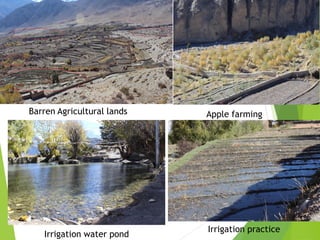
Barren Agricultural lands
Irrigation water pond
Irrigation practice
Apple farming
Governance
 Two local leaders: Mukhiya (traditional) and Ward
Chairman (elected)
 Mukhiya (village head) is more effective and major
decision maker at local level
 VDC and DDC are the formal decision making
bodies
 Presence of government and governance is lacking
Conclusion
 Agriculture and livestock rearing followed by tourism
and winter trading are major activities
 Less water availability for irrigation, less manpower,
less knowledge on use of advance tools and technology,
low information on weather condition and climatic
variability , decrease on grassland on grazing area are
major problems
 Improved agriculture practice might play crucial role on
poverty alleviation
 Eco-tourism and trade have opened new avenues of
livelihood
 Effective Mukhiya system has reduced the presence of
government and governance
 Bridging between the governmental bodies and local
community is necessary
Thank You !!!!

Praju gurung

  • 1.
    Evaluating the potentialof ecosystem services management to alleviate poverty in the Upper Mustang Region, Nepal International conference on climate change innovation and resilience for sustainable livelihood 12- 14 January 2015 Kathmandu, Nepal Jagat K. Bhusal, Keshav P. Sharma, Deepak Paudel, Santos Regmi, Praju Gurung, Zed Zulkafli, Timos Karpouzoglou, Wouter Buytaert, David M. Hannah, Bhopal Pandey (Mountain EVO Team- SOHAM Nepal)
  • 2.
    Research Objective  Tocollect data on Ecosystem Services  To understand processes like who, how and where decisions on ESS are being made  To understand the existing pressure on these ecosystem services
  • 3.
     Literature Review General Situation Analysis Selection of Village Development Committee  Socio-economic Survey Selection of Research Site  Detailed Situation Analysis Participatory tools Methodology
  • 4.
    Physiography: Trans-Himalayan Region Area:3144.1 km2 (11 VDC) Population: 7,154 (CBS, 2011)(11 VDC) Climate: Alpine cold, dry, and arid climate Main income source: On farm and off farm Activities Major Ecosystem Services: Provisional services (Food and Water); soil, Rangeland ecosystem, Recreational services and regulating Research Area- Upper Mustang
  • 5.
  • 6.
    1. Provisional services (Foodand Water)  Mainly yak & goat  Cereal crops, cash crops and vegetables, distillery,  Fuel wood, Timber, Dry leaves and fodders, Grassland  Water for irrigation, drinking, hydro-electricity, mills 2. Regulating services (climate and natural hazards)  Maintenance of soil fertility;  Biodiversity;  Soil erosion, landslide, floods, droughts,  Purification of water and air,  Pest and disease control 3. Recreational services Key ESS in Upper Mustang
  • 7.
     Practices combinationof agriculture, livestock farming and winter trade followed by tourism Major agricultural production : naked wheat, buckwheat, barley, potato, pulses, wheat and maize. Major fruit : apple and apricot. Major livestock : cow, goat, horse, jhopa and mule Herbs: Yarsagumba, Panchaule, Jimbu  Only one crop a year in Upper Mustang and two crop a year in Central Mustang  Major Stresses on:  Irrigation water : Decreasing stream flow  Drinking water: Drying spring sources  Agricultural land  Pasture land: decreasing grass productivity Livelihood
  • 8.
    Climate change inducedstress on water  Annual precipitation has increasing trend where as winter precipitation has decreasing trend  Percentage of winter precipitation to annual is more compare to other part of country  Yields of water sources found to be continuously decreasing as accumulation of snowfall over the watershed is decreasing  Water is sufficient only from June to August
  • 9.
    A Case study:Dhakarjung and Phalyak Village  Common source of water- ‘Lumbhuk Stream’  Share water- 3 day for Phalyak and 2 day for Dhakarjung  Water collection pond at each village- to store water at night time and irrigate field at day time  Shifting farming practice
  • 10.
    Barren Agricultural lands Irrigationwater pond Irrigation practice Apple farming
  • 11.
    Governance  Two localleaders: Mukhiya (traditional) and Ward Chairman (elected)  Mukhiya (village head) is more effective and major decision maker at local level  VDC and DDC are the formal decision making bodies  Presence of government and governance is lacking
  • 12.
    Conclusion  Agriculture andlivestock rearing followed by tourism and winter trading are major activities  Less water availability for irrigation, less manpower, less knowledge on use of advance tools and technology, low information on weather condition and climatic variability , decrease on grassland on grazing area are major problems  Improved agriculture practice might play crucial role on poverty alleviation  Eco-tourism and trade have opened new avenues of livelihood  Effective Mukhiya system has reduced the presence of government and governance  Bridging between the governmental bodies and local community is necessary
  • 13.