NON BANKING FINANCIAL
INSTITUTION
NAVEEN SAINI
bs12mba004
CONTENTS
 Meaning
 Difference between NBFI and banks
 Importance
 Role of NBFI
 Functions
 Regulations
 Types
 Guidelines
 Current status
 Top five NBFI
 Conclusion
Financial institution
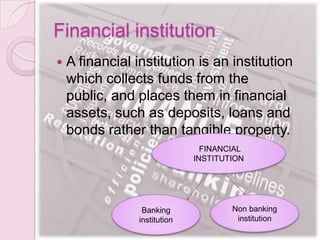
 A financial institution is an institution
which collects funds from the
public, and places them in financial
assets, such as deposits, loans and
bonds rather than tangible property.
FINANCIAL
INSTITUTION
Banking
institution
Non banking
institution
NON BANKING FINANCIAL
INSTITUTION
 A non-bank financial institution (NBFI) is
a financial institution that does not have a
full banking license or is not supervised by
a national or international banking
regulatory agency.
 Non-banking financial institutions, are
financial institutions that provide banking
services, but do not hold a banking license.
These institutions are not allowed to take
deposits from the public.
NBFI’s VERSUS BANK’s
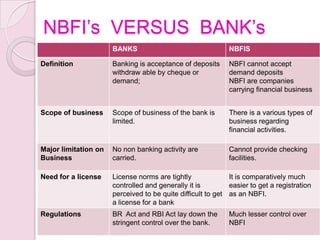
BANKS NBFIS
Definition Banking is acceptance of deposits
withdraw able by cheque or
demand;
NBFI cannot accept
demand deposits
NBFI are companies
carrying financial business
Scope of business Scope of business of the bank is
limited.
There is a various types of
business regarding
financial activities.
Major limitation on
Business
No non banking activity are
carried.
Cannot provide checking
facilities.
Need for a license License norms are tightly
controlled and generally it is
perceived to be quite difficult to get
a license for a bank
It is comparatively much
easier to get a registration
as an NBFI.
Regulations BR Act and RBI Act lay down the
stringent control over the bank.
Much lesser control over
NBFI
IMPORTANCE
 Non banking financial institutions have
the following importance in Indian
economy.
 Greater reach.
 Flexibility in tapping resources.
 Retail services to small and medium
business.
 Important component of financial
market.
Role of NBFIs
 Development of sectors like Transport &
Infrastructure
 Substantial employment generation
 Help & increase wealth creation
 Broad base economic development
 To finance economically weaker sections
FUNCTIONS
 Brokers of loanable funds.
 Mobilization of savings.
 Channelization of funds into
investment,
 Stabilize the capital market,
 Provide liquidity.
REGULATIONS
 RBI Act, 1934, it is mandatory that every
NBFI should be registered with RBI to
commence or carry on any business of
non-banking financial institution.
TYPES
types
Risk
pooling
institutions
Contractual
saving
institutions
Market
makers
Specialized
sectoral
financiers
Financial
services
providers
Cont.
 Risk-pooling institutions:
Insurance companies underwrite economic risks
associated with illness, death, damage and other risks
of loss.
There are two main types of insurance companies:
(a)general insurance (b)life insurance.
 Contractual savings institutions:
Contractual savings institutions (also called institutional
investors) give individuals the opportunity to invest in
collective investment vehicles (CIV).
Collective investment vehicles pool resources from
individuals and firms into various financial instruments
including equity, debt and derivatives.
Eg- mutual funds, pension funds.
cont
 Market makers
Market makers are broker-dealer institutions that
quote a buy and sell price and facilitate
transactions for financial assets. Such assets
include equities, government and corporate
debt, derivatives, and foreign currencies.
 Specialized sectoral financiers:
They provide a limited range of financial services
to a targeted sector. For example, real estate
financiers channel capital to prospective
homeowners, leasing companies provide
financing for equipment and payday lending
companies that provide short term loans to
individuals that are under banked or have limited
resources.
Cont.
 Financial service providers
Financial service providers include
brokers management consultants, and
financial advisors, and they operate on a
fee-for-service basis.
Their services include: improving
informational efficiency for the investors
and, in the case of brokers, offering a
transactions service by which an investor
can liquidate existing assets.
COMPANY’S UNDER NBFC
They are also categorized in a different
format among 8 categories
LOAN COMPANY
HIRE PURCHASE COMPANY
INVESTMENT COMPANY
MUTUAL BENEFIT COMPANY
HOUSING FINANCE COMPANY
EQUIPMENT LEASING COMPANY
GUIDELINES ON FAIR
PRACTICES
• Application for loans and their processing.
• Loan appraisal and termsconditions.
• Disbursement of loan.
• Customer acceptance policy.
• Customer identification procedure.
• Monitoring of transactions.
• Risk management.
• Kyc for existing accounts.
• Appointment of principal officer
Current status
 NBFI have improved their operations and
strategies. Industry experts opine that they
are much more mature today than they were
during the last decade.
 In fact, aggressive strategies helped LIC
housing finance to grab new customers and
increase its market share in national
mortgage market.
 The segment which was hit hardest was
vehicle financing.
 Fortunately, since vehicle finance is asset
based business, their asset quality did not
suffer as against other consumer financing
business.
Top five NBFCs in India:
• Housing Development Finance
Corporation Limited
• Power Finance Corporation Limited
• Rural Electrification Corporation
Limited
• National Bank of Agricultural and
Rural Development
• Infrastructure Development Finance
Company Limited
FUTURE PROSPECTS
Some of the future prospects of NBFI
are-
 FUTURE CAPITAL
 ASHOK LEYLAND FINANCE.
 RELIANCE CAPITAL.
FUTURE CAPITAL
 Future Capital, the financial arm of
Future Group, will soon start rolling out
Money Bazaars across the country.
 This one stop-shop would be providing
numerous services like-
o Housing loans
o Personal loans
o Insurance
o MFs
o Credit cards
ASHOK LEYLAND FIN.
 Traditionally, ALF has depended on
commercial vehicle financing for a significant
proportion of its revenue.
• The other segment they are concentrating
on is passenger cars.
• The other segment they have is multi-
utility vehicles (MUVs).
• The move of Ashok Leyland Finance to
launch a finance portal that would be
used to sell products of other
financial intermediaries.
RELIANCE CAPITAL
 Reliance Capital, an arm of the Anil
Dhirubhai Ambani Group, will set up a
separate housing financial subsidiary
and non-banking financial company
(NBFC) for the consumer finance sector.
 Ambani said his company is also
planning to selectively expand its-
o Asset management.
o Life insurance.
o Broking operations.
CONCLUSION
 Strengthening the professionalism of
NBFC sector through education and
training, making them more organised.
 RBI needs to educate people about
NBFC.
 The credit delivery mechanism needs to
be more transparent and hassle free.
 There should be more stringent norms for
the defaulters.
non banking financial institution

non banking financial institution

  • 1.
  • 2.
    CONTENTS  Meaning  Differencebetween NBFI and banks  Importance  Role of NBFI  Functions  Regulations  Types  Guidelines  Current status  Top five NBFI  Conclusion
  • 3.
    Financial institution  Afinancial institution is an institution which collects funds from the public, and places them in financial assets, such as deposits, loans and bonds rather than tangible property. FINANCIAL INSTITUTION Banking institution Non banking institution
  • 4.
    NON BANKING FINANCIAL INSTITUTION A non-bank financial institution (NBFI) is a financial institution that does not have a full banking license or is not supervised by a national or international banking regulatory agency.  Non-banking financial institutions, are financial institutions that provide banking services, but do not hold a banking license. These institutions are not allowed to take deposits from the public.
  • 5.
    NBFI’s VERSUS BANK’s BANKSNBFIS Definition Banking is acceptance of deposits withdraw able by cheque or demand; NBFI cannot accept demand deposits NBFI are companies carrying financial business Scope of business Scope of business of the bank is limited. There is a various types of business regarding financial activities. Major limitation on Business No non banking activity are carried. Cannot provide checking facilities. Need for a license License norms are tightly controlled and generally it is perceived to be quite difficult to get a license for a bank It is comparatively much easier to get a registration as an NBFI. Regulations BR Act and RBI Act lay down the stringent control over the bank. Much lesser control over NBFI
  • 6.
    IMPORTANCE  Non bankingfinancial institutions have the following importance in Indian economy.  Greater reach.  Flexibility in tapping resources.  Retail services to small and medium business.  Important component of financial market.
  • 7.
    Role of NBFIs Development of sectors like Transport & Infrastructure  Substantial employment generation  Help & increase wealth creation  Broad base economic development  To finance economically weaker sections
  • 8.
    FUNCTIONS  Brokers ofloanable funds.  Mobilization of savings.  Channelization of funds into investment,  Stabilize the capital market,  Provide liquidity.
  • 9.
    REGULATIONS  RBI Act,1934, it is mandatory that every NBFI should be registered with RBI to commence or carry on any business of non-banking financial institution.
  • 10.
  • 11.
    Cont.  Risk-pooling institutions: Insurancecompanies underwrite economic risks associated with illness, death, damage and other risks of loss. There are two main types of insurance companies: (a)general insurance (b)life insurance.  Contractual savings institutions: Contractual savings institutions (also called institutional investors) give individuals the opportunity to invest in collective investment vehicles (CIV). Collective investment vehicles pool resources from individuals and firms into various financial instruments including equity, debt and derivatives. Eg- mutual funds, pension funds.
  • 12.
    cont  Market makers Marketmakers are broker-dealer institutions that quote a buy and sell price and facilitate transactions for financial assets. Such assets include equities, government and corporate debt, derivatives, and foreign currencies.  Specialized sectoral financiers: They provide a limited range of financial services to a targeted sector. For example, real estate financiers channel capital to prospective homeowners, leasing companies provide financing for equipment and payday lending companies that provide short term loans to individuals that are under banked or have limited resources.
  • 13.
    Cont.  Financial serviceproviders Financial service providers include brokers management consultants, and financial advisors, and they operate on a fee-for-service basis. Their services include: improving informational efficiency for the investors and, in the case of brokers, offering a transactions service by which an investor can liquidate existing assets.
  • 14.
    COMPANY’S UNDER NBFC Theyare also categorized in a different format among 8 categories LOAN COMPANY HIRE PURCHASE COMPANY INVESTMENT COMPANY MUTUAL BENEFIT COMPANY HOUSING FINANCE COMPANY EQUIPMENT LEASING COMPANY
  • 15.
    GUIDELINES ON FAIR PRACTICES •Application for loans and their processing. • Loan appraisal and termsconditions. • Disbursement of loan. • Customer acceptance policy. • Customer identification procedure. • Monitoring of transactions. • Risk management. • Kyc for existing accounts. • Appointment of principal officer
  • 16.
    Current status  NBFIhave improved their operations and strategies. Industry experts opine that they are much more mature today than they were during the last decade.  In fact, aggressive strategies helped LIC housing finance to grab new customers and increase its market share in national mortgage market.  The segment which was hit hardest was vehicle financing.  Fortunately, since vehicle finance is asset based business, their asset quality did not suffer as against other consumer financing business.
  • 17.
    Top five NBFCsin India: • Housing Development Finance Corporation Limited • Power Finance Corporation Limited • Rural Electrification Corporation Limited • National Bank of Agricultural and Rural Development • Infrastructure Development Finance Company Limited
  • 18.
    FUTURE PROSPECTS Some ofthe future prospects of NBFI are-  FUTURE CAPITAL  ASHOK LEYLAND FINANCE.  RELIANCE CAPITAL.
  • 19.
    FUTURE CAPITAL  FutureCapital, the financial arm of Future Group, will soon start rolling out Money Bazaars across the country.  This one stop-shop would be providing numerous services like- o Housing loans o Personal loans o Insurance o MFs o Credit cards
  • 20.
    ASHOK LEYLAND FIN. Traditionally, ALF has depended on commercial vehicle financing for a significant proportion of its revenue. • The other segment they are concentrating on is passenger cars. • The other segment they have is multi- utility vehicles (MUVs). • The move of Ashok Leyland Finance to launch a finance portal that would be used to sell products of other financial intermediaries.
  • 21.
    RELIANCE CAPITAL  RelianceCapital, an arm of the Anil Dhirubhai Ambani Group, will set up a separate housing financial subsidiary and non-banking financial company (NBFC) for the consumer finance sector.  Ambani said his company is also planning to selectively expand its- o Asset management. o Life insurance. o Broking operations.
  • 22.
    CONCLUSION  Strengthening theprofessionalism of NBFC sector through education and training, making them more organised.  RBI needs to educate people about NBFC.  The credit delivery mechanism needs to be more transparent and hassle free.  There should be more stringent norms for the defaulters.

Editor's Notes

  • #12 A collective investment vehicle (CIV) is any entity that allows investors to pool their money and invest the pooled funds, instead of buying securities directly as individuals. The most common types of collective investment vehicles are mutual funds, exchange-traded funds, collective investment schemes and venture capital funds.