Nontraditional Security Threats in South Asia
(focus on Bangladesh floods)
Non traditional?
Non traditional security issues include areas
such as transnational organized crimes,
global terror, disaster relief, information
security, climate change and public health
epidemics, energy security and water security.
South Asia: Region of Conflicts
South Asia, which consists of eight states of different sizes and capabilities,
is characterized by high levels of insecurity in interstate, and human
dimensions.
South Asian states including irreconcilable national, sub-national and
religious identities; lack of political development (i.e. absence of proper
democratic institutions and procedures); weak economies; unsettled
territorial disputes; and lack of regional institutions.
Non Traditional Security Challenges
• Inter-state conflict
• Terrorism
• Climate change
• Diseases
• Irregular migration
• Drug trafficking
• Economic crises
• Energy security
• Food security
AFGHANISTAN
Historically, Afghanistan has been used by regional and extra regional actors for strategic
interests. The great game between the British and the Russians, followed by U.S and Soviet
Russia, and then the strategic game of Pakistan, who is a crucial actor at the moment and
whose maneuvers are directly related to Afghanistan’s security, shows how the world has
always tried to extract its strategic interest from Afghanistan.
PAKISTAN
Pakistan is facing terrorism and extremism, sectarianism and ethnic diversity, gender
discrimination and population explosion as non-traditional security threats, which not only
threaten national security but also threaten human security. Violence increased in Pakistani
society due non-traditional security threats and there is need to handle these issues with
cooperation and mutual trust among the all institutions.
Nepal
Nepal also has had a violent internal conflict, which has recently made a crucial turn for a
settlement. But still there are many challenges that need to be over come for a peaceful
settlement of this conflict. The unstable political environment, poverty and growing ethnic
tensions and religious fragmentations are some elements, which could renew violence
anytime.
Sari Lanka
In Sri Lanka, the Liberation Tigers of Tamil Eelam (LTTE) has been conducting an armed
campaign for a separate Tamil homeland since the early 1980s. It seems that even if the Sri
Lankan army wins the war, the island nation may not achieve peace without proper
reconciliation of the aspirations of the Tamil population.
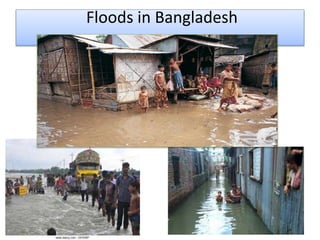
Flooding in Bangladesh
• Bangladesh is one of the world’s most vulnerable countries to climate change and natural
disasters, with over six percent of the population affected by disasters each year.
• The primary threats to Bangladesh are floods, droughts, cyclones and sea-level rise due to
climate change.
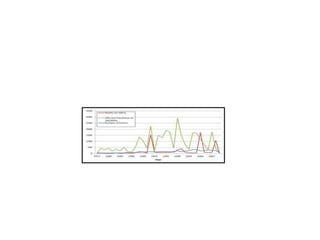
• Over the last thirty years, Bangladesh has experienced nearly 200 of these climate-related
disasters, which have killed thousands of people, destroyed homes and cost the nation
around $16 billion in damage and economic losses .
Floods in Bangladesh
Response to Floods
• CPP volunteers:
About 42,000 volunteers of Bangladesh Red Crescent Society’s Cyclone Preparedness Program [CPP] were mobilized in
the coastal belt five days before the cyclone made landfall on 15 November 2007,” Abdur Rob, chairman of the Bangladesh
Red Crescent Society explained.
• Warning system :
Once a cyclone appears in the Bay of Bengal, the Storm Warning Centre of the Bangladesh Meteorological Department (BMD) begins
issuing special weather bulletins.
• UNDP:
After the 1991 cyclone, disaster management activities were upgraded through a three-year, US$5 million
technical assistance project of the UN Development Program (UNDP).
• WARPO:
The Ministry of Water Resources created the Water Resources Planning Organization (WARPO), a key organization in dealing
with the nation’s water resources planning and management.
Conclusion
• The fall of the polarized world structure has generated a sense of insecurity among countries.
In Asia, pent-up local conflicts have acquired a new activism and strength in the context of
the end of the Cold War.
• Afghanistan is the key issue in any discourse on the future of present day South Asia for
prompting internal and external tensions within and outside the countries in the region.
THANK YOU

Non traditional presentation

  • 1.
    Nontraditional Security Threatsin South Asia (focus on Bangladesh floods)
  • 2.
    Non traditional? Non traditionalsecurity issues include areas such as transnational organized crimes, global terror, disaster relief, information security, climate change and public health epidemics, energy security and water security.
  • 3.
    South Asia: Regionof Conflicts South Asia, which consists of eight states of different sizes and capabilities, is characterized by high levels of insecurity in interstate, and human dimensions. South Asian states including irreconcilable national, sub-national and religious identities; lack of political development (i.e. absence of proper democratic institutions and procedures); weak economies; unsettled territorial disputes; and lack of regional institutions.
  • 4.
    Non Traditional SecurityChallenges • Inter-state conflict • Terrorism • Climate change • Diseases • Irregular migration • Drug trafficking • Economic crises • Energy security • Food security
  • 5.
    AFGHANISTAN Historically, Afghanistan hasbeen used by regional and extra regional actors for strategic interests. The great game between the British and the Russians, followed by U.S and Soviet Russia, and then the strategic game of Pakistan, who is a crucial actor at the moment and whose maneuvers are directly related to Afghanistan’s security, shows how the world has always tried to extract its strategic interest from Afghanistan.
  • 6.
    PAKISTAN Pakistan is facingterrorism and extremism, sectarianism and ethnic diversity, gender discrimination and population explosion as non-traditional security threats, which not only threaten national security but also threaten human security. Violence increased in Pakistani society due non-traditional security threats and there is need to handle these issues with cooperation and mutual trust among the all institutions.
  • 7.
    Nepal Nepal also hashad a violent internal conflict, which has recently made a crucial turn for a settlement. But still there are many challenges that need to be over come for a peaceful settlement of this conflict. The unstable political environment, poverty and growing ethnic tensions and religious fragmentations are some elements, which could renew violence anytime.
  • 8.
    Sari Lanka In SriLanka, the Liberation Tigers of Tamil Eelam (LTTE) has been conducting an armed campaign for a separate Tamil homeland since the early 1980s. It seems that even if the Sri Lankan army wins the war, the island nation may not achieve peace without proper reconciliation of the aspirations of the Tamil population.
  • 9.
    Flooding in Bangladesh •Bangladesh is one of the world’s most vulnerable countries to climate change and natural disasters, with over six percent of the population affected by disasters each year. • The primary threats to Bangladesh are floods, droughts, cyclones and sea-level rise due to climate change. • Over the last thirty years, Bangladesh has experienced nearly 200 of these climate-related disasters, which have killed thousands of people, destroyed homes and cost the nation around $16 billion in damage and economic losses .
  • 11.
  • 12.
    Response to Floods •CPP volunteers: About 42,000 volunteers of Bangladesh Red Crescent Society’s Cyclone Preparedness Program [CPP] were mobilized in the coastal belt five days before the cyclone made landfall on 15 November 2007,” Abdur Rob, chairman of the Bangladesh Red Crescent Society explained. • Warning system : Once a cyclone appears in the Bay of Bengal, the Storm Warning Centre of the Bangladesh Meteorological Department (BMD) begins issuing special weather bulletins. • UNDP: After the 1991 cyclone, disaster management activities were upgraded through a three-year, US$5 million technical assistance project of the UN Development Program (UNDP). • WARPO: The Ministry of Water Resources created the Water Resources Planning Organization (WARPO), a key organization in dealing with the nation’s water resources planning and management.
  • 13.
    Conclusion • The fallof the polarized world structure has generated a sense of insecurity among countries. In Asia, pent-up local conflicts have acquired a new activism and strength in the context of the end of the Cold War. • Afghanistan is the key issue in any discourse on the future of present day South Asia for prompting internal and external tensions within and outside the countries in the region.
  • 14.