Chapter 7 Design Principles  Composition Balance Focal Point Variety  Unity  Contrast
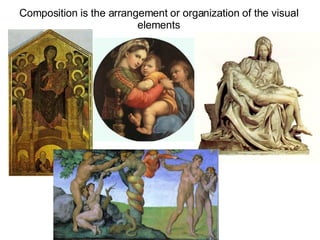
Composition is the arrangement or organization of the visual elements
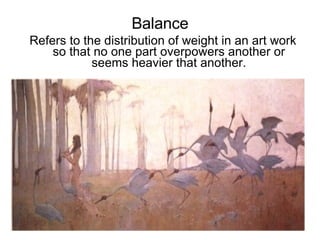
Balance Refers to the distribution of weight in an art work so that no one part overpowers another or seems heavier that another.
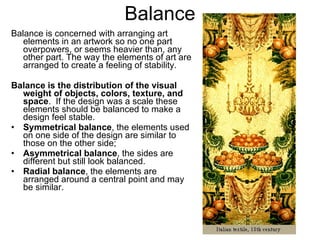
Balance Balance is concerned with arranging art elements in an artwork so no one part overpowers, or seems heavier than, any other part.  The way the elements of art are arranged to create a feeling of stability. Balance is the distribution of the visual weight of objects, colors, texture, and space .  If the design was a scale these elements should be balanced to make a design feel stable.  Symmetrical balance , the elements used on one side of the design are similar to those on the other side;  Asymmetrical balance , the sides are different but still look balanced.  Radial balance , the elements are arranged around a central point and may be similar. 
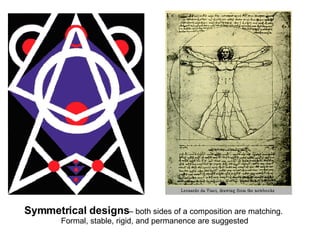
Symmetrical designs – both sides of a composition are matching.  Formal, stable, rigid, and permanence are suggested
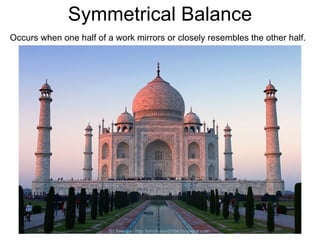
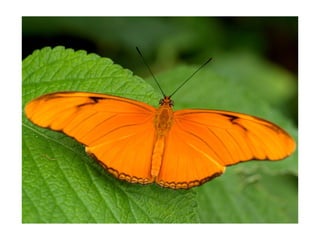
Symmetrical Balance Occurs when one half of a work mirrors or closely resembles the other half.
 
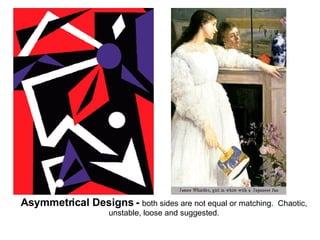
Asymmetrical Designs -  both sides are not equal or matching.  Chaotic, unstable, loose and suggested.
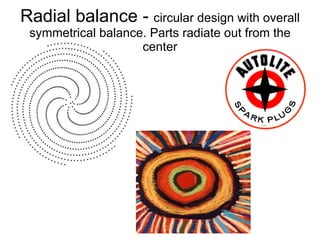
Radial balance -  circular design with overall symmetrical balance. Parts radiate out from the center
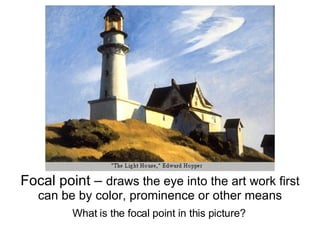
Focal point –  draws the eye into the art work first can be by color, prominence or other means What is the focal point in this picture?
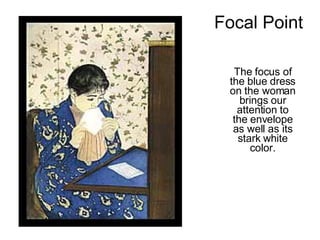
The focus of the blue dress on the woman brings our attention to the envelope as well as its stark white color. Focal Point
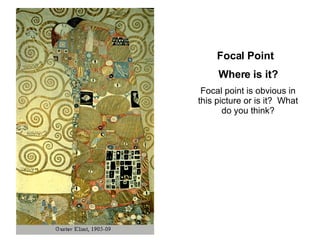
Focal Point  Where is it? Focal point is obvious in this picture or is it?  What do you think?
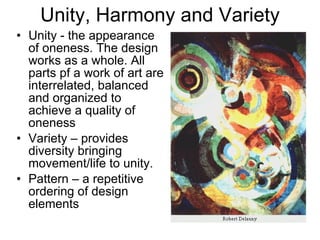
Unity, Harmony and Variety Unity - the appearance of oneness. The design works as a whole. All parts pf a work of art are interrelated, balanced and organized to achieve a quality of oneness Variety – provides diversity bringing movement/life to unity. Pattern – a repetitive ordering of design elements
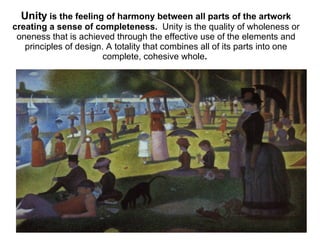
Unity  is the feeling of harmony between all parts of the artwork creating a sense of completeness.  Unity is the quality of wholeness or oneness that is achieved through the effective use of the elements and principles of design. A totality that combines all of its parts into one complete, cohesive whole .
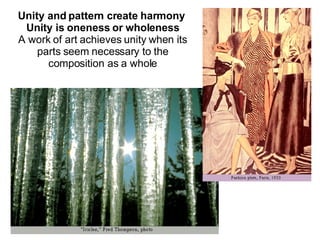
Unity and pattern create harmony   Unity is oneness or wholeness A work of art achieves unity when its parts seem necessary to the composition as a whole
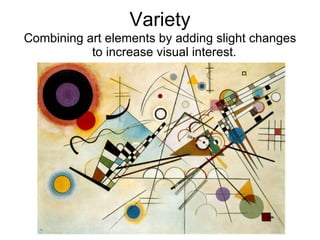
Variety Combining art elements by adding slight changes to increase visual interest.
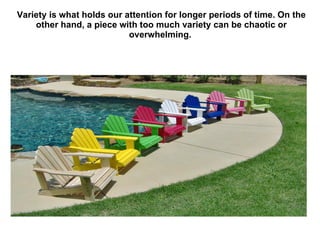
Variety is what holds our attention for longer periods of time. On the other hand, a piece with too much variety can be chaotic or overwhelming.
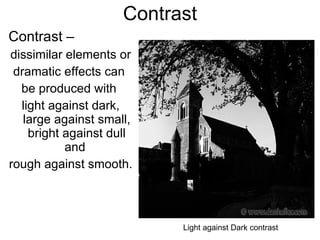
Contrast Contrast –  dissimilar elements or dramatic effects can  be produced with  light against dark, large against small, bright against dull and  rough against smooth. Light against Dark contrast
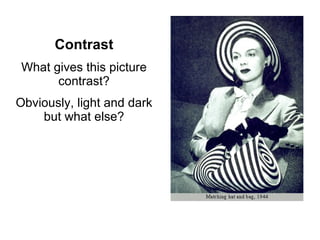
Contrast What gives this picture contrast? Obviously, light and dark but what else?

KCC Art 141 Chapter 7 Design Principles

  • 1.
    Chapter 7 DesignPrinciples Composition Balance Focal Point Variety Unity Contrast
  • 2.
    Composition is thearrangement or organization of the visual elements
  • 3.
    Balance Refers tothe distribution of weight in an art work so that no one part overpowers another or seems heavier that another.
  • 4.
    Balance Balance isconcerned with arranging art elements in an artwork so no one part overpowers, or seems heavier than, any other part. The way the elements of art are arranged to create a feeling of stability. Balance is the distribution of the visual weight of objects, colors, texture, and space . If the design was a scale these elements should be balanced to make a design feel stable. Symmetrical balance , the elements used on one side of the design are similar to those on the other side; Asymmetrical balance , the sides are different but still look balanced. Radial balance , the elements are arranged around a central point and may be similar. 
  • 5.
    Symmetrical designs –both sides of a composition are matching. Formal, stable, rigid, and permanence are suggested
  • 6.
    Symmetrical Balance Occurswhen one half of a work mirrors or closely resembles the other half.
  • 7.
  • 8.
    Asymmetrical Designs - both sides are not equal or matching. Chaotic, unstable, loose and suggested.
  • 9.
    Radial balance - circular design with overall symmetrical balance. Parts radiate out from the center
  • 10.
    Focal point – draws the eye into the art work first can be by color, prominence or other means What is the focal point in this picture?
  • 11.
    The focus ofthe blue dress on the woman brings our attention to the envelope as well as its stark white color. Focal Point
  • 12.
    Focal Point Where is it? Focal point is obvious in this picture or is it? What do you think?
  • 13.
    Unity, Harmony andVariety Unity - the appearance of oneness. The design works as a whole. All parts pf a work of art are interrelated, balanced and organized to achieve a quality of oneness Variety – provides diversity bringing movement/life to unity. Pattern – a repetitive ordering of design elements
  • 14.
    Unity isthe feeling of harmony between all parts of the artwork creating a sense of completeness. Unity is the quality of wholeness or oneness that is achieved through the effective use of the elements and principles of design. A totality that combines all of its parts into one complete, cohesive whole .
  • 15.
    Unity and patterncreate harmony Unity is oneness or wholeness A work of art achieves unity when its parts seem necessary to the composition as a whole
  • 16.
    Variety Combining artelements by adding slight changes to increase visual interest.
  • 17.
    Variety is whatholds our attention for longer periods of time. On the other hand, a piece with too much variety can be chaotic or overwhelming.
  • 18.
    Contrast Contrast – dissimilar elements or dramatic effects can be produced with light against dark, large against small, bright against dull and rough against smooth. Light against Dark contrast
  • 19.
    Contrast What givesthis picture contrast? Obviously, light and dark but what else?