Elements of Art
and
Principles of Design
Elements of Art
The building blocks or ingredients of art.
They structure and carry the work.
Elements of Art
Line
Color
Value
Shape
Form
Space
Texture
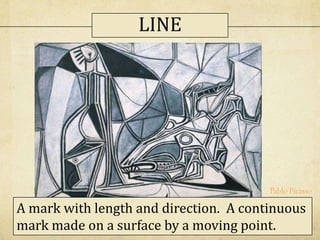
LINE
A mark with length and direction. A continuous
mark made on a surface by a moving point.
Pablo Picasso
LINE
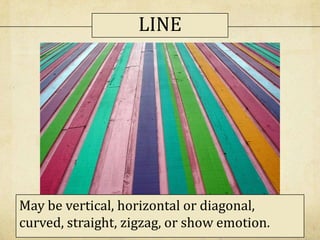
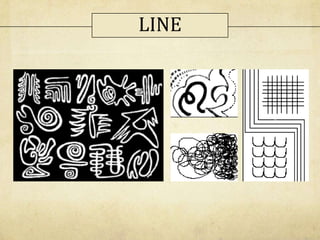
May be vertical, horizontal or diagonal,
curved, straight, zigzag, or show emotion.
LINE
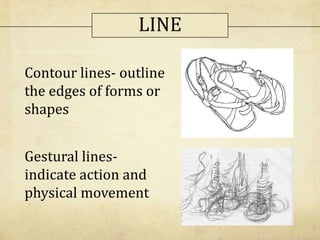
Contour lines- outline
the edges of forms or
shapes
Gestural lines-
indicate action and
physical movement
LINE
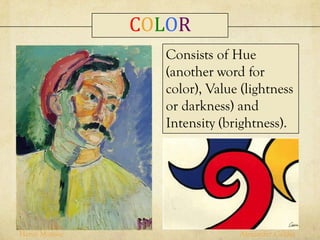
Consists of Hue
(another word for
color), Value (lightness
or darkness) and
Intensity (brightness).
Henri Matisse Alexander Calder
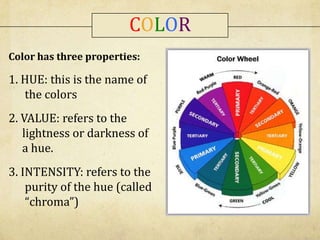
COLOR
Color has three properties:
1. HUE: this is the name of
the colors
2. VALUE: refers to the
lightness or darkness of
a hue.
3. INTENSITY: refers to the
purity of the hue (called
“chroma”)
COLOR
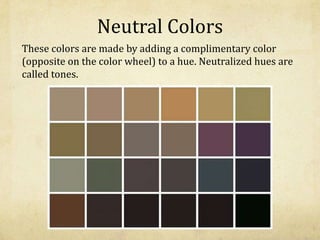
Neutral Colors
These colors are made by adding a complimentary color
(opposite on the color wheel) to a hue. Neutralized hues are
called tones.
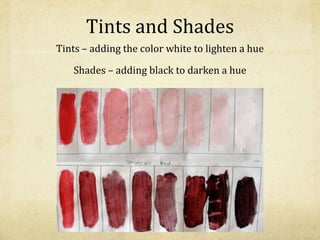
Tints – adding the color white to lighten a hue
Shades – adding black to darken a hue
Tints and Shades
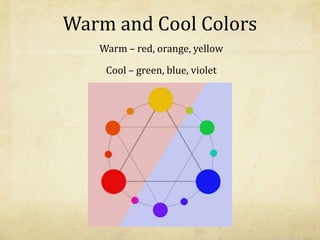
Warm and Cool Colors
Warm – red, orange, yellow
Cool – green, blue, violet
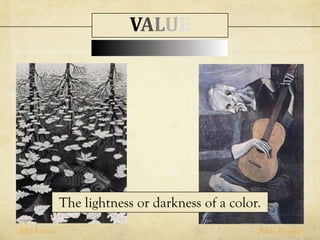
The lightness or darkness of a color.
MC Escher Pablo Picasso
VALUE
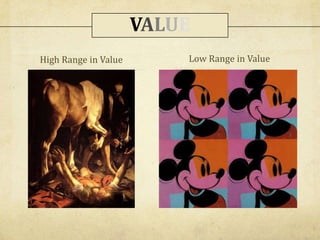
High Range in Value Low Range in Value
VALUE
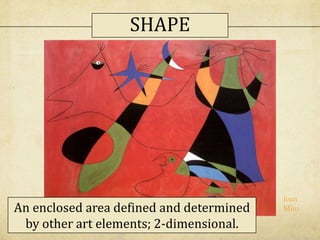
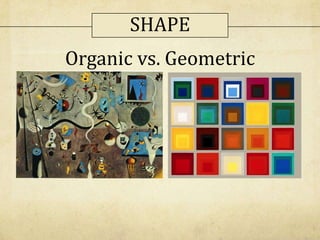
An enclosed area defined and determined
by other art elements; 2-dimensional.
Joan
Miro
SHAPE
SHAPE
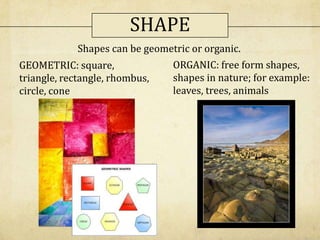
Shapes can be geometric or organic.
GEOMETRIC: square,
triangle, rectangle, rhombus,
circle, cone
ORGANIC: free form shapes,
shapes in nature; for example:
leaves, trees, animals
Organic vs. Geometric
SHAPE
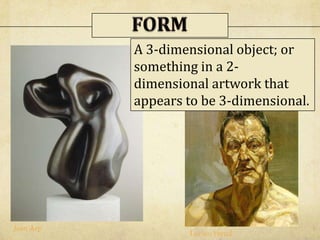
A 3-dimensional object; or
something in a 2-
dimensional artwork that
appears to be 3-dimensional.
Jean Arp
Lucien Freud
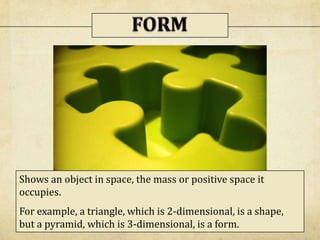
Shows an object in space, the mass or positive space it
occupies.
For example, a triangle, which is 2-dimensional, is a shape,
but a pyramid, which is 3-dimensional, is a form.
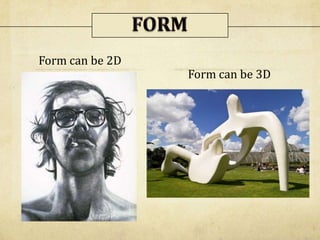
Form can be 2D
Form can be 3D
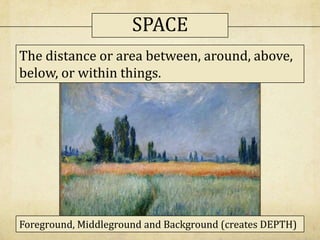
The distance or area between, around, above,
below, or within things.
Foreground, Middleground and Background (creates DEPTH)
SPACE
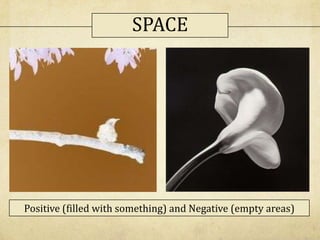
Positive (filled with something) and Negative (empty areas)
SPACE
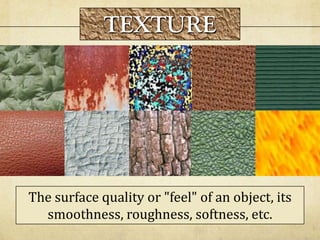
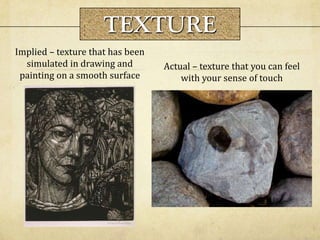
The surface quality or "feel" of an object, its
smoothness, roughness, softness, etc.
TEXTURE
TEXTURE
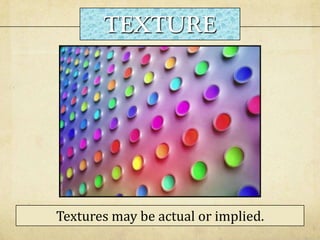
Textures may be actual or implied.
Actual – texture that you can feel
with your sense of touch
Implied – texture that has been
simulated in drawing and
painting on a smooth surface
TEXTURE
You should now have
7 Elements of Art
Cards
to save in your
Art Card Envelope!
Principles of Design
What we use to organize the Elements
of Art, or the tools to make art.
They are concepts that affect content
and message.
Principles of Design
Balance
Emphasis
Contrast
Movement &
Rhythm
Unity
Variety
Proportion
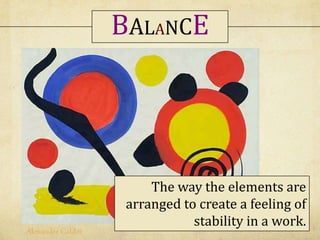
The way the elements are
arranged to create a feeling of
stability in a work.
Alexander Calder
BALANCE
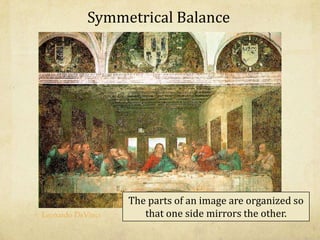
Symmetrical Balance
The parts of an image are organized so
that one side mirrors the other.Leonardo DaVinci
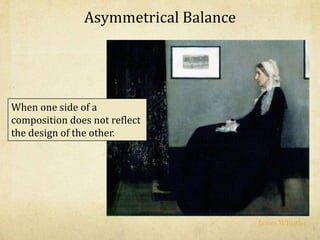
Asymmetrical Balance
When one side of a
composition does not reflect
the design of the other.
James Whistler
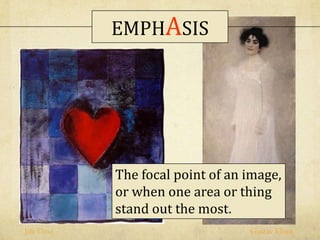
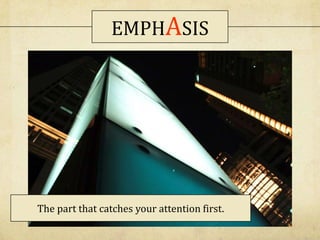
The focal point of an image,
or when one area or thing
stand out the most.
Jim Dine Gustav Klimt
EMPHASIS
EMPHASIS
The part that catches your attention first.
Can be created through the use of many different
elements and principles like…
CONTRAST
PROPORTION
COLOR
EMPHASIS
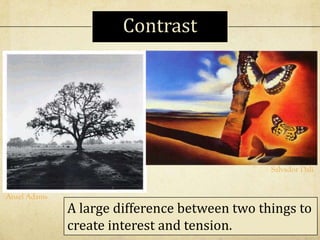
A large difference between two things to
create interest and tension.
Ansel Adams
Salvador Dali
Contrast
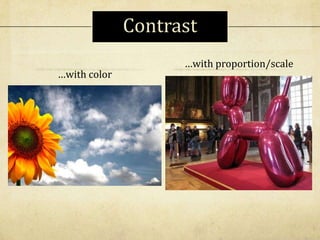
…with color
…with proportion/scale
Contrast
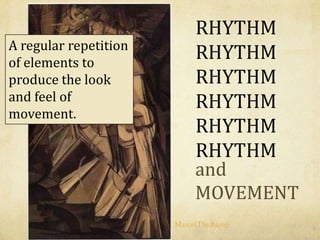
RHYTHM
RHYTHM
RHYTHM
RHYTHM
RHYTHM
RHYTHM
and
MOVEMENT
A regular repetition
of elements to
produce the look
and feel of
movement.
Marcel Duchamp
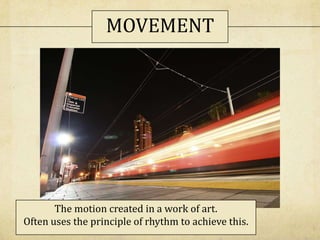
MOVEMENT
The motion created in a work of art.
Often uses the principle of rhythm to achieve this.
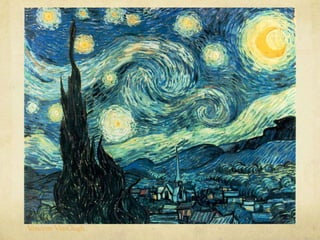
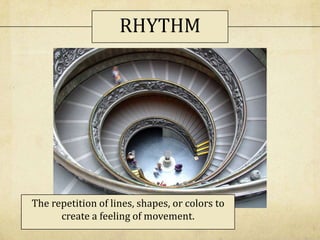
RHYTHM
The repetition of lines, shapes, or colors to
create a feeling of movement.
Vincent VanGogh
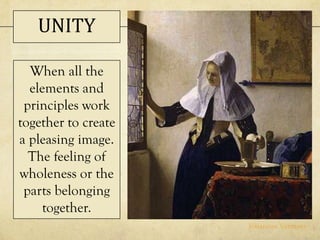
When all the
elements and
principles work
together to create
a pleasing image.
The feeling of
wholeness or the
parts belonging
together.
Johannes Vermeer
UNITY
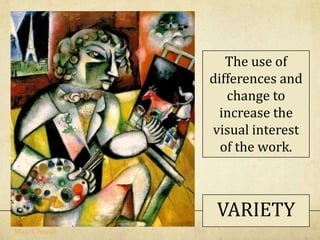
The use of
differences and
change to
increase the
visual interest
of the work.
Marc Chagall
VARIETY
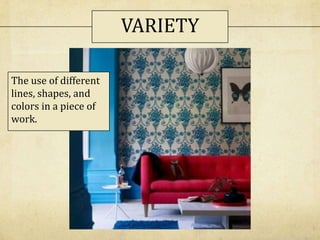
VARIETY
The use of different
lines, shapes, and
colors in a piece of
work.
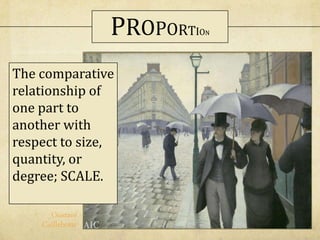
The comparative
relationship of
one part to
another with
respect to size,
quantity, or
degree; SCALE.
Gustave
Caillebotte
PROPORTION
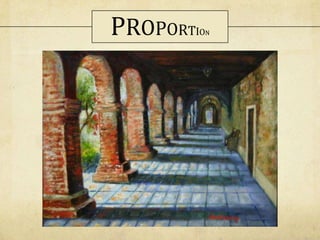
PROPORTION
You should now have
7 Principles of Design
Cards
to save in your
Art Card Envelope!
Please hand in your
14 E&P Art Cards
with the rubric when
they’re done !
Write your name on them!!!
When returned to you, keep all of your
Art Cards
in your
Art Card Envelope!
You can study from them for your
mid-term and final exams.
* You should have 22 cards. *

Elements principles update