LINE
Design Elements   Design Principles
    SHAP
       E            BALANCE
    COLO            VARIETY
       R
                   MOVEMENT
     VALU
                   CONTRAST
       E
                   EMPHASIS
     TEXT
      URE         PROPORTION
    SPAC             UNITY
Elements of Design


   Are the seven basic building blocks of art & design.


        Without these building blocks the principles are meaningless.
 Without the principles the elements can not be used to their best ability.
Design Elements

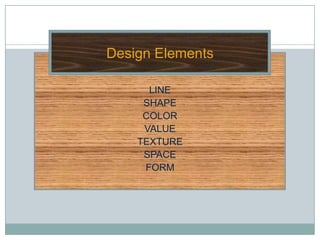
      LINE
     SHAPE
     COLOR
     VALUE
    TEXTURE
     SPACE
     FORM
Line


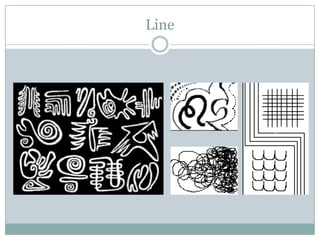
 A mark. Lines have thickness, direction, and
movement; they can be interrupted and can show
            emotion in an artwork.
Line
Line


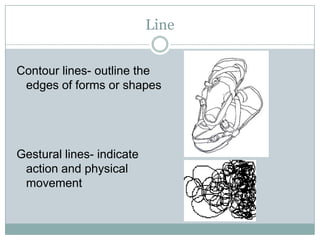
Contour lines- outline the
 edges of forms or shapes


Gestural lines- indicate
 action and physical
 movement
Shape


When line curves or corners around and crosses
         over itself it becomes a shape.
Shape

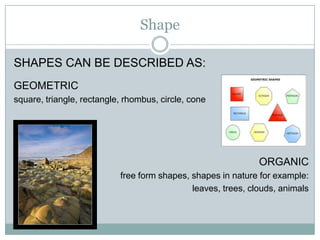
SHAPES CAN BE DESCRIBED AS:
GEOMETRIC
square, triangle, rectangle, rhombus, circle, cone


                                                              ORGANIC
                           free form shapes, shapes in nature for example:
                                             leaves, trees, clouds, animals
Color


Color has three main properties:
             1. Hue
            2. Value
          3. Intensity
Color
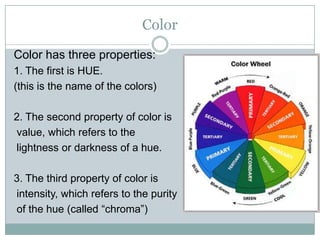
Color has three properties:
1. The first is HUE.
(this is the name of the colors)

2. The second property of color is
value, which refers to the
lightness or darkness of a hue.

3. The third property of color is
intensity, which refers to the purity
of the hue (called “chroma”)
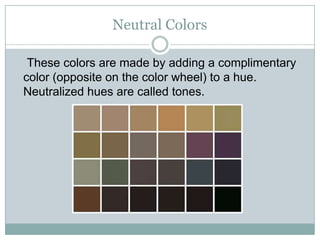
Neutral Colors

 These colors are made by adding a complimentary
color (opposite on the color wheel) to a hue.
Neutralized hues are called tones.
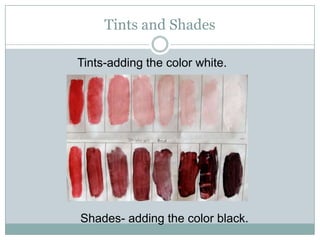
Tints and Shades

Tints-adding the color white.


Shades- adding the color black.
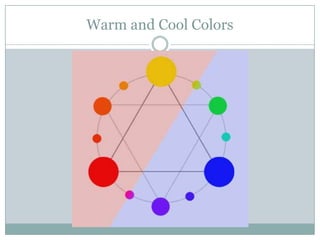
Warm and Cool Colors
Value


The lightness or darkness of a hue.
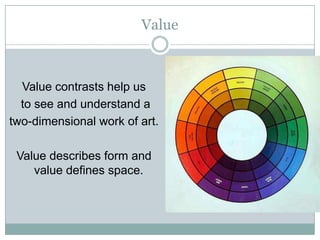
Value


  Value contrasts help us
  to see and understand a
two-dimensional work of art.

 Value describes form and
    value defines space.
Texture


The quality of a surface: Smooth, rough, bumpy,
                     hairy, etc.
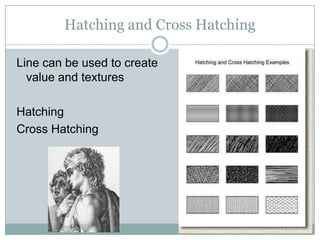
Hatching and Cross Hatching

Line can be used to create
  value and textures

Hatching
Cross Hatching
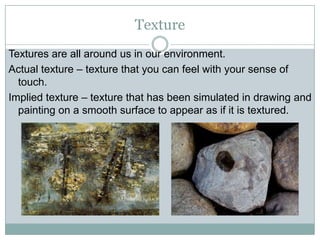
Texture
Textures are all around us in our environment.
Actual texture – texture that you can feel with your sense of
  touch.
Implied texture – texture that has been simulated in drawing and
  painting on a smooth surface to appear as if it is textured.
Space


The amount of depth in both 2D and 3D artworks.
  Around, above, inside, outside, help describe
                      space
Space

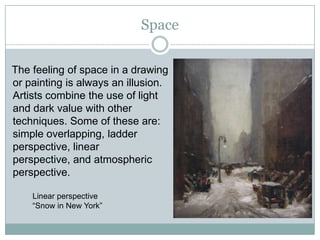
The feeling of space in a drawing
or painting is always an illusion.
Artists combine the use of light
and dark value with other
techniques. Some of these are:
simple overlapping, ladder
perspective, linear
perspective, and atmospheric
perspective.

    Linear perspective
    “Snow in New York”
Form


In 3D artworks it is the quality of the shape.
      Ex. Cubes, spheres and cones
Form

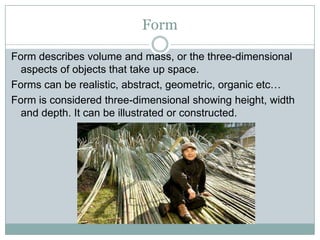
Form describes volume and mass, or the three-dimensional
  aspects of objects that take up space.
Forms can be realistic, abstract, geometric, organic etc…
Form is considered three-dimensional showing height, width
  and depth. It can be illustrated or constructed.
Principles of Design


The basic rules of aesthetics that guide in the
 organization of elements in a work of art.
Design Principles

     Balance
    Emphasis
      Variety
    Movement
    Proportion
     Contrast
       Unity
Balance


 An appearance of evenness in an artwork.
There are two kinds: Symmetry & Asymmetry
Balance

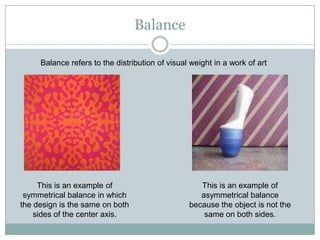
     Balance refers to the distribution of visual weight in a work of art


     This is an example of                          This is an example of
 symmetrical balance in which                       asymmetrical balance
the design is the same on both                   because the object is not the
    sides of the center axis.                        same on both sides.
Balance


 An appearance of evenness in an artwork.
There are two kinds: Symmetry & Asymmetry
Symmetry


In composition it is an arrangement of elements
             using order or disorder.
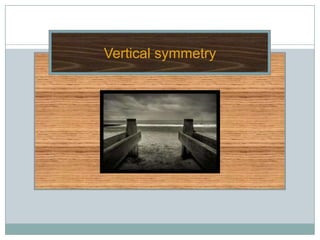
Vertical symmetry


A composition with identical or similar elements
 arranged on both the right and left halves of an
                     image.
Vertical symmetry
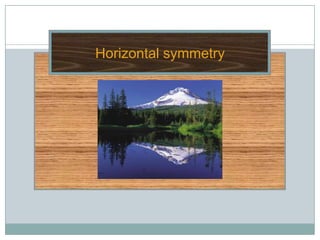
Horizontal symmetry


A composition with identical or similar elements
arranged on both the top and bottom halves of an
                     image.
Horizontal symmetry
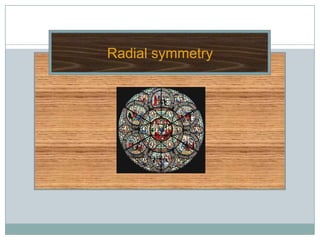
Radial symmetry

A composition with a center point from which the arrangement
       of elements radiate around in a circular format.

                            Imagine:
Cut a piece of “pie” out of an empty circle. Create a design on
                         the piece of pie.
         Repeat the pie piece to finish off the “pie.”
Radial symmetry
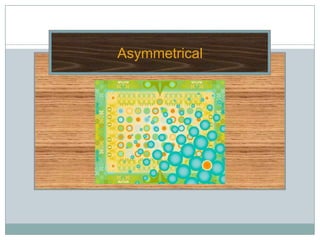
Asymmetry


A composition with a heavy and light amount of elements.
      Asymmetry uses disorder to create balance.
Asymmetrical
Contrast


A large difference between elements. Green and
    Red, dark and light, large and small, thin and
                thick, bright and dull.
Contrast


  Contrast refers to differences in values,
colors textures, shapes and other elements.
Emphasis


Where an artist draws attention to one or more
                parts of a design.
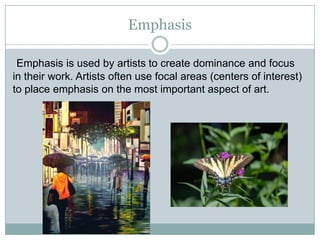
Emphasis

 Emphasis is used by artists to create dominance and focus
in their work. Artists often use focal areas (centers of interest)
to place emphasis on the most important aspect of art.
Movement


The path the viewer’s eye is directed to take by the
      artist’s choice of elements such as line.
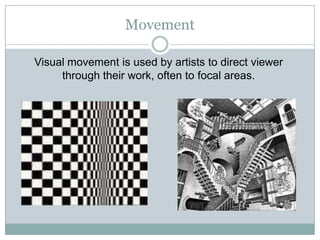
Movement

Visual movement is used by artists to direct viewer
     through their work, often to focal areas.
Variety

The differences in any element in a work of art give
                      it variety.

  Ex: A variety of shape sizes or a variety of the
                      same hue
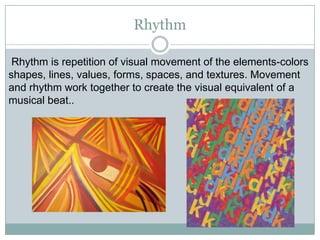
Rhythm

 Rhythm is repetition of visual movement of the elements-colors
shapes, lines, values, forms, spaces, and textures. Movement
and rhythm work together to create the visual equivalent of a
musical beat..
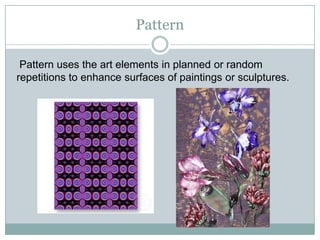
Pattern

 Pattern uses the art elements in planned or random
repetitions to enhance surfaces of paintings or sculptures.
Unity


A sense that all of the parts belong together as one
                    piece of artwork.
Unity

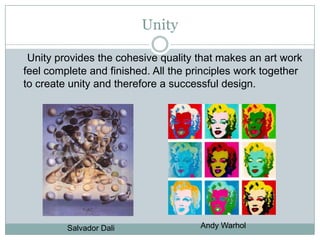
 Unity provides the cohesive quality that makes an art work
feel complete and finished. All the principles work together
to create unity and therefore a successful design.


         Salvador Dali                Andy Warhol
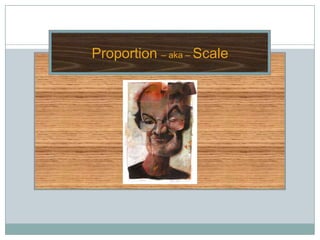
Proportion – aka – Scale

The relationships of size in artworks in relation to
           how they are normally viewed.

 Ex. A perfectly drawn person in proportion or a perfectly drawn
                      person with a tiny head
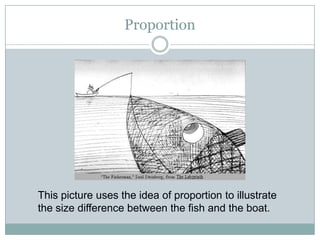
Proportion


This picture uses the idea of proportion to illustrate
the size difference between the fish and the boat.
Proportion – aka – Scale

Elements principles

  • 1.
    LINE Design Elements Design Principles SHAP E BALANCE COLO VARIETY R MOVEMENT VALU CONTRAST E EMPHASIS TEXT URE PROPORTION SPAC UNITY
  • 2.
    Elements of Design Are the seven basic building blocks of art & design.  Without these building blocks the principles are meaningless.  Without the principles the elements can not be used to their best ability.
  • 3.
    Design Elements LINE SHAPE COLOR VALUE TEXTURE SPACE FORM
  • 4.
    Line A mark.Lines have thickness, direction, and movement; they can be interrupted and can show emotion in an artwork.
  • 5.
  • 6.
    Line Contour lines- outlinethe edges of forms or shapes Gestural lines- indicate action and physical movement
  • 7.
    Shape When line curvesor corners around and crosses over itself it becomes a shape.
  • 8.
    Shape SHAPES CAN BEDESCRIBED AS: GEOMETRIC square, triangle, rectangle, rhombus, circle, cone ORGANIC free form shapes, shapes in nature for example: leaves, trees, clouds, animals
  • 9.
    Color Color has threemain properties: 1. Hue 2. Value 3. Intensity
  • 10.
    Color Color has threeproperties: 1. The first is HUE. (this is the name of the colors) 2. The second property of color is value, which refers to the lightness or darkness of a hue. 3. The third property of color is intensity, which refers to the purity of the hue (called “chroma”)
  • 11.
    Neutral Colors Thesecolors are made by adding a complimentary color (opposite on the color wheel) to a hue. Neutralized hues are called tones.
  • 12.
    Tints and Shades Tints-addingthe color white. Shades- adding the color black.
  • 13.
  • 14.
    Value The lightness ordarkness of a hue.
  • 15.
    Value Valuecontrasts help us to see and understand a two-dimensional work of art. Value describes form and value defines space.
  • 16.
    Texture The quality ofa surface: Smooth, rough, bumpy, hairy, etc.
  • 17.
    Hatching and CrossHatching Line can be used to create value and textures Hatching Cross Hatching
  • 18.
    Texture Textures are allaround us in our environment. Actual texture – texture that you can feel with your sense of touch. Implied texture – texture that has been simulated in drawing and painting on a smooth surface to appear as if it is textured.
  • 19.
    Space The amount ofdepth in both 2D and 3D artworks. Around, above, inside, outside, help describe space
  • 20.
    Space The feeling ofspace in a drawing or painting is always an illusion. Artists combine the use of light and dark value with other techniques. Some of these are: simple overlapping, ladder perspective, linear perspective, and atmospheric perspective. Linear perspective “Snow in New York”
  • 21.
    Form In 3D artworksit is the quality of the shape. Ex. Cubes, spheres and cones
  • 22.
    Form Form describes volumeand mass, or the three-dimensional aspects of objects that take up space. Forms can be realistic, abstract, geometric, organic etc… Form is considered three-dimensional showing height, width and depth. It can be illustrated or constructed.
  • 23.
    Principles of Design Thebasic rules of aesthetics that guide in the organization of elements in a work of art.
  • 24.
    Design Principles Balance Emphasis Variety Movement Proportion Contrast Unity
  • 25.
    Balance An appearanceof evenness in an artwork. There are two kinds: Symmetry & Asymmetry
  • 26.
    Balance Balance refers to the distribution of visual weight in a work of art This is an example of This is an example of symmetrical balance in which asymmetrical balance the design is the same on both because the object is not the sides of the center axis. same on both sides.
  • 27.
    Balance An appearanceof evenness in an artwork. There are two kinds: Symmetry & Asymmetry
  • 28.
    Symmetry In composition itis an arrangement of elements using order or disorder.
  • 29.
    Vertical symmetry A compositionwith identical or similar elements arranged on both the right and left halves of an image.
  • 30.
  • 31.
    Horizontal symmetry A compositionwith identical or similar elements arranged on both the top and bottom halves of an image.
  • 32.
  • 33.
    Radial symmetry A compositionwith a center point from which the arrangement of elements radiate around in a circular format. Imagine: Cut a piece of “pie” out of an empty circle. Create a design on the piece of pie. Repeat the pie piece to finish off the “pie.”
  • 34.
  • 35.
    Asymmetry A composition witha heavy and light amount of elements. Asymmetry uses disorder to create balance.
  • 36.
  • 37.
    Contrast A large differencebetween elements. Green and Red, dark and light, large and small, thin and thick, bright and dull.
  • 38.
    Contrast Contrastrefers to differences in values, colors textures, shapes and other elements.
  • 39.
    Emphasis Where an artistdraws attention to one or more parts of a design.
  • 40.
    Emphasis Emphasis isused by artists to create dominance and focus in their work. Artists often use focal areas (centers of interest) to place emphasis on the most important aspect of art.
  • 41.
    Movement The path theviewer’s eye is directed to take by the artist’s choice of elements such as line.
  • 42.
    Movement Visual movement isused by artists to direct viewer through their work, often to focal areas.
  • 43.
    Variety The differences inany element in a work of art give it variety. Ex: A variety of shape sizes or a variety of the same hue
  • 44.
    Rhythm Rhythm isrepetition of visual movement of the elements-colors shapes, lines, values, forms, spaces, and textures. Movement and rhythm work together to create the visual equivalent of a musical beat..
  • 45.
    Pattern Pattern usesthe art elements in planned or random repetitions to enhance surfaces of paintings or sculptures.
  • 46.
    Unity A sense thatall of the parts belong together as one piece of artwork.
  • 47.
    Unity Unity providesthe cohesive quality that makes an art work feel complete and finished. All the principles work together to create unity and therefore a successful design. Salvador Dali Andy Warhol
  • 48.
    Proportion – aka– Scale The relationships of size in artworks in relation to how they are normally viewed. Ex. A perfectly drawn person in proportion or a perfectly drawn person with a tiny head
  • 49.
    Proportion This picture usesthe idea of proportion to illustrate the size difference between the fish and the boat.
  • 50.