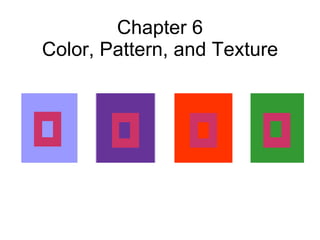
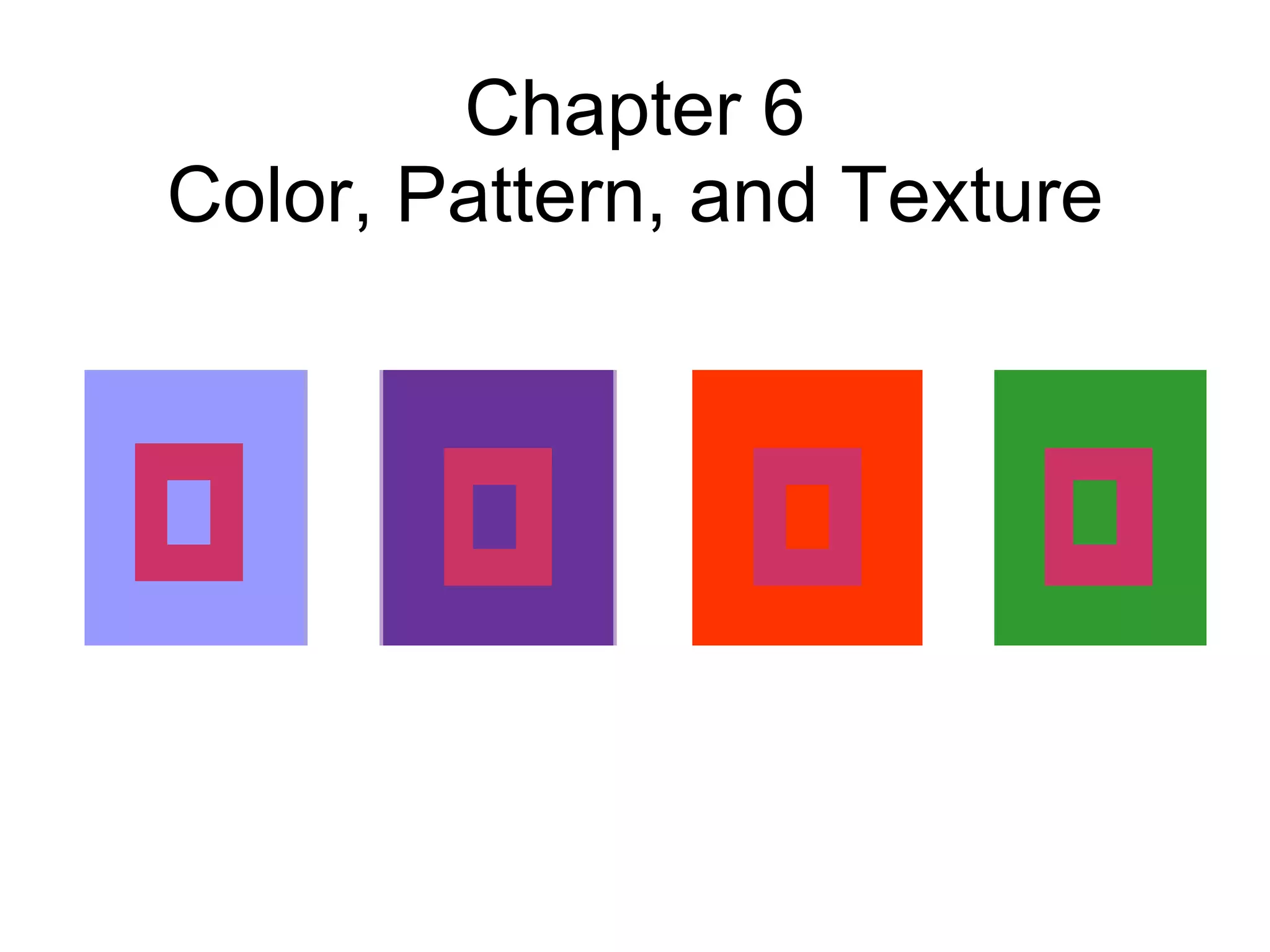
Chapter 6 Color, Pattern, and Texture
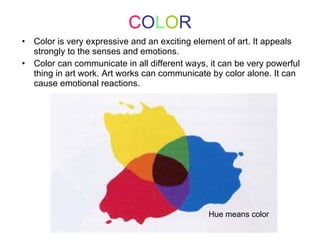
C O L O R Color is very expressive and an exciting element of art. It appeals strongly to the senses and emotions. Color can communicate in all different ways, it can be very powerful thing in art work. Art works can communicate by color alone. It can cause emotional reactions. Hue means color
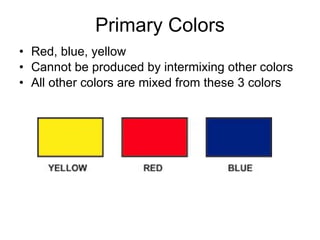
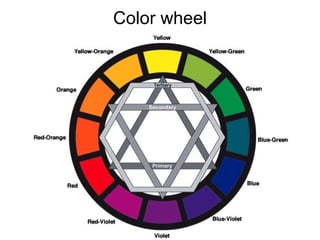
Primary Colors Red, blue, yellow Cannot be produced by intermixing other colors All other colors are mixed from these 3 colors
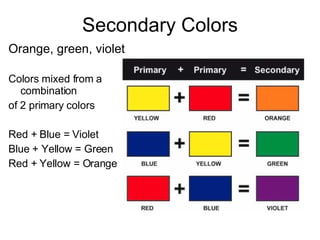
Secondary Colors Orange, green, violet Colors mixed from a combination  of 2 primary colors Red + Blue = Violet Blue + Yellow = Green Red + Yellow = Orange
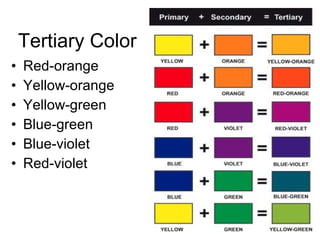
Tertiary Color Red-orange Yellow-orange Yellow-green Blue-green Blue-violet Red-violet
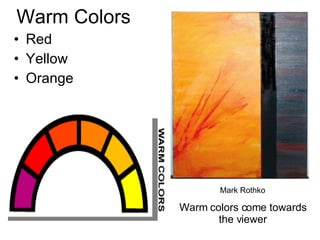
Warm Colors Red Yellow Orange Mark Rothko Warm colors come towards the viewer
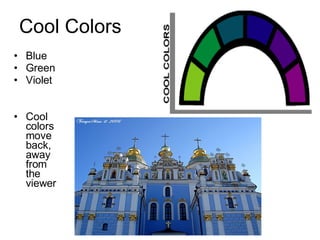
Cool Colors Blue Green Violet Cool colors move back,  away from  the viewer
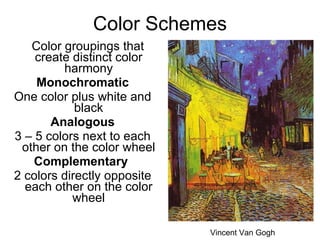
Color Schemes Color groupings that create distinct color harmony Monochromatic One color plus white and black Analogous 3 – 5 colors next to each other on the color wheel Complementary  2 colors directly opposite each other on the color wheel Vincent Van Gogh
Color wheel
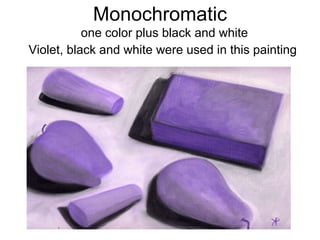
Monochromatic one color plus black and white Violet, black and white were used in this painting
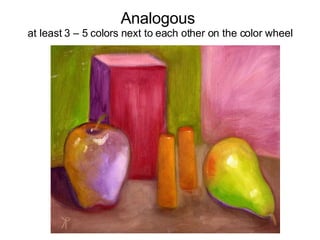
Analogous  at least 3 – 5 colors next to each other on the color wheel
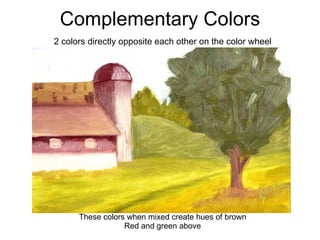
Complementary Colors 2 colors directly opposite each other on the color wheel These colors when mixed create hues of brown Red and green above
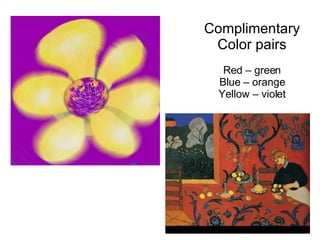
Complimentary Color pairs Red – green Blue – orange Yellow – violet
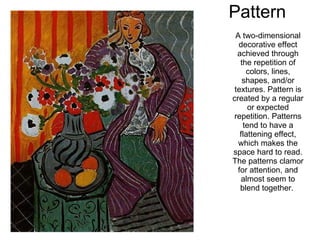
Pattern A two-dimensional decorative effect achieved through the repetition of colors, lines, shapes, and/or textures.  Pattern is created by a regular or expected repetition. Patterns tend to have a flattening effect, which makes the space hard to read. The patterns clamor for attention, and almost seem to blend together.
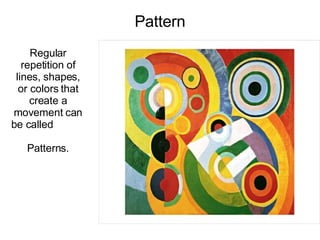
Regular repetition of lines, shapes, or colors that create a movement can be called  Patterns. Pattern
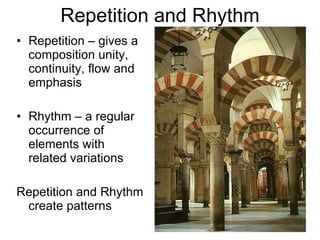
Repetition and Rhythm Repetition – gives a composition unity, continuity, flow and emphasis Rhythm – a regular occurrence of elements with related variations Repetition and Rhythm create patterns
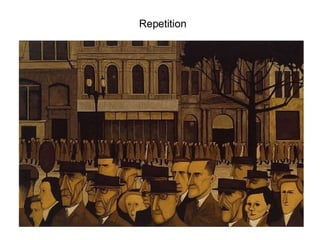
Repetition
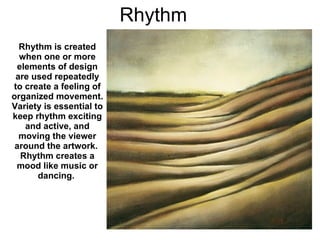
Rhythm Rhythm is created when one or more elements of design are used repeatedly to create a feeling of organized movement.  Variety is essential to keep rhythm exciting and active, and moving the viewer around the artwork.  Rhythm creates a mood like music or dancing.
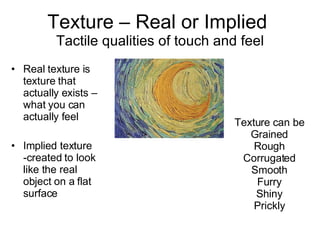
Texture – Real or Implied  Tactile qualities of touch and feel Real texture is texture that actually exists –  what you can actually feel Implied texture -created to look like the real object on a flat surface Texture can be Grained Rough Corrugated Smooth Furry Shiny Prickly
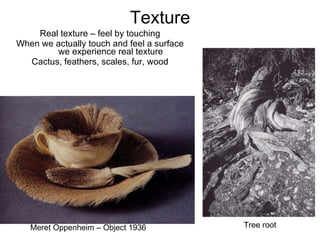
Texture Real texture – feel by touching When we actually touch and feel a surface we experience real texture Cactus, feathers, scales, fur, wood Meret Oppenheim – Object 1936  Tree root
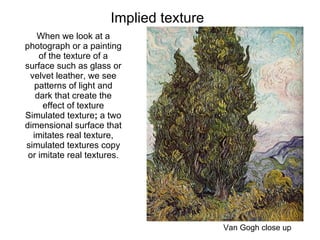
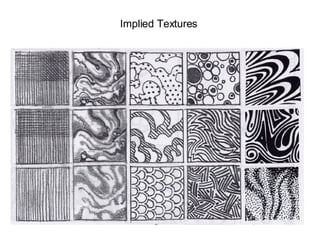
Implied texture  Van Gogh close up When we look at a photograph or a painting of the texture of a surface such as glass or velvet leather, we see patterns of light and dark that create the effect of texture Simulated texture ;  a two dimensional surface that imitates real texture, simulated textures copy or imitate real textures.
Implied Textures

KCC Art 141 Chapter 6 Color Pattern Texture

  • 1.
    Chapter 6 Color,Pattern, and Texture
  • 2.
    C O LO R Color is very expressive and an exciting element of art. It appeals strongly to the senses and emotions. Color can communicate in all different ways, it can be very powerful thing in art work. Art works can communicate by color alone. It can cause emotional reactions. Hue means color
  • 3.
    Primary Colors Red,blue, yellow Cannot be produced by intermixing other colors All other colors are mixed from these 3 colors
  • 4.
    Secondary Colors Orange,green, violet Colors mixed from a combination of 2 primary colors Red + Blue = Violet Blue + Yellow = Green Red + Yellow = Orange
  • 5.
    Tertiary Color Red-orangeYellow-orange Yellow-green Blue-green Blue-violet Red-violet
  • 6.
    Warm Colors RedYellow Orange Mark Rothko Warm colors come towards the viewer
  • 7.
    Cool Colors BlueGreen Violet Cool colors move back, away from the viewer
  • 8.
    Color Schemes Colorgroupings that create distinct color harmony Monochromatic One color plus white and black Analogous 3 – 5 colors next to each other on the color wheel Complementary 2 colors directly opposite each other on the color wheel Vincent Van Gogh
  • 9.
  • 10.
    Monochromatic one colorplus black and white Violet, black and white were used in this painting
  • 11.
    Analogous atleast 3 – 5 colors next to each other on the color wheel
  • 12.
    Complementary Colors 2colors directly opposite each other on the color wheel These colors when mixed create hues of brown Red and green above
  • 13.
    Complimentary Color pairsRed – green Blue – orange Yellow – violet
  • 14.
    Pattern A two-dimensionaldecorative effect achieved through the repetition of colors, lines, shapes, and/or textures. Pattern is created by a regular or expected repetition. Patterns tend to have a flattening effect, which makes the space hard to read. The patterns clamor for attention, and almost seem to blend together.
  • 15.
    Regular repetition oflines, shapes, or colors that create a movement can be called Patterns. Pattern
  • 16.
    Repetition and RhythmRepetition – gives a composition unity, continuity, flow and emphasis Rhythm – a regular occurrence of elements with related variations Repetition and Rhythm create patterns
  • 17.
  • 18.
    Rhythm Rhythm iscreated when one or more elements of design are used repeatedly to create a feeling of organized movement. Variety is essential to keep rhythm exciting and active, and moving the viewer around the artwork. Rhythm creates a mood like music or dancing.
  • 19.
    Texture – Realor Implied Tactile qualities of touch and feel Real texture is texture that actually exists – what you can actually feel Implied texture -created to look like the real object on a flat surface Texture can be Grained Rough Corrugated Smooth Furry Shiny Prickly
  • 20.
    Texture Real texture– feel by touching When we actually touch and feel a surface we experience real texture Cactus, feathers, scales, fur, wood Meret Oppenheim – Object 1936 Tree root
  • 21.
    Implied texture Van Gogh close up When we look at a photograph or a painting of the texture of a surface such as glass or velvet leather, we see patterns of light and dark that create the effect of texture Simulated texture ; a two dimensional surface that imitates real texture, simulated textures copy or imitate real textures.
  • 22.