RUBBER INDUSTRIES
CONTENTS 
 DEFINITION OF RUBBER 
 RUBBER IN THE WORLD 
 INDONESIA RUBBER’S INDUSTRIES 
 CHANCE’S INTRACOPENTA
DEFINITIONS OF RUBBER 
CHAPTER ONE
Natural rubber, also called India rubber or 
caoutchouc, as initially produced, consists of 
polymers of the organic compound isoprene, with 
minor impurities of other organic compounds plus 
water 
Currently, rubber is harvested mainly in 
the form of the latex from certain trees. 
The latex is a sticky, milky colloid drawn 
off by making incisions into the bark and 
collecting the fluid in vessels in a 
process called "tapping"
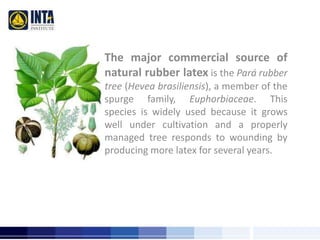
The major commercial source of 
natural rubber latex is the Pará rubber 
tree (Hevea brasiliensis), a member of the 
spurge family, Euphorbiaceae. This 
species is widely used because it grows 
well under cultivation and a properly 
managed tree responds to wounding by 
producing more latex for several years.
Cultivation 
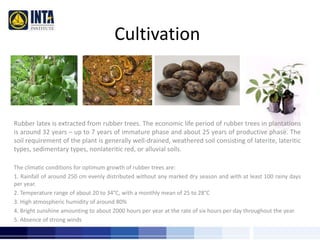
Rubber latex is extracted from rubber trees. The economic life period of rubber trees in plantations 
is around 32 years – up to 7 years of immature phase and about 25 years of productive phase. The 
soil requirement of the plant is generally well-drained, weathered soil consisting of laterite, lateritic 
types, sedimentary types, nonlateritic red, or alluvial soils. 
The climatic conditions for optimum growth of rubber trees are: 
1. Rainfall of around 250 cm evenly distributed without any marked dry season and with at least 100 rainy days 
per year. 
2. Temperature range of about 20 to 34°C, with a monthly mean of 25 to 28°C 
3. High atmospheric humidity of around 80% 
4. Bright sunshine amounting to about 2000 hours per year at the rate of six hours per day throughout the year 
5. Absence of strong winds
PRODUCTIVITY 
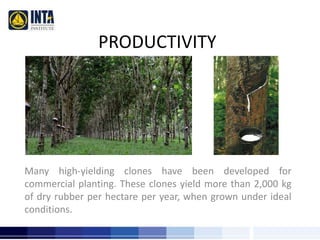
Many high-yielding clones have been developed for 
commercial planting. These clones yield more than 2,000 kg 
of dry rubber per hectare per year, when grown under ideal 
conditions.
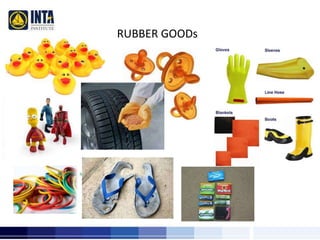
RUBBER GOODs
RAW MATERIAL
RAW MATERIAL
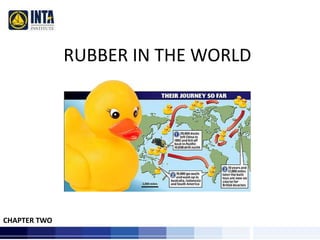
RUBBER IN THE WORLD 
CHAPTER TWO
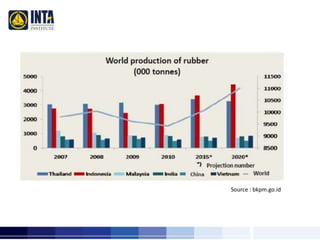
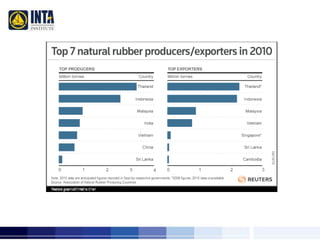
Rubber is a commodity that is used in many 
products and applications around the globe 
(from industrial to household products). Around 
70% percent of global production comes from 
Thailand, Indonesia and Malaysia. Indonesia is 
the second largest producer of rubber after 
Thailand in 2010.
Source : bkpm.go.id
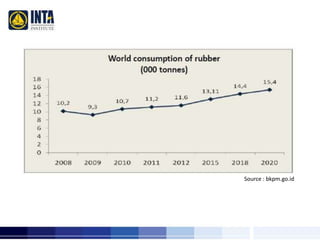
While the world consumption rate of rubber has 
been steadily increased over years with average 
growth of 6.7%, the prospects of rubber 
industry are enormous. As the second-largest 
rubber producer, the Indonesian rubber industry 
has shown a steady increased in production.
Source : bkpm.go.id
INDONESIA RUBBER’S INDUSTRIES
STANDART QUALITY
CONTRIBUTOR
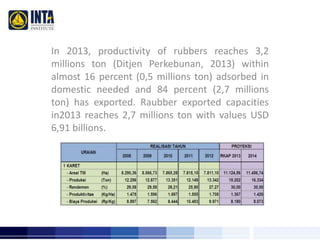
In 2013, productivity of rubbers reaches 3,2 
millions ton (Ditjen Perkebunan, 2013) within 
almost 16 percent (0,5 millions ton) adsorbed in 
domestic needed and 84 percent (2,7 millions 
ton) has exported. Raubber exported capacities 
in2013 reaches 2,7 millions ton with values USD 
6,91 billions.
PERKEBUNAN NUSANTARA 
Product of PTPN areRubber - Latex, Crumb Rubber and Rubber Smoke Sheet 
Throughout the globe, Sumatera, java, Borneo, and Sulawesi is well known as a 
source of high quality rubber. Perkebunan Nusantara are devoted to cultivate some 
of the best quality rubbers in the world. 
RSS-1, SIR-10, SIR-20 and concentrated latex was capable to penetrated the 
international market, in various tire factory such as Bridgestone, Dunlop, Good 
Year, Firestone, Han Kook, and so on 
PT. Perkebunan Nusantara have 3 processing facilities at present, namely Rubber 
Thread Factory, Rubber Article Factory, and Cyclized Rubber Resin Factory. Rubber 
Threads, Rubber Dockfender, Rubber Article, Rubber Cowmat, Conveyor Belt, 
Rubber Karlet and Resin, are the main products of these factories. 
Company's products has received Indonesian Industries Standard (SII) Certificate, 
international quality certificate ISO 9001 : 2000 and ISO 14001 : 1996, TUV and 
OCOTEX
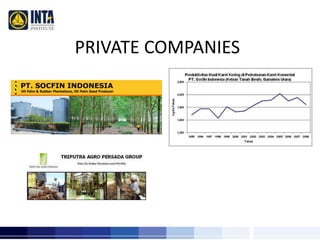
PRIVATE COMPANIES
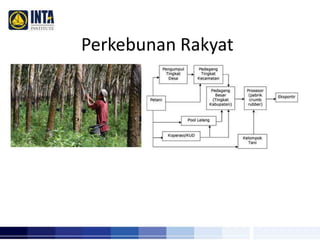
Perkebunan Rakyat
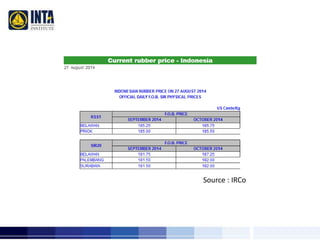
Source : IRCo
CHANCE INTRACOPENTA 
1. Heavy equipment distributor, what that’s business rubber 
needed 
2. Create the business opportunities in field of rubber business.
THANK YOU

Karet

  • 1.
  • 2.
    CONTENTS  DEFINITIONOF RUBBER  RUBBER IN THE WORLD  INDONESIA RUBBER’S INDUSTRIES  CHANCE’S INTRACOPENTA
  • 3.
  • 5.
    Natural rubber, alsocalled India rubber or caoutchouc, as initially produced, consists of polymers of the organic compound isoprene, with minor impurities of other organic compounds plus water Currently, rubber is harvested mainly in the form of the latex from certain trees. The latex is a sticky, milky colloid drawn off by making incisions into the bark and collecting the fluid in vessels in a process called "tapping"
  • 6.
    The major commercialsource of natural rubber latex is the Pará rubber tree (Hevea brasiliensis), a member of the spurge family, Euphorbiaceae. This species is widely used because it grows well under cultivation and a properly managed tree responds to wounding by producing more latex for several years.
  • 7.
    Cultivation Rubber latexis extracted from rubber trees. The economic life period of rubber trees in plantations is around 32 years – up to 7 years of immature phase and about 25 years of productive phase. The soil requirement of the plant is generally well-drained, weathered soil consisting of laterite, lateritic types, sedimentary types, nonlateritic red, or alluvial soils. The climatic conditions for optimum growth of rubber trees are: 1. Rainfall of around 250 cm evenly distributed without any marked dry season and with at least 100 rainy days per year. 2. Temperature range of about 20 to 34°C, with a monthly mean of 25 to 28°C 3. High atmospheric humidity of around 80% 4. Bright sunshine amounting to about 2000 hours per year at the rate of six hours per day throughout the year 5. Absence of strong winds
  • 8.
    PRODUCTIVITY Many high-yieldingclones have been developed for commercial planting. These clones yield more than 2,000 kg of dry rubber per hectare per year, when grown under ideal conditions.
  • 9.
  • 10.
  • 11.
  • 12.
    RUBBER IN THEWORLD CHAPTER TWO
  • 13.
    Rubber is acommodity that is used in many products and applications around the globe (from industrial to household products). Around 70% percent of global production comes from Thailand, Indonesia and Malaysia. Indonesia is the second largest producer of rubber after Thailand in 2010.
  • 14.
  • 15.
    While the worldconsumption rate of rubber has been steadily increased over years with average growth of 6.7%, the prospects of rubber industry are enormous. As the second-largest rubber producer, the Indonesian rubber industry has shown a steady increased in production.
  • 16.
  • 18.
  • 19.
  • 20.
  • 21.
    In 2013, productivityof rubbers reaches 3,2 millions ton (Ditjen Perkebunan, 2013) within almost 16 percent (0,5 millions ton) adsorbed in domestic needed and 84 percent (2,7 millions ton) has exported. Raubber exported capacities in2013 reaches 2,7 millions ton with values USD 6,91 billions.
  • 22.
    PERKEBUNAN NUSANTARA Productof PTPN areRubber - Latex, Crumb Rubber and Rubber Smoke Sheet Throughout the globe, Sumatera, java, Borneo, and Sulawesi is well known as a source of high quality rubber. Perkebunan Nusantara are devoted to cultivate some of the best quality rubbers in the world. RSS-1, SIR-10, SIR-20 and concentrated latex was capable to penetrated the international market, in various tire factory such as Bridgestone, Dunlop, Good Year, Firestone, Han Kook, and so on PT. Perkebunan Nusantara have 3 processing facilities at present, namely Rubber Thread Factory, Rubber Article Factory, and Cyclized Rubber Resin Factory. Rubber Threads, Rubber Dockfender, Rubber Article, Rubber Cowmat, Conveyor Belt, Rubber Karlet and Resin, are the main products of these factories. Company's products has received Indonesian Industries Standard (SII) Certificate, international quality certificate ISO 9001 : 2000 and ISO 14001 : 1996, TUV and OCOTEX
  • 23.
  • 24.
  • 25.
  • 27.
    CHANCE INTRACOPENTA 1.Heavy equipment distributor, what that’s business rubber needed 2. Create the business opportunities in field of rubber business.
  • 28.

Editor's Notes

  • #28 Terdapat sejumlah alasan yang memberikan peluang bagi kegiatan ekonomi utama alutsista untuk tumbuh dan berkembang di Indonesia, yaitu: Indonesia memiliki ancaman perbatasan yang cukup tinggi sebagai akibat adanya perbatasan laut dan darat yang cukup luas. Kasus perbatasan di Indonesia sering memicu disharmonisasi hubungan dengan negara tetangga. Bentuk-bentuk pelanggaran yang terjadi sangat kompleks, mulai dari illegal fishing, Illegal mining, dan trading diantaranya berupa penambangan pasir, penebangan kayu, dan sebagainya; Bentuk-bentuk pelanggaran tersebut menuntut upaya sistematis bangsa dan pemerintah untuk menyelamatkan perairan Indonesia, maupun meningkatkan kemampuan sumber daya untuk memanfaatkan laut Indonesia; Posisi strategis Indonesia sebagai salah satu poros lalu lintas dunia internasional, menempatkan Indonesia rawan terhadap berbagai ancaman keamanan udara. Isu keamanan udara dengan potensi ancaman di masa mendatang meliputi ancaman kekerasan (pembajakan udara, sabotase obyek vital, teror, dan sebagainya), ancaman pelanggaran udara (penerbangan gelap dan pengintaian terhadap wilayah Indonesia), ancaman sumber daya (pemanfaatan wilayah udara oleh negara lain), dan ancaman pelanggaran hukum melalui media udara (migrasi ilegal dan penyelundupan manusia).