Presented by BM.Ginting
https://www.linkedin.com/posts/dr-pallavi-dasgupta-14615772_eumdr-samd-mdsw-activity-
7204082067628822528-E-On/?utm_source=share&utm_medium=member_desktop
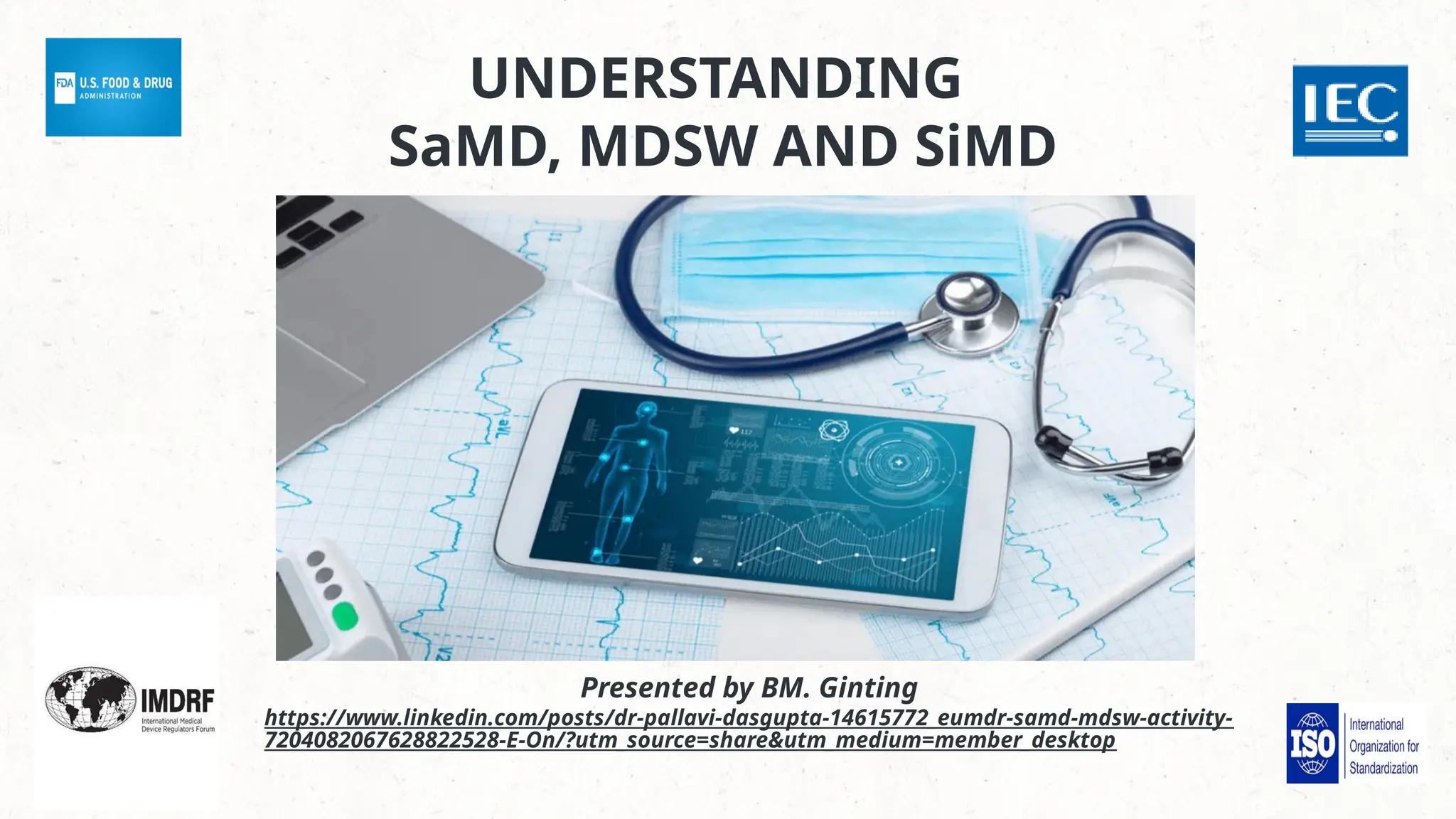
UNDERSTANDING
SaMD, MDSW AND SiMD
2.
INTRODUCTION
▸ Classifying yoursoftware under the EUMDR can be a complex task,
particularly when navigating the distinctions between SaMD, MDSW,
and SiMD.
▸ This infographic breaks down these terms, outlining their key
characteristics, classification rules, and associated regulatory
requirements for clinical evaluation.
3.
Functions independentlyas a medical device, without influencing
other devices. Think mobile health apps for diagnostics or
treatment.
Berfungsi secara mandiri sebagai alat kesehatan, tanpa
mempengaruhi alat lain. Lihat aplikasi kesehatan seluler untuk
diagnostik atau pengobatan.
SaMD (Software as Medical Device)
4.
A broader categoryencompassing both standalone software and software
embedded within medical devices, as long as it has a medical purpose.
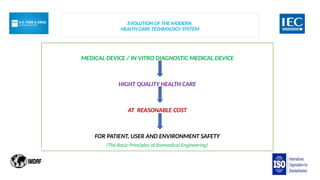
Examples include software controlling infusion pumps or imaging analysis
tools.
Kategori yang lebih luas yang mencakup perangkat lunak mandiri dan
perangkat lunak yang tertanam dalam alat kesehatan, selama perangkat
lunak tersebut memiliki tujuan medis. Contohnya termasuk perangkat
lunak yang mengendalikan pompa infus atau alat analisis pencitraan.
MDSW (Medical Device Software)
5.
Software that isn'tthe primary function of a medical device but contributes to
its intended purpose. For instance, software managing the user interface of a
dialysis
Perangkat lunak yang bukan merupakan fungsi utama alat Kesehatan namun
berkontribusi terhadap tujuan alat kesehatan (intended use) tersebut. Misalnya,
perangkat lunak yang mengelola antarmuka pengguna mesin dialisis.
SiMD (Software in a Medical Device)
6.
Classification Rules forSaMD
❇ EU MDR: Annex VIII ( https://lnkd.in/dqJ3e7nY )defines classification rules based
on factors such as risk to patients and intended purpose.
❇ FDA: Similar risk-based approach outlines in the 21 CFR 862.1000
❇ IMDRF: Provides general guidance on SaMD classification, which may influence national
regulations.
❇ TGA: Classification aligns more closely with IMDRF guidance compared to the EU MDR's
potentially higher risk classes.
7.
Challenges for MeetingRegulatory
Requirements
🔲 Continuously evolving technology: Keeping pace with rapid software development
and ensuring regulatory compliance can be difficult.
🔲 Varying international regulations: Navigating the different requirements across global
markets can be complex and resource-intensive.
🔲 Cybersecurity threats: Mitigating cybersecurity risks throughout the software lifecycle
is crucial for patient safety.
8.
Challenges for MeetingRegulatory
Requirements
🔲 Teknologi yang terus berkembang: Mungkin sulit untuk mengimbangi perkembangan
perangkat lunak yang pesat dan memastikan kepatuhan terhadap peraturan.
🔲 Peraturan internasional yang berbeda-beda: Menavigasi berbagai persyaratan di
pasar global bisa jadi rumit dan membutuhkan banyak sumber daya.
🔲 Ancaman keamanan siber: Mengurangi risiko keamanan siber di seluruh siklus hidup
perangkat lunak sangat penting untuk keselamatan pasien.
9.
What about ofSaMD?
(IMDRF MDCE WG/N56FINAL:2019)
• SaMD can best be described as software that utilizes an algorithm (logic, set
of rules, or model) that operates on data input (digitized content) to produce
an output that is intended for medical purposes as defined by the SaMD
manufacturer.
• Like other medical device, SaMD clinical evaluation should be consistent with
this document.
• Moreover, IMDRF developed a specific guidance document “Software as a
Medical Device (SaMD): Clinical Evaluation SaMD WG/N41:2017” to address
more detailed instructions on SaMD clinical evaluation.
10.
Definition of SaMD
(IMDRF/SaMDWG/N10FINAL:2013)
“Software intended to be used for one or more
medical purposes that perform these purposes
without being part of a hardware medical device”.
11.
NOTES:
▸ SaMD isa medical device and includes in-vitro diagnostic (IVD) medical device.
▸ SaMD is capable of running on general purpose (non-medical purpose)
computing platform
▸ “without being part of” means software not necessary for a hardware medical
device to achieve its intended medical purpose;
▸ Software does not meet the definition of SaMD if its intended purpose is to drive
a hardware medical device.
▸ SaMD may be used in combination (e.g., as a module) with other products
including medical devices;
▸ SaMD may be interfaced with other medical devices, including hardware medical
devices and other SaMD software, as well as general purpose software
▸ Mobile apps that meet the definition above are considered SaMD.
12.
Computing platforms
“Computing platforms”Include hardware and software resources
(e.g. operating system, processing hardware, storage, software
libraries, displays, input devices, programming languages etc.).
“Operating systems” that SaMD require may be run on a server, a
workstation, a mobile platform, or other general purpose hardware
platform.
13.
What are examplesof
Software as a Medical Device
(SaMD)?
https://www.fda.gov/medical-de
vices/software-medical-device-sa
md/what-are-examples-software
-medical-device
14.
Example
▸ Software asa Medical Device range from software that
allows a smartphone to view images obtained from a
magnetic resonance imaging (MRI) medical device for
diagnostic purposes to..
▸ Computer-Aided Detection (CAD) software that performs
image post-processing to help detect breast cancer.
15.
Other example include:
▸Software as a Medical Device may be interfaced with other medical
devices, including hardware medical devices, and other software as a
medical device software, as well as general purpose software.
▸ Software that provides parameters that become the input for a different
hardware medical device or other Software as a Medical Device.
▸ For example, treatment planning software that supplies information used
in a linear accelerator is Software as a Medical Device.
16.
Continue..
▸ Software witha medical purpose that operates on a general purpose
computing platform, i.e., a computing platform that does not have a
medical purpose, is considered Software as a Medical Device.
▸ For example, software that is intended for diagnosis of a condition
using the tri-axial accelerometer that operates on the embedded
processor on a consumer digital camera is considered Software as a
Medical Device.
17.
Continue..
▸ Software thatis connected to a hardware medical device but is not needed by that
hardware medical device to achieve its intended medical purpose is Software as a
Medical Device and not an accessory to the hardware medical device.
▸ Software as a Medical Device is capable of running on general purpose
(nonmedical purpose) computing platforms.
▸ Software as a medical device running on these general purpose computing
platforms could be located in a hardware medical device.
18.
What are examplesof
Software that are not
software as a Medical Device?
If the software is part of a hardware medical device, it does
not meet the definition of Software as a Medical Device
19.
Example include:
▸ Softwareused to "drive or control" the motors and the pumping of
medication in an infusion pump;
▸ or software used in closed loop control in an implantable
pacemaker or other types of hardware medical devices.
▸ These types of software, sometimes referred to as "embedded
software", "firmware", or "micro-code" are not Software as a Medical
Device.
20.
Continue…
▸ Software requiredby a hardware medical device to perform the
hardware's medical device intended use, even if sold separately from the
hardware medical device.
▸ Software that relies on data from a medical device, but does not have a
medical purpose, e.g., software that encrypts data for transmission from a
medical device.
▸ Software that enables clinical communication and workflow including
patient registration, scheduling visits, voice calling, and video calling.
21.
Continue…
▸ Software thatmonitors performance or proper functioning of a device
for the purpose of servicing the device, (e.g., software that monitors
x-ray tube performance to anticipate the need for replacement), or
▸ software that integrates and analyzes laboratory quality control
data to identify increased random errors or trends in calibration
on IVDs
22.
Continue…
▸ Software thatprovides parameters that become the input for
software as a medical device is not software as a medical device
if it does not have a medical purpose.
▸ For example, a database including search and query functions
by itself or when used by Software as a Medical Device.
23.
AI/ML-based SaMD
All orpart of the device software function maybe have been replaced by AI/ML
“The extent to which the understanding of the ethical and trustworthy criteria
of artificial intelligence and the references used may be still a question today”.
24.
EVOLUTION OF THEMODERN
HEALTH CARE TECHNOLOGY SYSTEM
MEDICAL DEVICE / IN VITRO DIAGNOSTIC MEDICAL DEVICE
HIGHT QUALITY HEALTH CARE
AT REASONABLE COST
FOR PATIENT, USER AND ENVIRONMENT SAFETY
(The Basic Principles of Biomedical Engineering)



![Software design for_medical_devices_europe_conferent_19012011[1]](https://cdn.slidesharecdn.com/ss_thumbnails/softwaredesignformedicaldeviceseuropeconferent190120111-110119154405-phpapp02-thumbnail.jpg?width=640&height=640&fit=bounds)


![PERI-PROSTHETIC FRACTURE NAIL-PLATE CONSTRUCT [NPC].pptx](https://cdn.slidesharecdn.com/ss_thumbnails/drarunkumardrmohamedashrafperiprostheticfrasturenail-plateconstructnpc-260209164459-7e9d15a1-thumbnail.jpg?width=640&height=640&fit=bounds)


