THE ROLES OF INDIGENOUS PEOPLES
ORGANIZATION, TRIBAL LEADERS
REPRESENTATIVES, AND ICCS/IPS
MEMBER IN THE NATIONAL UNITY AND
DEVELOPMENT
REY JOHN B. REBUCAS, LPT
Instructor
LEARNING OBJECTIVE
Discuss the roles of Indigenous
Cultural Communities (ICCs)
/Indigenous Peoples (IPs) in the
framework of national unity and
development.
PART II: ROLE OF PEOPLES
ORGANIZATIONS
Section 1. Right to Organize and Associate for Collective Actions.
The NCIP shall recognize the vital role of IPOs as autonomous partners
in development and shall fully support the development and
empowerment of indigenous people’s organizations, or associations to
pursue and protect their legitimate and collective interests and
aspirations.
In consultation with the Indigenous Peoples Organizations (IPOs), the
NCIP shall prepare guidelines for strengthening the capability of the
members which shall be culture sensitive and shall cover, among others,
the following:
a) Awareness and knowledge of IPRA and its IRR;
PART II: ROLE OF PEOPLES
ORGANIZATIONS
b) IPs’ holistic and sustainable development framework;
c) Research and documentation skills particularly in
taking the testimonies of elders by way of individual and
group interviews;
d) Community Organization to include traditional
leadership, community and cooperative value system,
socio-political structures and self advocacy;
PART II: ROLE OF PEOPLES
ORGANIZATIONS
e) Indigenous Knowledge Systems and Practices (IKSPs) to
include but not limited to customary laws, traditions and practices;
sustainable resource management systems and practices; family
and community life value systems;
f) Conflict resolution mechanisms and peace-building processes;
g) Project management; and
h) Networking and development work partnership with other POs,
NGOs and GOs.
PART III. RIGHTS OF THE ICCS/IPS
TO THEIR ANCESTRAL LANDS
Section 1. Right to Transfer Land or Property.
The various indigenous modes of acquisition and transfer of property
between and among members of the ICCs/IPs shall be recognized as legal,
valid and enforceable.
Indigenous property rights arising from marriages between IPs and non-
IPs shall be governed by customary laws of the IP spouse. The non-IP
spouse shall have usufructuary rights (A Civil Law term referring to the right of
one individual to use and enjoy the property of another, provided its substance is
neither impaired nor altered.) thereto for the maintenance and support of the
family.
PART III. RIGHTS OF THE ICCS/IPS
TO THEIR ANCESTRAL LANDS
Section 2. Right to Redemption.
Transfer of ancestral lands by IPs to non-IPs attended by vitiated consent
or made for an unconscionable price shall, upon investigation and proof
thereof, be declared null and void ab initio (to be treated as invalid from the
beginning) and the transferor has the right to redeem the property within a
period of fifteen years from the date of transfer. In case of fraudulent
transactions, the redemption period shall be reckoned upon the discovery
of the fraud.
Consent is deemed vitiated when given through error or mistake,
violence, intimidation, undue influence, fraud or deceit. The price is
considered unconscionable when the amount compared to the value of the
property is so disproportionate as to be revolting to human conscience.
PART III. RIGHTS OF THE ICCS/IPS
TO THEIR ANCESTRAL LANDS
 The transfer or shall exercise his right to redeem within
fifteen years from date of transfer.
The NCIP shall provide, as part of its Rules of
Procedures, the process for the exercise of this right. It
shall include the filing of a petition therefor stating the
circumstances of vitiated consent or unconscionable
price; due notice and hearing; and the reconveyance of
the property to the transfer or ICC/IP.
PART III. RIGHTS OF THE ICCS/IPS
TO THEIR ANCESTRAL LANDS
 Section 3. Option to Secure Patents under Commonwealth
Act No. 141, as Amended.
Formal recognition of native title to ancestral lands is secured
through the issuance of a Certificate of Ancestral Land Title under
the Act.
 Members of the ICCs/IP communities who individually own
ancestral lands shall have the option to secure Certificates of Title
to such land pursuant to the provisions of Commonwealth Act No.
141, as amended, provided such option is exercised within twenty
(20) years from approval of the Act.
PART III. RIGHTS OF THE ICCS/IPS
TO THEIR ANCESTRAL LANDS
 Pursuant to Section 12 of the Act, all ancestral lands which have
been individually owned and actually used continuously by ICCs/IPs for
a period of at least thirty (30) years for agricultural, residential, pasture,
or tree farming purposes, including those with slope of more than
eighteen (18) degrees are hereby classified as alienable and disposable
agricultural lands and may be titled in accordance with the provisions of
Commonwealth Act No. 141, as amended.
 Ancestral lands within ancestral domains shall remain an integral part
thereof and can only be transferred or otherwise encumbered subject to
customary laws and traditions of the community where the same is
located.
PART VIII. COMPOSITION OF AND
GUIDELINES FOR THE CONVENING OF
THE CONSULTATIVE BODY
Section 1. Definition and Composition.
Pursuant to Section 50 of the Act, the NCIP shall convene the consultative
body which is defined as:
a) A body consisting of the traditional leaders, elders and representatives from
the women and youth sectors of the different ICCs/IPs shall be constituted by
the NCIP from time to time to advise it on matters relating to the problems,
aspirations and interests of the ICCs/IPs.
b) A grassroots consensus building process, and/or multi-level mechanism of
people’s participation in the implementation of the provisions of the Act and
the objectives of the NCIP.
PART VIII. COMPOSITION OF AND
GUIDELINES FOR THE CONVENING OF
THE CONSULTATIVE BODY
Section 2. Guidelines for the Convening of the Consultative Body.
In convening the Consultative Body as provided in Section 50 of the Act, the
following guidelines shall be applicable:
a) The Consultative Body shall be composed of tribal leaders and indigenous
peoples representatives from the elderly, women, youth and children sectors,
who shall be accredited for this purpose, and where applicable, in accordance
with the principle of equitable representation of all ICCs/IPs at each level;
b) The Consultative Body shall be constituted from time to time at the
ancestral domain, barangay, municipal, provincial, regional and national
levels, to advise the NCIP on matters relating to the problems, aspirations and
interests of the ICCs/IPs;
PART VIII. COMPOSITION OF AND
GUIDELINES FOR THE CONVENING OF
THE CONSULTATIVE BODY
c) On matters pertinent to the formulation of development plans and
monitoring of programs and projects, including those concerning poverty
alleviation/reduction, the Commission shall convene the Consultative Body at
the national level, preferably on a quarterly basis;
d) Regional representation to the national consultative body shall be selected
through an ascending multi-level process emanating from the community
level, and shall be rotated among the different ICC/IP communities;
e) The national consultative body shall be composed of regional
representatives not exceeding a total of thirty five (35), at the participation rate
of five (5) representatives from each of the seven (7) ethnographic regions as
allocated under Section 40 of the Act;
PART VIII. COMPOSITION OF AND
GUIDELINES FOR THE CONVENING OF
THE CONSULTATIVE BODY
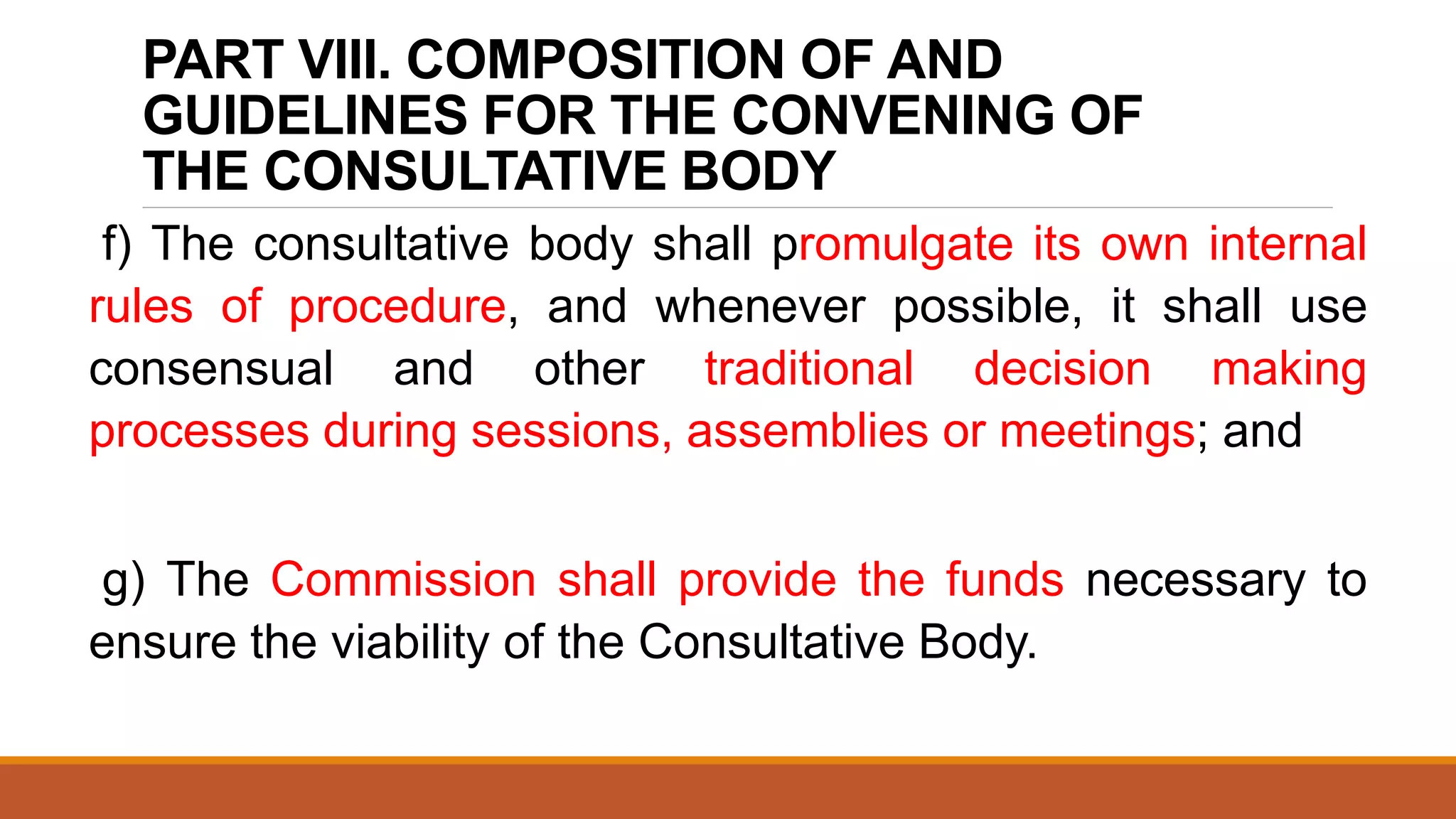
f) The consultative body shall promulgate its own internal
rules of procedure, and whenever possible, it shall use
consensual and other traditional decision making
processes during sessions, assemblies or meetings; and
g) The Commission shall provide the funds necessary to
ensure the viability of the Consultative Body.
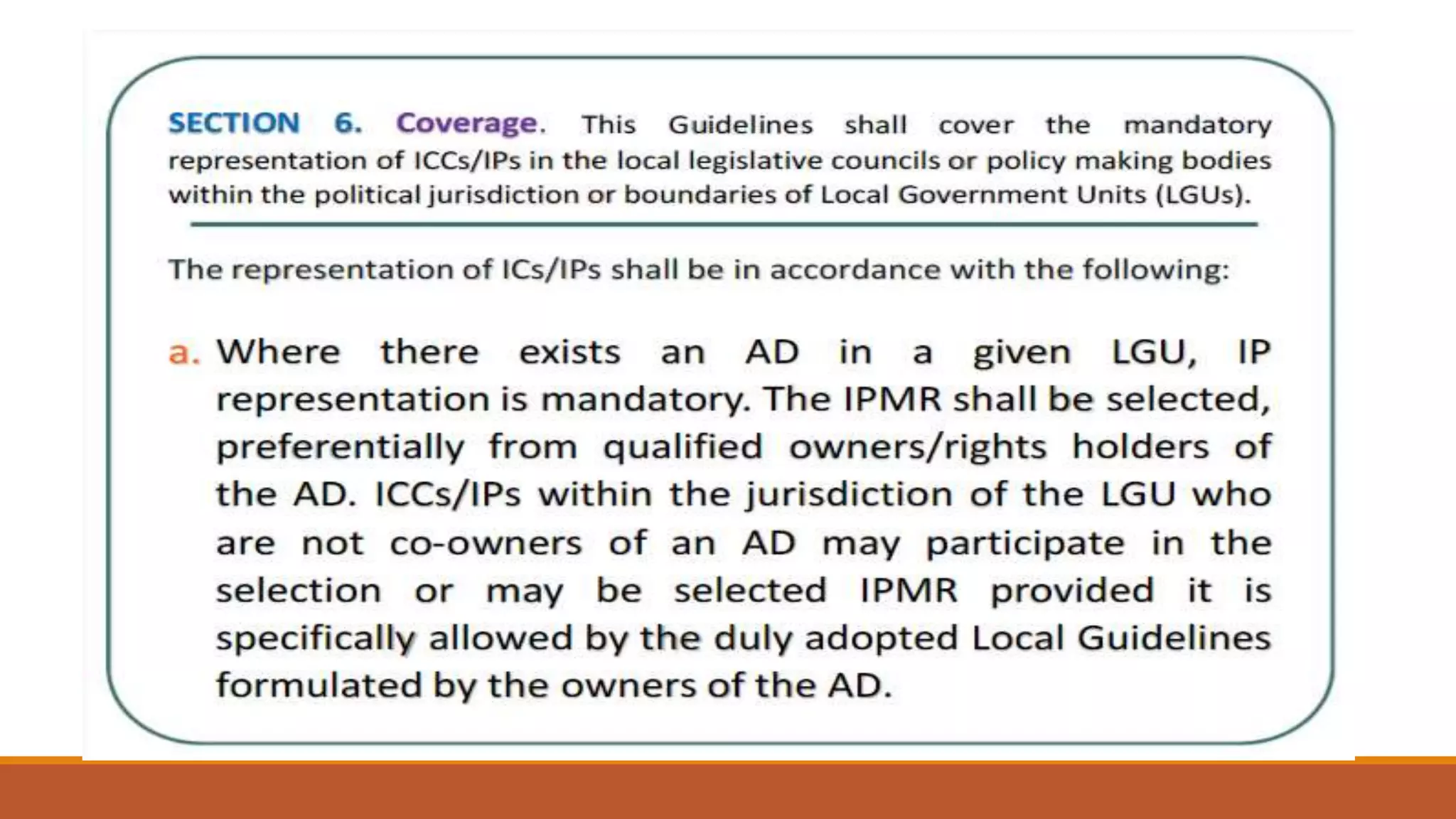
NCIP ADMINISTRATIVE ORDER NO. 03, S. 2018
“Revised National Guidelines for the Mandatory Representation of
Indigenous Peoples in Local Legislative Councils and Policy-making
Bodies”.
Pursuant to the provisions of Republic Act 8371 otherwise known as
the Indigenous Peoples Rights Act of 1997, the following guidelines
are promulgated in the lieu of NCIP Administrative Order No. 001,
series of 2009.
LATEST DATA OF IPMRS IN THE PHILIPPINES
based on Philippines Action Plan 2019-2021
from https://www.opengovpartnership.org/members/philippines
Currently, there are 4,294 IPMRs in the country with the following breakdown:
❏ City – 30
❏ Province-32
❏ Municipality-380
❏ Barangay- 3,852
In the consultations conducted by NCIP during the 2016 Indigenous Peoples Conferences with almost
2,000 IP leaders from all over the country in attendance and additional Open Government Partnership
(OGP) consultations, the following are specific gaps in the status quo identified:
Non-acceptance by local government units of selected IPMR and pushback from politicians and other
stakeholders. IP groups expressed that the process of selecting the Indigenous People Mandatory
Representative (IPMR) is politicized Tribal leaders aspire to represent the IPs in the Sanggunian and
other local bodies. The tribal communities endorse the aspiring tribal leaders as IPMRs. However, the
endorsement is not honored and these IP representatives are not recognized by local bodies. Thus, there
is a need for multi-sectoral involvement to ensure a political representation.
209 BARANGAYS SA COMVAL DUNA NAY IPMR
From Serbisyo Oro Mismo dated March 27, 2019
Base sa Official Record nga gipagula sa opisina ni Provincial IPMR BM Felipe Masambo nga sa pagkakaron
ang tibuok Comval Province aduna nay 209 ka mga Barangay nga duna nay IPMR diin sa Maco ang
pinakadaghan nga sa pagkakaron miabot na sa 34 ang gidaghanon sa ilang ihap. Sa Laak 28 na ka mga
barangay nga dunay IPMR, sa Monkayo dunay 22, sa Montevista-20, sa Maragusan-20, sa Compostela-14,
sa Nabunturan-14, sa New Bataan-11, sa Mawab-11, sa Pantukan-11, ug sa Mabini duna nay 10 ka mga
IPMR nga milngkod isip kagawad sa konseho sa barangay.
Niadtong milabayng Miyerkules (Marso 20,2019) gipanguluhan mismo ni Provincial IPMR BM Felipe
Masambo ang 60 ka mga Regular Members sa Provincial Tribal Council nga nagtapok diha sa Comval
Capitol alang usa ka adlawng “Workshop on National and Local IPMR Selection Guidelines” nga parte sa
preparasyon sa pagahimoong “IPMR Selection Process Guidelines” sa probinsiya, sa mga munisipyo, ug sa
mga kabaranggayan.
Sa Comval Province miyembro sa Provincial Tribal Council (PTC) ang Mun. Tribal Chieftains, ang Mun.
IPMR, ang Mun. IP Youth President, ang Ancestral Domain Managers sa onse ka mga munisipyo, ug ang
Mun. Women President nga pulos molingkod sa PTC ug Municipal Tribal Council(MTC) para sa
nagpadayong IPMR Selection Processes.
Facilitator si NCIP Region XI Legal Officer Atty. Ronnie Bulotano sa usa ka adlawng Workshop nga maoy
nagpasabot sa mga Tribal Leaders sa mga salient points sa “National Guidelines”. Siya sad maoy
nagdumala sa Workshop Proper nga nahitabo human ang Welcome Message ni BM Felipe Masambo.
ATTY. GERONCIO R. AGUIO, MPA, CPA, CESO III
Director IV
NCIP Region XI
◦ HON. ALBERT P. CAMANA
◦ IPMR Board Member
◦ Davao de Oro
NCIP OFFICALS and IPMRs
HON. FELIPE MASAMBO
IPMR Councilor
Municipality of Nabunturan
◦ HON. MANIGUON PRIMO EJERA
IPMR Councilor
Municipality of Montevista
NCIP OFFICALS and IPMRs
5 YOUNG INDIGENOUS LEADERS MAKING A
DIFFERENCE IN THEIR COMMUNITIES
Written by Julienne Joven dated Nov 5, 2018 4:15:00 PM at cnnphilippines.com
RIA ESTEVES is an IP youth organizer from
Casiguran, Aurora and the current President of her
IP organization, Sulong Ipagtanggol Karapatan
Katutubo (SIKAP-KA). She considers it her personal
advocacy to uphold the different rights of her fellow
Agtas in order to promote unity among their people.
Esteves has played a key role in various efforts such
as the Agta’s fight against APECO or the Aurora
Pacific Economic Zone, and Bagong Lumad Artists'
Foundation Inc’s Siningbayan workshops, a program
that combines the arts, indigenous culture, and
coastal resource management for the youths and
elders of fisherfolk communities in Casiguran.RIA ESTEVES
27 Y/O, AGTA YOUTH ORGANIZER
5 YOUNG INDIGENOUS LEADERS MAKING A
DIFFERENCE IN THEIR COMMUNITIES
Written by Julienne Joven dated Nov 5, 2018 4:15:00 PM at cnnphilippines.com
When Esteves first observed how low others regard the Agta, she
says that it was her love for her people that drove her to organize
their tribe into a collective. Their efforts then revolved around
ensuring their ancestral domains and their culture are not erased
or taken away from them, because she says that these are what
they consider their wealth as indigenous people.
“Mahal ko ang aking sarili bilang isang Agta or Indigenous Person
at hindi ko ito ikinakahiya,” Esteves declares. “Sa pagiging
Indigenous Person, lalo akong nagsusumikap sa pagiging youth
organizer dahil dito maipapakita namin sa ibang tao na meron
kaming kakayahan at mayamang kultura sa lipunan.”
Esteves’ job includes showing her tribe the importance of
collective action towards the promotion of rights, and the role
indigenous culture and education play in this. She hopes that one
day, their efforts will ultimately lead them to attaining quality
education and unity among her people.RIA ESTEVES
27 Y/O, AGTA YOUTH ORGANIZER
5 YOUNG INDIGENOUS LEADERS MAKING A
DIFFERENCE IN THEIR COMMUNITIES
Written by Julienne Joven dated Nov 5, 2018 4:15:00 PM at cnnphilippines.com
Even before Shernan Gamol became a councilor at the LGU of
Mansalay, Oriental Mindoro, he already was a seasoned youth leader
for the Mangyans.
Beyond working with the local government, Gamol is involved with
NGOs, international organizations, and National Government
Agencies to promote the welfare of Mangyan indigenous communities
and the youth sector. He is also the founder and chairman of Keep
Hope Alive, a youth volunteer organization that won a Ten
Accomplished Youth Organizations (TAYO) Award in 2015 for their
FIGHT4FIVE program.
“I was born in a community where majority of the indigenous
population are living under poverty line with scarce amount of aid and
resources coming from the government,” Gamol shares. “I also see
declining interest in the cultural heritage and tradition among young
people because of social inequality, discrimination, and stigma.”
SHERNAN GAMOL
29 Y/O, MANGYAN LGU COUNCILOR
5 YOUNG INDIGENOUS LEADERS MAKING A
DIFFERENCE IN THEIR COMMUNITIES
Written by Julienne Joven dated Nov 5, 2018 4:15:00 PM at cnnphilippines.com
As a young legislator, Gamol wants to make an impact in the lives of his
constituents and partner-beneficiaries through addressing protected land
ownership, justice system, quality education, health services, and economic
opportunities while fostering and promoting the rich culture and heritage. They
now plan to expand their efforts beyond Mansalay and to the communities
around Mindoro and Palawan where majority of IPs in the region thrive.
Gamol has his Mangyan heritage to thank for his vision and inspiration in life.
He says that identifying himself as Mangyan made him realize the importance
of his role as a local legislator, youth leader, and community development
worker. But Gamol emphasizes that the work does not stop with him, and that
he is merely part of a shared vision.
“I think it's more of a shared responsibility to introduce and promote our
culture to the world and empower our fellow Mangyans through our work in
the development sector,” he says. “When you inspire people with your work,
they will be empowered to find their voice to advocate for their own rights and
freedom.”
SHERNAN GAMOL
29 Y/O, MANGYAN LGU COUNCILOR
5 YOUNG INDIGENOUS LEADERS MAKING A
DIFFERENCE IN THEIR COMMUNITIES
Written by Julienne Joven dated Nov 5, 2018 4:15:00 PM at cnnphilippines.com
DM Alburo is a self-professed “millennial” Lumad, who has made strides
towards his motto: “No Lumad shall be left behind.” He is the lead convenor of
the NGO Helping Humans Initiative (HHI), where they continuously equip
emerging leaders through volunteerism and civic engagement, in protecting
and promoting peace, human rights, and cultural heritage. He is also an
applied linguist researching on the morphological and phonological features of
Tagabawa-Bagobo as an indigenous language.
“Social exclusivity of the Lumads pushed me to pursue this advocacy,” Alburo
recounts. “Though Lumads are protected through IPRA law, it’s not enough; it
will never be enough. The reality says that many [Lumads] are still the poorest
of the poor, the least healthy, and inaccessible to quality basic education.”
Alburo shares that despite Bukidnon being rich in agriculture, 2015 statistics
showed that poverty incidence among families was still at 53.6 percent and
that many are suffering from malnutrition.
Through their signature project, I’m Juan Project, Alburo and his team trek
mountains, conduct community and household assessments, and talk to tribal
councils and IPed teachers.
DM ALBURO
24, TAGABAWA-MANOBO NGO
FOUNDER
5 YOUNG INDIGENOUS LEADERS MAKING A
DIFFERENCE IN THEIR COMMUNITIES
Written by Julienne Joven dated Nov 5, 2018 4:15:00 PM at cnnphilippines.com
“Every community has its own problem, and we are very proud that in just a year of
working, we have gathered more than 250,000 pesos from grants and generous
stakeholders to solve [them],” says Alburo. “Some have problems in sanitation, that
was why we looked for donors of decent toilet bowls, water jugs, plates, spoons
etc.”
Alburo also started LIBRO Program or Leaders Initiative of Bringing Resources
Outreach Program to provide quality education for Lumads, initiated the Highland
MOM, a project supported by Angat Buhay that addresses malnutrition through
livelihood, and organized Panagdait Camp which aimed to promote Lumad culture
and rights among the youth. He is currently working on providing water and solar
lights to Sitio Tun-ogan.
Alburo says that he has never been ashamed of what he is, and that he has his
father to thank for teaching him about his origin. “Sometimes, my father and I would
talk about how Tagabawa-Bagobo tribe has excelled and created professionals
such as lawyers who can defend our fellows, teachers who are serving IPed,
successful businessmen and among those members who are very successful
Lumads. This is also my aspiration to the communities that I am serving — that one
day, through my service and through education, they can also have this kind of
success.”
DM ALBURO
24, TAGABAWA-MANOBO NGO
FOUNDER
5 YOUNG INDIGENOUS LEADERS MAKING A
DIFFERENCE IN THEIR COMMUNITIES
Written by Julienne Joven dated Nov 5, 2018 4:15:00 PM at cnnphilippines.com
Merly Suday was the first among the Daraghuyan of Malaybalay, Bukidnon to
have graduated from college. She is now also being trained to become the
‘Bae’ or female leader of their tribe, following the steps of Bae Inatlawan.
In her aim of fostering harmony among the Seven Tribes of Bukidnon, she
convened all tribal youth leaders and created a series of developmental
workshops for them.
Suday has also always been invested in sustaining her community through
livelihood, and she shares that the concept of sustainability is in fact ingrained
in IP culture. “Dream ng tribo namin sa Bukidnon to reforest yung areas na
kalbo na. Ang bundok ay ang siyang buhay ng mga katutubo,” she says.
In order to strengthen reforestation efforts, Suday works as a technical
assistant at Hineleban Foundation, an organization committed to reforesting
the mountain ranges of Mindanao and transforming lives through agricultural
livelihood for the different Bukidnon tribes. They also have an online store
where they sell coffee, adlai, yacon syrup, turmeric, honey, as well as arts and
crafts.
MERLY SUDAY, 29
BUKIDNON TRIBE SUSTAINABLE
LIVELIHOOD CHAMPION
5 YOUNG INDIGENOUS LEADERS MAKING A
DIFFERENCE IN THEIR COMMUNITIES
Written by Julienne Joven dated Nov 5, 2018 4:15:00 PM at cnnphilippines.com
Suday also promotes coffee planting among IP youth. “Sa
kape, may forever dahil sa umpisa kailangan mo talaga mag-
effort para makapagtanim ka ng kape. Pero pagkatapos ng
iyong paghihirap, andyan na yan pirme sa iyo, you just need to
love and care para ito ay productive.”
Another project of Suday is the Daraghuyan Tribal Store, which
showcases the community’s products such as honey, essential
oils, clay and bead jewelries, carvings, and soil paintings.
Suday herself is a soil painter, and her love for nature shines
not only through her material but also in how her art focuses on
landscapes and seascapes. As an active young leader, Suday
also promotes her tribe's products through the various
conferences she attends, because she would like to show
others that IPs are here to stay, their culture as everlasting as
the mountains that provide their livelihood.
MERLY SUDAY, 29
BUKIDNON TRIBE SUSTAINABLE
LIVELIHOOD CHAMPION
5 YOUNG INDIGENOUS LEADERS MAKING A
DIFFERENCE IN THEIR COMMUNITIES
Written by Julienne Joven dated Nov 5, 2018 4:15:00 PM at cnnphilippines.com
One could say that caring for the environment is interwoven with the life
of IP communities, and that’s exactly the work that Tan Gican does.
A member of the Daraghuyan community of the Bukidnon tribe, Gican
takes these values into his work as a Site Management Officer of the
Department of Environment and Natural Resources (DENR), where he
provides technical assistance to peoples’ organizations and mobilizes
them for projects on reforestation, agroforestry farming, commercial tree
planting, and conservation farming. With DENR, Gican also works to
provide additional income and sustainable livelihood to the communities
in these timber land areas.
Much like the environment’s cyclical nature, Gican’s journey began with
other environmentalists who decided to believe and invest in him. This
environmental NGO came into their community to work in partnership
with the IPs, and they selected Gican as one of their scholars,
supporting his education from high school to college. This was what led
him to sincerely think about what he could do for his community as well.
TAN GICAN, 26
BUKIDNON TRIBE
ENVIRONMENTAL ADVOCATE
5 YOUNG INDIGENOUS LEADERS MAKING A
DIFFERENCE IN THEIR COMMUNITIES
Written by Julienne Joven dated Nov 5, 2018 4:15:00 PM at cnnphilippines.com
“After that, I realized that these people are not part of any IP
communities but they are working for the environment and the IPs, so I
wondered and realized na gusto ko ring gawin ‘yung ginagawa nila,” he
shares. “I’m from the community also, so mas madali sa akin ang
pakitunguhan ‘yung mga tao.” Gican eventually took up Environmental
Science in college.
Tan says that although he doesn’t directly serve his own tribe, his work
as an advocate for the environment allows him to take what his
community gave him and pay it forward. Tan also dreams of passing on
the gifts he received to the next generations of young IPs, and of unity
among IPs, Muslims, and Christians, tying back to the IPs’ belief in the
interconnectedness of life.
“Ang kultura at ninuno na ating pinanggalingan ay isa lang, kaya sa
pamamagitan nito, alam kong hindi lang sarili kong kumunidad ang
mapagsisilbihan ko kundi ang nakararami na ibang kumunidad, tribo,
lahi na kapwa naming gustong mamuhay nang mapayapa.”
TAN GICAN, 26
BUKIDNON TRIBE
ENVIRONMENTAL ADVOCATE
ACTIVITY 4
MAKING AN ADVOCACY LETTER
This advocacy letter addresses the IPs/ICCS
concerns or problems towards assistance from
LGU,PGO NGO, Private Group, Religious Group
and etc.
Refer to the pdf advocacy letter sample format for your
reference.
ACTIVITY 5
MAKING A PROPOSAL
ADVOCACY PAPER
This advocacy paper encompasses your advocacy
letter wherein the details on the introduction, purpose,
background, discussion and conclusion are well-
emphasized in the paper for the benefit of IPs/ICCs.
Refer to the pdf advocacy paper sample format for your reference.
The Roles of Indigenous Peoples Organization, Tribal Leaders Representative & ICCs/IPs Member

The Roles of Indigenous Peoples Organization, Tribal Leaders Representative & ICCs/IPs Member

  • 1.
    THE ROLES OFINDIGENOUS PEOPLES ORGANIZATION, TRIBAL LEADERS REPRESENTATIVES, AND ICCS/IPS MEMBER IN THE NATIONAL UNITY AND DEVELOPMENT REY JOHN B. REBUCAS, LPT Instructor
  • 2.
    LEARNING OBJECTIVE Discuss theroles of Indigenous Cultural Communities (ICCs) /Indigenous Peoples (IPs) in the framework of national unity and development.
  • 3.
    PART II: ROLEOF PEOPLES ORGANIZATIONS Section 1. Right to Organize and Associate for Collective Actions. The NCIP shall recognize the vital role of IPOs as autonomous partners in development and shall fully support the development and empowerment of indigenous people’s organizations, or associations to pursue and protect their legitimate and collective interests and aspirations. In consultation with the Indigenous Peoples Organizations (IPOs), the NCIP shall prepare guidelines for strengthening the capability of the members which shall be culture sensitive and shall cover, among others, the following: a) Awareness and knowledge of IPRA and its IRR;
  • 4.
    PART II: ROLEOF PEOPLES ORGANIZATIONS b) IPs’ holistic and sustainable development framework; c) Research and documentation skills particularly in taking the testimonies of elders by way of individual and group interviews; d) Community Organization to include traditional leadership, community and cooperative value system, socio-political structures and self advocacy;
  • 5.
    PART II: ROLEOF PEOPLES ORGANIZATIONS e) Indigenous Knowledge Systems and Practices (IKSPs) to include but not limited to customary laws, traditions and practices; sustainable resource management systems and practices; family and community life value systems; f) Conflict resolution mechanisms and peace-building processes; g) Project management; and h) Networking and development work partnership with other POs, NGOs and GOs.
  • 6.
    PART III. RIGHTSOF THE ICCS/IPS TO THEIR ANCESTRAL LANDS Section 1. Right to Transfer Land or Property. The various indigenous modes of acquisition and transfer of property between and among members of the ICCs/IPs shall be recognized as legal, valid and enforceable. Indigenous property rights arising from marriages between IPs and non- IPs shall be governed by customary laws of the IP spouse. The non-IP spouse shall have usufructuary rights (A Civil Law term referring to the right of one individual to use and enjoy the property of another, provided its substance is neither impaired nor altered.) thereto for the maintenance and support of the family.
  • 7.
    PART III. RIGHTSOF THE ICCS/IPS TO THEIR ANCESTRAL LANDS Section 2. Right to Redemption. Transfer of ancestral lands by IPs to non-IPs attended by vitiated consent or made for an unconscionable price shall, upon investigation and proof thereof, be declared null and void ab initio (to be treated as invalid from the beginning) and the transferor has the right to redeem the property within a period of fifteen years from the date of transfer. In case of fraudulent transactions, the redemption period shall be reckoned upon the discovery of the fraud. Consent is deemed vitiated when given through error or mistake, violence, intimidation, undue influence, fraud or deceit. The price is considered unconscionable when the amount compared to the value of the property is so disproportionate as to be revolting to human conscience.
  • 8.
    PART III. RIGHTSOF THE ICCS/IPS TO THEIR ANCESTRAL LANDS  The transfer or shall exercise his right to redeem within fifteen years from date of transfer. The NCIP shall provide, as part of its Rules of Procedures, the process for the exercise of this right. It shall include the filing of a petition therefor stating the circumstances of vitiated consent or unconscionable price; due notice and hearing; and the reconveyance of the property to the transfer or ICC/IP.
  • 9.
    PART III. RIGHTSOF THE ICCS/IPS TO THEIR ANCESTRAL LANDS  Section 3. Option to Secure Patents under Commonwealth Act No. 141, as Amended. Formal recognition of native title to ancestral lands is secured through the issuance of a Certificate of Ancestral Land Title under the Act.  Members of the ICCs/IP communities who individually own ancestral lands shall have the option to secure Certificates of Title to such land pursuant to the provisions of Commonwealth Act No. 141, as amended, provided such option is exercised within twenty (20) years from approval of the Act.
  • 10.
    PART III. RIGHTSOF THE ICCS/IPS TO THEIR ANCESTRAL LANDS  Pursuant to Section 12 of the Act, all ancestral lands which have been individually owned and actually used continuously by ICCs/IPs for a period of at least thirty (30) years for agricultural, residential, pasture, or tree farming purposes, including those with slope of more than eighteen (18) degrees are hereby classified as alienable and disposable agricultural lands and may be titled in accordance with the provisions of Commonwealth Act No. 141, as amended.  Ancestral lands within ancestral domains shall remain an integral part thereof and can only be transferred or otherwise encumbered subject to customary laws and traditions of the community where the same is located.
  • 11.
    PART VIII. COMPOSITIONOF AND GUIDELINES FOR THE CONVENING OF THE CONSULTATIVE BODY Section 1. Definition and Composition. Pursuant to Section 50 of the Act, the NCIP shall convene the consultative body which is defined as: a) A body consisting of the traditional leaders, elders and representatives from the women and youth sectors of the different ICCs/IPs shall be constituted by the NCIP from time to time to advise it on matters relating to the problems, aspirations and interests of the ICCs/IPs. b) A grassroots consensus building process, and/or multi-level mechanism of people’s participation in the implementation of the provisions of the Act and the objectives of the NCIP.
  • 12.
    PART VIII. COMPOSITIONOF AND GUIDELINES FOR THE CONVENING OF THE CONSULTATIVE BODY Section 2. Guidelines for the Convening of the Consultative Body. In convening the Consultative Body as provided in Section 50 of the Act, the following guidelines shall be applicable: a) The Consultative Body shall be composed of tribal leaders and indigenous peoples representatives from the elderly, women, youth and children sectors, who shall be accredited for this purpose, and where applicable, in accordance with the principle of equitable representation of all ICCs/IPs at each level; b) The Consultative Body shall be constituted from time to time at the ancestral domain, barangay, municipal, provincial, regional and national levels, to advise the NCIP on matters relating to the problems, aspirations and interests of the ICCs/IPs;
  • 13.
    PART VIII. COMPOSITIONOF AND GUIDELINES FOR THE CONVENING OF THE CONSULTATIVE BODY c) On matters pertinent to the formulation of development plans and monitoring of programs and projects, including those concerning poverty alleviation/reduction, the Commission shall convene the Consultative Body at the national level, preferably on a quarterly basis; d) Regional representation to the national consultative body shall be selected through an ascending multi-level process emanating from the community level, and shall be rotated among the different ICC/IP communities; e) The national consultative body shall be composed of regional representatives not exceeding a total of thirty five (35), at the participation rate of five (5) representatives from each of the seven (7) ethnographic regions as allocated under Section 40 of the Act;
  • 14.
    PART VIII. COMPOSITIONOF AND GUIDELINES FOR THE CONVENING OF THE CONSULTATIVE BODY f) The consultative body shall promulgate its own internal rules of procedure, and whenever possible, it shall use consensual and other traditional decision making processes during sessions, assemblies or meetings; and g) The Commission shall provide the funds necessary to ensure the viability of the Consultative Body.
  • 15.
    NCIP ADMINISTRATIVE ORDERNO. 03, S. 2018 “Revised National Guidelines for the Mandatory Representation of Indigenous Peoples in Local Legislative Councils and Policy-making Bodies”. Pursuant to the provisions of Republic Act 8371 otherwise known as the Indigenous Peoples Rights Act of 1997, the following guidelines are promulgated in the lieu of NCIP Administrative Order No. 001, series of 2009.
  • 82.
    LATEST DATA OFIPMRS IN THE PHILIPPINES based on Philippines Action Plan 2019-2021 from https://www.opengovpartnership.org/members/philippines Currently, there are 4,294 IPMRs in the country with the following breakdown: ❏ City – 30 ❏ Province-32 ❏ Municipality-380 ❏ Barangay- 3,852 In the consultations conducted by NCIP during the 2016 Indigenous Peoples Conferences with almost 2,000 IP leaders from all over the country in attendance and additional Open Government Partnership (OGP) consultations, the following are specific gaps in the status quo identified: Non-acceptance by local government units of selected IPMR and pushback from politicians and other stakeholders. IP groups expressed that the process of selecting the Indigenous People Mandatory Representative (IPMR) is politicized Tribal leaders aspire to represent the IPs in the Sanggunian and other local bodies. The tribal communities endorse the aspiring tribal leaders as IPMRs. However, the endorsement is not honored and these IP representatives are not recognized by local bodies. Thus, there is a need for multi-sectoral involvement to ensure a political representation.
  • 83.
    209 BARANGAYS SACOMVAL DUNA NAY IPMR From Serbisyo Oro Mismo dated March 27, 2019 Base sa Official Record nga gipagula sa opisina ni Provincial IPMR BM Felipe Masambo nga sa pagkakaron ang tibuok Comval Province aduna nay 209 ka mga Barangay nga duna nay IPMR diin sa Maco ang pinakadaghan nga sa pagkakaron miabot na sa 34 ang gidaghanon sa ilang ihap. Sa Laak 28 na ka mga barangay nga dunay IPMR, sa Monkayo dunay 22, sa Montevista-20, sa Maragusan-20, sa Compostela-14, sa Nabunturan-14, sa New Bataan-11, sa Mawab-11, sa Pantukan-11, ug sa Mabini duna nay 10 ka mga IPMR nga milngkod isip kagawad sa konseho sa barangay. Niadtong milabayng Miyerkules (Marso 20,2019) gipanguluhan mismo ni Provincial IPMR BM Felipe Masambo ang 60 ka mga Regular Members sa Provincial Tribal Council nga nagtapok diha sa Comval Capitol alang usa ka adlawng “Workshop on National and Local IPMR Selection Guidelines” nga parte sa preparasyon sa pagahimoong “IPMR Selection Process Guidelines” sa probinsiya, sa mga munisipyo, ug sa mga kabaranggayan. Sa Comval Province miyembro sa Provincial Tribal Council (PTC) ang Mun. Tribal Chieftains, ang Mun. IPMR, ang Mun. IP Youth President, ang Ancestral Domain Managers sa onse ka mga munisipyo, ug ang Mun. Women President nga pulos molingkod sa PTC ug Municipal Tribal Council(MTC) para sa nagpadayong IPMR Selection Processes. Facilitator si NCIP Region XI Legal Officer Atty. Ronnie Bulotano sa usa ka adlawng Workshop nga maoy nagpasabot sa mga Tribal Leaders sa mga salient points sa “National Guidelines”. Siya sad maoy nagdumala sa Workshop Proper nga nahitabo human ang Welcome Message ni BM Felipe Masambo.
  • 84.
    ATTY. GERONCIO R.AGUIO, MPA, CPA, CESO III Director IV NCIP Region XI ◦ HON. ALBERT P. CAMANA ◦ IPMR Board Member ◦ Davao de Oro NCIP OFFICALS and IPMRs
  • 85.
    HON. FELIPE MASAMBO IPMRCouncilor Municipality of Nabunturan ◦ HON. MANIGUON PRIMO EJERA IPMR Councilor Municipality of Montevista NCIP OFFICALS and IPMRs
  • 86.
    5 YOUNG INDIGENOUSLEADERS MAKING A DIFFERENCE IN THEIR COMMUNITIES Written by Julienne Joven dated Nov 5, 2018 4:15:00 PM at cnnphilippines.com RIA ESTEVES is an IP youth organizer from Casiguran, Aurora and the current President of her IP organization, Sulong Ipagtanggol Karapatan Katutubo (SIKAP-KA). She considers it her personal advocacy to uphold the different rights of her fellow Agtas in order to promote unity among their people. Esteves has played a key role in various efforts such as the Agta’s fight against APECO or the Aurora Pacific Economic Zone, and Bagong Lumad Artists' Foundation Inc’s Siningbayan workshops, a program that combines the arts, indigenous culture, and coastal resource management for the youths and elders of fisherfolk communities in Casiguran.RIA ESTEVES 27 Y/O, AGTA YOUTH ORGANIZER
  • 87.
    5 YOUNG INDIGENOUSLEADERS MAKING A DIFFERENCE IN THEIR COMMUNITIES Written by Julienne Joven dated Nov 5, 2018 4:15:00 PM at cnnphilippines.com When Esteves first observed how low others regard the Agta, she says that it was her love for her people that drove her to organize their tribe into a collective. Their efforts then revolved around ensuring their ancestral domains and their culture are not erased or taken away from them, because she says that these are what they consider their wealth as indigenous people. “Mahal ko ang aking sarili bilang isang Agta or Indigenous Person at hindi ko ito ikinakahiya,” Esteves declares. “Sa pagiging Indigenous Person, lalo akong nagsusumikap sa pagiging youth organizer dahil dito maipapakita namin sa ibang tao na meron kaming kakayahan at mayamang kultura sa lipunan.” Esteves’ job includes showing her tribe the importance of collective action towards the promotion of rights, and the role indigenous culture and education play in this. She hopes that one day, their efforts will ultimately lead them to attaining quality education and unity among her people.RIA ESTEVES 27 Y/O, AGTA YOUTH ORGANIZER
  • 88.
    5 YOUNG INDIGENOUSLEADERS MAKING A DIFFERENCE IN THEIR COMMUNITIES Written by Julienne Joven dated Nov 5, 2018 4:15:00 PM at cnnphilippines.com Even before Shernan Gamol became a councilor at the LGU of Mansalay, Oriental Mindoro, he already was a seasoned youth leader for the Mangyans. Beyond working with the local government, Gamol is involved with NGOs, international organizations, and National Government Agencies to promote the welfare of Mangyan indigenous communities and the youth sector. He is also the founder and chairman of Keep Hope Alive, a youth volunteer organization that won a Ten Accomplished Youth Organizations (TAYO) Award in 2015 for their FIGHT4FIVE program. “I was born in a community where majority of the indigenous population are living under poverty line with scarce amount of aid and resources coming from the government,” Gamol shares. “I also see declining interest in the cultural heritage and tradition among young people because of social inequality, discrimination, and stigma.” SHERNAN GAMOL 29 Y/O, MANGYAN LGU COUNCILOR
  • 89.
    5 YOUNG INDIGENOUSLEADERS MAKING A DIFFERENCE IN THEIR COMMUNITIES Written by Julienne Joven dated Nov 5, 2018 4:15:00 PM at cnnphilippines.com As a young legislator, Gamol wants to make an impact in the lives of his constituents and partner-beneficiaries through addressing protected land ownership, justice system, quality education, health services, and economic opportunities while fostering and promoting the rich culture and heritage. They now plan to expand their efforts beyond Mansalay and to the communities around Mindoro and Palawan where majority of IPs in the region thrive. Gamol has his Mangyan heritage to thank for his vision and inspiration in life. He says that identifying himself as Mangyan made him realize the importance of his role as a local legislator, youth leader, and community development worker. But Gamol emphasizes that the work does not stop with him, and that he is merely part of a shared vision. “I think it's more of a shared responsibility to introduce and promote our culture to the world and empower our fellow Mangyans through our work in the development sector,” he says. “When you inspire people with your work, they will be empowered to find their voice to advocate for their own rights and freedom.” SHERNAN GAMOL 29 Y/O, MANGYAN LGU COUNCILOR
  • 90.
    5 YOUNG INDIGENOUSLEADERS MAKING A DIFFERENCE IN THEIR COMMUNITIES Written by Julienne Joven dated Nov 5, 2018 4:15:00 PM at cnnphilippines.com DM Alburo is a self-professed “millennial” Lumad, who has made strides towards his motto: “No Lumad shall be left behind.” He is the lead convenor of the NGO Helping Humans Initiative (HHI), where they continuously equip emerging leaders through volunteerism and civic engagement, in protecting and promoting peace, human rights, and cultural heritage. He is also an applied linguist researching on the morphological and phonological features of Tagabawa-Bagobo as an indigenous language. “Social exclusivity of the Lumads pushed me to pursue this advocacy,” Alburo recounts. “Though Lumads are protected through IPRA law, it’s not enough; it will never be enough. The reality says that many [Lumads] are still the poorest of the poor, the least healthy, and inaccessible to quality basic education.” Alburo shares that despite Bukidnon being rich in agriculture, 2015 statistics showed that poverty incidence among families was still at 53.6 percent and that many are suffering from malnutrition. Through their signature project, I’m Juan Project, Alburo and his team trek mountains, conduct community and household assessments, and talk to tribal councils and IPed teachers. DM ALBURO 24, TAGABAWA-MANOBO NGO FOUNDER
  • 91.
    5 YOUNG INDIGENOUSLEADERS MAKING A DIFFERENCE IN THEIR COMMUNITIES Written by Julienne Joven dated Nov 5, 2018 4:15:00 PM at cnnphilippines.com “Every community has its own problem, and we are very proud that in just a year of working, we have gathered more than 250,000 pesos from grants and generous stakeholders to solve [them],” says Alburo. “Some have problems in sanitation, that was why we looked for donors of decent toilet bowls, water jugs, plates, spoons etc.” Alburo also started LIBRO Program or Leaders Initiative of Bringing Resources Outreach Program to provide quality education for Lumads, initiated the Highland MOM, a project supported by Angat Buhay that addresses malnutrition through livelihood, and organized Panagdait Camp which aimed to promote Lumad culture and rights among the youth. He is currently working on providing water and solar lights to Sitio Tun-ogan. Alburo says that he has never been ashamed of what he is, and that he has his father to thank for teaching him about his origin. “Sometimes, my father and I would talk about how Tagabawa-Bagobo tribe has excelled and created professionals such as lawyers who can defend our fellows, teachers who are serving IPed, successful businessmen and among those members who are very successful Lumads. This is also my aspiration to the communities that I am serving — that one day, through my service and through education, they can also have this kind of success.” DM ALBURO 24, TAGABAWA-MANOBO NGO FOUNDER
  • 92.
    5 YOUNG INDIGENOUSLEADERS MAKING A DIFFERENCE IN THEIR COMMUNITIES Written by Julienne Joven dated Nov 5, 2018 4:15:00 PM at cnnphilippines.com Merly Suday was the first among the Daraghuyan of Malaybalay, Bukidnon to have graduated from college. She is now also being trained to become the ‘Bae’ or female leader of their tribe, following the steps of Bae Inatlawan. In her aim of fostering harmony among the Seven Tribes of Bukidnon, she convened all tribal youth leaders and created a series of developmental workshops for them. Suday has also always been invested in sustaining her community through livelihood, and she shares that the concept of sustainability is in fact ingrained in IP culture. “Dream ng tribo namin sa Bukidnon to reforest yung areas na kalbo na. Ang bundok ay ang siyang buhay ng mga katutubo,” she says. In order to strengthen reforestation efforts, Suday works as a technical assistant at Hineleban Foundation, an organization committed to reforesting the mountain ranges of Mindanao and transforming lives through agricultural livelihood for the different Bukidnon tribes. They also have an online store where they sell coffee, adlai, yacon syrup, turmeric, honey, as well as arts and crafts. MERLY SUDAY, 29 BUKIDNON TRIBE SUSTAINABLE LIVELIHOOD CHAMPION
  • 93.
    5 YOUNG INDIGENOUSLEADERS MAKING A DIFFERENCE IN THEIR COMMUNITIES Written by Julienne Joven dated Nov 5, 2018 4:15:00 PM at cnnphilippines.com Suday also promotes coffee planting among IP youth. “Sa kape, may forever dahil sa umpisa kailangan mo talaga mag- effort para makapagtanim ka ng kape. Pero pagkatapos ng iyong paghihirap, andyan na yan pirme sa iyo, you just need to love and care para ito ay productive.” Another project of Suday is the Daraghuyan Tribal Store, which showcases the community’s products such as honey, essential oils, clay and bead jewelries, carvings, and soil paintings. Suday herself is a soil painter, and her love for nature shines not only through her material but also in how her art focuses on landscapes and seascapes. As an active young leader, Suday also promotes her tribe's products through the various conferences she attends, because she would like to show others that IPs are here to stay, their culture as everlasting as the mountains that provide their livelihood. MERLY SUDAY, 29 BUKIDNON TRIBE SUSTAINABLE LIVELIHOOD CHAMPION
  • 94.
    5 YOUNG INDIGENOUSLEADERS MAKING A DIFFERENCE IN THEIR COMMUNITIES Written by Julienne Joven dated Nov 5, 2018 4:15:00 PM at cnnphilippines.com One could say that caring for the environment is interwoven with the life of IP communities, and that’s exactly the work that Tan Gican does. A member of the Daraghuyan community of the Bukidnon tribe, Gican takes these values into his work as a Site Management Officer of the Department of Environment and Natural Resources (DENR), where he provides technical assistance to peoples’ organizations and mobilizes them for projects on reforestation, agroforestry farming, commercial tree planting, and conservation farming. With DENR, Gican also works to provide additional income and sustainable livelihood to the communities in these timber land areas. Much like the environment’s cyclical nature, Gican’s journey began with other environmentalists who decided to believe and invest in him. This environmental NGO came into their community to work in partnership with the IPs, and they selected Gican as one of their scholars, supporting his education from high school to college. This was what led him to sincerely think about what he could do for his community as well. TAN GICAN, 26 BUKIDNON TRIBE ENVIRONMENTAL ADVOCATE
  • 95.
    5 YOUNG INDIGENOUSLEADERS MAKING A DIFFERENCE IN THEIR COMMUNITIES Written by Julienne Joven dated Nov 5, 2018 4:15:00 PM at cnnphilippines.com “After that, I realized that these people are not part of any IP communities but they are working for the environment and the IPs, so I wondered and realized na gusto ko ring gawin ‘yung ginagawa nila,” he shares. “I’m from the community also, so mas madali sa akin ang pakitunguhan ‘yung mga tao.” Gican eventually took up Environmental Science in college. Tan says that although he doesn’t directly serve his own tribe, his work as an advocate for the environment allows him to take what his community gave him and pay it forward. Tan also dreams of passing on the gifts he received to the next generations of young IPs, and of unity among IPs, Muslims, and Christians, tying back to the IPs’ belief in the interconnectedness of life. “Ang kultura at ninuno na ating pinanggalingan ay isa lang, kaya sa pamamagitan nito, alam kong hindi lang sarili kong kumunidad ang mapagsisilbihan ko kundi ang nakararami na ibang kumunidad, tribo, lahi na kapwa naming gustong mamuhay nang mapayapa.” TAN GICAN, 26 BUKIDNON TRIBE ENVIRONMENTAL ADVOCATE
  • 96.
    ACTIVITY 4 MAKING ANADVOCACY LETTER This advocacy letter addresses the IPs/ICCS concerns or problems towards assistance from LGU,PGO NGO, Private Group, Religious Group and etc. Refer to the pdf advocacy letter sample format for your reference.
  • 97.
    ACTIVITY 5 MAKING APROPOSAL ADVOCACY PAPER This advocacy paper encompasses your advocacy letter wherein the details on the introduction, purpose, background, discussion and conclusion are well- emphasized in the paper for the benefit of IPs/ICCs. Refer to the pdf advocacy paper sample format for your reference.