PAMPANGA STATE AGRICULTURAL UNIVERSITY
Magalang , Pampanga
Institute of Graduate Studies
DOCTORS of EDUCATION
Educational Management
PRESENTED TO:
Dr. EPIFANIA S. GOSIOCO
Compartive Studies on Philippine Culture
Educ 313
PRESENTED BY :
GLENDA NACPIL NAGUIT
VISAYANS
The Visayans or Visayan people
The Visayans or Visayan people (Visayan languages and
Tagalog: mga Bisaya) are a Filipino ethnic group whose
members share a great extent of cultural, historical and
linguistic affinity stretching across islands within the
Visayan Sea. The people are speakers of one or more
Visayan languages, the most widely spoken being
CEBUANO, HILIGAYNON, AND WARAY-WARAY. They live
in the Visayan island group and in many parts of
Mindanao.. The Visayans, as one ethnolinguistic umbrella
and notwithstanding the population exclusive to that of
Visayas, are the largest ethnic group in the country,
numbering at around 33 million as of 2010.
KABISAY-AN refers both to the Visayan people
collectively and the lands occupied by them. The
Anglicized term Visayas (via Hispanized plural form of
Bisaya) is commonly used to refer to the latter. Based
on loose definitions, the unofficial boundaries of
Visayas traditionally comprise the following provinces
commonly known where Visayans or people with
Visayan culture reside: Aklan, Iloilo, Antique,
Guimaras, Negros Occidental, Negros Oriental, Cebu,
Siquijor, Bohol, Southern Leyte, Leyte, Biliran,
Northern Samar, Eastern Samar, Samar, Romblon and
Masbate.
According to H. Otley Beyer and other anthropologists, the term
Visayan was first applied only to the people of PANAY and to their
settlements eastward in the island of Negros, and northward in
the smaller islands, which now compose the province of Romblon.
In fact, at the early part of Spanish colonialization of the
Philippines, the Spaniards used the term Visayan only for these
areas, while the people of Cebu, Bohol, and Leyte were for a long
time known only as Pintados. The name Visayan was later
extended to these other islands because, as several of the early
writers state, their languages are closely allied to the Visayan
"dialect" of Panay.
The impression of these similarities was in fact carefully analyzed
by David Zorc, who, while able to linguistically classify the
Austronesian subfamily termed Visayan languages, noticed their
overall connections as one dialect continuum. However, these
must not be confused to dialects, since not all Visayan languages
contain a unified set of features.
History
Classical period
The earliest settlements in the Visayan Islands were from
valley-dwelling Austronesians and highland-dwelling Negrito
dated around 30,000 BC. These early settlers were mostly
Animist tribes.
In the 12th century, Hindu-Buddhist descendants from the
late empire of the Sri Vijaya, Majapahit and Brunei settled the
islands.
By the 14th century, Arab traders and their followers who
ventured into Maritime Southeast Asia, converted some of
these tribal groups to Islam. These groups practiced a mixture
of Islamic, Hindu and Buddhist beliefs although there were
also groups that were varied: some groups exclusively
practiced Islam or Hinduism or Buddhism.
Pedro Alcantara Monteclaro known as the MARAGTAS
attempts to retell the origins of the present-day Visayan
people based on folklore revolving around ten datus of
Borneo.It was said that they originated from an area occupied
by the thalassocratic empire of Sri Vijaya during the early 13th
century. In an attempt to escape the despotic rule of a Rajah
Makatunaw and the subsequent fall of the empire, the
chieftains, led by Datu Puti, fled eastwards to what is now the
island of Panay. The island at that time was ruled by an Ati
Chief Marikudo who was later given a golden sadok and a
necklace for his wife, Maniwantiwan, in purchase of the
Borneans of Panay for new settlement. It was said that the
name for the inhabitants, Bisaya, was derived from their
original land, Sri Vijaya.
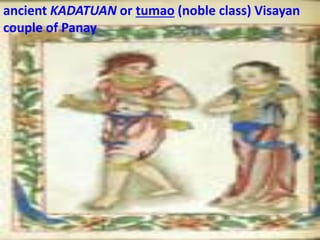
ancient KADATUAN or tumao (noble class) Visayan
couple of Panay
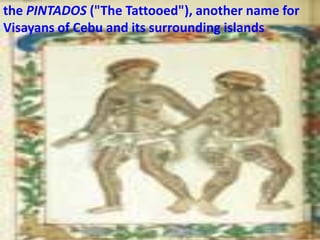
the PINTADOS ("The Tattooed"), another name for
Visayans of Cebu and its surrounding islands
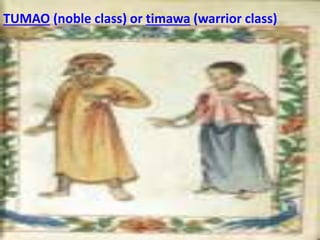
TUMAO (noble class) or timawa (warrior class)
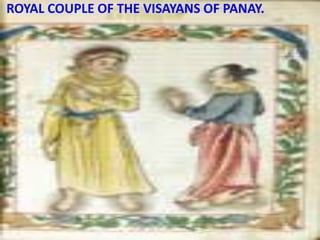
ROYAL COUPLE OF THE VISAYANS OF PANAY.
VISAYAN IMPORTANT
PERSONALITIES
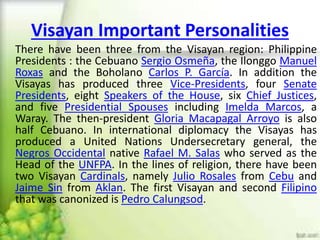
Visayan Important Personalities
There have been three from the Visayan region: Philippine
Presidents : the Cebuano Sergio Osmeña, the Ilonggo Manuel
Roxas and the Boholano Carlos P. García. In addition the
Visayas has produced three Vice-Presidents, four Senate
Presidents, eight Speakers of the House, six Chief Justices,
and five Presidential Spouses including Imelda Marcos, a
Waray. The then-president Gloria Macapagal Arroyo is also
half Cebuano. In international diplomacy the Visayas has
produced a United Nations Undersecretary general, the
Negros Occidental native Rafael M. Salas who served as the
Head of the UNFPA. In the lines of religion, there have been
two Visayan Cardinals, namely Julio Rosales from Cebu and
Jaime Sin from Aklan. The first Visayan and second Filipino
that was canonized is Pedro Calungsod.
VISAYAN
LITERATURE ,MUSIC and
DANCES
LITERATURE
Spanish Jesuit named
Ignacio Francisco Alzina
during had documented
literary piece, among
these literary pieces
from ancient Eastern
Visayas were candu,
haya, ambahan,
canogon, bical, balac,
siday and awit which are
predominantly in Waray.
MUSIC
Traditional Visayan folk
music were known to many
such as Dandansoy
originally in Hiligaynon and
is now commonly sang in
other Visayan languages.
A very popular Filipino
Christmas carol Ang Pasko ay
Sumapit translated by Levi
Celerio to Tagalog was originally
a Cebuano song entitled
Kasadya Ning Taknaa
popularized by Ruben Tagalog.
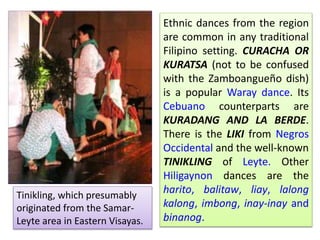
Tinikling, which presumably
originated from the Samar-
Leyte area in Eastern Visayas.
Ethnic dances from the region
are common in any traditional
Filipino setting. CURACHA OR
KURATSA (not to be confused
with the Zamboangueño dish)
is a popular Waray dance. Its
Cebuano counterparts are
KURADANG AND LA BERDE.
There is the LIKI from Negros
Occidental and the well-known
TINIKLING of Leyte. Other
Hiligaynon dances are the
harito, balitaw, liay, lalong
kalong, imbong, inay-inay and
binanog.
VISAYAN CULTURE
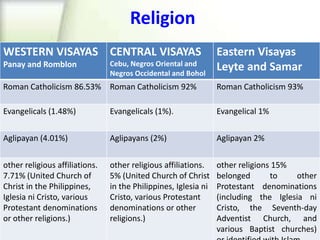
Religion
WESTERN VISAYAS
Panay and Romblon
CENTRAL VISAYAS
Cebu, Negros Oriental and
Negros Occidental and Bohol
Eastern Visayas
Leyte and Samar
Roman Catholicism 86.53% Roman Catholicism 92% Roman Catholicism 93%
Evangelicals (1.48%) Evangelicals (1%). Evangelical 1%
Aglipayan (4.01%) Aglipayans (2%) Aglipayan 2%
other religious affiliations.
7.71% (United Church of
Christ in the Philippines,
Iglesia ni Cristo, various
Protestant denominations
or other religions.)
other religious affiliations.
5% (United Church of Christ
in the Philippines, Iglesia ni
Cristo, various Protestant
denominations or other
religions.)
other religions 15%
belonged to other
Protestant denominations
(including the Iglesia ni
Cristo, the Seventh-day
Adventist Church, and
various Baptist churches)
FESTIVALS
Visayans are known in the Philippines for their festivities such
as the
•Sinulog ( Cebu )
•Maskara ( Bacolod )
• Sandugo ( Tagbilaran Bohol)
•Ati – Atihan ( Aklan )
•Pintados – Kasadyaan ( Tacloban )
•Dinagyang ( Iloilo )
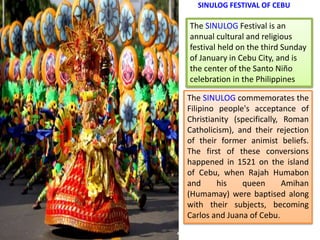
SINULOG FESTIVAL OF CEBU
The SINULOG Festival is an
annual cultural and religious
festival held on the third Sunday
of January in Cebu City, and is
the center of the Santo Niño
celebration in the Philippines
The SINULOG commemorates the
Filipino people's acceptance of
Christianity (specifically, Roman
Catholicism), and their rejection
of their former animist beliefs.
The first of these conversions
happened in 1521 on the island
of Cebu, when Rajah Humabon
and his queen Amihan
(Humamay) were baptised along
with their subjects, becoming
Carlos and Juana of Cebu.
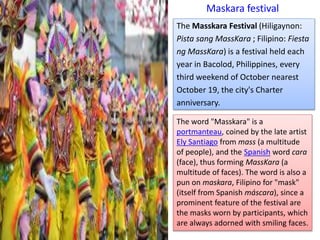
Maskara festival
The Masskara Festival (Hiligaynon:
Pista sang MassKara ; Filipino: Fiesta
ng MassKara) is a festival held each
year in Bacolod, Philippines, every
third weekend of October nearest
October 19, the city's Charter
anniversary.
The word "Masskara" is a
portmanteau, coined by the late artist
Ely Santiago from mass (a multitude
of people), and the Spanish word cara
(face), thus forming MassKara (a
multitude of faces). The word is also a
pun on maskara, Filipino for "mask"
(itself from Spanish máscara), since a
prominent feature of the festival are
the masks worn by participants, which
are always adorned with smiling faces.
SANDUGO FESTIVAL
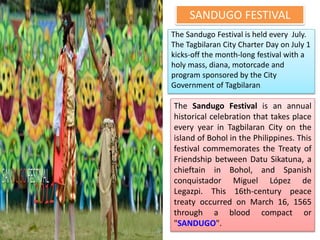
The Sandugo Festival is held every July.
The Tagbilaran City Charter Day on July 1
kicks-off the month-long festival with a
holy mass, diana, motorcade and
program sponsored by the City
Government of Tagbilaran.

The Sandugo Festival is an annual
historical celebration that takes place
every year in Tagbilaran City on the
island of Bohol in the Philippines. This
festival commemorates the Treaty of
Friendship between Datu Sikatuna, a
chieftain in Bohol, and Spanish
conquistador Miguel López de
Legazpi. This 16th-century peace
treaty occurred on March 16, 1565
through a blood compact or
"SANDUGO".
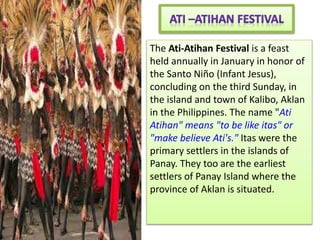
The Ati-Atihan Festival is a feast
held annually in January in honor of
the Santo Niño (Infant Jesus),
concluding on the third Sunday, in
the island and town of Kalibo, Aklan
in the Philippines. The name "Ati
Atihan" means "to be like itas" or
"make believe Ati's." Itas were the
primary settlers in the islands of
Panay. They too are the earliest
settlers of Panay Island where the
province of Aklan is situated.
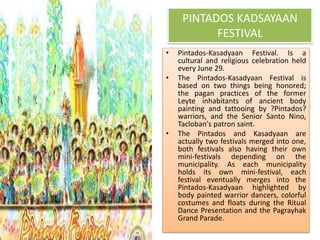
PINTADOS KADSAYAAN
FESTIVAL
• Pintados-Kasadyaan Festival. Is a
cultural and religious celebration held
every June 29.
• The Pintados-Kasadyaan Festival is
based on two things being honored;
the pagan practices of the former
Leyte inhabitants of ancient body
painting and tattooing by ?Pintados?
warriors, and the Senior Santo Nino,
Tacloban's patron saint.
• The Pintados and Kasadyaan are
actually two festivals merged into one,
both festivals also having their own
mini-festivals depending on the
municipality. As each municipality
holds its own mini-festival, each
festival eventually merges into the
Pintados-Kasadyaan highlighted by
body painted warrior dancers, colorful
costumes and floats during the Ritual
Dance Presentation and the Pagrayhak
Grand Parade.
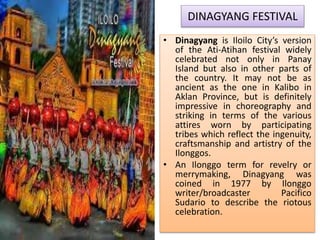
DINAGYANG FESTIVAL
• Dinagyang is Iloilo City’s version
of the Ati-Atihan festival widely
celebrated not only in Panay
Island but also in other parts of
the country. It may not be as
ancient as the one in Kalibo in
Aklan Province, but is definitely
impressive in choreography and
striking in terms of the various
attires worn by participating
tribes which reflect the ingenuity,
craftsmanship and artistry of the
Ilonggos.
• An Ilonggo term for revelry or
merrymaking, Dinagyang was
coined in 1977 by Ilonggo
writer/broadcaster Pacifico
Sudario to describe the riotous
celebration.
VISAYANS TRAITS
THE VISAYAN PEOPLE
The Visayan is happy- go-lucky and is more interested in the here and
now than in the past or the future. Further, Teodoro A. Agoncillo states
that the Visayan exceeds the Tagalog's for the finer thins in life, so much
so that he is ready to spend his last peso for these.
The Visayan is adventurous, independent and loves to go place. He will
be ready to leave his home in search of adventure.
Agoncillo also describes the Visayan as a hedonist. His guiding principle
in life is to drink and be merry for tomorrow he dies.
The Visayan is a music lover. His musical instrument and his songs are
sufficient to drive all his sorrows away.
VISAYANS CUSTOMS AND
TRADITIONS
BIRTH
The coming of a child is welcomed by a VISAYAN
family for it is about to give birth, pomelo leaves are
placed under the house so as to drive away all evil
spirits which maybe hovering around. While the
woman is in labor, the family burn some dried leaves
and roots so that smoke will free the mother from
painful labor pains. It is a sign of good luck when the
mothers first baby happens to be a boy. After the
child is born, the placenta is buried on the seashore
to insure the baby's good health. During the first
haircut of the child some pieces of hair are set aside
and inserted in the prayer book or any book to make
the child a wide reader when he grows up.
BAPTISM
It is the customs among the Visayans to
baptize child a few days after birth or in a
week's time Godparents are chosen very
carefully because they are the second
parents of the child. The parents hope the
child will emulate the good examples
shown by his godparents.
COURTSHIP
When a man falls in love with a girl, the first step that he does is
to visit her at home. Woman are quite shy and it will take the man
a long time before a girl answers his proposal. Sometimes the man
asks a third person to act as his go-between to help him win the
favor of the girl he loves. As soon as he engaged, the man's
parents request an important person in the community, preferably
the barangay chairman, to ask for the girl's hand in marriage. The
mediator has to go back several times before the girls parents give
their consent to the marriage of their daughter. Every time he goes
to the house of the girl's parent he bring with him food and drinks
for merrymaking. An important requirement which the parents of
the girl ask for the living of DOWRY consisting of a certain amount
of money of some valuable pieces of jewelry.
MARRIAGE
All the preparations for the wedding party is done at the
groom's house. Part of it is bought to the bride's house to be
served to her guests and relatives. The expenses for the party
are shouldered by the groom.
After the wedding ceremony, the newlyweds walk together to
the bride's house. Two plates filled with water and some
leaves of the San Francisco plant are placed at the foot of the
stairs for the newlyweds to step on. An old woman who is a
member of the bride's family combs the hair of the
newlyweds and offers some advice for a happy life together. It
is believed that by stepping on the plates and combing the
hair of the married couple, they will have an orderly, and
harmonious life.
VISAYANS SUPERSTITIOUS
BELIEFS
PLANTING
It is believed that crops planted during low
tide bear more fruit so farmers observe the
movement of the tides before planting
anything.
When the skies are filled with thousands
stars, it is the best time to plant for it will
bear plenty of fruits.
COURTSHIP
When a star is close to the moon, it is
believed that it is the proper time to
court a lady. The man's proposal will
readily be accepted
ILLNESS
When someone gets sick in the family, it is believed that the
sick person is being punished by the fairies because of his
carelessness or naughtiness. An herbolario is invited to
perform the healing ceremony. The family kills or dresses a
pig or two chickens on this occasion.
ReferencesREFERENCES:
• · G. Nye Steiger, H. Otley Beyer, Conrado Benitez, A History of the Orient, Oxford: 1929, Ginn and
Company, pp. 122–123.
• · · Zorc, David Paul. The Bisayan Dialects of the Philippines: Subgrouping and Reconstruction.
Canberra, Australia: Dept. of Linguistics, Research School of Pacific Studies, Australian National
University, 1977.
• · · Cf. BLAIR, Emma Helen & ROBERTSON, James Alexander, eds. (1911). The Philippine Islands,
1493–1803. Volume 04 of 55 (1493-1803). Historical introduction and additional notes by Edward
Gaylord BOURNE. Cleveland, Ohio: Arthur H. Clark Company. ISBN 978-0554259598. OCLC
769945704. "Explorations by early navigators, descriptions of the islands and their peoples, their
history and records of the catholic missions, as related in contemporaneous books and
manuscripts, showing the political, economic, commercial and religious conditions of those islands
from their earliest relations with European nations to the beginning of the nineteenth century.",
pp. 257–260.
• · · Jovito S. Abellana, "Bisaya Patronymesis Sri Visjaya" (Ms., Cebuano Studies Center, ca. 1960)
• · · Argos, B. M. (26 November 2007). "Binukot: Revisiting Western Visayas' only indigenous
group". Retrieved 18 April 2015.
• · · Paul Morrow (1998). "The Maragtas Legend". Retrieved 17 April 2014.
• · · Maria Christine N. Halili (2004). Philippine History. Quezon City: Rex Bookstore, Inc. pp. 9–10.
ISBN 971-233-934-3.
• · · Celedonio G. Aguilar (1994). Readings in Philippine Literature. Quezon City: Rex Book Store,
Inc. pp. 64–67. ISBN 971-231-564-9.
• · · Rasul, Jainal D. (2003). Agonies and Dreams: The Filipino Muslims and Other Minorities.
Quezon City: CARE Minorities. p. 77.
Gnnaguit

Visayans

  • 1.
    PAMPANGA STATE AGRICULTURALUNIVERSITY Magalang , Pampanga Institute of Graduate Studies DOCTORS of EDUCATION Educational Management PRESENTED TO: Dr. EPIFANIA S. GOSIOCO Compartive Studies on Philippine Culture Educ 313 PRESENTED BY : GLENDA NACPIL NAGUIT VISAYANS
  • 2.
    The Visayans orVisayan people The Visayans or Visayan people (Visayan languages and Tagalog: mga Bisaya) are a Filipino ethnic group whose members share a great extent of cultural, historical and linguistic affinity stretching across islands within the Visayan Sea. The people are speakers of one or more Visayan languages, the most widely spoken being CEBUANO, HILIGAYNON, AND WARAY-WARAY. They live in the Visayan island group and in many parts of Mindanao.. The Visayans, as one ethnolinguistic umbrella and notwithstanding the population exclusive to that of Visayas, are the largest ethnic group in the country, numbering at around 33 million as of 2010.
  • 3.
    KABISAY-AN refers bothto the Visayan people collectively and the lands occupied by them. The Anglicized term Visayas (via Hispanized plural form of Bisaya) is commonly used to refer to the latter. Based on loose definitions, the unofficial boundaries of Visayas traditionally comprise the following provinces commonly known where Visayans or people with Visayan culture reside: Aklan, Iloilo, Antique, Guimaras, Negros Occidental, Negros Oriental, Cebu, Siquijor, Bohol, Southern Leyte, Leyte, Biliran, Northern Samar, Eastern Samar, Samar, Romblon and Masbate.
  • 4.
    According to H.Otley Beyer and other anthropologists, the term Visayan was first applied only to the people of PANAY and to their settlements eastward in the island of Negros, and northward in the smaller islands, which now compose the province of Romblon. In fact, at the early part of Spanish colonialization of the Philippines, the Spaniards used the term Visayan only for these areas, while the people of Cebu, Bohol, and Leyte were for a long time known only as Pintados. The name Visayan was later extended to these other islands because, as several of the early writers state, their languages are closely allied to the Visayan "dialect" of Panay. The impression of these similarities was in fact carefully analyzed by David Zorc, who, while able to linguistically classify the Austronesian subfamily termed Visayan languages, noticed their overall connections as one dialect continuum. However, these must not be confused to dialects, since not all Visayan languages contain a unified set of features.
  • 5.
    History Classical period The earliestsettlements in the Visayan Islands were from valley-dwelling Austronesians and highland-dwelling Negrito dated around 30,000 BC. These early settlers were mostly Animist tribes. In the 12th century, Hindu-Buddhist descendants from the late empire of the Sri Vijaya, Majapahit and Brunei settled the islands. By the 14th century, Arab traders and their followers who ventured into Maritime Southeast Asia, converted some of these tribal groups to Islam. These groups practiced a mixture of Islamic, Hindu and Buddhist beliefs although there were also groups that were varied: some groups exclusively practiced Islam or Hinduism or Buddhism.
  • 6.
    Pedro Alcantara Monteclaroknown as the MARAGTAS attempts to retell the origins of the present-day Visayan people based on folklore revolving around ten datus of Borneo.It was said that they originated from an area occupied by the thalassocratic empire of Sri Vijaya during the early 13th century. In an attempt to escape the despotic rule of a Rajah Makatunaw and the subsequent fall of the empire, the chieftains, led by Datu Puti, fled eastwards to what is now the island of Panay. The island at that time was ruled by an Ati Chief Marikudo who was later given a golden sadok and a necklace for his wife, Maniwantiwan, in purchase of the Borneans of Panay for new settlement. It was said that the name for the inhabitants, Bisaya, was derived from their original land, Sri Vijaya.
  • 7.
    ancient KADATUAN ortumao (noble class) Visayan couple of Panay
  • 8.
    the PINTADOS ("TheTattooed"), another name for Visayans of Cebu and its surrounding islands
  • 9.
    TUMAO (noble class)or timawa (warrior class)
  • 10.
    ROYAL COUPLE OFTHE VISAYANS OF PANAY.
  • 11.
  • 12.
    Visayan Important Personalities Therehave been three from the Visayan region: Philippine Presidents : the Cebuano Sergio Osmeña, the Ilonggo Manuel Roxas and the Boholano Carlos P. García. In addition the Visayas has produced three Vice-Presidents, four Senate Presidents, eight Speakers of the House, six Chief Justices, and five Presidential Spouses including Imelda Marcos, a Waray. The then-president Gloria Macapagal Arroyo is also half Cebuano. In international diplomacy the Visayas has produced a United Nations Undersecretary general, the Negros Occidental native Rafael M. Salas who served as the Head of the UNFPA. In the lines of religion, there have been two Visayan Cardinals, namely Julio Rosales from Cebu and Jaime Sin from Aklan. The first Visayan and second Filipino that was canonized is Pedro Calungsod.
  • 13.
  • 14.
    LITERATURE Spanish Jesuit named IgnacioFrancisco Alzina during had documented literary piece, among these literary pieces from ancient Eastern Visayas were candu, haya, ambahan, canogon, bical, balac, siday and awit which are predominantly in Waray. MUSIC Traditional Visayan folk music were known to many such as Dandansoy originally in Hiligaynon and is now commonly sang in other Visayan languages. A very popular Filipino Christmas carol Ang Pasko ay Sumapit translated by Levi Celerio to Tagalog was originally a Cebuano song entitled Kasadya Ning Taknaa popularized by Ruben Tagalog.
  • 15.
    Tinikling, which presumably originatedfrom the Samar- Leyte area in Eastern Visayas. Ethnic dances from the region are common in any traditional Filipino setting. CURACHA OR KURATSA (not to be confused with the Zamboangueño dish) is a popular Waray dance. Its Cebuano counterparts are KURADANG AND LA BERDE. There is the LIKI from Negros Occidental and the well-known TINIKLING of Leyte. Other Hiligaynon dances are the harito, balitaw, liay, lalong kalong, imbong, inay-inay and binanog.
  • 16.
  • 17.
    Religion WESTERN VISAYAS Panay andRomblon CENTRAL VISAYAS Cebu, Negros Oriental and Negros Occidental and Bohol Eastern Visayas Leyte and Samar Roman Catholicism 86.53% Roman Catholicism 92% Roman Catholicism 93% Evangelicals (1.48%) Evangelicals (1%). Evangelical 1% Aglipayan (4.01%) Aglipayans (2%) Aglipayan 2% other religious affiliations. 7.71% (United Church of Christ in the Philippines, Iglesia ni Cristo, various Protestant denominations or other religions.) other religious affiliations. 5% (United Church of Christ in the Philippines, Iglesia ni Cristo, various Protestant denominations or other religions.) other religions 15% belonged to other Protestant denominations (including the Iglesia ni Cristo, the Seventh-day Adventist Church, and various Baptist churches)
  • 18.
    FESTIVALS Visayans are knownin the Philippines for their festivities such as the •Sinulog ( Cebu ) •Maskara ( Bacolod ) • Sandugo ( Tagbilaran Bohol) •Ati – Atihan ( Aklan ) •Pintados – Kasadyaan ( Tacloban ) •Dinagyang ( Iloilo )
  • 19.
    SINULOG FESTIVAL OFCEBU The SINULOG Festival is an annual cultural and religious festival held on the third Sunday of January in Cebu City, and is the center of the Santo Niño celebration in the Philippines The SINULOG commemorates the Filipino people's acceptance of Christianity (specifically, Roman Catholicism), and their rejection of their former animist beliefs. The first of these conversions happened in 1521 on the island of Cebu, when Rajah Humabon and his queen Amihan (Humamay) were baptised along with their subjects, becoming Carlos and Juana of Cebu.
  • 20.
    Maskara festival The MasskaraFestival (Hiligaynon: Pista sang MassKara ; Filipino: Fiesta ng MassKara) is a festival held each year in Bacolod, Philippines, every third weekend of October nearest October 19, the city's Charter anniversary. The word "Masskara" is a portmanteau, coined by the late artist Ely Santiago from mass (a multitude of people), and the Spanish word cara (face), thus forming MassKara (a multitude of faces). The word is also a pun on maskara, Filipino for "mask" (itself from Spanish máscara), since a prominent feature of the festival are the masks worn by participants, which are always adorned with smiling faces.
  • 21.
    SANDUGO FESTIVAL The SandugoFestival is held every July. The Tagbilaran City Charter Day on July 1 kicks-off the month-long festival with a holy mass, diana, motorcade and program sponsored by the City Government of Tagbilaran. The Sandugo Festival is an annual historical celebration that takes place every year in Tagbilaran City on the island of Bohol in the Philippines. This festival commemorates the Treaty of Friendship between Datu Sikatuna, a chieftain in Bohol, and Spanish conquistador Miguel López de Legazpi. This 16th-century peace treaty occurred on March 16, 1565 through a blood compact or "SANDUGO".
  • 22.
    The Ati-Atihan Festivalis a feast held annually in January in honor of the Santo Niño (Infant Jesus), concluding on the third Sunday, in the island and town of Kalibo, Aklan in the Philippines. The name "Ati Atihan" means "to be like itas" or "make believe Ati's." Itas were the primary settlers in the islands of Panay. They too are the earliest settlers of Panay Island where the province of Aklan is situated.
  • 23.
    PINTADOS KADSAYAAN FESTIVAL • Pintados-KasadyaanFestival. Is a cultural and religious celebration held every June 29. • The Pintados-Kasadyaan Festival is based on two things being honored; the pagan practices of the former Leyte inhabitants of ancient body painting and tattooing by ?Pintados? warriors, and the Senior Santo Nino, Tacloban's patron saint. • The Pintados and Kasadyaan are actually two festivals merged into one, both festivals also having their own mini-festivals depending on the municipality. As each municipality holds its own mini-festival, each festival eventually merges into the Pintados-Kasadyaan highlighted by body painted warrior dancers, colorful costumes and floats during the Ritual Dance Presentation and the Pagrayhak Grand Parade.
  • 24.
    DINAGYANG FESTIVAL • Dinagyangis Iloilo City’s version of the Ati-Atihan festival widely celebrated not only in Panay Island but also in other parts of the country. It may not be as ancient as the one in Kalibo in Aklan Province, but is definitely impressive in choreography and striking in terms of the various attires worn by participating tribes which reflect the ingenuity, craftsmanship and artistry of the Ilonggos. • An Ilonggo term for revelry or merrymaking, Dinagyang was coined in 1977 by Ilonggo writer/broadcaster Pacifico Sudario to describe the riotous celebration.
  • 25.
  • 26.
    THE VISAYAN PEOPLE TheVisayan is happy- go-lucky and is more interested in the here and now than in the past or the future. Further, Teodoro A. Agoncillo states that the Visayan exceeds the Tagalog's for the finer thins in life, so much so that he is ready to spend his last peso for these. The Visayan is adventurous, independent and loves to go place. He will be ready to leave his home in search of adventure. Agoncillo also describes the Visayan as a hedonist. His guiding principle in life is to drink and be merry for tomorrow he dies. The Visayan is a music lover. His musical instrument and his songs are sufficient to drive all his sorrows away.
  • 27.
  • 28.
    BIRTH The coming ofa child is welcomed by a VISAYAN family for it is about to give birth, pomelo leaves are placed under the house so as to drive away all evil spirits which maybe hovering around. While the woman is in labor, the family burn some dried leaves and roots so that smoke will free the mother from painful labor pains. It is a sign of good luck when the mothers first baby happens to be a boy. After the child is born, the placenta is buried on the seashore to insure the baby's good health. During the first haircut of the child some pieces of hair are set aside and inserted in the prayer book or any book to make the child a wide reader when he grows up.
  • 29.
    BAPTISM It is thecustoms among the Visayans to baptize child a few days after birth or in a week's time Godparents are chosen very carefully because they are the second parents of the child. The parents hope the child will emulate the good examples shown by his godparents.
  • 30.
    COURTSHIP When a manfalls in love with a girl, the first step that he does is to visit her at home. Woman are quite shy and it will take the man a long time before a girl answers his proposal. Sometimes the man asks a third person to act as his go-between to help him win the favor of the girl he loves. As soon as he engaged, the man's parents request an important person in the community, preferably the barangay chairman, to ask for the girl's hand in marriage. The mediator has to go back several times before the girls parents give their consent to the marriage of their daughter. Every time he goes to the house of the girl's parent he bring with him food and drinks for merrymaking. An important requirement which the parents of the girl ask for the living of DOWRY consisting of a certain amount of money of some valuable pieces of jewelry.
  • 31.
    MARRIAGE All the preparationsfor the wedding party is done at the groom's house. Part of it is bought to the bride's house to be served to her guests and relatives. The expenses for the party are shouldered by the groom. After the wedding ceremony, the newlyweds walk together to the bride's house. Two plates filled with water and some leaves of the San Francisco plant are placed at the foot of the stairs for the newlyweds to step on. An old woman who is a member of the bride's family combs the hair of the newlyweds and offers some advice for a happy life together. It is believed that by stepping on the plates and combing the hair of the married couple, they will have an orderly, and harmonious life.
  • 32.
  • 33.
    PLANTING It is believedthat crops planted during low tide bear more fruit so farmers observe the movement of the tides before planting anything. When the skies are filled with thousands stars, it is the best time to plant for it will bear plenty of fruits.
  • 34.
    COURTSHIP When a staris close to the moon, it is believed that it is the proper time to court a lady. The man's proposal will readily be accepted
  • 35.
    ILLNESS When someone getssick in the family, it is believed that the sick person is being punished by the fairies because of his carelessness or naughtiness. An herbolario is invited to perform the healing ceremony. The family kills or dresses a pig or two chickens on this occasion.
  • 36.
    ReferencesREFERENCES: • · G.Nye Steiger, H. Otley Beyer, Conrado Benitez, A History of the Orient, Oxford: 1929, Ginn and Company, pp. 122–123. • · · Zorc, David Paul. The Bisayan Dialects of the Philippines: Subgrouping and Reconstruction. Canberra, Australia: Dept. of Linguistics, Research School of Pacific Studies, Australian National University, 1977. • · · Cf. BLAIR, Emma Helen & ROBERTSON, James Alexander, eds. (1911). The Philippine Islands, 1493–1803. Volume 04 of 55 (1493-1803). Historical introduction and additional notes by Edward Gaylord BOURNE. Cleveland, Ohio: Arthur H. Clark Company. ISBN 978-0554259598. OCLC 769945704. "Explorations by early navigators, descriptions of the islands and their peoples, their history and records of the catholic missions, as related in contemporaneous books and manuscripts, showing the political, economic, commercial and religious conditions of those islands from their earliest relations with European nations to the beginning of the nineteenth century.", pp. 257–260. • · · Jovito S. Abellana, "Bisaya Patronymesis Sri Visjaya" (Ms., Cebuano Studies Center, ca. 1960) • · · Argos, B. M. (26 November 2007). "Binukot: Revisiting Western Visayas' only indigenous group". Retrieved 18 April 2015. • · · Paul Morrow (1998). "The Maragtas Legend". Retrieved 17 April 2014. • · · Maria Christine N. Halili (2004). Philippine History. Quezon City: Rex Bookstore, Inc. pp. 9–10. ISBN 971-233-934-3. • · · Celedonio G. Aguilar (1994). Readings in Philippine Literature. Quezon City: Rex Book Store, Inc. pp. 64–67. ISBN 971-231-564-9. • · · Rasul, Jainal D. (2003). Agonies and Dreams: The Filipino Muslims and Other Minorities. Quezon City: CARE Minorities. p. 77.
  • 37.

Editor's Notes

  • #3 Ethnolinguistics (sometimes called cultural linguistics) is a field of linguistics which studies the relationship between language and culture, and the way different ethnic groups perceive the world. It is the combination between ethnology and linguistics. The former refers to the way of life of an entire community, i.e., all the characteristics which distinguish one community from the other. Those characteristics make the cultural aspects of a community or a society.
  • #5 The Austronesian-speaking peoples are various populations in Southeast Asia and Oceania that speak languages of the Austronesian family. They include Taiwanese; the majority ethnic groups of Malaysia, East Timor, the Philippines, Indonesia, Brunei, Madagascar, Micronesia, and Polynesia, as well as the Polynesian peoples of New Zealand and Hawaii, and the non-Papuan people of Melanesia. They are also found in the minorities of Singapore where Malay is an indigenous language, the Pattani region of Thailand, and the Cham areas in Vietnam, Cambodia, and Hainan. The territories populated by Austronesian -speaking peoples are known collectively as Austronesia.
  • #27 The Ilongos, Cebuano, Warays, and Magahats are a few of the ethic groups that inhabit the Visayan community.