FOLK ARTS
AND
CRAFTS OF
NORTHERN
LUZON
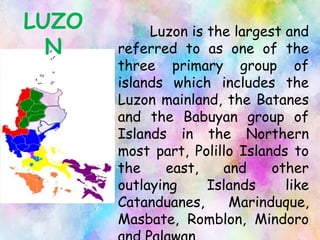
Luzon is the largest and
referred to as one of the
three primary group of
islands which includes the
Luzon mainland, the Batanes
and the Babuyan group of
Islands in the Northern
most part, Polillo Islands to
the east, and other
outlaying Islands like
Catanduanes, Marinduque,
Masbate, Romblon, Mindoro
LUZO
N
ILOCOS REGION
The historic town of Vigan was
built in the 16th century. It is
considered as one of the best-
preserved examples of planned
Spanish colonial town in Asia. Vigan
houses are unique for having
preserved much of its colonial
character and influences. The
distinctiveness of the structure of
the houses is evident in their grid
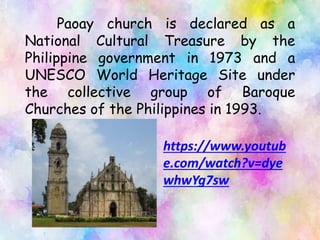
Paoay church is declared as a
National Cultural Treasure by the
Philippine government in 1973 and a
UNESCO World Heritage Site under
the collective group of Baroque
Churches of the Philippines in 1993.
https://www.youtub
e.com/watch?v=dye
whwYg7sw
Binatbatan is one of the
Ilocano ways of processing textile.
The word comes from an Ilocano
term batbatin which means
separating cotton balls from seeds
of the local fruit tree Kapasanglay.
The cotton balls are then spun and
used in meaning the abel (woven
cloth). It is also an occupational
dance from Paoay Ilocos Norte
Pagabel or Panagabel or Loom
weaving is one of the oldest
industries that Ilocanos have
acquired from their Ancestors.
Inabel or Abel Iloco simply means
“hand woven cloth”. Loom is a device
used to weave cloth. Weaving is to
interlace threads, yarns, strips, and
other fibrous materials so as to
form a fabric.
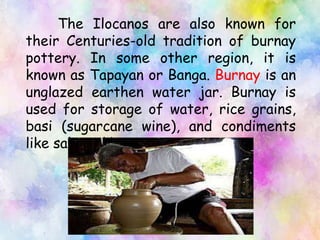
The Ilocanos are also known for
their Centuries-old tradition of burnay
pottery. In some other region, it is
known as Tapayan or Banga. Burnay is an
unglazed earthen water jar. Burnay is
used for storage of water, rice grains,
basi (sugarcane wine), and condiments
like salt and bagoong.
PANGASINAN
Pangasinan is a province located
at Northern end of the Central
Luzon plain and its shores form a
lap of Lingayen Gulf. Pangasinan is
also known as the salt capital during
the pre-Hispanic times. Pangasinan
comes from the word asin which
means ‘’salt’’ and interprets as “a
place where salt is made”.
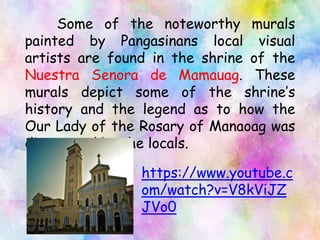
Some of the noteworthy murals
painted by Pangasinans local visual
artists are found in the shrine of the
Nuestra Senora de Mamauag. These
murals depict some of the shrine’s
history and the legend as to how the
Our Lady of the Rosary of Manaoag was
discovered by the locals.
https://www.youtube.c
om/watch?v=V8kViJZ
JVo0
BENGUET
Benguet is a highland province of the
Philippines located in the southern tip of
the Cordillera Administrative Region (CAR)
in the island of Luzon. Benguet is also
known as the “Salad Bowl of the
Philippines” because of its large production
of upland vegetables. Most of the people
living in Benguet are commonly known as
Igorots. However, the term is politically
corrected as Cordillerans. Aside from the
Cordillerans, there are other people from
other places living in Benguet such as
Tagalogs, Ibalois, Kankanaeys, Ilocanos,
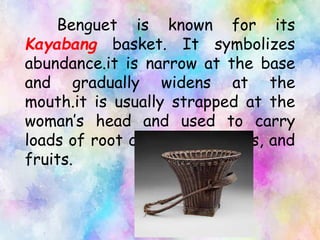
Benguet is known for its
Kayabang basket. It symbolizes
abundance.it is narrow at the base
and gradually widens at the
mouth.it is usually strapped at the
woman’s head and used to carry
loads of root crops, vegetables, and
fruits.
KALINGA
The people of kalinga are also
known as great weavers. Their art of
cloth weaving and basketry are among
the finest products in the whole
country. The kalinga fabrics are
characterized by dominant red stripes
and various motifs of geometric
shapes and patterns, with inclusions of
varied symbols interlaced with white,
yellow, and sometimes with blue of
Wang-od Oggay
She’s a Filipina tattoo artist from
Buscalan, Tinglayan, Kalinga. She has been
tattooing headhunters and women of the
indigenous people of Butbut in Buscalan,
Kalinga, since she was 15 years old, but the
Butbut warriors who used to earn tattoos
by protecting villages or killing enemies no
longer exist. She is often described as the
"last" and oldest mambabatok and is part of
the Butbut people of the larger Kalinga
ethnic group.
IFUGAO
The term ifugao means “people
from the hills”. The Ifugao women
usually weave a loincloth utilizing the
tie. Ifugao is a landlocked province of
the Philippines in the Cordillera
Administrative Region in Luzon. Its
capital is Lagawe and it borders
Benguet to the west, Mountain
Province to the north, Isabela to the
east, and Nueva Vizcaya to the south.
The ifugaos are known for their
sculpted bul’ul which they considered
as a granary God. Bul’ul are believed to
be powerful guardians of the crops and
responsible for bountiful harvest. The
ifugao treat their bul’ul with respect
and praise because it is said that their
dead ancestors reside in it and if not
properly cared for, can bring plague
and sickness. Bul’ul is also referred to
as the “Rise God”.
The ulo di kang-o is an Ifugao
headdress worn on the head of the
groom during wedding ceremony. This
is made of a hornbill beak (kalaw)
wrapped with a piece of blue cloth.
The hornbill beak symbolizes a good
omen and usually adorned to Ifugao
headdress especially those worn by
the mumbaki.
MOUNTAIN PROVINCE
It is located at the center of
Cordillera Mountains, a home for the
Ibalois. Its capital is Bontoc. Mountain
Province was formerly referred to
as Mountain in some foreign
references. The name is usually
shortened by locals to Mt. Province.
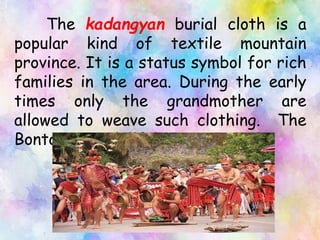
The kadangyan burial cloth is a
popular kind of textile mountain
province. It is a status symbol for rich
families in the area. During the early
times only the grandmother are
allowed to weave such clothing. The
Bontocs are skillful weavers.
ABRA
Abra is known as the “Natural Dye
Capital of the Philippines”. It is an
inland province of the Cordillera
Administrative Region. Bontoc and
Ifugaos are the original incomers in
this place. The place is rich in natural
dye yielding plants extracted from the
barsk, leaves, fruits, and roots to color
foods, beverages, fabrics, cosmetics,
furniture, and other products.
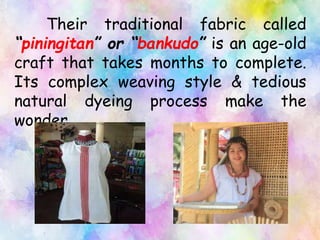
Their traditional fabric called
“piningitan” or “bankudo” is an age-old
craft that takes months to complete.
Its complex weaving style & tedious
natural dyeing process make the
wonder.
KANKANAEY
The Kankanaey domain includes
Western Mountain Province, northern
Benguet and southeastern Ilocos Sur.
Like most Igorot ethnic groups, the
Kankanaey built sloping terraces to
maximize farm space in the rugged
terrain of the Cordilleras
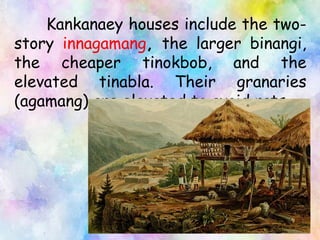
Kankanaey houses include the two-
story innagamang, the larger binangi,
the cheaper tinokbob, and the
elevated tinabla. Their granaries
(agamang) are elevated to avoid rats.
FOLK ARTS
AND CRAFTS
OF CAGAYAN
VALLEY AND
CENTRAL
LUZON
CAGAYAN VALLEY
It is the second largest region of the
Philippines in terms of land area. The longest
and largest river in the country is also named
after this place- Rio Grande De Cagayan or
Cagayan River. Batanes, Cagayan, Isabela,
Nueva Vizcaya, and Quirino are the provinces
of Cagayan Valley. During the early times, it is
believed that this place is dominated by
mammoths and other extinct animals. Even as
early as 6000 B.C.E., there have been a
number of evidences that Filipinos are indeed
artistic and innovative.
BATANES
Batanes is a placed often visited
by typhoons. The people in Batanes are
called Ivatans. They are able to adapt
to the frequent weather disturbances.
Their houses are made of limestones.
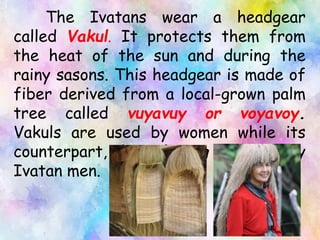
The Ivatans wear a headgear
called Vakul. It protects them from
the heat of the sun and during the
rainy sasons. This headgear is made of
fiber derived from a local-grown palm
tree called vuyavuy or voyavoy.
Vakuls are used by women while its
counterpart, the talugong are worn by
Ivatan men.
The Ivatans wear a headgear
called Vakul. It protects them from
the heat of the sun and during the
rainy sasons. This headgear is made of
fiber derived from a local-grown palm
tree called vuyavuy or voyavoy.
Vakuls are used by women while its
counterpart, the talugong are worn by
Ivatan men.
NUEVA VIZCAYA
Nueva Vizcaya is known for
creative and unique styles of crafts
and textiles. It is a mountainous place
near Ifugao, Benguet, and Quirino. The
Gaddang tribe most lives in the
highlands of southeastern Kalinga-
Apayao, Eastern Bontok, Nueva
Vizcaya, and Isabela provinces. They
are skilled weaver and known for their
traditional woven Bakwat belt.
ISABELA
Isabela was also a treasure trove
of crafts: butaka chairs in all sizes
from Vicky's Narra Wood Products;
puzzle-like wall art and décor from
VGC Wooden Artickles; creative abaca
and rattan products from Merlyn's
Family Collection; bamboo lamps and
sound boosters from Gakit
Handicrafts; elegant and eco- friendly
Karigo.
CENTRAL LUZON
BULACAN
This place is known for canon-
making.it was in Barasoain Church in
Malolo, Bulacan where the first
written constitution in Asia was
adopted. This place is known for so
many historic events.
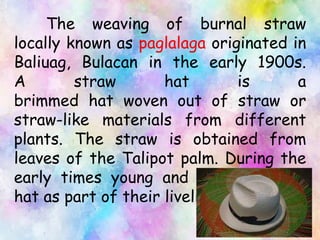
The weaving of burnal straw
locally known as paglalaga originated in
Baliuag, Bulacan in the early 1900s.
A straw hat is a
brimmed hat woven out of straw or
straw-like materials from different
plants. The straw is obtained from
leaves of the Talipot palm. During the
early times young and old make this
hat as part of their livelihood.
PAMPANGA
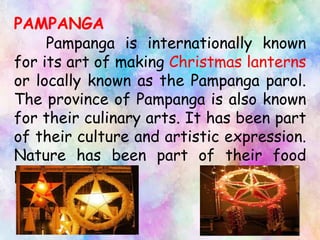
Pampanga is internationally known
for its art of making Christmas lanterns
or locally known as the Pampanga parol.
The province of Pampanga is also known
for their culinary arts. It has been part
of their culture and artistic expression.
Nature has been part of their food
presentation.
NUEVA ECIJA
Slipper industry is a growing
business industry in the community
level in Gapan city. The Novo Ecijanos’
metal, rattan and wooden industries
are becoming part of the local’s folk
arts and livelihoods.
BATAAN
In Mt. Samat, Bataan, sculptured
302-feet memorials cross known as
“Dambana ng kagitingan” (shrine of
valor) has been part of main landmark
and tourism attraction in the province.
The shirne is in honor of the heroism
of the brave men who walk from
Bataan to Tarlac during World War II,
also known as the Bataan Death March.
ZAMBALES
The aetas from mt. Pinatubo are
known for their indigenous ways of
making basket and bilao made of
rattan and other indigenous materials
from their mountains. The Aeta
were once exclusively hunters and
food gatherers, surviving by means of
extensive use of the Pinatubo
vegetation and dependency on access

MAPEH 7-ARTS (LESSON 1).pptx

  • 1.
  • 2.
    Luzon is thelargest and referred to as one of the three primary group of islands which includes the Luzon mainland, the Batanes and the Babuyan group of Islands in the Northern most part, Polillo Islands to the east, and other outlaying Islands like Catanduanes, Marinduque, Masbate, Romblon, Mindoro LUZO N
  • 3.
    ILOCOS REGION The historictown of Vigan was built in the 16th century. It is considered as one of the best- preserved examples of planned Spanish colonial town in Asia. Vigan houses are unique for having preserved much of its colonial character and influences. The distinctiveness of the structure of the houses is evident in their grid
  • 4.
    Paoay church isdeclared as a National Cultural Treasure by the Philippine government in 1973 and a UNESCO World Heritage Site under the collective group of Baroque Churches of the Philippines in 1993. https://www.youtub e.com/watch?v=dye whwYg7sw
  • 5.
    Binatbatan is oneof the Ilocano ways of processing textile. The word comes from an Ilocano term batbatin which means separating cotton balls from seeds of the local fruit tree Kapasanglay. The cotton balls are then spun and used in meaning the abel (woven cloth). It is also an occupational dance from Paoay Ilocos Norte
  • 6.
    Pagabel or Panagabelor Loom weaving is one of the oldest industries that Ilocanos have acquired from their Ancestors. Inabel or Abel Iloco simply means “hand woven cloth”. Loom is a device used to weave cloth. Weaving is to interlace threads, yarns, strips, and other fibrous materials so as to form a fabric.
  • 7.
    The Ilocanos arealso known for their Centuries-old tradition of burnay pottery. In some other region, it is known as Tapayan or Banga. Burnay is an unglazed earthen water jar. Burnay is used for storage of water, rice grains, basi (sugarcane wine), and condiments like salt and bagoong.
  • 8.
    PANGASINAN Pangasinan is aprovince located at Northern end of the Central Luzon plain and its shores form a lap of Lingayen Gulf. Pangasinan is also known as the salt capital during the pre-Hispanic times. Pangasinan comes from the word asin which means ‘’salt’’ and interprets as “a place where salt is made”.
  • 9.
    Some of thenoteworthy murals painted by Pangasinans local visual artists are found in the shrine of the Nuestra Senora de Mamauag. These murals depict some of the shrine’s history and the legend as to how the Our Lady of the Rosary of Manaoag was discovered by the locals. https://www.youtube.c om/watch?v=V8kViJZ JVo0
  • 10.
    BENGUET Benguet is ahighland province of the Philippines located in the southern tip of the Cordillera Administrative Region (CAR) in the island of Luzon. Benguet is also known as the “Salad Bowl of the Philippines” because of its large production of upland vegetables. Most of the people living in Benguet are commonly known as Igorots. However, the term is politically corrected as Cordillerans. Aside from the Cordillerans, there are other people from other places living in Benguet such as Tagalogs, Ibalois, Kankanaeys, Ilocanos,
  • 11.
    Benguet is knownfor its Kayabang basket. It symbolizes abundance.it is narrow at the base and gradually widens at the mouth.it is usually strapped at the woman’s head and used to carry loads of root crops, vegetables, and fruits.
  • 12.
    KALINGA The people ofkalinga are also known as great weavers. Their art of cloth weaving and basketry are among the finest products in the whole country. The kalinga fabrics are characterized by dominant red stripes and various motifs of geometric shapes and patterns, with inclusions of varied symbols interlaced with white, yellow, and sometimes with blue of
  • 13.
    Wang-od Oggay She’s aFilipina tattoo artist from Buscalan, Tinglayan, Kalinga. She has been tattooing headhunters and women of the indigenous people of Butbut in Buscalan, Kalinga, since she was 15 years old, but the Butbut warriors who used to earn tattoos by protecting villages or killing enemies no longer exist. She is often described as the "last" and oldest mambabatok and is part of the Butbut people of the larger Kalinga ethnic group.
  • 14.
    IFUGAO The term ifugaomeans “people from the hills”. The Ifugao women usually weave a loincloth utilizing the tie. Ifugao is a landlocked province of the Philippines in the Cordillera Administrative Region in Luzon. Its capital is Lagawe and it borders Benguet to the west, Mountain Province to the north, Isabela to the east, and Nueva Vizcaya to the south.
  • 15.
    The ifugaos areknown for their sculpted bul’ul which they considered as a granary God. Bul’ul are believed to be powerful guardians of the crops and responsible for bountiful harvest. The ifugao treat their bul’ul with respect and praise because it is said that their dead ancestors reside in it and if not properly cared for, can bring plague and sickness. Bul’ul is also referred to as the “Rise God”.
  • 16.
    The ulo dikang-o is an Ifugao headdress worn on the head of the groom during wedding ceremony. This is made of a hornbill beak (kalaw) wrapped with a piece of blue cloth. The hornbill beak symbolizes a good omen and usually adorned to Ifugao headdress especially those worn by the mumbaki.
  • 17.
    MOUNTAIN PROVINCE It islocated at the center of Cordillera Mountains, a home for the Ibalois. Its capital is Bontoc. Mountain Province was formerly referred to as Mountain in some foreign references. The name is usually shortened by locals to Mt. Province.
  • 18.
    The kadangyan burialcloth is a popular kind of textile mountain province. It is a status symbol for rich families in the area. During the early times only the grandmother are allowed to weave such clothing. The Bontocs are skillful weavers.
  • 19.
    ABRA Abra is knownas the “Natural Dye Capital of the Philippines”. It is an inland province of the Cordillera Administrative Region. Bontoc and Ifugaos are the original incomers in this place. The place is rich in natural dye yielding plants extracted from the barsk, leaves, fruits, and roots to color foods, beverages, fabrics, cosmetics, furniture, and other products.
  • 20.
    Their traditional fabriccalled “piningitan” or “bankudo” is an age-old craft that takes months to complete. Its complex weaving style & tedious natural dyeing process make the wonder.
  • 21.
    KANKANAEY The Kankanaey domainincludes Western Mountain Province, northern Benguet and southeastern Ilocos Sur. Like most Igorot ethnic groups, the Kankanaey built sloping terraces to maximize farm space in the rugged terrain of the Cordilleras
  • 22.
    Kankanaey houses includethe two- story innagamang, the larger binangi, the cheaper tinokbob, and the elevated tinabla. Their granaries (agamang) are elevated to avoid rats.
  • 23.
    FOLK ARTS AND CRAFTS OFCAGAYAN VALLEY AND CENTRAL LUZON
  • 24.
    CAGAYAN VALLEY It isthe second largest region of the Philippines in terms of land area. The longest and largest river in the country is also named after this place- Rio Grande De Cagayan or Cagayan River. Batanes, Cagayan, Isabela, Nueva Vizcaya, and Quirino are the provinces of Cagayan Valley. During the early times, it is believed that this place is dominated by mammoths and other extinct animals. Even as early as 6000 B.C.E., there have been a number of evidences that Filipinos are indeed artistic and innovative.
  • 25.
    BATANES Batanes is aplaced often visited by typhoons. The people in Batanes are called Ivatans. They are able to adapt to the frequent weather disturbances. Their houses are made of limestones.
  • 26.
    The Ivatans weara headgear called Vakul. It protects them from the heat of the sun and during the rainy sasons. This headgear is made of fiber derived from a local-grown palm tree called vuyavuy or voyavoy. Vakuls are used by women while its counterpart, the talugong are worn by Ivatan men.
  • 27.
    The Ivatans weara headgear called Vakul. It protects them from the heat of the sun and during the rainy sasons. This headgear is made of fiber derived from a local-grown palm tree called vuyavuy or voyavoy. Vakuls are used by women while its counterpart, the talugong are worn by Ivatan men.
  • 28.
    NUEVA VIZCAYA Nueva Vizcayais known for creative and unique styles of crafts and textiles. It is a mountainous place near Ifugao, Benguet, and Quirino. The Gaddang tribe most lives in the highlands of southeastern Kalinga- Apayao, Eastern Bontok, Nueva Vizcaya, and Isabela provinces. They are skilled weaver and known for their traditional woven Bakwat belt.
  • 29.
    ISABELA Isabela was alsoa treasure trove of crafts: butaka chairs in all sizes from Vicky's Narra Wood Products; puzzle-like wall art and décor from VGC Wooden Artickles; creative abaca and rattan products from Merlyn's Family Collection; bamboo lamps and sound boosters from Gakit Handicrafts; elegant and eco- friendly Karigo.
  • 30.
    CENTRAL LUZON BULACAN This placeis known for canon- making.it was in Barasoain Church in Malolo, Bulacan where the first written constitution in Asia was adopted. This place is known for so many historic events.
  • 31.
    The weaving ofburnal straw locally known as paglalaga originated in Baliuag, Bulacan in the early 1900s. A straw hat is a brimmed hat woven out of straw or straw-like materials from different plants. The straw is obtained from leaves of the Talipot palm. During the early times young and old make this hat as part of their livelihood.
  • 32.
    PAMPANGA Pampanga is internationallyknown for its art of making Christmas lanterns or locally known as the Pampanga parol. The province of Pampanga is also known for their culinary arts. It has been part of their culture and artistic expression. Nature has been part of their food presentation.
  • 33.
    NUEVA ECIJA Slipper industryis a growing business industry in the community level in Gapan city. The Novo Ecijanos’ metal, rattan and wooden industries are becoming part of the local’s folk arts and livelihoods.
  • 34.
    BATAAN In Mt. Samat,Bataan, sculptured 302-feet memorials cross known as “Dambana ng kagitingan” (shrine of valor) has been part of main landmark and tourism attraction in the province. The shirne is in honor of the heroism of the brave men who walk from Bataan to Tarlac during World War II, also known as the Bataan Death March.
  • 35.
    ZAMBALES The aetas frommt. Pinatubo are known for their indigenous ways of making basket and bilao made of rattan and other indigenous materials from their mountains. The Aeta were once exclusively hunters and food gatherers, surviving by means of extensive use of the Pinatubo vegetation and dependency on access