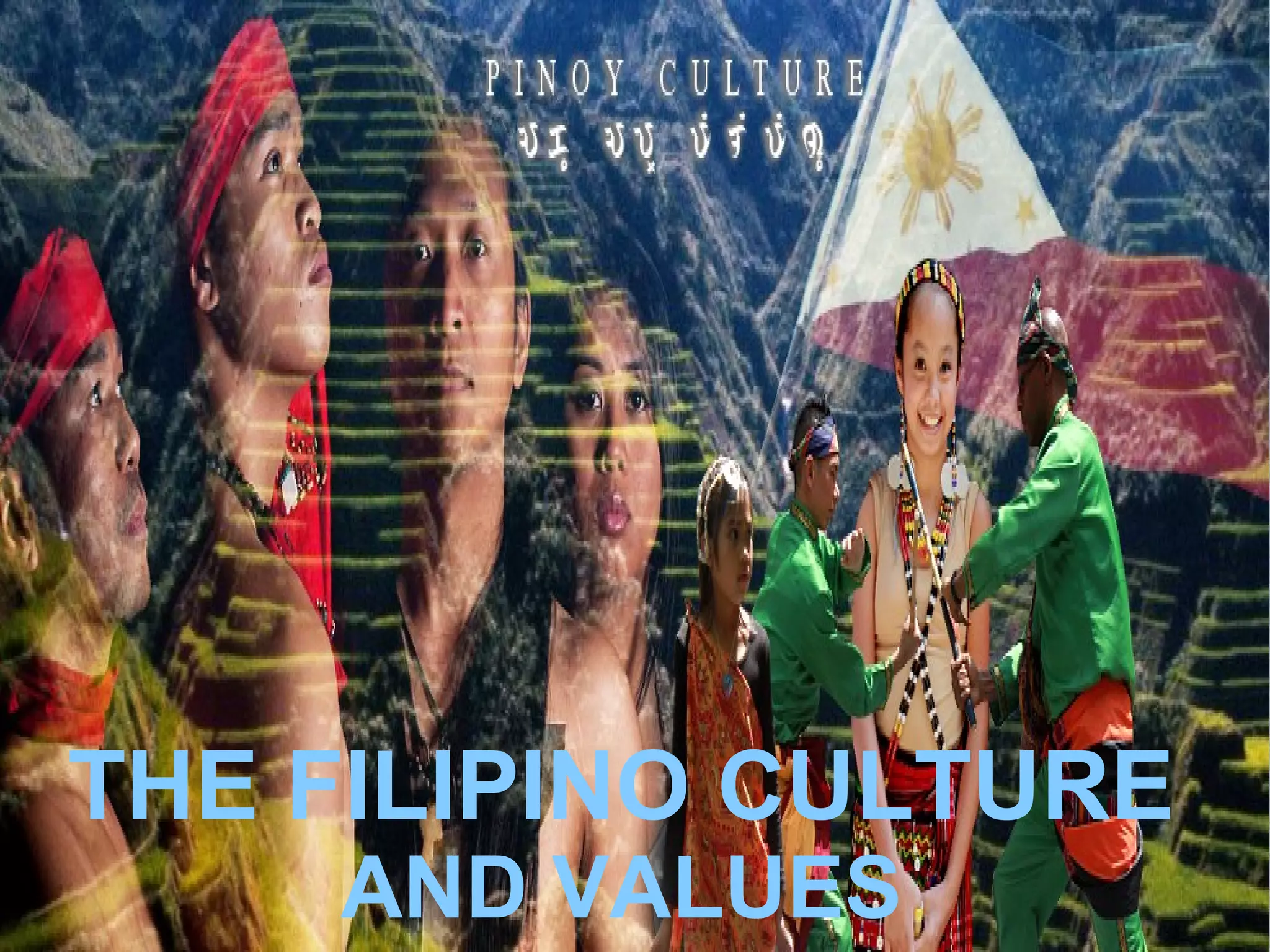
THE FILIPINO CULTURE
AND VALUES
Filipino culture- is the summation
of indigenous forces and foreign
influences that had come to bear
upon the people in varying degrees
during the last centuries.
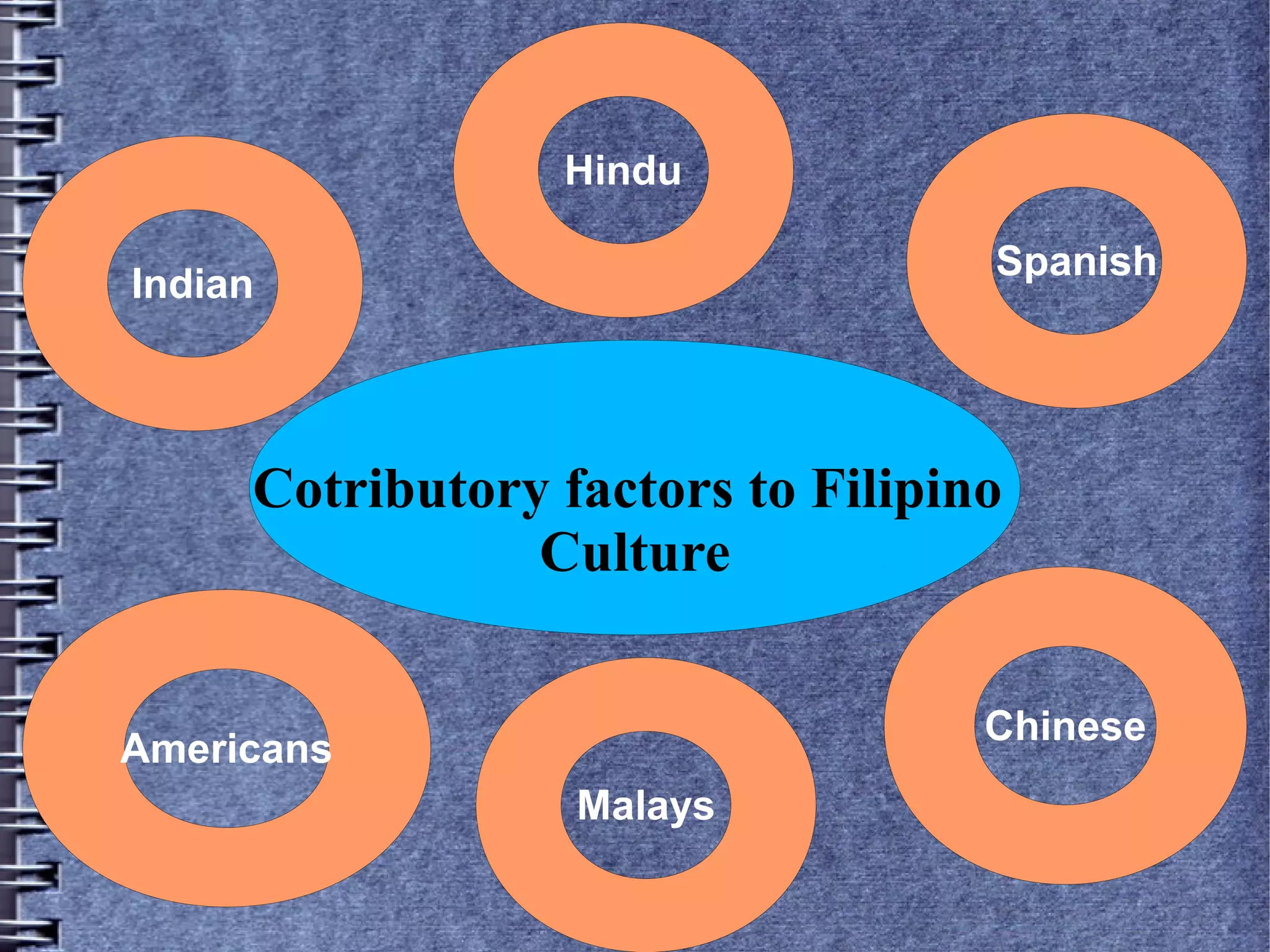
Cotributory factors to Filipino
Culture
Malays
Chinese
Indian
Hindu
Spanish
Americans
The Filipino Cultural Perspectives
1. The Traditional Concept
Hold that Filipino culture was developed due to the
conglomeration of the physical, intellectual, moral and
spriritual aspects.
2. The Nationalistic View
Regards culture as the summation of the needs of
people, the description of their past and present
condition, an expression of their values, thoughts and
emotions, and the dipiction of their historic struggles
too liberate themselves.
The Filipino Cultural Perspectives
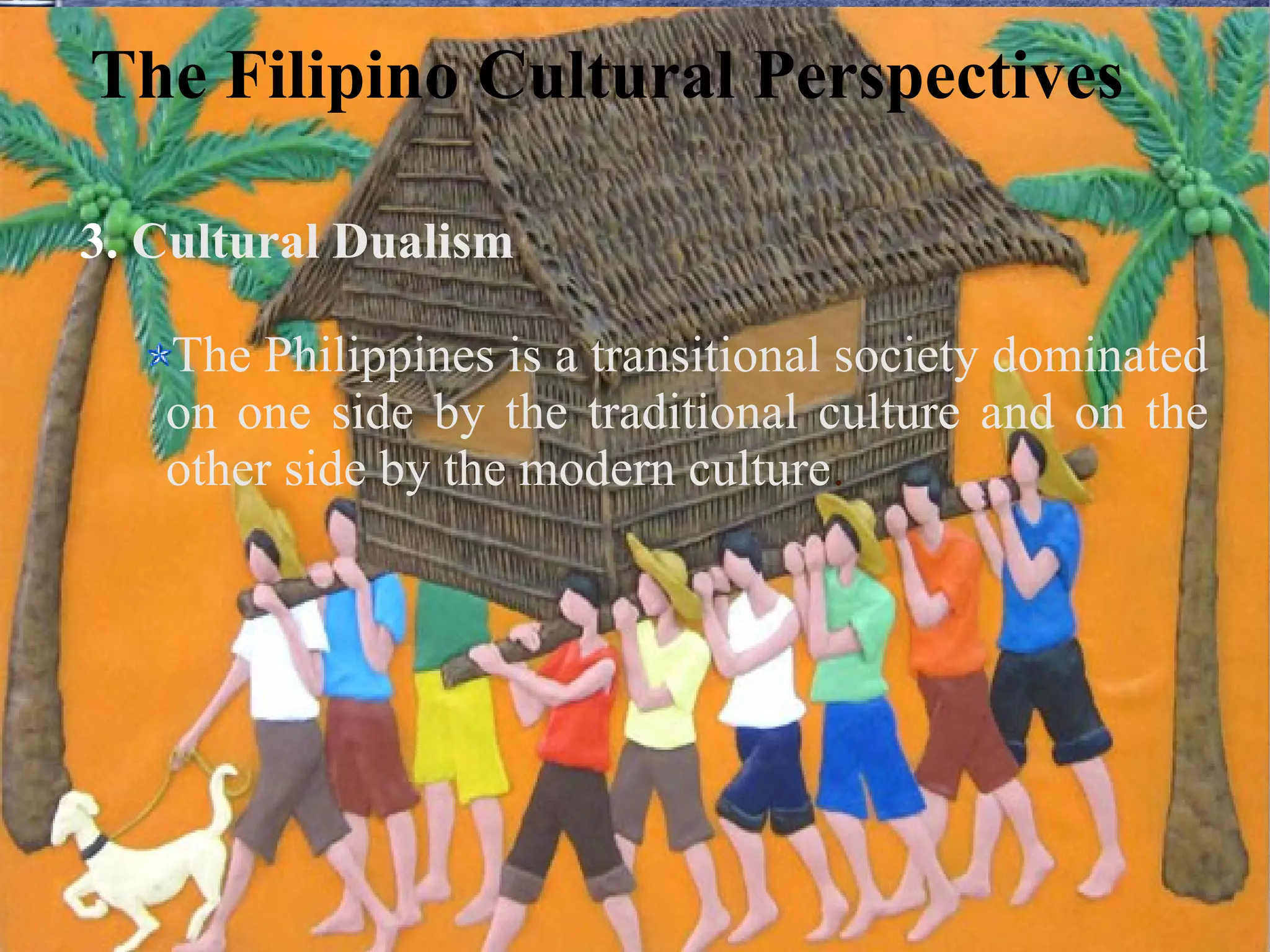
3. Cultural Dualism
The Philippines is a transitional society dominated
on one side by the traditional culture and on the
other side by the modern culture.
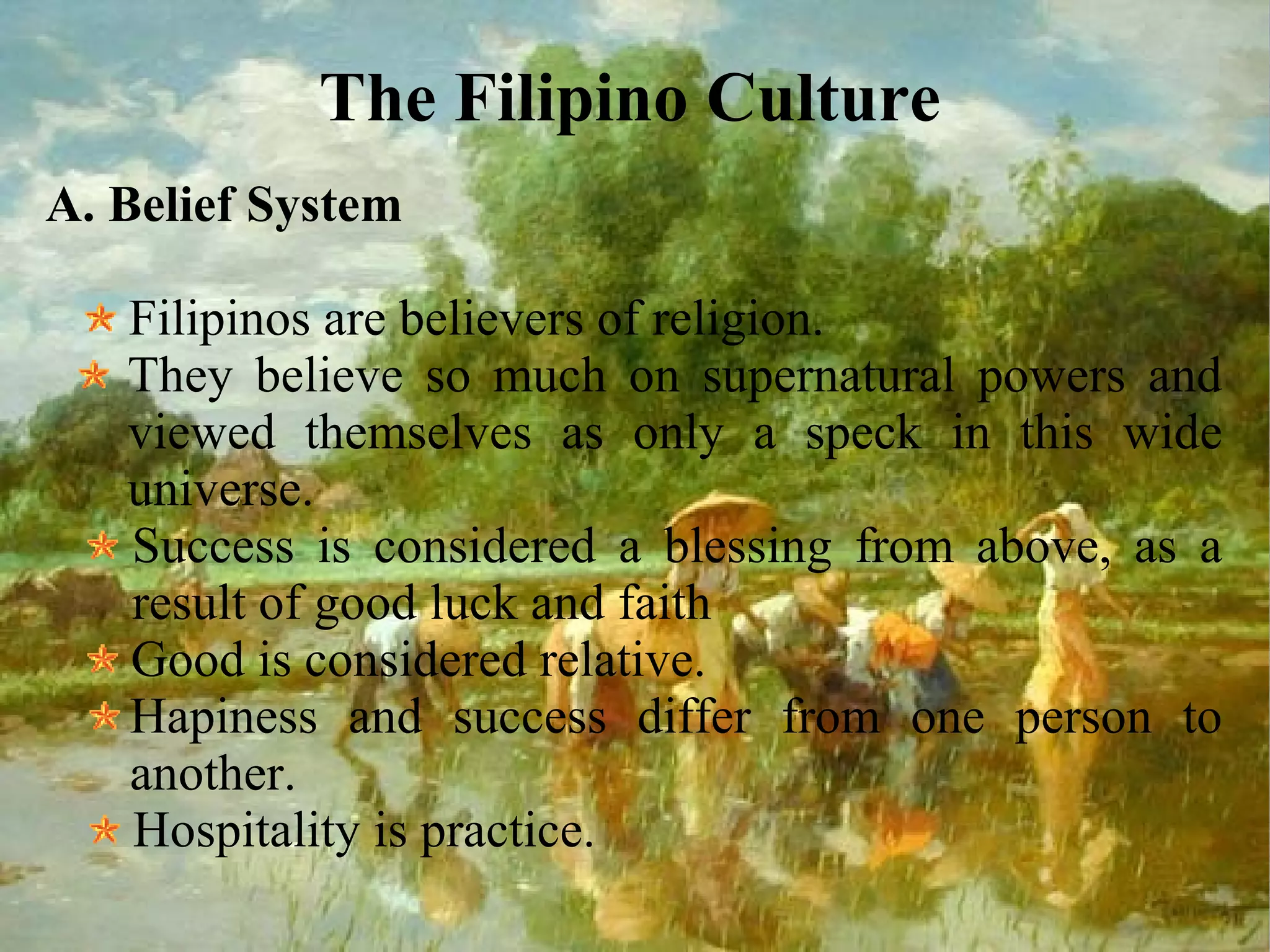
The Filipino Culture
A. Belief System
Filipinos are believers of religion.
They believe so much on supernatural powers and
viewed themselves as only a speck in this wide
universe.
Success is considered a blessing from above, as a
result of good luck and faith
Good is considered relative.
Hapiness and success differ from one person to
another.
Hospitality is practice.
B. Value System
Cultural values are shared assumptions of what is
right, good or important.
Guide man's behavior and action as he relates
himself in most situations in life.
Can best be seen from the aspects of personal and
social relationships.
Majority of Filipinos value more their honor
(karangalan) rather than wealth.
In decision- making, the Filipinos usually consult and
take into consideration the consensus of the family
members as the feelings of those who are to be
affected.
Filipinos love to mingle with other people
particularly with friends and relatives.
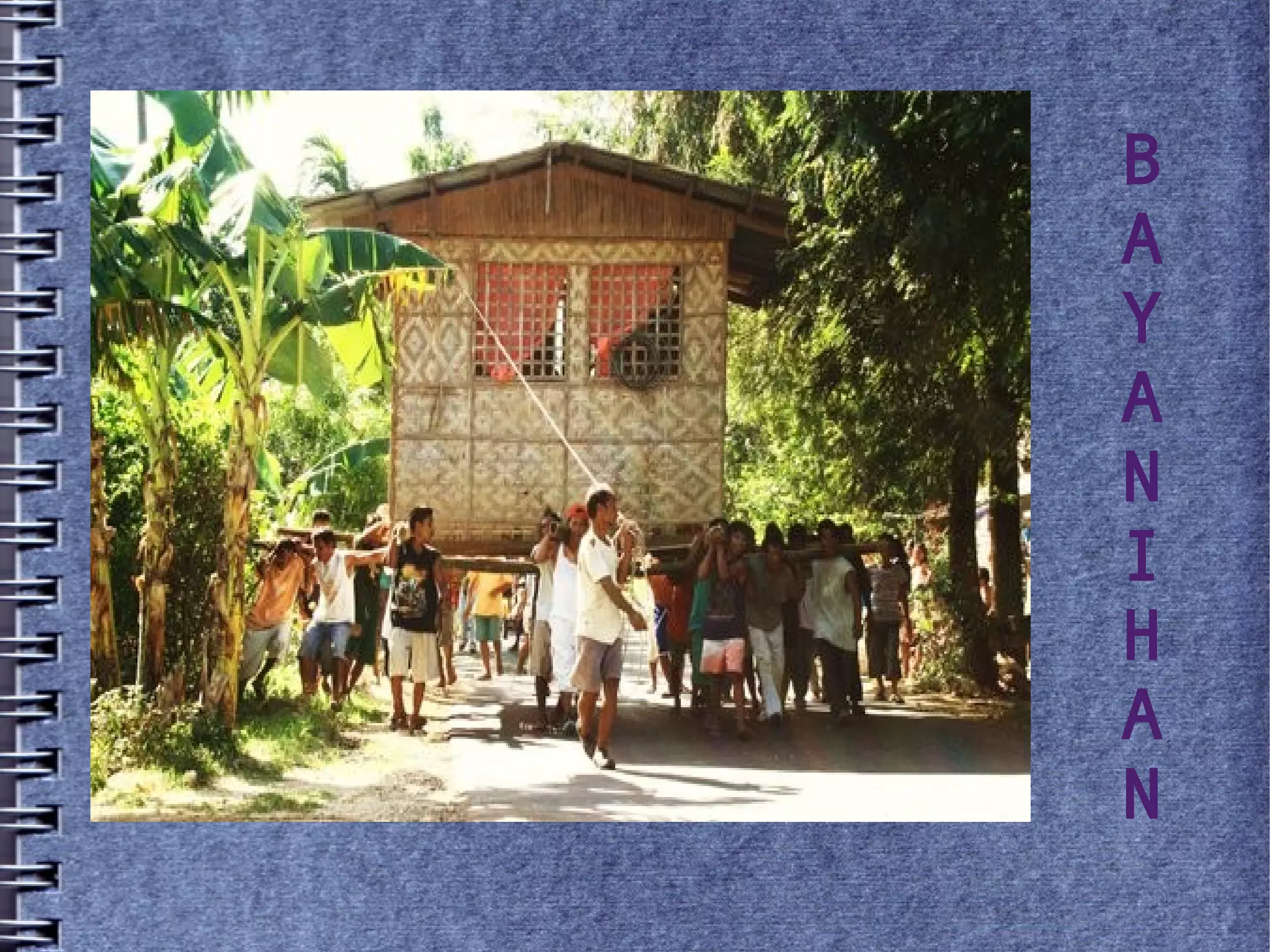
They engaged themselves in mutual cooperation
(Bayanihan)
Filipinos are friendly. They smile at people, even with
strangers
They are warm and simple
Filipino women are regardd and respected.
B. Value System
The Filipino Values (predominant)
1. Utang-na -loob
it is a technique of receprocity of debt of gratitude to
others within the family circle or primary group,
sometimes unlimited in nature, emotional rather than
financial or rational.
It is sign of marginal economy where no place is
available in bargaining, formal agreeements, written
contracts, specific rights and responsibilities.
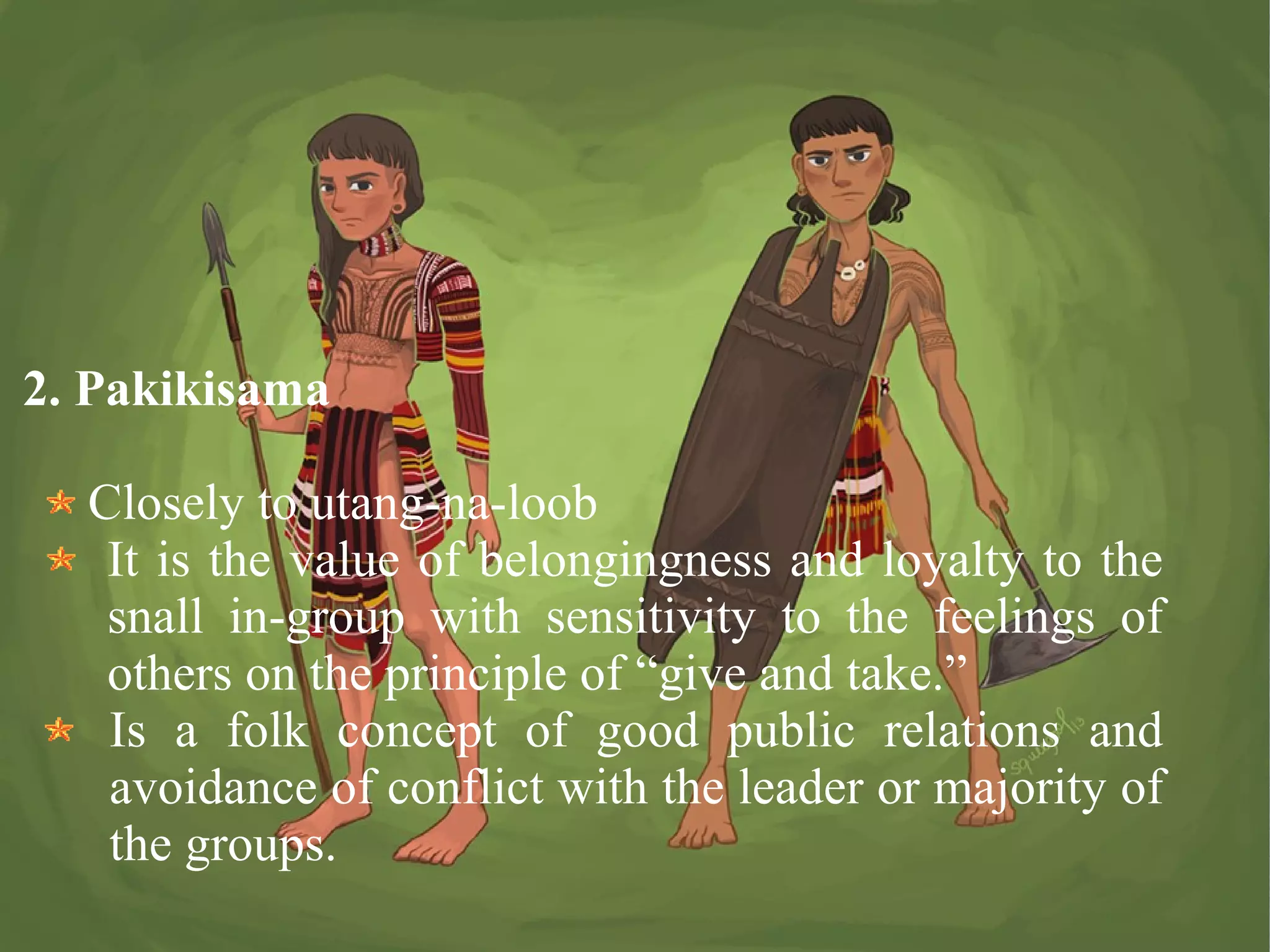
2. Pakikisama
Closely to utang-na-loob
It is the value of belongingness and loyalty to the
snall in-group with sensitivity to the feelings of
others on the principle of “give and take.”
Is a folk concept of good public relations and
avoidance of conflict with the leader or majority of
the groups.
3. Hiya
Controls a large extent the behavior of the
individual.
Dependent on others will think, say and do.
Because of hiya, a Filipino cannot say “NO”
even it is against his will to do what is being
requested.
4. Bahala na
Common expression among Filipinos and this rest
on the fatalistic outlook and strong dependence on
the “spirits” who will take care of everything if
they are really meant for a person.
5. Authoritarianism
It is the dependense of the Filipinos in a
paternalistic rather than in a stern way upon the
eldres of the family, upon their boss, if employed,
and upon people in authority as their father figure.
Commonly practice in the Filipino familoyt which
basically patriachal in nature.
The father is seen as the head that makes major
decisions affecting the family.
6. Individualism
Pattern of behavior which characterizes the
Filipino as self-centered
The desire to make the name for himself becomes
the primary motivation for success.
7. Amor-propio
Individual's highly emotional reaction to protect
his honor and dignity when they are threaten or
questioned and to retaliate.
Common forms of this are “hele hele bago quiere”
or pakipot which shows at aperson initially
refusing an offer even if he wants very much to
accept it.
Harana
S
E
R
E
N
A
D
E
B
A
Y
A
N
I
H
A
N
P
A
K
I
K
I
S
A
M
A
P
A
G
M
A
M
A
N
O
THANK YOU :)
Reported by: 
Mary Joy C. Oredito BSED­II

Filipino culture and values

  • 1.
  • 2.
    Filipino culture- isthe summation of indigenous forces and foreign influences that had come to bear upon the people in varying degrees during the last centuries.
  • 3.
    Cotributory factors toFilipino Culture Malays Chinese Indian Hindu Spanish Americans
  • 4.
    The Filipino CulturalPerspectives 1. The Traditional Concept Hold that Filipino culture was developed due to the conglomeration of the physical, intellectual, moral and spriritual aspects. 2. The Nationalistic View Regards culture as the summation of the needs of people, the description of their past and present condition, an expression of their values, thoughts and emotions, and the dipiction of their historic struggles too liberate themselves.
  • 5.
    The Filipino CulturalPerspectives 3. Cultural Dualism The Philippines is a transitional society dominated on one side by the traditional culture and on the other side by the modern culture.
  • 6.
    The Filipino Culture A.Belief System Filipinos are believers of religion. They believe so much on supernatural powers and viewed themselves as only a speck in this wide universe. Success is considered a blessing from above, as a result of good luck and faith Good is considered relative. Hapiness and success differ from one person to another. Hospitality is practice.
  • 7.
    B. Value System Culturalvalues are shared assumptions of what is right, good or important. Guide man's behavior and action as he relates himself in most situations in life. Can best be seen from the aspects of personal and social relationships. Majority of Filipinos value more their honor (karangalan) rather than wealth.
  • 8.
    In decision- making,the Filipinos usually consult and take into consideration the consensus of the family members as the feelings of those who are to be affected. Filipinos love to mingle with other people particularly with friends and relatives. They engaged themselves in mutual cooperation (Bayanihan) Filipinos are friendly. They smile at people, even with strangers They are warm and simple Filipino women are regardd and respected. B. Value System
  • 9.
    The Filipino Values(predominant) 1. Utang-na -loob it is a technique of receprocity of debt of gratitude to others within the family circle or primary group, sometimes unlimited in nature, emotional rather than financial or rational. It is sign of marginal economy where no place is available in bargaining, formal agreeements, written contracts, specific rights and responsibilities.
  • 10.
    2. Pakikisama Closely toutang-na-loob It is the value of belongingness and loyalty to the snall in-group with sensitivity to the feelings of others on the principle of “give and take.” Is a folk concept of good public relations and avoidance of conflict with the leader or majority of the groups.
  • 11.
    3. Hiya Controls alarge extent the behavior of the individual. Dependent on others will think, say and do. Because of hiya, a Filipino cannot say “NO” even it is against his will to do what is being requested.
  • 12.
    4. Bahala na Commonexpression among Filipinos and this rest on the fatalistic outlook and strong dependence on the “spirits” who will take care of everything if they are really meant for a person.
  • 13.
    5. Authoritarianism It isthe dependense of the Filipinos in a paternalistic rather than in a stern way upon the eldres of the family, upon their boss, if employed, and upon people in authority as their father figure. Commonly practice in the Filipino familoyt which basically patriachal in nature. The father is seen as the head that makes major decisions affecting the family.
  • 14.
    6. Individualism Pattern ofbehavior which characterizes the Filipino as self-centered The desire to make the name for himself becomes the primary motivation for success.
  • 15.
    7. Amor-propio Individual's highlyemotional reaction to protect his honor and dignity when they are threaten or questioned and to retaliate. Common forms of this are “hele hele bago quiere” or pakipot which shows at aperson initially refusing an offer even if he wants very much to accept it.
  • 16.
  • 17.
  • 18.
  • 19.
  • 20.