LESSON 2: FACTORS AFFECTING READING
FPPT.com
LEARNING OBJECTIVES:
A. Distinguish the factors affecting reading; and
B. Evaluate a child’s case on the factor/s affecting
Let the morning bring
me word of your
unfailing love, for I have
put my trust in you.
Show me the way I
should go, for to you I
entrust my life.
PSALM 143:8
REVIEW
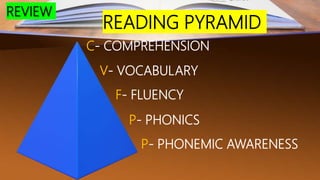
READING PYRAMID
P- PHONEMIC AWARENESS
P- PHONICS
F- FLUENCY
V- VOCABULARY
C- COMPREHENSION
2018 PISA results, DepEd assessment and
studies will aid in reform plan towards
globalizing the quality of PH basic education
TOP 10 FROM THE TOP TOP 10 FROM THE
BOTTOM
Data Source: PISA 2018 Results (Volume I): What Students Know and Can Do, OECD (2019), page
18
retrieved from https://www.oecd.org/pisa/Combined_Executive_Summaries_PISA_2018.pdf
FACTORS ACCORDING TO
EXPERTS:
1. FREDERICK PEREZ-President, Reading
Association of the Philippines
a. Students are used to read narrative texts
and not the informational or expository
texts.
b. Poor connectivity in the far-flung areas.
c. Filipino Teachers are not equipped with new
21st century teaching techniques and should
undergo reading instruction strategy
training.
Data Source: ABS-CBN News Channel (ANC), Matters of Fact an Interview with Christian
Esguerra aired on December 04, 2019
2. SEC. LEONOR BRIONES, Philippine Education
Department Secretary
a. Hunger and Poverty
b. School Facilities and Educational Resources
c. Teacher-Student Ratio and Classroom Size
d. Curriculum and Pedagogy
3. ARNEL SALVA, Filipino Head Teacher of Sauyo
High School
a. Mass Promotion
FACTORS ACCORDING TO
EXPERTS:
Data Source: ABS-CBN News Channel (ANC), Headstart an Interview with Karen Davila aired on
December 09, 2019
LESSON 2: FACTORS AFFECTING READING
FPPT.com
LEARNING OBJECTIVES:
A. Distinguish the factors affecting reading; and
B. Evaluate a child’s case on the factor/s affecting
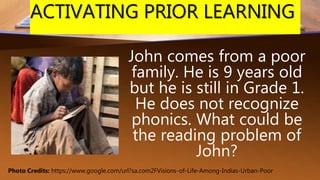
ACTIVATING PRIOR LEARNING
John comes from a poor
family. He is 9 years old
but he is still in Grade 1.
He does not recognize
phonics. What could be
the reading problem of
John?
Photo Credits: https://www.google.com/url?sa.com2FVisions-of-Life-Among-Indias-Urban-Poor
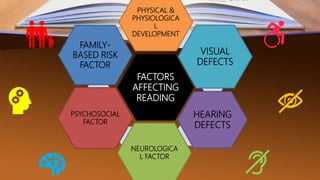
FACTORS
AFFECTING
READING
PHYSICAL &
PHYSIOLOGICA
L
DEVELOPMENT
VISUAL
DEFECTS
HEARING
DEFECTS
NEUROLOGICA
L FACTOR
PSYCHOSOCIAL
FACTOR
FAMILY-
BASED RISK
FACTOR
A. PHYSICAL AND PHYSIOLOGICAL
FACTOR
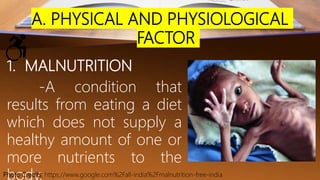
1. MALNUTRITION
-A condition that
results from eating a diet
which does not supply a
healthy amount of one or
more nutrients to the
Photo Credits: https://www.google.com%2Fall-india%2Fmalnutrition-free-india
A. PHYSICAL AND PHYSIOLOGICAL
FACTOR
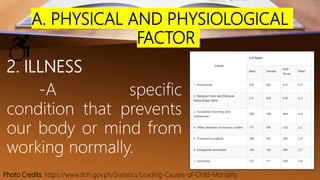
2. ILLNESS
-A specific
condition that prevents
our body or mind from
working normally.
Photo Credits: https://www.doh.gov.ph/Statistics/Leading-Causes-of-Child-Mortality
A. PHYSICAL AND PHYSIOLOGICAL
FACTOR
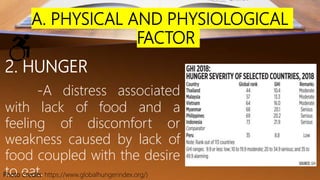
2. HUNGER
-A distress associated
with lack of food and a
feeling of discomfort or
weakness caused by lack of
food coupled with the desire
to eat.Photo Credits: https://www.globalhungerindex.org/)
B. VISUAL DEFECTS
A. REFRACTIVE ERROR
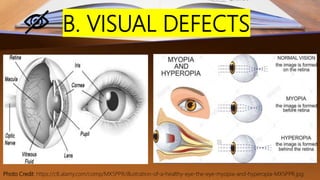
1. MYOPIA OR NEARSIGHTEDNESS- a common
vision condition in which you can see objects near to
you clearly, but objects farther away are blurry.
2. HYPEROPIA OR FARSIGHTEDNESS– a common
vision condition in which you can see distant objects
clearly, but objects nearby may be blurry. The degree
of your farsightedness influences your focusing ability.
B. VISUAL DEFECTS
Photo Credit: https://c8.alamy.com/comp/MX5PPR/illustration-of-a-healthy-eye-the-eye-myopia-and-hyperopia-MX5PPR.jpg
B. VISUAL DEFECTS
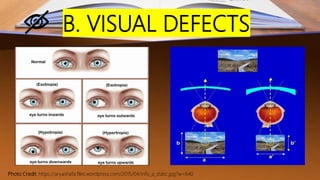
A. BINOCULAR DIFFICULTIES
1. STRABISMUS
-A condition in which the eyes do not properly
align with each other when looking at an object.
2. ANISEIKONIA
-An ocular condition where there is a
significant difference in the perceived size of images, it
can occur as an overall difference between the two
B. VISUAL DEFECTS
Photo Credit: https://aryashafa.files.wordpress.com/2015/04/info_a_static.jpg?w=640
C. HEARING DEFECTS
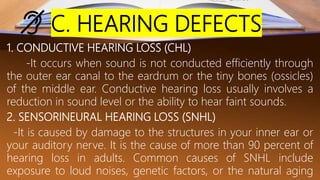
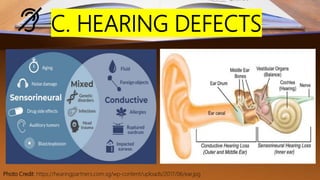
1. CONDUCTIVE HEARING LOSS (CHL)
-It occurs when sound is not conducted efficiently through
the outer ear canal to the eardrum or the tiny bones (ossicles)
of the middle ear. Conductive hearing loss usually involves a
reduction in sound level or the ability to hear faint sounds.
2. SENSORINEURAL HEARING LOSS (SNHL)
-It is caused by damage to the structures in your inner ear or
your auditory nerve. It is the cause of more than 90 percent of
hearing loss in adults. Common causes of SNHL include
exposure to loud noises, genetic factors, or the natural aging
C. HEARING DEFECTS
Photo Credit: https://hearingpartners.com.sg/wp-content/uploads/2017/06/ear.jpg
D. NEUROLOGICAL DEFECTS
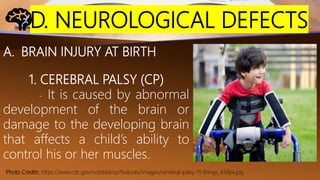
A. BRAIN INJURY AT BIRTH
1. CEREBRAL PALSY (CP)
- It is caused by abnormal
development of the brain or
damage to the developing brain
that affects a child’s ability to
control his or her muscles.
Photo Credits: https://www.cdc.gov/ncbddd/cp/features/images/cerebral-palsy-11-things_456px.jpg
D. NEUROLOGICAL DEFECTS
B. BRAIN DEFECTS (INHERITED)
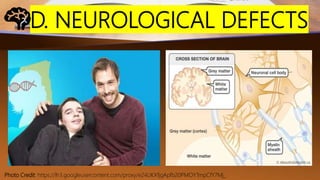
1. LEUKODYSTROPHY
- A disease that affects the cells of the brain
specifically, the myelin sheath, the material that
surrounds and protects nerve cells. Damage to this
sheath slows down or blocks messages between the
brain and the rest of the body. It an cause problems
with movement, vision, hearing, balance, ability to eat,
memory, behavior, and thought.
D. NEUROLOGICAL DEFECTS
Photo Credit: https://lh3.googleusercontent.com/proxy/e24UKXfjgApfb20PMOYTmpCfY7Mj_
D. NEUROLOGICAL DEFECTS
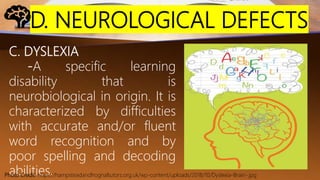
C. DYSLEXIA
-A specific learning
disability that is
neurobiological in origin. It is
characterized by difficulties
with accurate and/or fluent
word recognition and by
poor spelling and decoding
abilities.Photo Credit: https://hampsteadandfrognaltutors.org.uk/wp-content/uploads/2018/10/Dyslexia-Brain-.jpg
E. PSYCHOSOCIAL FACTOR
A.EMOTIONAL PROBLEMS
B.PERSONALITY DEVELOPMENT
C.MOTIVATION
D.READING INTERESTS
F. FAMILY-BASED RISK FACTORS
A. FAMILY HISTORY OF READING
DIFFICULTIES
B. HOME LITERACY ENVIRONMENT
C. OPPORTUNITIES FOR VERBAL
INTERACTION
D. HOME LANGUAGE OTHER THAN
ENGLISH
Among the pupils of Teacher Camelia there is a student
that challenged her the most. And this student is Anna, who is ten
years old and is still in Grade 3. She can’t read well because she
has cerebral palsy, and sometimes she is not interested in reading.
Her parents cannot enroll her in a specialized private school to
address her needs because they are just selling banana cues in the
townsite.
 What are the factors to be considered that affect the reading
skills of Anna?
Instruction: Analyze the situation below and distinguish
the factor that affects the reading ability of the child:
Teacher Sheila has three slow-reader students. One student is
Anna who is 10 years old and in Grade 3. She can’t read well
because she is deaf. Another student is Jessa who is in Grade 2.
She can’t read well because she is not interested in reading
activities. Another student is Michael who is in Grade 1 and 12
years old. His family can’t afford his education is late. What are
the factors affecting the reading of these students?
REFERENCE
Tejero, E. & Catchillar, Gerry C. (2006). Teaching
Reading in Elementary Grades. Mandaluyong City,
National Bookstore

Factors Affecting Reading and the Reading Pyramid

  • 1.
    LESSON 2: FACTORSAFFECTING READING FPPT.com LEARNING OBJECTIVES: A. Distinguish the factors affecting reading; and B. Evaluate a child’s case on the factor/s affecting
  • 2.
    Let the morningbring me word of your unfailing love, for I have put my trust in you. Show me the way I should go, for to you I entrust my life. PSALM 143:8
  • 3.
    REVIEW READING PYRAMID P- PHONEMICAWARENESS P- PHONICS F- FLUENCY V- VOCABULARY C- COMPREHENSION
  • 4.
    2018 PISA results,DepEd assessment and studies will aid in reform plan towards globalizing the quality of PH basic education TOP 10 FROM THE TOP TOP 10 FROM THE BOTTOM Data Source: PISA 2018 Results (Volume I): What Students Know and Can Do, OECD (2019), page 18 retrieved from https://www.oecd.org/pisa/Combined_Executive_Summaries_PISA_2018.pdf
  • 5.
    FACTORS ACCORDING TO EXPERTS: 1.FREDERICK PEREZ-President, Reading Association of the Philippines a. Students are used to read narrative texts and not the informational or expository texts. b. Poor connectivity in the far-flung areas. c. Filipino Teachers are not equipped with new 21st century teaching techniques and should undergo reading instruction strategy training. Data Source: ABS-CBN News Channel (ANC), Matters of Fact an Interview with Christian Esguerra aired on December 04, 2019
  • 6.
    2. SEC. LEONORBRIONES, Philippine Education Department Secretary a. Hunger and Poverty b. School Facilities and Educational Resources c. Teacher-Student Ratio and Classroom Size d. Curriculum and Pedagogy 3. ARNEL SALVA, Filipino Head Teacher of Sauyo High School a. Mass Promotion FACTORS ACCORDING TO EXPERTS: Data Source: ABS-CBN News Channel (ANC), Headstart an Interview with Karen Davila aired on December 09, 2019
  • 7.
    LESSON 2: FACTORSAFFECTING READING FPPT.com LEARNING OBJECTIVES: A. Distinguish the factors affecting reading; and B. Evaluate a child’s case on the factor/s affecting
  • 8.
    ACTIVATING PRIOR LEARNING Johncomes from a poor family. He is 9 years old but he is still in Grade 1. He does not recognize phonics. What could be the reading problem of John? Photo Credits: https://www.google.com/url?sa.com2FVisions-of-Life-Among-Indias-Urban-Poor
  • 9.
  • 10.
    A. PHYSICAL ANDPHYSIOLOGICAL FACTOR 1. MALNUTRITION -A condition that results from eating a diet which does not supply a healthy amount of one or more nutrients to the Photo Credits: https://www.google.com%2Fall-india%2Fmalnutrition-free-india
  • 11.
    A. PHYSICAL ANDPHYSIOLOGICAL FACTOR 2. ILLNESS -A specific condition that prevents our body or mind from working normally. Photo Credits: https://www.doh.gov.ph/Statistics/Leading-Causes-of-Child-Mortality
  • 12.
    A. PHYSICAL ANDPHYSIOLOGICAL FACTOR 2. HUNGER -A distress associated with lack of food and a feeling of discomfort or weakness caused by lack of food coupled with the desire to eat.Photo Credits: https://www.globalhungerindex.org/)
  • 13.
    B. VISUAL DEFECTS A.REFRACTIVE ERROR 1. MYOPIA OR NEARSIGHTEDNESS- a common vision condition in which you can see objects near to you clearly, but objects farther away are blurry. 2. HYPEROPIA OR FARSIGHTEDNESS– a common vision condition in which you can see distant objects clearly, but objects nearby may be blurry. The degree of your farsightedness influences your focusing ability.
  • 14.
    B. VISUAL DEFECTS PhotoCredit: https://c8.alamy.com/comp/MX5PPR/illustration-of-a-healthy-eye-the-eye-myopia-and-hyperopia-MX5PPR.jpg
  • 15.
    B. VISUAL DEFECTS A.BINOCULAR DIFFICULTIES 1. STRABISMUS -A condition in which the eyes do not properly align with each other when looking at an object. 2. ANISEIKONIA -An ocular condition where there is a significant difference in the perceived size of images, it can occur as an overall difference between the two
  • 16.
    B. VISUAL DEFECTS PhotoCredit: https://aryashafa.files.wordpress.com/2015/04/info_a_static.jpg?w=640
  • 17.
    C. HEARING DEFECTS 1.CONDUCTIVE HEARING LOSS (CHL) -It occurs when sound is not conducted efficiently through the outer ear canal to the eardrum or the tiny bones (ossicles) of the middle ear. Conductive hearing loss usually involves a reduction in sound level or the ability to hear faint sounds. 2. SENSORINEURAL HEARING LOSS (SNHL) -It is caused by damage to the structures in your inner ear or your auditory nerve. It is the cause of more than 90 percent of hearing loss in adults. Common causes of SNHL include exposure to loud noises, genetic factors, or the natural aging
  • 18.
    C. HEARING DEFECTS PhotoCredit: https://hearingpartners.com.sg/wp-content/uploads/2017/06/ear.jpg
  • 19.
    D. NEUROLOGICAL DEFECTS A.BRAIN INJURY AT BIRTH 1. CEREBRAL PALSY (CP) - It is caused by abnormal development of the brain or damage to the developing brain that affects a child’s ability to control his or her muscles. Photo Credits: https://www.cdc.gov/ncbddd/cp/features/images/cerebral-palsy-11-things_456px.jpg
  • 20.
    D. NEUROLOGICAL DEFECTS B.BRAIN DEFECTS (INHERITED) 1. LEUKODYSTROPHY - A disease that affects the cells of the brain specifically, the myelin sheath, the material that surrounds and protects nerve cells. Damage to this sheath slows down or blocks messages between the brain and the rest of the body. It an cause problems with movement, vision, hearing, balance, ability to eat, memory, behavior, and thought.
  • 21.
    D. NEUROLOGICAL DEFECTS PhotoCredit: https://lh3.googleusercontent.com/proxy/e24UKXfjgApfb20PMOYTmpCfY7Mj_
  • 22.
    D. NEUROLOGICAL DEFECTS C.DYSLEXIA -A specific learning disability that is neurobiological in origin. It is characterized by difficulties with accurate and/or fluent word recognition and by poor spelling and decoding abilities.Photo Credit: https://hampsteadandfrognaltutors.org.uk/wp-content/uploads/2018/10/Dyslexia-Brain-.jpg
  • 23.
    E. PSYCHOSOCIAL FACTOR A.EMOTIONALPROBLEMS B.PERSONALITY DEVELOPMENT C.MOTIVATION D.READING INTERESTS
  • 24.
    F. FAMILY-BASED RISKFACTORS A. FAMILY HISTORY OF READING DIFFICULTIES B. HOME LITERACY ENVIRONMENT C. OPPORTUNITIES FOR VERBAL INTERACTION D. HOME LANGUAGE OTHER THAN ENGLISH
  • 26.
    Among the pupilsof Teacher Camelia there is a student that challenged her the most. And this student is Anna, who is ten years old and is still in Grade 3. She can’t read well because she has cerebral palsy, and sometimes she is not interested in reading. Her parents cannot enroll her in a specialized private school to address her needs because they are just selling banana cues in the townsite.  What are the factors to be considered that affect the reading skills of Anna?
  • 27.
    Instruction: Analyze thesituation below and distinguish the factor that affects the reading ability of the child: Teacher Sheila has three slow-reader students. One student is Anna who is 10 years old and in Grade 3. She can’t read well because she is deaf. Another student is Jessa who is in Grade 2. She can’t read well because she is not interested in reading activities. Another student is Michael who is in Grade 1 and 12 years old. His family can’t afford his education is late. What are the factors affecting the reading of these students?
  • 28.
    REFERENCE Tejero, E. &Catchillar, Gerry C. (2006). Teaching Reading in Elementary Grades. Mandaluyong City, National Bookstore

Editor's Notes

  • #2 a circumstance, fact, or influence that contributes to a result or outcome.
  • #5 Data is from https://pia.gov.ph/news/articles/1031148 published on Dec. 4, 2019 First time, the Philippines joined the Programme for International Student Assessment (PISA) of the Organization for Economic Co-operation and Development (OECD) in 2018-Comparison of education attainment across the world Conducted every 3 years since 2000, PISA is one of the most famous student assessments worldwide, and certainly among the most influential in terms of research and policy. Primarily PISA “measures 15-year-olds’ ability to use their reading, mathematics and science knowledge and skills to meet real-life challenges.” Among 79 participating government education departments/countries the Philippines ranked dead last in reading, and we ranked second last in both mathematics and science
  • #6 1. Factor is a circumstance, fact, or influence that contributes to a result or outcome. 2. An ANC-Matters of Fact Interview dated December 09, 2019 3. expository texts (graph analysis, argumentative essay, news articles et cetera)
  • #7 Mixed Stratified Random Sampling both Private and Public School Students
  • #8 a circumstance, fact, or influence that contributes to a result or outcome.
  • #9 Analysis: 1. What do you think is the factor that affects the reading ability of John? 2. What should be the level of John based on his age?
  • #11 Roughly 7 per cent of children are too thin for their height. Moreover, a tenth of Filipino adolescents are now overweight. Increased vulnerability to disease due to poor health-seeking behavior, incomplete immunization, poor hygiene and care practices, and inadequate diet – both in quantity and quality – causes undernutrition in early childhood. Each day, around 95 children in our country die from malnutrition, the United Nations Children’s Emergency Fund (UNICEF)
  • #13 The brain triggers the release of a hormone called ghrelin in response to an empty stomach or in anticipation of the next meal. Ghrelin signals the body to release stomach acids to digest food. If food is not consumed, the stomach acids begin to attack the lining of the stomach, causing hunger pains.
  • #14 Refractive error means that the shape of your eye does not bend light correctly, resulting in a blurred image. The main types of refractive errors are myopia (nearsightedness), hyperopia (farsightedness)
  • #15 Refractive error means that the shape of your eye does not bend light correctly, resulting in a blurred image. The main types of refractive errors are myopia (nearsightedness), hyperopia (farsightedness) https://c8.alamy.com/comp/MX5PPR/illustration-of-a-healthy-eye-the-eye-myopia-and-hyperopia-MX5PPR.jpg
  • #16 Binocular vision disorders are conditions where the eyes are unable to align properly. This causes overcorrection or overcompensation for the misalignment, creating strain on the muscles in the eye because he or she is constantly trying to re-align the eyes to eliminate blurriness and double-vision
  • #17 Binocular vision disorders are conditions where the eyes are unable to align properly. This causes overcorrection or overcompensation for the misalignment, creating strain on the muscles in the eye because he or she is constantly trying to re-align the eyes to eliminate blurriness and double-vision
  • #18 otitis media – an infection of the middle ear in which an accumulation of fluid may interfere with the movement of the eardrum and ossicles Otosclerosis (a hereditary disorder in which a bony growth forms around a small bone in the middle ear, preventing it from vibrating when stimulated by sound
  • #19 Refractive error means that the shape of your eye does not bend light correctly, resulting in a blurred image. The main types of refractive errors are myopia (nearsightedness), hyperopia (farsightedness) https://c8.alamy.com/comp/MX5PPR/illustration-of-a-healthy-eye-the-eye-myopia-and-hyperopia-MX5PPR.jpg