Topic - Jute Fibre
Prepared by :Ashwini Bansode
Subject. : Pharmacognosy and Phytochemistry
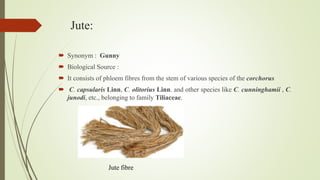
Jute:
 Synonym : Gunny
 Biological Source :
 It consists of phloem fibres from the stem of various species of the corchorus
 C. capsularis Linn, C. olitorius Linn. and other species like C. cunninghamii , C.
junodi, etc., belonging to family Tiliaceae.
Jute fibre
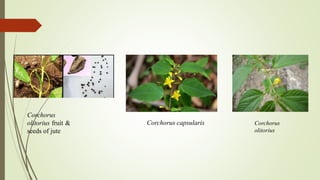
Corchorus
olitorius fruit &
seeds of jute
Corchorus
olitorius
Corchorus capsularis
Geographical source :
 Corchorus is a genus with 40-100 species of flowering plants. It is native to tropical and
subtropical regions throughout the world. Various species yield fibre .
 The chief sources of commercial jute are two Indian species :
 The C. capsularis and C. otitorius.
 West Bengal and Assam.
 These species are grown in Ganges and Brahmaputra valleys.
History :
 For past many centuries, Jute has been an integral part of Bengali culture. In the late 19th and early
20th centuries, much of the raw jute fibres were exported to the United Kingdom.
 In'50s and'60s (when nylon and polythene were rarely used), Pakistan was the world's lead jute
producer. During those periods it had earned its money through jute of East Pakistan, (now called
the Bangladesh). Jute was called the'Golden fibre'of Bangladesh because it brought the major
portion of the foreign currency for the country. World's largest jute trade and jute processing
economy was located in Bangladesh.
 Adamjee Jute Mill in Narayanganj , Bangladesh was world's largest jute mill with 1939 looms
and 25, 000 employees up to 2002. Presently Sonali Aansh is one of the largest jute products
manufacturers in Bangladesh.
Description :
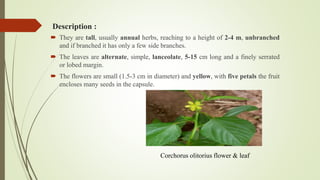
 They are tall, usually annual herbs, reaching to a height of 2-4 m, unbranched
and if branched it has only a few side branches.
 The leaves are alternate, simple, lanceolate, 5-15 cm long and a finely serrated
or lobed margin.
 The flowers are small (1.5-3 cm in diameter) and yellow, with five petals the fruit
encloses many seeds in the capsule.
Corchorus olitorius flower & leaf
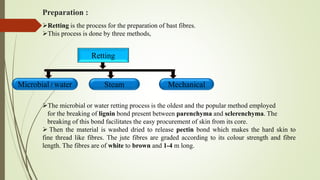
Retting is the process for the preparation of bast fibres.
This process is done by three methods,
The microbial or water retting process is the oldest and the popular method employed
for the breaking of lignin bond present between parenchyma and sclerenchyma. The
breaking of this bond facilitates the easy procurement of skin from its core.
 Then the material is washed dried to release pectin bond which makes the hard skin to
fine thread like fibres. The jute fibres are graded according to its colour strength and fibre
length. The fibres are of white to brown and 1-4 m long.
Preparation :
Retting
Steam
Microbial / water Mechanical
Cultivation, collection & preparation of jute :
• Jute requires 160–200 cm of rainfall weekly with extra needed during the
sowing period.
• River basins or alluvial or loamy soils are best for jute cultivation.
• Jute cultivation in red soils may require high dose of manure and pH
range between 4.8-5.8 is best for its cultivation
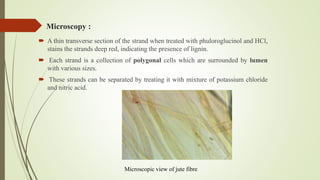
Microscopy :
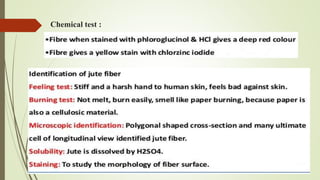
 A thin transverse section of the strand when treated with phuloroglucinol and HCl,
stains the strands deep red, indicating the presence of lignin.
 Each strand is a collection of polygonal cells which are surrounded by lumen
with various sizes.
 These strands can be separated by treating it with mixture of potassium chloride
and nitric acid.
Microscopic view of jute fibre
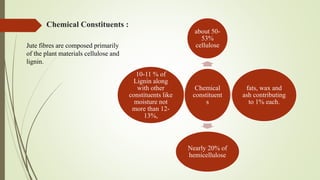
Jute fibres are composed primarily
of the plant materials cellulose and
lignin.
Chemical Constituents :
Chemical
constituent
s
about 50-
53%
cellulose
fats, wax and
ash contributing
to 1% each.
Nearly 20% of
hemicellulose
10-11 % of
Lignin along
with other
constituents like
moisture not
more than 12-
13%,
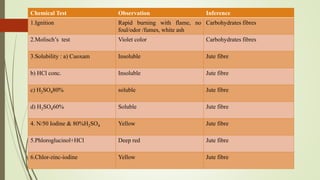
Chemical test :
Chemical Test Observation Inference
1.Ignition Rapid burning with flame, no
foul/odor /fumes, white ash
Carbohydrates fibres
2.Molisch’s test Violet color Carbohydrates fibres
3.Solubility : a) Cuoxam Insoluble Jute fibre
b) HCl conc. Insoluble Jute fibre
c) H2SO480% soluble Jute fibre
d) H2SO460% Soluble Jute fibre
4. N/50 Iodine & 80%H2SO4 Yellow Jute fibre
5.Phloroglucinol+HCl Deep red Jute fibre
6.Chlor-zinc-iodine Yellow Jute fibre
Medicinal use of Jute:
The leaves are appetizer, carminative, demulcent, laxative, stimulant
and stomachic.
An infusion is used in the treatment of dysentery, fevers, dyspepsia and
liver disorders. A decoction of the roots and unripe fruits is used in the
treatment of dysentery.
The seeds contain a substance that has a similar action on the heart to
digitalin (from Digitalis spp.), but less intense in its action.
Uses :
 It has a large range of use (about 1000 uses). It is listed as the second most important
vegetable fibre after cotton.
 Jute is used chiefly to make cloth for wrapping bales of raw cotton, in the preparation
of sacks and coarse cloth.
 They are also woven into curtains, chair coverings, carpets, Hessian cloth very fine
threads of jute can be made into imitation silk and also in the making of paper. It is
even used in the manufacture of tows, padding splints, filtering and straining
medium. Jute is used for the preparation of coarse bags.

JUTE.pptx

  • 1.
    Topic - JuteFibre Prepared by :Ashwini Bansode Subject. : Pharmacognosy and Phytochemistry
  • 2.
    Jute:  Synonym :Gunny  Biological Source :  It consists of phloem fibres from the stem of various species of the corchorus  C. capsularis Linn, C. olitorius Linn. and other species like C. cunninghamii , C. junodi, etc., belonging to family Tiliaceae. Jute fibre
  • 3.
    Corchorus olitorius fruit & seedsof jute Corchorus olitorius Corchorus capsularis
  • 4.
    Geographical source : Corchorus is a genus with 40-100 species of flowering plants. It is native to tropical and subtropical regions throughout the world. Various species yield fibre .  The chief sources of commercial jute are two Indian species :  The C. capsularis and C. otitorius.  West Bengal and Assam.  These species are grown in Ganges and Brahmaputra valleys.
  • 5.
    History :  Forpast many centuries, Jute has been an integral part of Bengali culture. In the late 19th and early 20th centuries, much of the raw jute fibres were exported to the United Kingdom.  In'50s and'60s (when nylon and polythene were rarely used), Pakistan was the world's lead jute producer. During those periods it had earned its money through jute of East Pakistan, (now called the Bangladesh). Jute was called the'Golden fibre'of Bangladesh because it brought the major portion of the foreign currency for the country. World's largest jute trade and jute processing economy was located in Bangladesh.  Adamjee Jute Mill in Narayanganj , Bangladesh was world's largest jute mill with 1939 looms and 25, 000 employees up to 2002. Presently Sonali Aansh is one of the largest jute products manufacturers in Bangladesh.
  • 6.
    Description :  Theyare tall, usually annual herbs, reaching to a height of 2-4 m, unbranched and if branched it has only a few side branches.  The leaves are alternate, simple, lanceolate, 5-15 cm long and a finely serrated or lobed margin.  The flowers are small (1.5-3 cm in diameter) and yellow, with five petals the fruit encloses many seeds in the capsule. Corchorus olitorius flower & leaf
  • 7.
    Retting is theprocess for the preparation of bast fibres. This process is done by three methods, The microbial or water retting process is the oldest and the popular method employed for the breaking of lignin bond present between parenchyma and sclerenchyma. The breaking of this bond facilitates the easy procurement of skin from its core.  Then the material is washed dried to release pectin bond which makes the hard skin to fine thread like fibres. The jute fibres are graded according to its colour strength and fibre length. The fibres are of white to brown and 1-4 m long. Preparation : Retting Steam Microbial / water Mechanical
  • 8.
    Cultivation, collection &preparation of jute : • Jute requires 160–200 cm of rainfall weekly with extra needed during the sowing period. • River basins or alluvial or loamy soils are best for jute cultivation. • Jute cultivation in red soils may require high dose of manure and pH range between 4.8-5.8 is best for its cultivation
  • 9.
    Microscopy :  Athin transverse section of the strand when treated with phuloroglucinol and HCl, stains the strands deep red, indicating the presence of lignin.  Each strand is a collection of polygonal cells which are surrounded by lumen with various sizes.  These strands can be separated by treating it with mixture of potassium chloride and nitric acid. Microscopic view of jute fibre
  • 10.
    Jute fibres arecomposed primarily of the plant materials cellulose and lignin. Chemical Constituents : Chemical constituent s about 50- 53% cellulose fats, wax and ash contributing to 1% each. Nearly 20% of hemicellulose 10-11 % of Lignin along with other constituents like moisture not more than 12- 13%,
  • 11.
  • 12.
    Chemical Test ObservationInference 1.Ignition Rapid burning with flame, no foul/odor /fumes, white ash Carbohydrates fibres 2.Molisch’s test Violet color Carbohydrates fibres 3.Solubility : a) Cuoxam Insoluble Jute fibre b) HCl conc. Insoluble Jute fibre c) H2SO480% soluble Jute fibre d) H2SO460% Soluble Jute fibre 4. N/50 Iodine & 80%H2SO4 Yellow Jute fibre 5.Phloroglucinol+HCl Deep red Jute fibre 6.Chlor-zinc-iodine Yellow Jute fibre
  • 13.
    Medicinal use ofJute: The leaves are appetizer, carminative, demulcent, laxative, stimulant and stomachic. An infusion is used in the treatment of dysentery, fevers, dyspepsia and liver disorders. A decoction of the roots and unripe fruits is used in the treatment of dysentery. The seeds contain a substance that has a similar action on the heart to digitalin (from Digitalis spp.), but less intense in its action.
  • 14.
    Uses :  Ithas a large range of use (about 1000 uses). It is listed as the second most important vegetable fibre after cotton.  Jute is used chiefly to make cloth for wrapping bales of raw cotton, in the preparation of sacks and coarse cloth.  They are also woven into curtains, chair coverings, carpets, Hessian cloth very fine threads of jute can be made into imitation silk and also in the making of paper. It is even used in the manufacture of tows, padding splints, filtering and straining medium. Jute is used for the preparation of coarse bags.