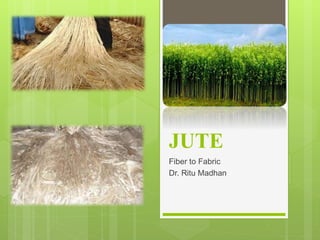
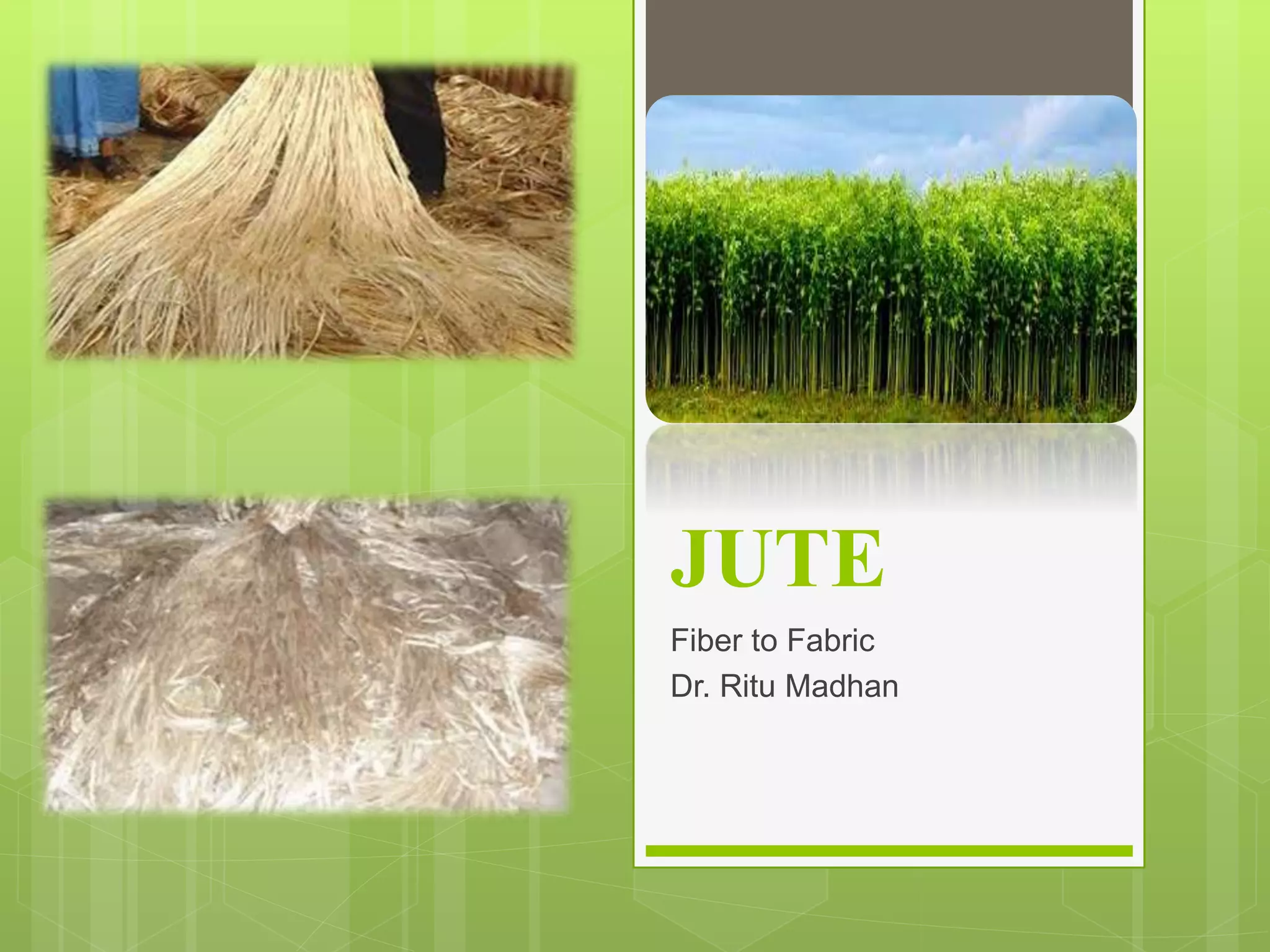
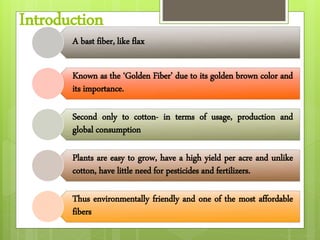
JUTE
Fiber to Fabric
Dr. Ritu Madhan
Introduction
A bast fiber, like flax
Known as the ‘Golden Fiber’ due to its golden brown color and
its importance.
Second only to cotton- in terms of usage, production and
global consumption
Plants are easy to grow, have a high yield per acre and unlike
cotton, have little need for pesticides and fertilizers.
Thus environmentally friendly and one of the most affordable
fibers
Jute plants
Growth is dependent
on the climate,
season, and soil.
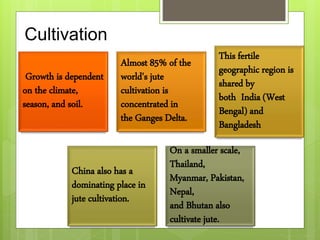
Almost 85% of the
world's jute
cultivation is
concentrated in
the Ganges Delta.
This fertile
geographic region is
shared by
both India (West
Bengal) and
Bangladesh
China also has a
dominating place in
jute cultivation.
On a smaller scale,
Thailand,
Myanmar, Pakistan,
Nepal,
and Bhutan also
cultivate jute.
Cultivation
Biology of the fiber
Produced from plants in the genus Corchorus, which has been classified
in the family Tiliaceae, or more recently in Malvaceae
The best varieties are Bangla Tosha - Corchorus olitorius (Golden shine)
and Bangla White - Corchorus capsularis (Whitish Shine)
Needs rainfall, warm weather and high humidity and grows best in
alluvial soil
Fibers composed of cellulose (major component of plant fiber) and
lignin (major components of wood fiber)
Cultivation
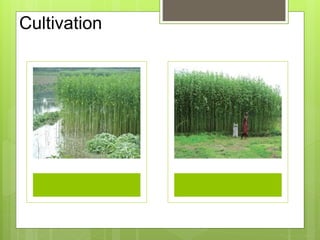
To grow jute, farmers scatter the
seeds on cultivated soil.
Stalks are thinned out when the plants
are about 15–20 cm tall
Harvesting begins about four months
after planting
The plant stems are about 2.5 to 3.5
mts tall and as thick as a finger.
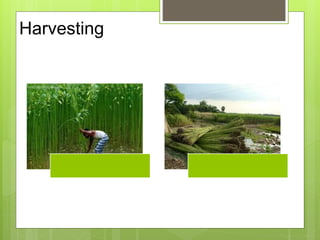
Jute fields may be under water at the
time of harvest and the workers wade in
the water to cut the stems at ground
level or to uproot the plants.
Cultivation
Harvesting
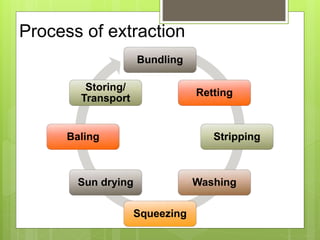
Process of extraction
Bundling
Retting
Stripping
Washing
Squeezing
Sun drying
Baling
Storing/
Transport
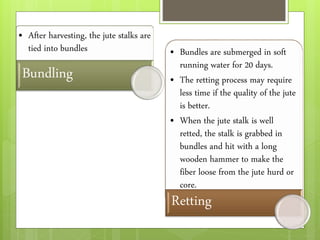
• After harvesting, the jute stalks are
tied into bundles
Bundling
• Bundles are submerged in soft
running water for 20 days.
• The retting process may require
less time if the quality of the jute
is better.
• When the jute stalk is well
retted, the stalk is grabbed in
bundles and hit with a long
wooden hammer to make the
fiber loose from the jute hurd or
core.
Retting
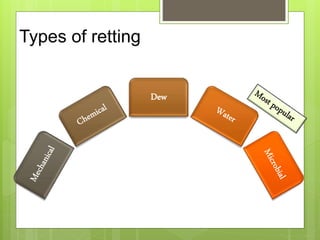
Types of retting
Dew
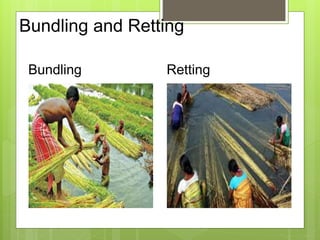
Bundling and Retting
Bundling Retting
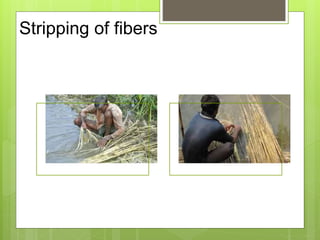
• Fibers are stripped from the stalks
in long strands and washed in
clear, running water.
Stripping
• Excess water is squeezed out from
the stripped fibers to hasten drying
Squeezing
Stripping of fibers
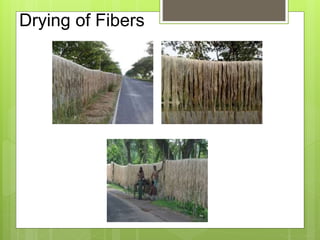
• Fibers are hung up or spread
on thatched roofs or bamboo
poles to dry.
Sun-drying
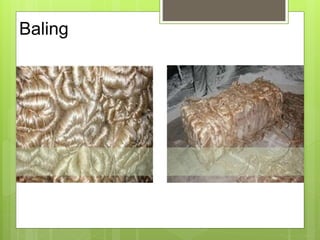
• Tied up in small bundles and
are then put together to form
bales which are transported to
mills
Baling
Drying of Fibers
Baling
Jute – An Ecofriendly fiber
• Good for the air
• Good for the soil
• Source of wood pulp
Low carbon footprint
Biodegradable- feeds the soil
All parts of the plant can be
used.
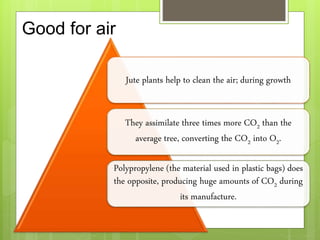
Good for air
Jute plants help to clean the air; during growth
They assimilate three times more CO2 than the
average tree, converting the CO2 into O2.
Polypropylene (the material used in plastic bags) does
the opposite, producing huge amounts of CO2 during
its manufacture.
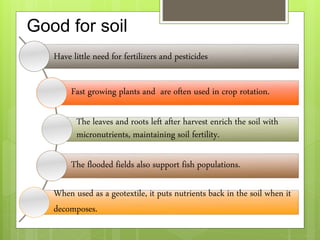
Good for soil
Have little need for fertilizers and pesticides
Fast growing plants and are often used in crop rotation.
The leaves and roots left after harvest enrich the soil with
micronutrients, maintaining soil fertility.
The flooded fields also support fish populations.
When used as a geotextile, it puts nutrients back in the soil when it
decomposes.
Source of wood
The jute stalks left after
the fiber has been
extracted may help to
meet the worlds need for
wood pulp
Wood also being used as
a renewable source of
cooking fuel.
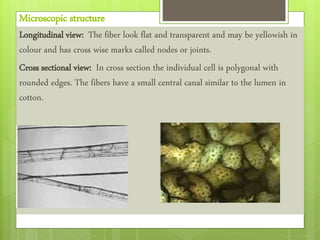
Microscopic structure
Longitudinal view: The fiber look flat and transparent and may be yellowish in
colour and has cross wise marks called nodes or joints.
Cross sectional view: In cross section the individual cell is polygonal with
rounded edges. The fibers have a small central canal similar to the lumen in
cotton.
Properties
• Unbleached jute can range from white, to
off white, to yellow, brown, grey, or golden.
Color
• The fiber is smoother and longer than
cotton and is therefore more lustrous.
Lustre
• The length of the fiber varies between 5 –
12 ft.
Length
• It has high tensile strength that is more
than cotton and low extensibility
Strength and Extensibility
Properties
Specific
Gravity
It is nearly like
cotton 1.50. Thus
it is heavier than
nylons and
polyesters if made
in similar weaves
Resiliency
Like all cellulosic
fibers it has low
resiliency and
easily forms
wrinkles that do
not easily open
out by themselves.
Dimensional
Stability
It can retain its
original size better
than cotton and
linen
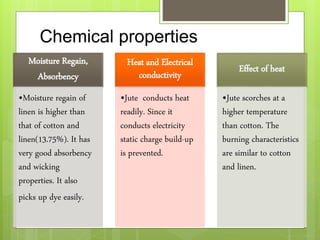
Chemical properties
Moisture Regain,
Absorbency
•Moisture regain of
linen is higher than
that of cotton and
linen(13.75%). It has
very good absorbency
and wicking
properties. It also
picks up dye easily.
Heat and Electrical
conductivity
•Jute conducts heat
readily. Since it
conducts electricity
static charge build-up
is prevented.
Effect of heat
•Jute scorches at a
higher temperature
than cotton. The
burning characteristics
are similar to cotton
and linen.
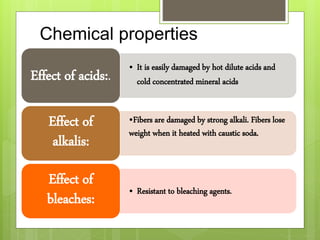
Chemical properties
• It is easily damaged by hot dilute acids and
cold concentrated mineral acids
Effect of acids:.
•Fibers are damaged by strong alkali. Fibers lose
weight when it heated with caustic soda.
Effect of
alkalis:
• Resistant to bleaching agents.
Effect of
bleaches:
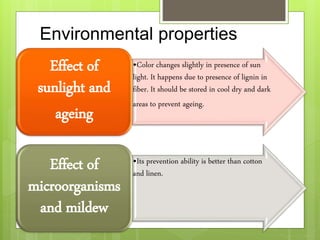
Environmental properties
•Color changes slightly in presence of sun
light. It happens due to presence of lignin in
fiber. It should be stored in cool dry and dark
areas to prevent ageing.
Effect of
sunlight and
ageing
•Its prevention ability is better than cotton
and linen.
Effect of
microorganisms
and mildew
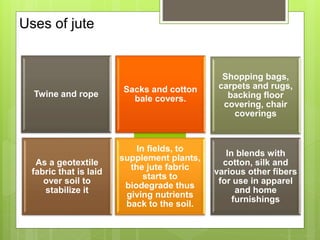
Uses of jute
Twine and rope
Sacks and cotton
bale covers.
Shopping bags,
carpets and rugs,
backing floor
covering, chair
coverings
As a geotextile
fabric that is laid
over soil to
stabilize it
In fields, to
supplement plants,
the jute fabric
starts to
biodegrade thus
giving nutrients
back to the soil.
In blends with
cotton, silk and
various other fibers
for use in apparel
and home
furnishings

Jute

  • 1.
  • 2.
    Introduction A bast fiber,like flax Known as the ‘Golden Fiber’ due to its golden brown color and its importance. Second only to cotton- in terms of usage, production and global consumption Plants are easy to grow, have a high yield per acre and unlike cotton, have little need for pesticides and fertilizers. Thus environmentally friendly and one of the most affordable fibers
  • 3.
  • 4.
    Growth is dependent onthe climate, season, and soil. Almost 85% of the world's jute cultivation is concentrated in the Ganges Delta. This fertile geographic region is shared by both India (West Bengal) and Bangladesh China also has a dominating place in jute cultivation. On a smaller scale, Thailand, Myanmar, Pakistan, Nepal, and Bhutan also cultivate jute. Cultivation
  • 5.
    Biology of thefiber Produced from plants in the genus Corchorus, which has been classified in the family Tiliaceae, or more recently in Malvaceae The best varieties are Bangla Tosha - Corchorus olitorius (Golden shine) and Bangla White - Corchorus capsularis (Whitish Shine) Needs rainfall, warm weather and high humidity and grows best in alluvial soil Fibers composed of cellulose (major component of plant fiber) and lignin (major components of wood fiber)
  • 6.
    Cultivation To grow jute,farmers scatter the seeds on cultivated soil. Stalks are thinned out when the plants are about 15–20 cm tall Harvesting begins about four months after planting The plant stems are about 2.5 to 3.5 mts tall and as thick as a finger. Jute fields may be under water at the time of harvest and the workers wade in the water to cut the stems at ground level or to uproot the plants.
  • 7.
  • 8.
  • 9.
  • 10.
    • After harvesting,the jute stalks are tied into bundles Bundling • Bundles are submerged in soft running water for 20 days. • The retting process may require less time if the quality of the jute is better. • When the jute stalk is well retted, the stalk is grabbed in bundles and hit with a long wooden hammer to make the fiber loose from the jute hurd or core. Retting
  • 11.
  • 12.
  • 13.
    • Fibers arestripped from the stalks in long strands and washed in clear, running water. Stripping • Excess water is squeezed out from the stripped fibers to hasten drying Squeezing
  • 14.
  • 15.
    • Fibers arehung up or spread on thatched roofs or bamboo poles to dry. Sun-drying • Tied up in small bundles and are then put together to form bales which are transported to mills Baling
  • 16.
  • 17.
  • 18.
    Jute – AnEcofriendly fiber • Good for the air • Good for the soil • Source of wood pulp Low carbon footprint Biodegradable- feeds the soil All parts of the plant can be used.
  • 19.
    Good for air Juteplants help to clean the air; during growth They assimilate three times more CO2 than the average tree, converting the CO2 into O2. Polypropylene (the material used in plastic bags) does the opposite, producing huge amounts of CO2 during its manufacture.
  • 20.
    Good for soil Havelittle need for fertilizers and pesticides Fast growing plants and are often used in crop rotation. The leaves and roots left after harvest enrich the soil with micronutrients, maintaining soil fertility. The flooded fields also support fish populations. When used as a geotextile, it puts nutrients back in the soil when it decomposes.
  • 21.
    Source of wood Thejute stalks left after the fiber has been extracted may help to meet the worlds need for wood pulp Wood also being used as a renewable source of cooking fuel.
  • 22.
    Microscopic structure Longitudinal view:The fiber look flat and transparent and may be yellowish in colour and has cross wise marks called nodes or joints. Cross sectional view: In cross section the individual cell is polygonal with rounded edges. The fibers have a small central canal similar to the lumen in cotton.
  • 23.
    Properties • Unbleached jutecan range from white, to off white, to yellow, brown, grey, or golden. Color • The fiber is smoother and longer than cotton and is therefore more lustrous. Lustre • The length of the fiber varies between 5 – 12 ft. Length • It has high tensile strength that is more than cotton and low extensibility Strength and Extensibility
  • 24.
    Properties Specific Gravity It is nearlylike cotton 1.50. Thus it is heavier than nylons and polyesters if made in similar weaves Resiliency Like all cellulosic fibers it has low resiliency and easily forms wrinkles that do not easily open out by themselves. Dimensional Stability It can retain its original size better than cotton and linen
  • 25.
    Chemical properties Moisture Regain, Absorbency •Moistureregain of linen is higher than that of cotton and linen(13.75%). It has very good absorbency and wicking properties. It also picks up dye easily. Heat and Electrical conductivity •Jute conducts heat readily. Since it conducts electricity static charge build-up is prevented. Effect of heat •Jute scorches at a higher temperature than cotton. The burning characteristics are similar to cotton and linen.
  • 26.
    Chemical properties • Itis easily damaged by hot dilute acids and cold concentrated mineral acids Effect of acids:. •Fibers are damaged by strong alkali. Fibers lose weight when it heated with caustic soda. Effect of alkalis: • Resistant to bleaching agents. Effect of bleaches:
  • 27.
    Environmental properties •Color changesslightly in presence of sun light. It happens due to presence of lignin in fiber. It should be stored in cool dry and dark areas to prevent ageing. Effect of sunlight and ageing •Its prevention ability is better than cotton and linen. Effect of microorganisms and mildew
  • 28.
    Uses of jute Twineand rope Sacks and cotton bale covers. Shopping bags, carpets and rugs, backing floor covering, chair coverings As a geotextile fabric that is laid over soil to stabilize it In fields, to supplement plants, the jute fabric starts to biodegrade thus giving nutrients back to the soil. In blends with cotton, silk and various other fibers for use in apparel and home furnishings