Adapting Landscapes to
Climate Change
State and Transition Models to
support conservation decision-
making: Including a climate change
context
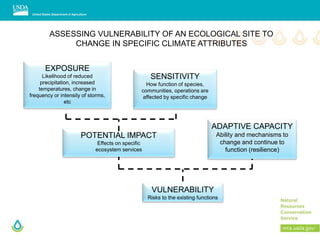
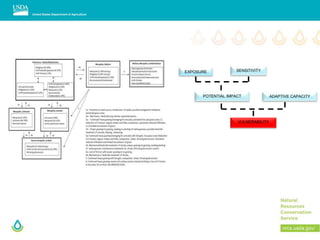
EXPOSURE
Likelihood of reduced
precipitation, increased
temperatures, change in
frequency or intensity of storms,
etc
SENSITIVITY
How function of species,
communities, operations are
affected by specific change
ADAPTIVE CAPACITY
Ability and mechanisms to
change and continue to
function (resilience)
POTENTIAL IMPACT
Effects on specific
ecosystem services
VULNERABILITY
Risks to the existing functions
ASSESSING VULNERABILITY OF AN ECOLOGICAL SITE TO
CHANGE IN SPECIFIC CLIMATE ATTRIBUTES
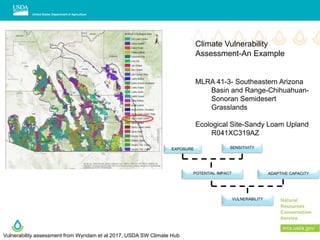
Climate Vulnerability
Assessment-An Example
MLRA 41-3- Southeastern Arizona
Basin and Range-Chihuahuan-
Sonoran Semidesert
Grasslands
Ecological Site-Sandy Loam Upland
R041XC319AZ
EXPOSURE SENSITIVITY
ADAPTIVE CAPACITYPOTENTIAL IMPACT
VULNERABILITY
Vulnerability assessment from Wyndam et al 2017, USDA SW Climate Hub
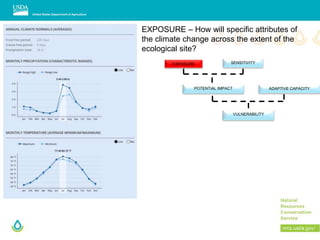
EXPOSURE – How will specific attributes of
the climate change across the extent of the
ecological site?
EXPOSURE SENSITIVITY
ADAPTIVE CAPACITYPOTENTIAL IMPACT
VULNERABILITY
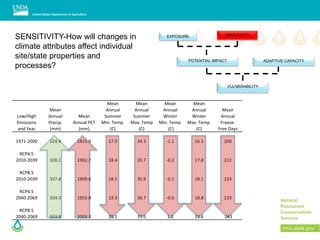
SENSITIVITY-How will changes in
climate attributes affect individual
site/state properties and
processes?
EXPOSURE SENSITIVITY
ADAPTIVE CAPACITYPOTENTIAL IMPACT
VULNERABILITY
Low/High
Emissions
and Year
Mean
Annual
Precip.
(mm)
Mean
Annual PET
(mm)
Mean
Annual
Summer
Min. Temp.
(C)
Mean
Annual
Summer
Max. Temp
(C)
Mean
Annual
Winter
Min. Temp.
(C)
Mean
Annual
Winter
Max. Temp.
(C)
Mean
Annual
Freeze-
Free Days
1971-2000 324.4 1815.9 17.0 34.3 -1.1 16.5 200
RCP4.5
2010-2039 328.1 1902.2 18.4 35.7 -0.2 17.8 222
RCP8.5
2010-2039 337.8 1909.6 18.5 35.9 -0.1 18.1 224
RCP4.5
2040-2069 334.3 1955.8 19.3 36.7 -0.6 18.8 233
RCP8.5
2040-2069 333.8 2003.3 20.1 37.5 1.2 19.6 243
SENSITIVITY-How will changes in
climate attributes affect individual
site/state properties and
processes?
EXPOSURE SENSITIVITY
ADAPTIVE CAPACITYPOTENTIAL IMPACT
VULNERABILITY
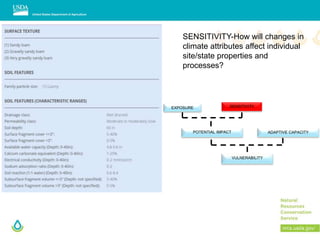
SENSITIVITY-How will changes in
climate attributes affect individual
site/state properties and
processes?
EXPOSURE SENSITIVITY
ADAPTIVE CAPACITYPOTENTIAL IMPACT
VULNERABILITY
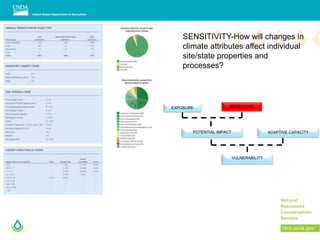
SENSITIVITY-How will changes in
climate attributes affect individual
site/state properties and
processes?
EXPOSURE SENSITIVITY
ADAPTIVE CAPACITYPOTENTIAL IMPACT
VULNERABILITY
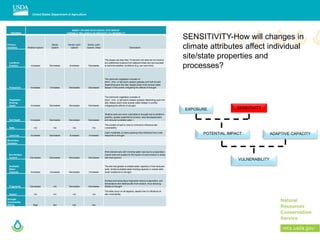
CRITERIA
SANDY UPLAND ECOLOGICAL SITE GROUP -
VARIABLE INFLUENCE ON DROUGHT VULNERABILTY
Primary
Variables Shallow Upland
Sandy
Upland
Sandy Loam
Upland
Sandy Loam
Upland, Deep Description
Landform
Position Increases Decreases Increases Decreases
The slopes are less than 15 percent, but sites do not receive
any additional moisture from adjacent sites and are exposed
to extreme weather conditions (e.g. sun and wind).
Production Increases Increases Decreases Decreases
The dominant vegetation consists of
short-, mid-, or tall warm-season grasses and half-shrubs
depending upon the site; deeper plant roots access water
deeper in the profile, mitigating the effects of drought.
Vegetation
Rooting
Depth Increases Decreases Decreases Decreases
The dominant vegetation consists of
short-, mid-, or tall warm-season grasses depending upon the
site; deeper plant roots access water deeper in profile,
mitigating the effects of drought.
Soil Depth Increases Decreases Decreases Decreases
Shallow soils are more vulnerable to drought due to landform
position, greater potential for erosion, less developed soils,
and reduced available water. l
Salts n/a n/a n/a n/a
The content of salt is none to minimal to influence site
vulnerability.
Land Use Increases Decreases Increases Increases
Light, moderate, or heavy grazing may influence how a site
responds to drought.
Secondary
Variables
Soil Surface
Texture Decreases Decreases Decreases Decreases
Well drained soils with minimal water loss due to evaporation;
coarse soils are subject to the hazard of wind erosion in areas
with bare ground.
Available
Water
Capacity Increases Increases Decreases Increases
The site has greater available water capacity in finer textured
soils; limited available water-holding capacity in coarse soils
lower resistance to drought.
Fragments Decreases n/a Decreases Decreases
Surface and subsurface fragments reduce evaporation, soil
temperature and stabilize site from erosion, thus reducing
effects of drought.
Aspect n/a n/o n/a n/a
The sites occur on all aspects; aspect has no influence on
site vulnerability.
Drought
Vulnerability
Rating High low low low
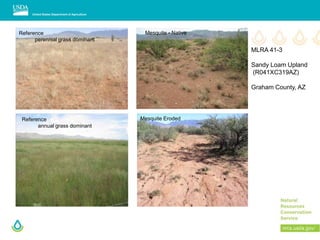
Reference
perennial grass dominant
Mesquite Eroded
Mesquite - Native
Reference
annual grass dominant
MLRA 41-3
Sandy Loam Upland
(R041XC319AZ)
Graham County, AZ
EXPOSURE SENSITIVITY
ADAPTIVE CAPACITYPOTENTIAL IMPACT
VULNERABILITY
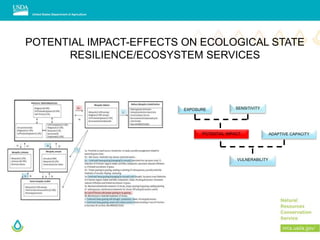
POTENTIAL IMPACT-EFFECTS ON ECOLOGICAL STATE
RESILIENCE/ECOSYSTEM SERVICES
EXPOSURE SENSITIVITY
ADAPTIVE CAPACITYPOTENTIAL IMPACT
VULNERABILITY
EXPOSURE SENSITIVITY
ADAPTIVE CAPACITYPOTENTIAL IMPACT
VULNERABILITY
A climate change context for state and transition models
• Ecological Sites and State and Transition Models include sufficient
climate, soil, vegetation and ecological process information to
systematically evaluate vulnerability to climate change
• The vulnerability assessment approach provides a way to
qualitatively assign a vulnerability index to each site within a region

July 29-130-Joel Brown

  • 1.
    Adapting Landscapes to ClimateChange State and Transition Models to support conservation decision- making: Including a climate change context
  • 2.
    EXPOSURE Likelihood of reduced precipitation,increased temperatures, change in frequency or intensity of storms, etc SENSITIVITY How function of species, communities, operations are affected by specific change ADAPTIVE CAPACITY Ability and mechanisms to change and continue to function (resilience) POTENTIAL IMPACT Effects on specific ecosystem services VULNERABILITY Risks to the existing functions ASSESSING VULNERABILITY OF AN ECOLOGICAL SITE TO CHANGE IN SPECIFIC CLIMATE ATTRIBUTES
  • 3.
    Climate Vulnerability Assessment-An Example MLRA41-3- Southeastern Arizona Basin and Range-Chihuahuan- Sonoran Semidesert Grasslands Ecological Site-Sandy Loam Upland R041XC319AZ EXPOSURE SENSITIVITY ADAPTIVE CAPACITYPOTENTIAL IMPACT VULNERABILITY Vulnerability assessment from Wyndam et al 2017, USDA SW Climate Hub
  • 4.
    EXPOSURE – Howwill specific attributes of the climate change across the extent of the ecological site? EXPOSURE SENSITIVITY ADAPTIVE CAPACITYPOTENTIAL IMPACT VULNERABILITY
  • 5.
    SENSITIVITY-How will changesin climate attributes affect individual site/state properties and processes? EXPOSURE SENSITIVITY ADAPTIVE CAPACITYPOTENTIAL IMPACT VULNERABILITY Low/High Emissions and Year Mean Annual Precip. (mm) Mean Annual PET (mm) Mean Annual Summer Min. Temp. (C) Mean Annual Summer Max. Temp (C) Mean Annual Winter Min. Temp. (C) Mean Annual Winter Max. Temp. (C) Mean Annual Freeze- Free Days 1971-2000 324.4 1815.9 17.0 34.3 -1.1 16.5 200 RCP4.5 2010-2039 328.1 1902.2 18.4 35.7 -0.2 17.8 222 RCP8.5 2010-2039 337.8 1909.6 18.5 35.9 -0.1 18.1 224 RCP4.5 2040-2069 334.3 1955.8 19.3 36.7 -0.6 18.8 233 RCP8.5 2040-2069 333.8 2003.3 20.1 37.5 1.2 19.6 243
  • 6.
    SENSITIVITY-How will changesin climate attributes affect individual site/state properties and processes? EXPOSURE SENSITIVITY ADAPTIVE CAPACITYPOTENTIAL IMPACT VULNERABILITY
  • 7.
    SENSITIVITY-How will changesin climate attributes affect individual site/state properties and processes? EXPOSURE SENSITIVITY ADAPTIVE CAPACITYPOTENTIAL IMPACT VULNERABILITY
  • 8.
    SENSITIVITY-How will changesin climate attributes affect individual site/state properties and processes? EXPOSURE SENSITIVITY ADAPTIVE CAPACITYPOTENTIAL IMPACT VULNERABILITY CRITERIA SANDY UPLAND ECOLOGICAL SITE GROUP - VARIABLE INFLUENCE ON DROUGHT VULNERABILTY Primary Variables Shallow Upland Sandy Upland Sandy Loam Upland Sandy Loam Upland, Deep Description Landform Position Increases Decreases Increases Decreases The slopes are less than 15 percent, but sites do not receive any additional moisture from adjacent sites and are exposed to extreme weather conditions (e.g. sun and wind). Production Increases Increases Decreases Decreases The dominant vegetation consists of short-, mid-, or tall warm-season grasses and half-shrubs depending upon the site; deeper plant roots access water deeper in the profile, mitigating the effects of drought. Vegetation Rooting Depth Increases Decreases Decreases Decreases The dominant vegetation consists of short-, mid-, or tall warm-season grasses depending upon the site; deeper plant roots access water deeper in profile, mitigating the effects of drought. Soil Depth Increases Decreases Decreases Decreases Shallow soils are more vulnerable to drought due to landform position, greater potential for erosion, less developed soils, and reduced available water. l Salts n/a n/a n/a n/a The content of salt is none to minimal to influence site vulnerability. Land Use Increases Decreases Increases Increases Light, moderate, or heavy grazing may influence how a site responds to drought. Secondary Variables Soil Surface Texture Decreases Decreases Decreases Decreases Well drained soils with minimal water loss due to evaporation; coarse soils are subject to the hazard of wind erosion in areas with bare ground. Available Water Capacity Increases Increases Decreases Increases The site has greater available water capacity in finer textured soils; limited available water-holding capacity in coarse soils lower resistance to drought. Fragments Decreases n/a Decreases Decreases Surface and subsurface fragments reduce evaporation, soil temperature and stabilize site from erosion, thus reducing effects of drought. Aspect n/a n/o n/a n/a The sites occur on all aspects; aspect has no influence on site vulnerability. Drought Vulnerability Rating High low low low
  • 9.
    Reference perennial grass dominant MesquiteEroded Mesquite - Native Reference annual grass dominant MLRA 41-3 Sandy Loam Upland (R041XC319AZ) Graham County, AZ
  • 10.
    EXPOSURE SENSITIVITY ADAPTIVE CAPACITYPOTENTIALIMPACT VULNERABILITY POTENTIAL IMPACT-EFFECTS ON ECOLOGICAL STATE RESILIENCE/ECOSYSTEM SERVICES
  • 11.
  • 12.
  • 13.
    A climate changecontext for state and transition models • Ecological Sites and State and Transition Models include sufficient climate, soil, vegetation and ecological process information to systematically evaluate vulnerability to climate change • The vulnerability assessment approach provides a way to qualitatively assign a vulnerability index to each site within a region

Editor's Notes

  • #2 GO TO VIEW > MASTER > SLIDE MASTER TO EDIT THE IMAGES ON THE TITLE AND DIVIDER SLIDES
  • #3 In order to develop consistent interpretations of how changes in climate are likely to affect specific ecological sites, it is necessary to have a common evaluation framework. In this case, the vulnerability assessment protocols provide a logical framework for determine how individual ecological sites are likely to respond to changes in temperature, precipitation, atmospheric chemistry, etc.
  • #4 For every ecological site, in the Ecological Site Description, there is a detailed, quantitative description of the climate associated with the static properties that describe the spatial distribution of the site and the behaviors that describe the temporal dynamics of the site.
  • #5 For every ecological site, in the Ecological Site Description, there is a detailed, quantitative description of the climate associated with the static properties that describe the spatial distribution of the site and the behaviors that describe the temporal dynamics of the site.
  • #6 Sensitivity requires an analysis of the effect of a defined change in climate attribute on the functional aspects of the soil and/or vegetation. In this example, small increases in mean annual precipitation are likely to be offset by large increases in PET and summer temps. These projections reflect trends from the last 30 years.
  • #7 Sensitivity requires an analysis of the effect of a defined change in climate attribute on the functional aspects of the soil and/or vegetation. In this case, soil..
  • #8 Sensitivity requires an analysis of the effect of a defined change in climate attribute on the functional aspects of the soil and/or vegetation. In this case, soil..
  • #9 Sensitivity requires an analysis of the effect of a defined change in climate attribute on the functional aspects of the soil and/or vegetation. The criteria in this analysis (Wyndam et al 2017) qualitatively evaluate the attributes of the site against the influence of drought on important ecological process, primarily Net Primary Production.
  • #10 Ecological states within a site are relatively easy to identify and verify.
  • #11 In this example, the potential impact of increased drought frequency on the likelihood of a state change can be assessed using the state and transition model. For example, any transition that is driven by “lack of fire” probability will increase as fuel is reduced. Similarly, the transitions driven by “heavy grazing” are likely to increase in probability as forage production declines. Notice that all of these transitions move away from the reference state dominated by midgrasses and toward increasing shrub and annual grass dominance. Therefore, any ecosystem services associated with warm season grass production will decline and those associated with shrub cover will increase.
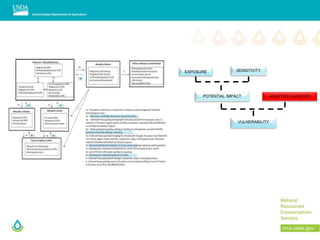
  • #12 To assess adaptive capacity at the ES level, you can examine the transitions associated with common planning objectives, or restoration. In this example, all of the transitions associated with desired results require conservation practices that are relatively expensive and time-consuming, as well as risky. Thus, adaptive capacity would be low.
  • #13 Based on the site level analysis, you would have to rate this site as vulnerable to increased frequency of drought as a result of changes in climate.