Adapting Landscapes to
Climate Change
Translating Site Level State and
Transition Models to Landscape
Levels
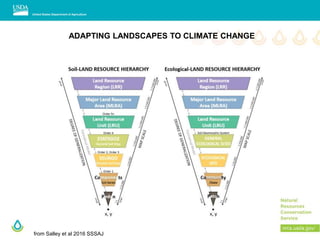
ADAPTING LANDSCAPES TO CLIMATE CHANGE
from Salley et al 2016 SSSAJ
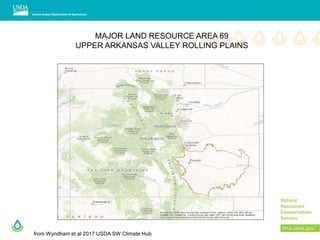
MAJOR LAND RESOURCE AREA 69
UPPER ARKANSAS VALLEY ROLLING PLAINS
from Wyndham et al 2017 USDA SW Climate Hub
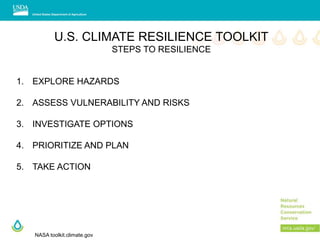
U.S. CLIMATE RESILIENCE TOOLKIT
STEPS TO RESILIENCE
1. EXPLORE HAZARDS
2. ASSESS VULNERABILITY AND RISKS
3. INVESTIGATE OPTIONS
4. PRIORITIZE AND PLAN
5. TAKE ACTION
NASA toolkit.climate.gov
Western Regional Climate Center and Northwest Knowledge Network
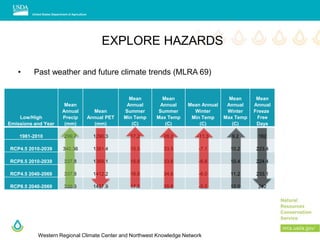
EXPLORE HAZARDS
• Past weather and future climate trends (MLRA 69)
Low/High
Emissions and Year
Mean
Annual
Precip
(mm)
Mean
Annual PET
(mm)
Mean
Annual
Summer
Min Temp
(C)
Mean
Annual
Summer
Max Temp
(C)
Mean Annual
Winter
Min Temp
(C)
Mean
Annual
Winter
Max Temp
(C)
Mean
Annual
Freeze
Free
Days
1981-2010 299.7 1290.3 17.2 28.2 -11.3 9.2 162
RCP4.5 2010-2039 340.36 1361.4 15.5 33.5 -7.1 10.2 223.4
RCP8.5 2010-2039 337.8 1369.1 15.6 33.6 -6.8 10.4 224.4
RCP4.5 2040-2069 337.8 1412.2 16.6 34.6 -6.0 11.2 233.1
RCP8.5 2040-2069 335.3 1457.9 17.5 35.6 -5.2 12.0 242
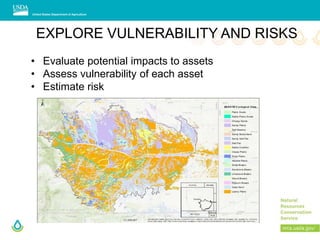
EXPLORE VULNERABILITY AND RISKS
• Evaluate potential impacts to assets
• Assess vulnerability of each asset
• Estimate risk
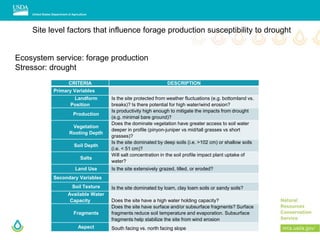
Site level factors that influence forage production susceptibility to drought
CRITERIA DESCRIPTION
Primary Variables
Landform
Position
Is the site protected from weather fluctuations (e.g. bottomland vs.
breaks)? Is there potential for high water/wind erosion?
Production
Is productivity high enough to mitigate the impacts from drought
(e.g. minimal bare ground)?
Vegetation
Rooting Depth
Does the dominate vegetation have greater access to soil water
deeper in profile (pinyon-juniper vs mid/tall grasses vs short
grasses)?
Soil Depth
Is the site dominated by deep soils (i.e. >102 cm) or shallow soils
(i.e. < 51 cm)?
Salts
Will salt concentration in the soil profile impact plant uptake of
water?
Land Use Is the site extensively grazed, tilled, or eroded?
Secondary Variables
Soil Texture Is the site dominated by loam, clay loam soils or sandy soils?
Available Water
Capacity Does the site have a high water holding capacity?
Fragments
Does the site have surface and/or subsurface fragments? Surface
fragments reduce soil temperature and evaporation. Subsurface
fragments help stabilize the site from wind erosion
Aspect South facing vs. north facing slope
Ecosystem service: forage production
Stressor: drought
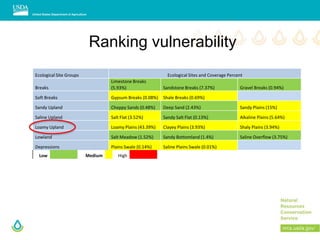
Ranking vulnerability
Ecological Site Groups Ecological Sites and Coverage Percent
Breaks
Limestone Breaks
(5.93%) Sandstone Breaks (7.37%) Gravel Breaks (0.94%)
Soft Breaks Gypsum Breaks (0.08%) Shale Breaks (0.69%)
Sandy Upland Choppy Sands (0.48%) Deep Sand (2.43%) Sandy Plains (15%)
Saline Upland Salt Flat (3.52%) Sandy Salt Flat (0.13%) Alkaline Plains (5.64%)
Loamy Upland Loamy Plains (43.39%) Clayey Plains (3.93%) Shaly Plains (3.94%)
Lowland Salt Meadow (1.52%) Sandy Bottomland (1.4%) Saline Overflow (3.75%)
Depressions Plains Swale (0.14%) Saline Plains Swale (0.01%)
Low Medium High
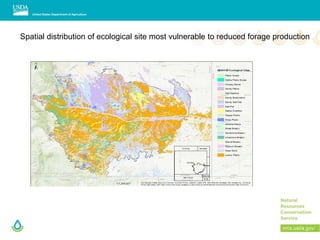
Spatial distribution of ecological site most vulnerable to reduced forage production
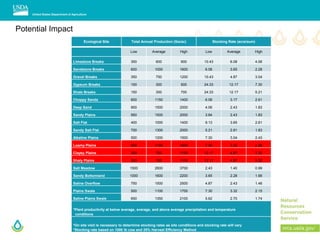
Potential Impact
Ecological Site Total Annual Production (lbs/ac) Stocking Rate (acre/aum)
Low Average High Low Average High
Limestone Breaks 350 600 900 10.43 6.08 4.06
Sandstone Breaks 600 1000 1600 6.08 3.65 2.28
Gravel Breaks 350 750 1200 10.43 4.87 3.04
Gypsum Breaks 150 300 500 24.33 12.17 7.30
Shale Breaks 150 300 700 24.33 12.17 5.21
Choppy Sands 600 1150 1400 6.08 3.17 2.61
Deep Sand 900 1500 2000 4.06 2.43 1.83
Sandy Plains 950 1500 2000 3.84 2.43 1.83
Salt Flat 400 1000 1400 9.13 3.65 2.61
Sandy Salt Flat 700 1300 2000 5.21 2.81 1.83
Alkaline Plains 500 1200 1500 7.30 3.04 2.43
Loamy Plains 500 1100 1600 7.30 3.32 2.28
Clayey Plains 300 750 1100 12.17 4.87 3.32
Shaly Plains 300 750 1100 12.17 4.87 3.32
Salt Meadow 1500 2600 3700 2.43 1.40 0.99
Sandy Bottomland 1000 1600 2200 3.65 2.28 1.66
Saline Overflow 750 1500 2500 4.87 2.43 1.46
Plains Swale 500 1100 1700 7.30 3.32 2.15
Saline Plains Swale 650 1350 2100 5.62 2.70 1.74
*Plant productivity at below average, average, and above average precipitation and temperature
conditions
*On site visit is necessary to determine stocking rates as site conditions and stocking rate will vary
*Stocking rate based on 1000 lb cow and 25% Harvest Efficiency Method
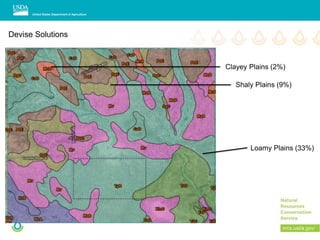
Devise Solutions
Clayey Plains (2%)
Loamy Plains (33%)
Shaly Plains (9%)
PRIORITIZE AND PLAN
ENHANCING LANDSCAPE RESILIENCE
• Ecological Sites and State and Transition Models include sufficient
climate, soil, vegetation and ecological process information to
systematically evaluate vulnerability to climate change
• Assessments across scales can be implemented to develop more
effective response strategies at field, ranch and MLRA scales.
• Implementing these responses can be used to target technical and
financial assistance to improve the chances of success and reduce
risk.

July 29-330-Joel Brown

  • 1.
    Adapting Landscapes to ClimateChange Translating Site Level State and Transition Models to Landscape Levels
  • 2.
    ADAPTING LANDSCAPES TOCLIMATE CHANGE from Salley et al 2016 SSSAJ
  • 3.
    MAJOR LAND RESOURCEAREA 69 UPPER ARKANSAS VALLEY ROLLING PLAINS from Wyndham et al 2017 USDA SW Climate Hub
  • 4.
    U.S. CLIMATE RESILIENCETOOLKIT STEPS TO RESILIENCE 1. EXPLORE HAZARDS 2. ASSESS VULNERABILITY AND RISKS 3. INVESTIGATE OPTIONS 4. PRIORITIZE AND PLAN 5. TAKE ACTION NASA toolkit.climate.gov
  • 5.
    Western Regional ClimateCenter and Northwest Knowledge Network EXPLORE HAZARDS • Past weather and future climate trends (MLRA 69) Low/High Emissions and Year Mean Annual Precip (mm) Mean Annual PET (mm) Mean Annual Summer Min Temp (C) Mean Annual Summer Max Temp (C) Mean Annual Winter Min Temp (C) Mean Annual Winter Max Temp (C) Mean Annual Freeze Free Days 1981-2010 299.7 1290.3 17.2 28.2 -11.3 9.2 162 RCP4.5 2010-2039 340.36 1361.4 15.5 33.5 -7.1 10.2 223.4 RCP8.5 2010-2039 337.8 1369.1 15.6 33.6 -6.8 10.4 224.4 RCP4.5 2040-2069 337.8 1412.2 16.6 34.6 -6.0 11.2 233.1 RCP8.5 2040-2069 335.3 1457.9 17.5 35.6 -5.2 12.0 242
  • 6.
    EXPLORE VULNERABILITY ANDRISKS • Evaluate potential impacts to assets • Assess vulnerability of each asset • Estimate risk
  • 7.
    Site level factorsthat influence forage production susceptibility to drought CRITERIA DESCRIPTION Primary Variables Landform Position Is the site protected from weather fluctuations (e.g. bottomland vs. breaks)? Is there potential for high water/wind erosion? Production Is productivity high enough to mitigate the impacts from drought (e.g. minimal bare ground)? Vegetation Rooting Depth Does the dominate vegetation have greater access to soil water deeper in profile (pinyon-juniper vs mid/tall grasses vs short grasses)? Soil Depth Is the site dominated by deep soils (i.e. >102 cm) or shallow soils (i.e. < 51 cm)? Salts Will salt concentration in the soil profile impact plant uptake of water? Land Use Is the site extensively grazed, tilled, or eroded? Secondary Variables Soil Texture Is the site dominated by loam, clay loam soils or sandy soils? Available Water Capacity Does the site have a high water holding capacity? Fragments Does the site have surface and/or subsurface fragments? Surface fragments reduce soil temperature and evaporation. Subsurface fragments help stabilize the site from wind erosion Aspect South facing vs. north facing slope Ecosystem service: forage production Stressor: drought
  • 8.
    Ranking vulnerability Ecological SiteGroups Ecological Sites and Coverage Percent Breaks Limestone Breaks (5.93%) Sandstone Breaks (7.37%) Gravel Breaks (0.94%) Soft Breaks Gypsum Breaks (0.08%) Shale Breaks (0.69%) Sandy Upland Choppy Sands (0.48%) Deep Sand (2.43%) Sandy Plains (15%) Saline Upland Salt Flat (3.52%) Sandy Salt Flat (0.13%) Alkaline Plains (5.64%) Loamy Upland Loamy Plains (43.39%) Clayey Plains (3.93%) Shaly Plains (3.94%) Lowland Salt Meadow (1.52%) Sandy Bottomland (1.4%) Saline Overflow (3.75%) Depressions Plains Swale (0.14%) Saline Plains Swale (0.01%) Low Medium High
  • 9.
    Spatial distribution ofecological site most vulnerable to reduced forage production
  • 10.
    Potential Impact Ecological SiteTotal Annual Production (lbs/ac) Stocking Rate (acre/aum) Low Average High Low Average High Limestone Breaks 350 600 900 10.43 6.08 4.06 Sandstone Breaks 600 1000 1600 6.08 3.65 2.28 Gravel Breaks 350 750 1200 10.43 4.87 3.04 Gypsum Breaks 150 300 500 24.33 12.17 7.30 Shale Breaks 150 300 700 24.33 12.17 5.21 Choppy Sands 600 1150 1400 6.08 3.17 2.61 Deep Sand 900 1500 2000 4.06 2.43 1.83 Sandy Plains 950 1500 2000 3.84 2.43 1.83 Salt Flat 400 1000 1400 9.13 3.65 2.61 Sandy Salt Flat 700 1300 2000 5.21 2.81 1.83 Alkaline Plains 500 1200 1500 7.30 3.04 2.43 Loamy Plains 500 1100 1600 7.30 3.32 2.28 Clayey Plains 300 750 1100 12.17 4.87 3.32 Shaly Plains 300 750 1100 12.17 4.87 3.32 Salt Meadow 1500 2600 3700 2.43 1.40 0.99 Sandy Bottomland 1000 1600 2200 3.65 2.28 1.66 Saline Overflow 750 1500 2500 4.87 2.43 1.46 Plains Swale 500 1100 1700 7.30 3.32 2.15 Saline Plains Swale 650 1350 2100 5.62 2.70 1.74 *Plant productivity at below average, average, and above average precipitation and temperature conditions *On site visit is necessary to determine stocking rates as site conditions and stocking rate will vary *Stocking rate based on 1000 lb cow and 25% Harvest Efficiency Method
  • 11.
    Devise Solutions Clayey Plains(2%) Loamy Plains (33%) Shaly Plains (9%)
  • 12.
  • 14.
    ENHANCING LANDSCAPE RESILIENCE •Ecological Sites and State and Transition Models include sufficient climate, soil, vegetation and ecological process information to systematically evaluate vulnerability to climate change • Assessments across scales can be implemented to develop more effective response strategies at field, ranch and MLRA scales. • Implementing these responses can be used to target technical and financial assistance to improve the chances of success and reduce risk.

Editor's Notes

  • #2 GO TO VIEW > MASTER > SLIDE MASTER TO EDIT THE IMAGES ON THE TITLE AND DIVIDER SLIDES
  • #3 A key element in developing climate change response, regardless of the location, is an understanding of the spatial relationships illustrated in this hierarchy. In this case, landscapes are probably most closely aligned with the MLRA or LRU level in the ecological hierarchy. This organization is also important as a way to organize information and examine important interactions that affect outcomes.
  • #4 We will examine the principles in the context of MLRA 69.
  • #5 The climate toolkit offers a good guide for developing a transparent plan.
  • #6 At the MLRA level, climate analysis provides a framework against which to evaluate relative impacts on natural resources. Like most of the high plains, relatively small increases in mean annual precip are projected, but temperatures and PET are projected to increase substantially under all scenarios. Increased PET and summer temps reduce ppt effectiveness and increase animal stress, while increased winter temperatures can decrease livestock cold stress, but allow pests and pathogens to overwinter more successfully.
  • #7 The next step is to determine the effects of increasing temperatures and PET on natural resource management systems in order to evaluate the potential impacts and develop responses. This is a spatial distribution of ecological sites within the MLRA.
  • #8 In this analysis, the dominant land use is rangeland, the dominant operating system is livestock production, which is dependent on forage production.
  • #9 Evaluating all 19 ESs against the criteria and developing qualitative rankings results in the identification of ESs that are vulnerable to the greatest reductions in forage production in a drought scenario.
  • #10 The Loamy plains site, the Shaly Plains site and the Clayey Plains site (as a group, the Loamy Upland group) are the most vulnerable and the most widespread, comprising more than 50% of the total land area.
  • #11 Long term data collection indicates that these sites will see a more than 50% reduction in forage production in drought years. These forage production and stocking rate estimates can be used to determine how many fewer animals can be grazed on a specific field, ranch or region. Conversely, if the enterprise level management objective is to maintain herd size, these numbers can be used to estimate the supply:demand imbalance and guide acquisition of forage resources.
  • #12 For any given spatial unit-watershed, ranch, field-a number of tools (WSS, EDIT) can be used to determine the composition and spatial pattern of vulnerable vs less vulnerable sites. These maps can help land managers develop rotational schedules, monitoring schemes and contingency plans. Programs can also use this information to target technical and financial resources to MLRAs or sub-MLRA areas with greatest risk.
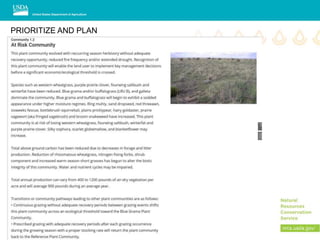
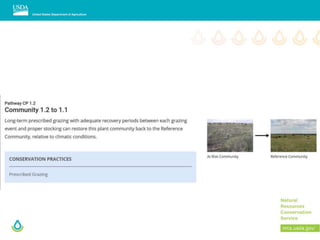
  • #13 Finally, what do you do on the ground? Specifically, what should those technical and financial resources be focused on accomplishing. In this case, the Loamy Plains ES STM identifies the plant community in the photo as the most at risk to change to a state that produces less forage and has lost the capacity to respond when precip returns to normal (i.e. less resilient). So, programmatically, identifying the distribution of this site/state combination would allow the technical and financial assistance to support decision-making.
  • #14 This transition can be managed effectively with the implementation of reduced stocking rates and seasonally appropriate grazing (Prescribed Grazing 582). So, the response in this case is relatively minimal in terms of financial requirements and very low risk.