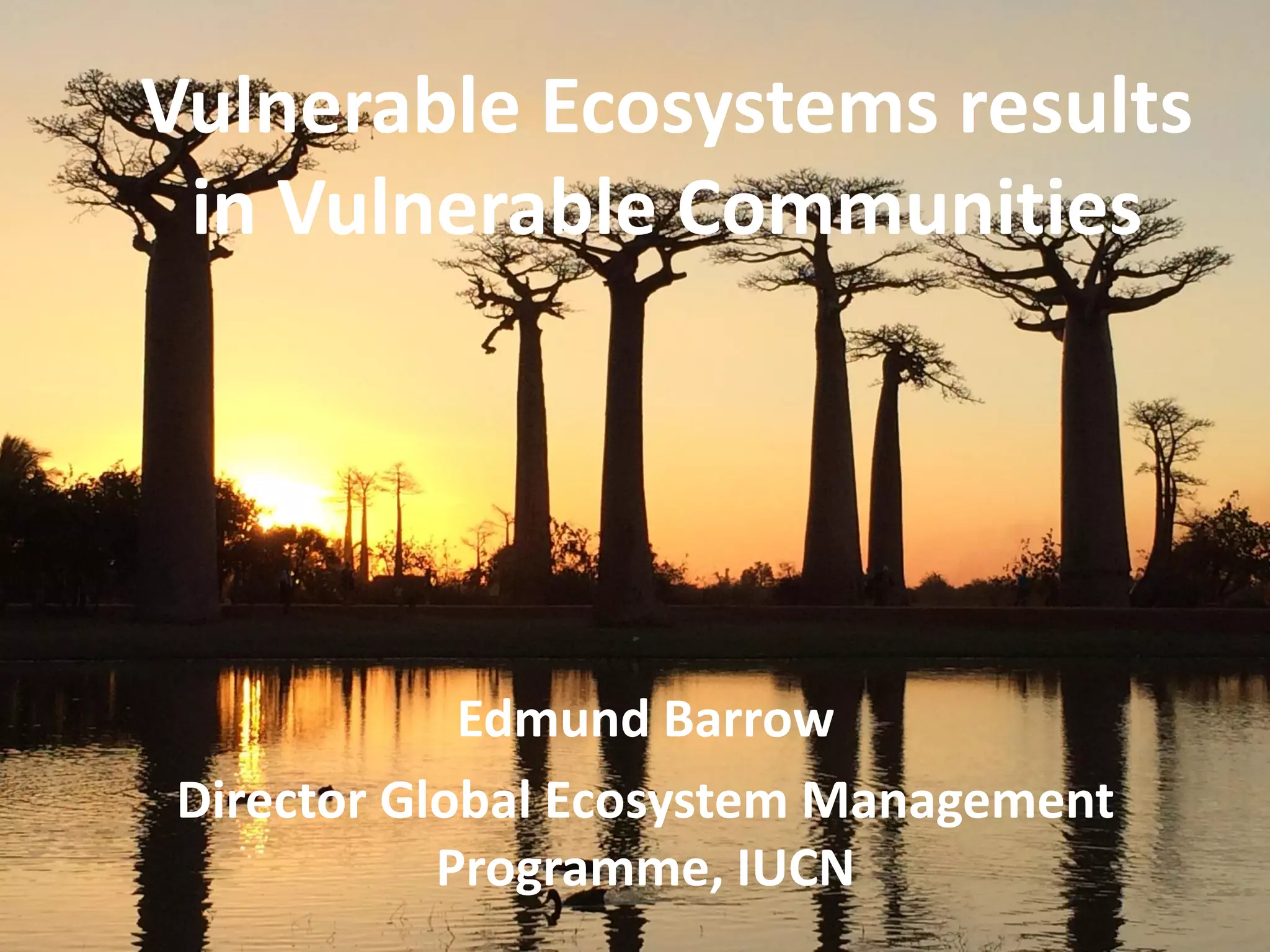
Vulnerable Ecosystems results
in Vulnerable Communities
Edmund Barrow
Director Global Ecosystem Management
Programme, IUCN
Key elements
• Which are the Climate vulnerable ecosystems
& why?
• Which are vulnerable for different reasons?
• How do we know? (tools, methods)
• How can we help vulnerable ecosystems adapt
to climate change
• How can we safeguard ecosystems to help
vulnerable communities
• What are some key challenges for us?
Which Ecosystems – vulnerable
& Why?
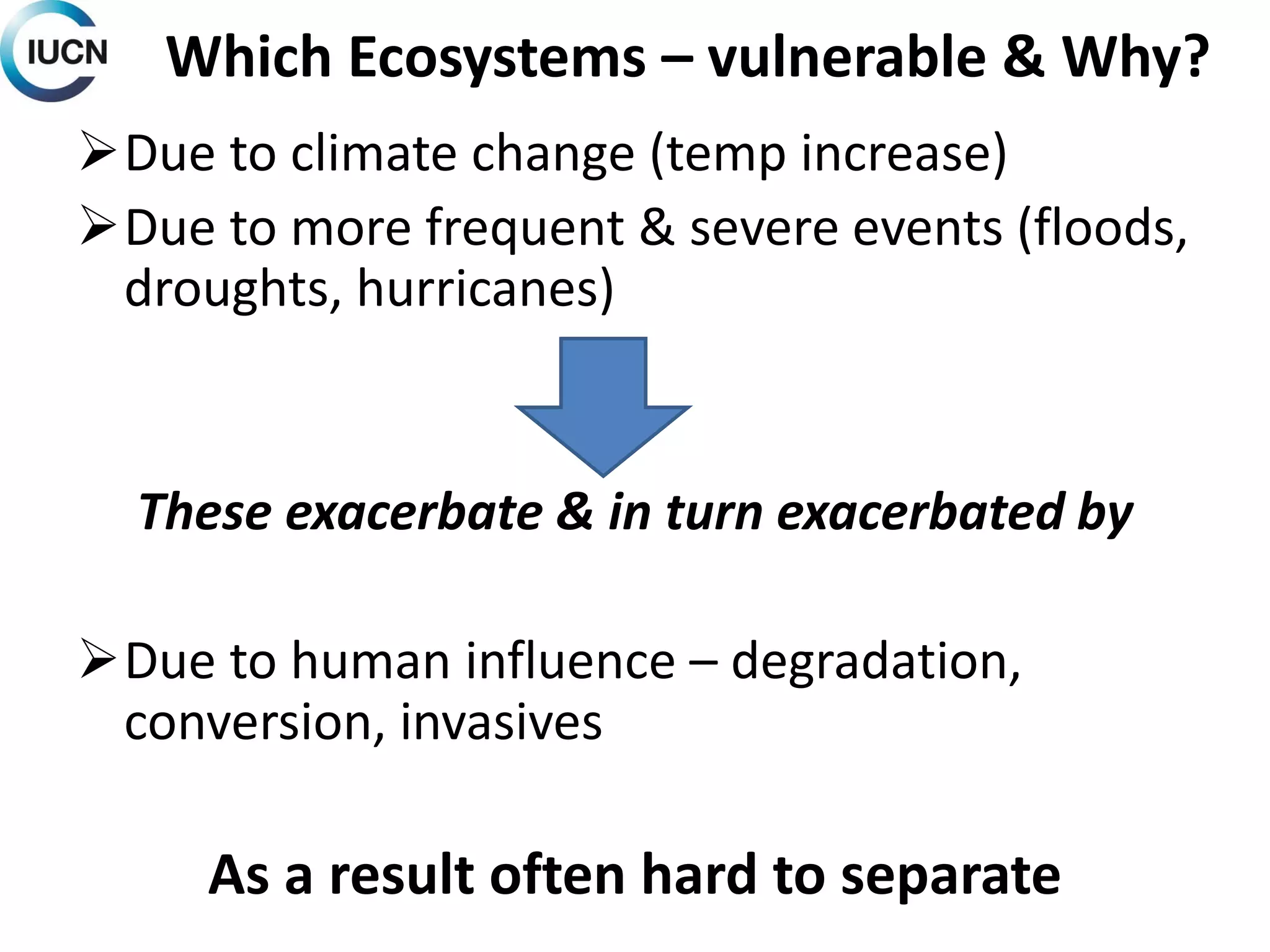
Which Ecosystems – vulnerable & Why?
Due to climate change (temp increase)
Due to more frequent & severe events (floods,
droughts, hurricanes)
These exacerbate & in turn exacerbated by
Due to human influence – degradation,
conversion, invasives
As a result often hard to separate
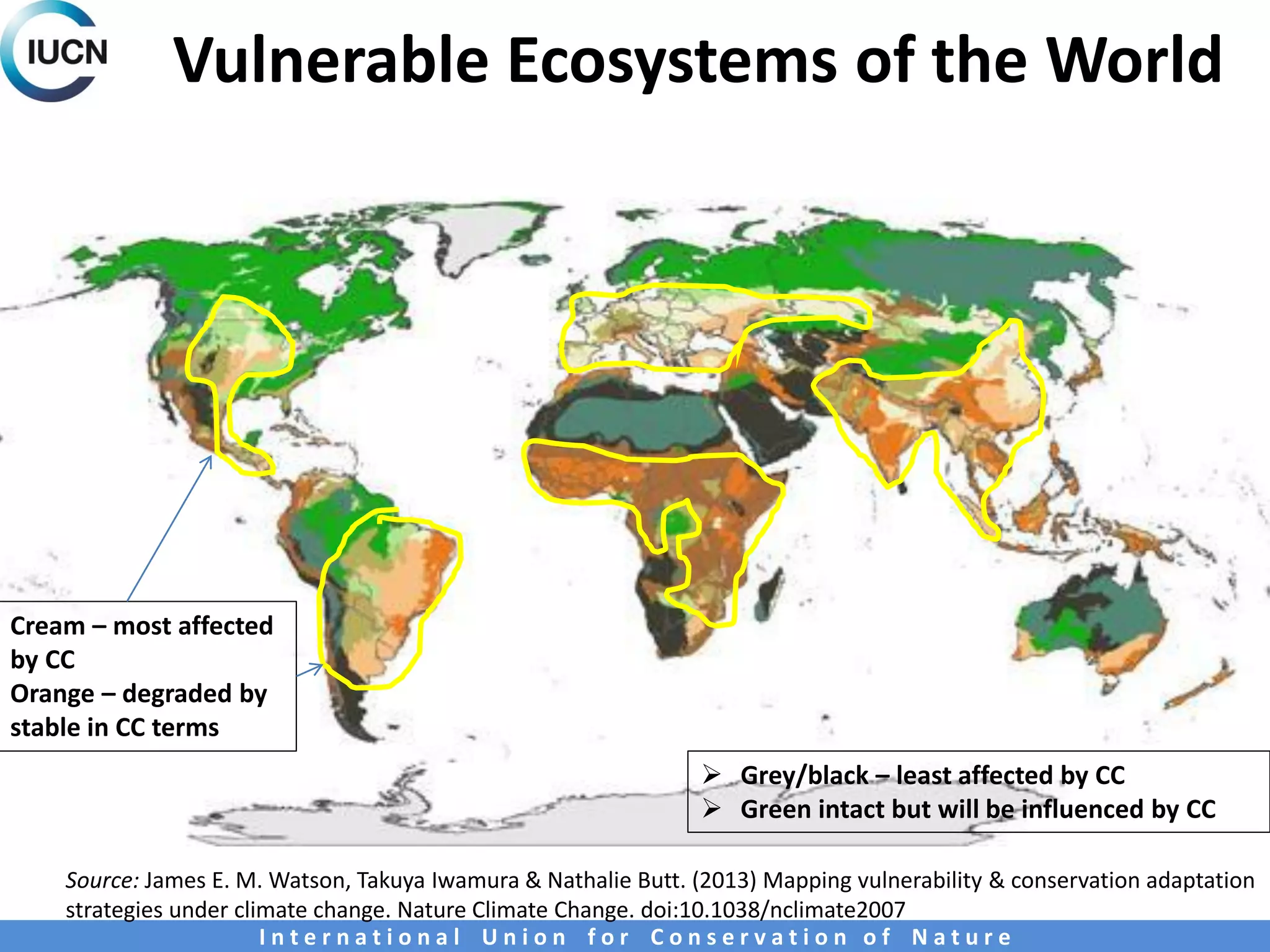
Vulnerable Ecosystems of the World
I n t e r n a t i o n a l U n i o n f o r C o n s e r v a t i o n o f N a t u r e
Cream – most affected
by CC
Orange – degraded by
stable in CC terms
 Grey/black – least affected by CC
 Green intact but will be influenced by CC
Source: James E. M. Watson, Takuya Iwamura & Nathalie Butt. (2013) Mapping vulnerability & conservation adaptation
strategies under climate change. Nature Climate Change. doi:10.1038/nclimate2007
Some examples CC vulnerable
Ecosystems now
• Mountains, alpine
• Polar & tundra
• Drylands & woodlands
• Coral reefs
Some Results of climate risk (&
other risks)
I n t e r n a t i o n a l U n i o n f o r C o n s e r v a t i o n o f N a t u r e
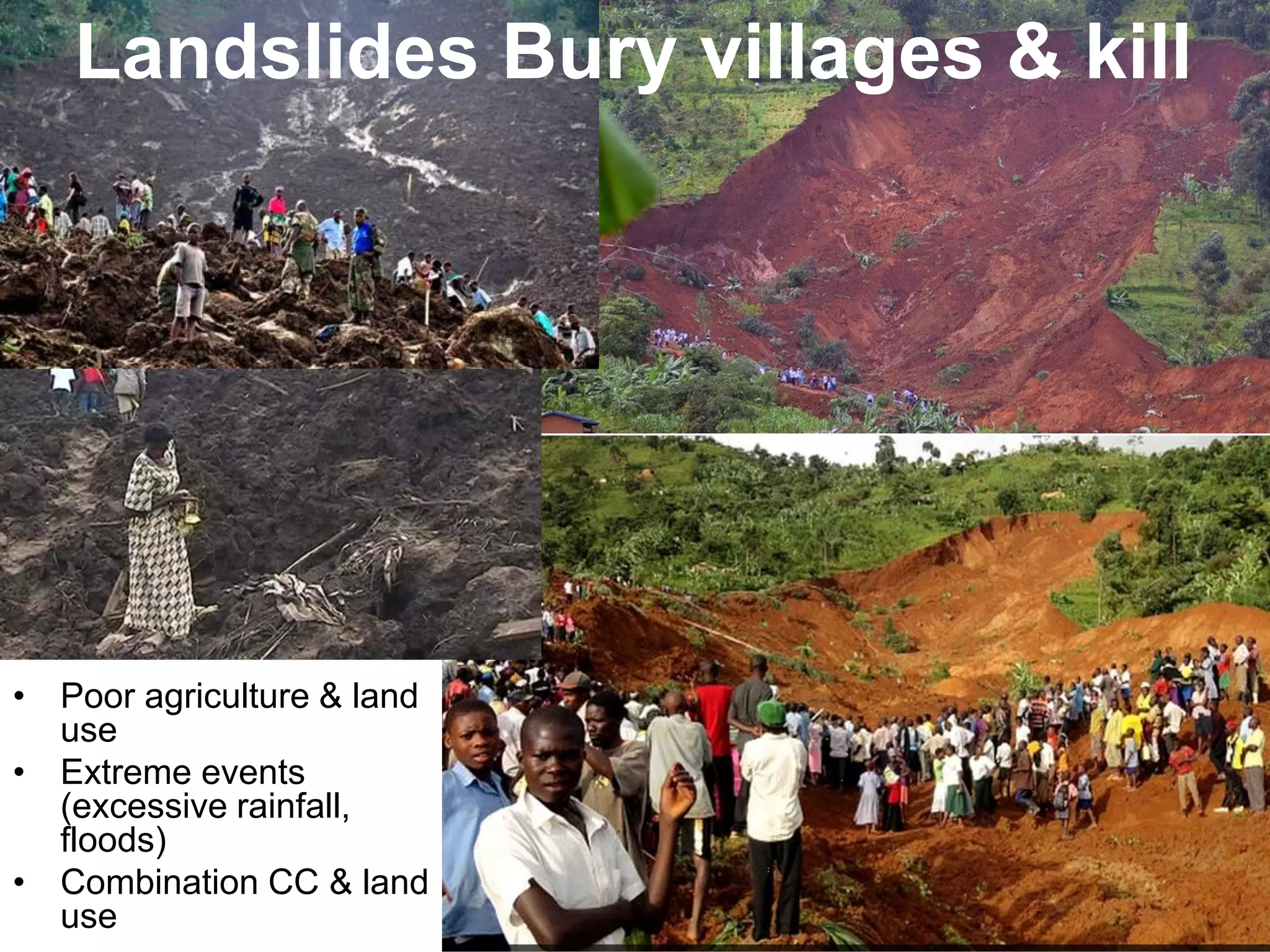
Landslides Bury villages & kill
• Poor agriculture & land
use
• Extreme events
(excessive rainfall,
floods)
• Combination CC & land
use
Prosopis – well meaning
development becoming an
environmental disaster• Highly invasive
• Management helps (e.g. cutting & use for
charcoal, fuel) but not enough
• Needs bio-control
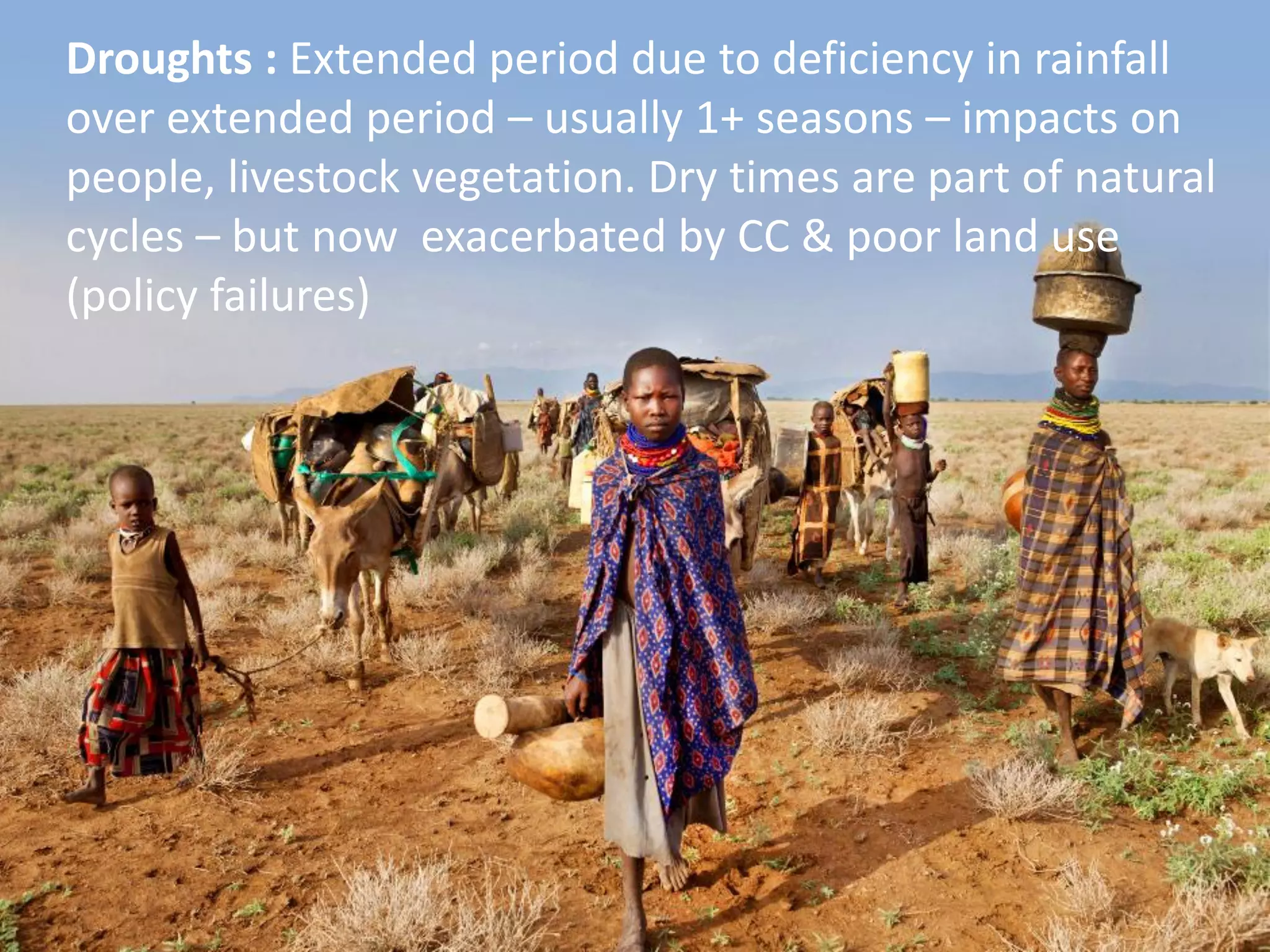
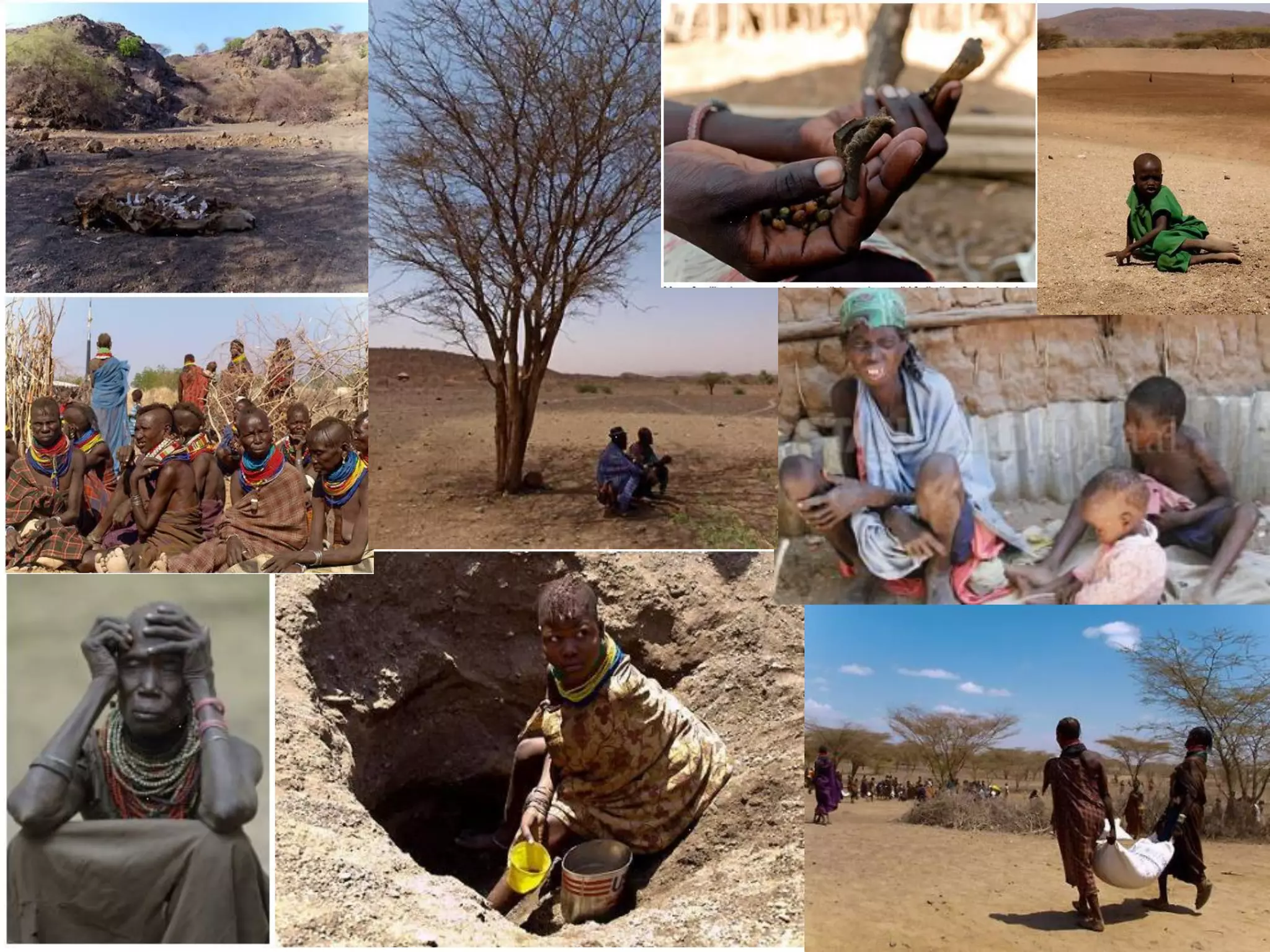
Droughts : Extended period due to deficiency in rainfall
over extended period – usually 1+ seasons – impacts on
people, livestock vegetation. Dry times are part of natural
cycles – but now exacerbated by CC & poor land use
(policy failures)
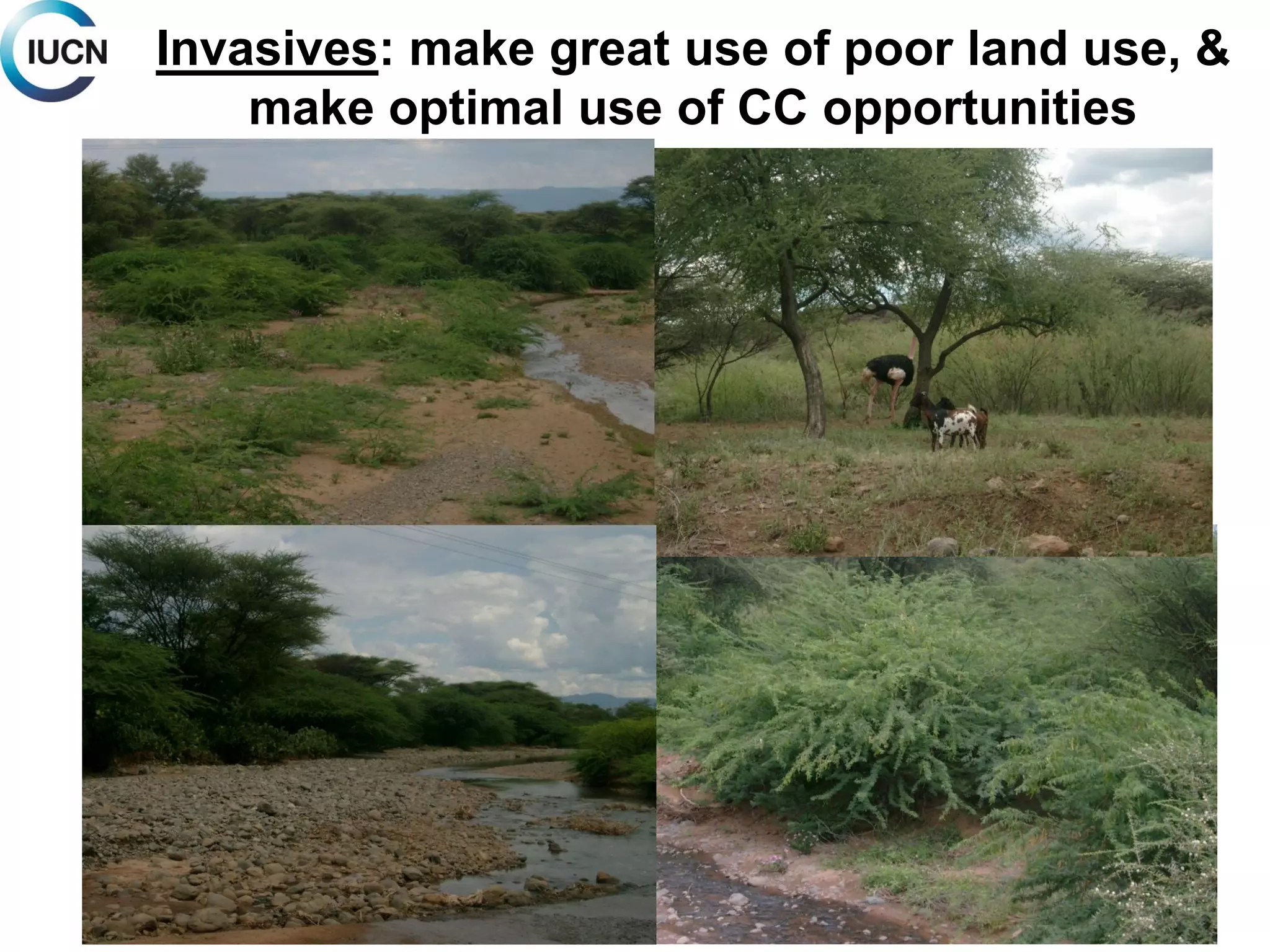
Invasives: make great use of poor land use, &
make optimal use of CC opportunities
How do we know that
Ecosystems are at Risk & why??
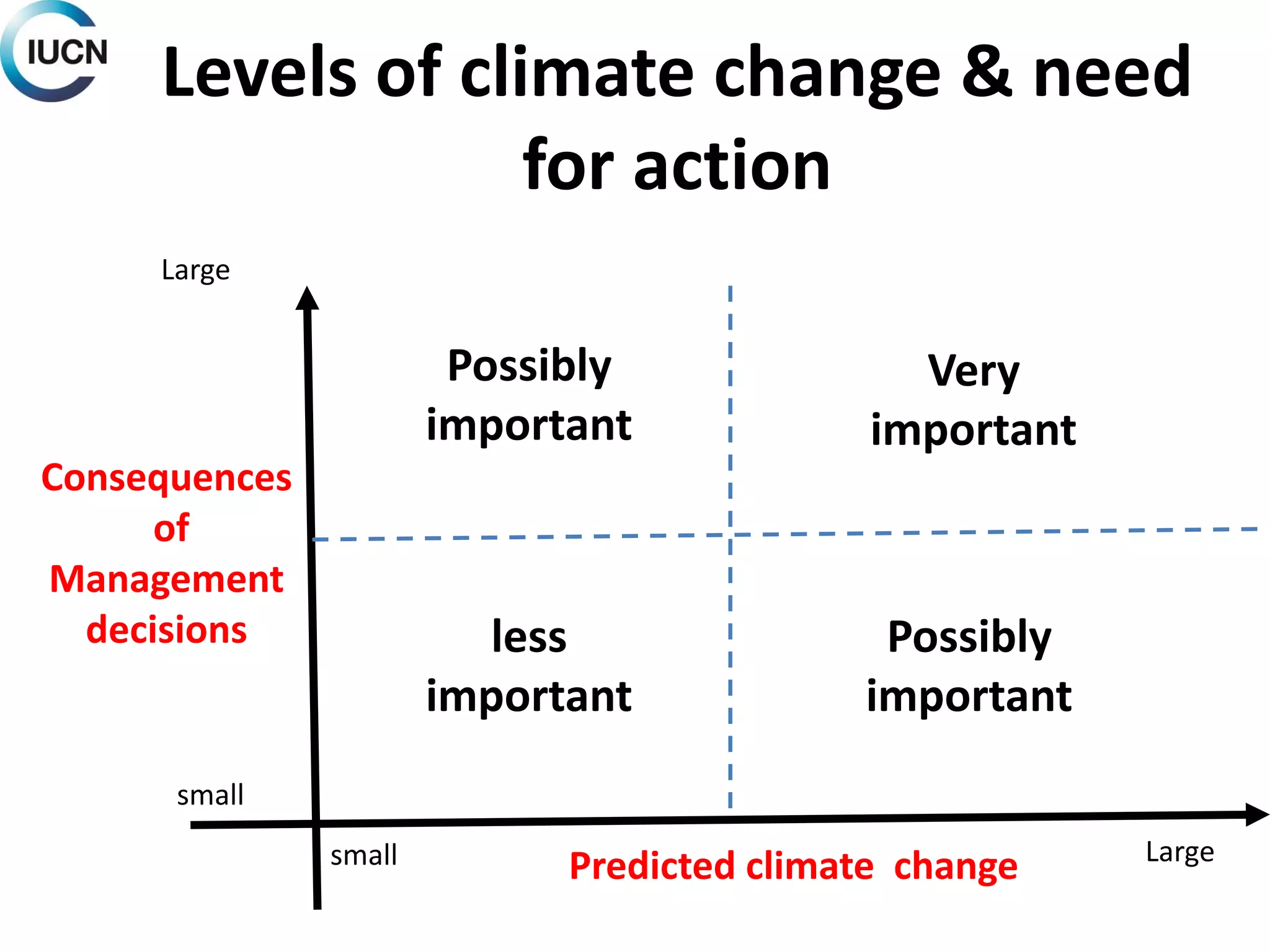
Levels of climate change & need
for action
Large
small
small Large
Consequences
of
Management
decisions
Predicted climate change
Possibly
important
Possibly
important
Very
important
less
important
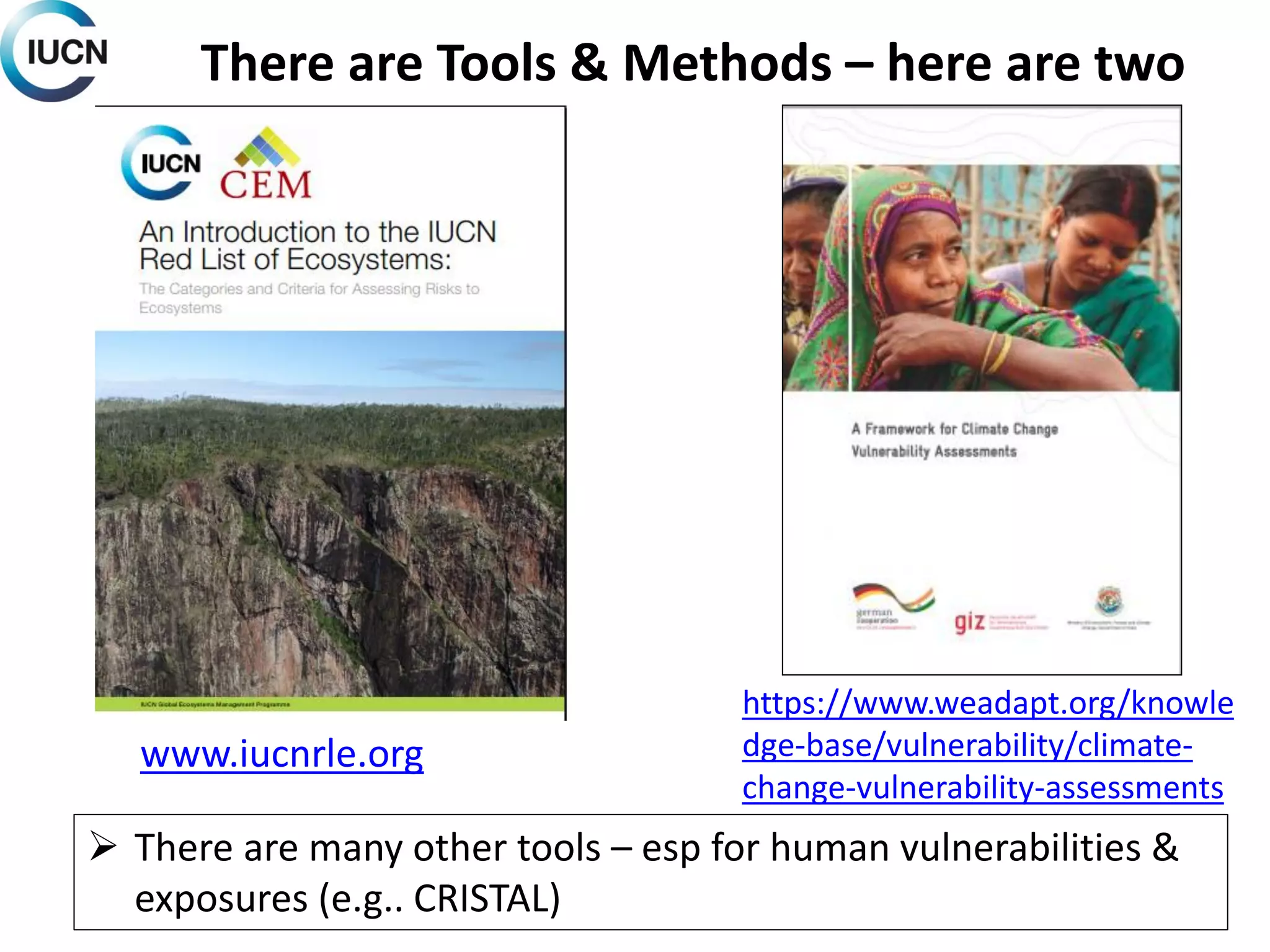
https://www.weadapt.org/knowle
dge-base/vulnerability/climate-
change-vulnerability-assessments
There are Tools & Methods – here are two
www.iucnrle.org
 There are many other tools – esp for human vulnerabilities &
exposures (e.g.. CRISTAL)
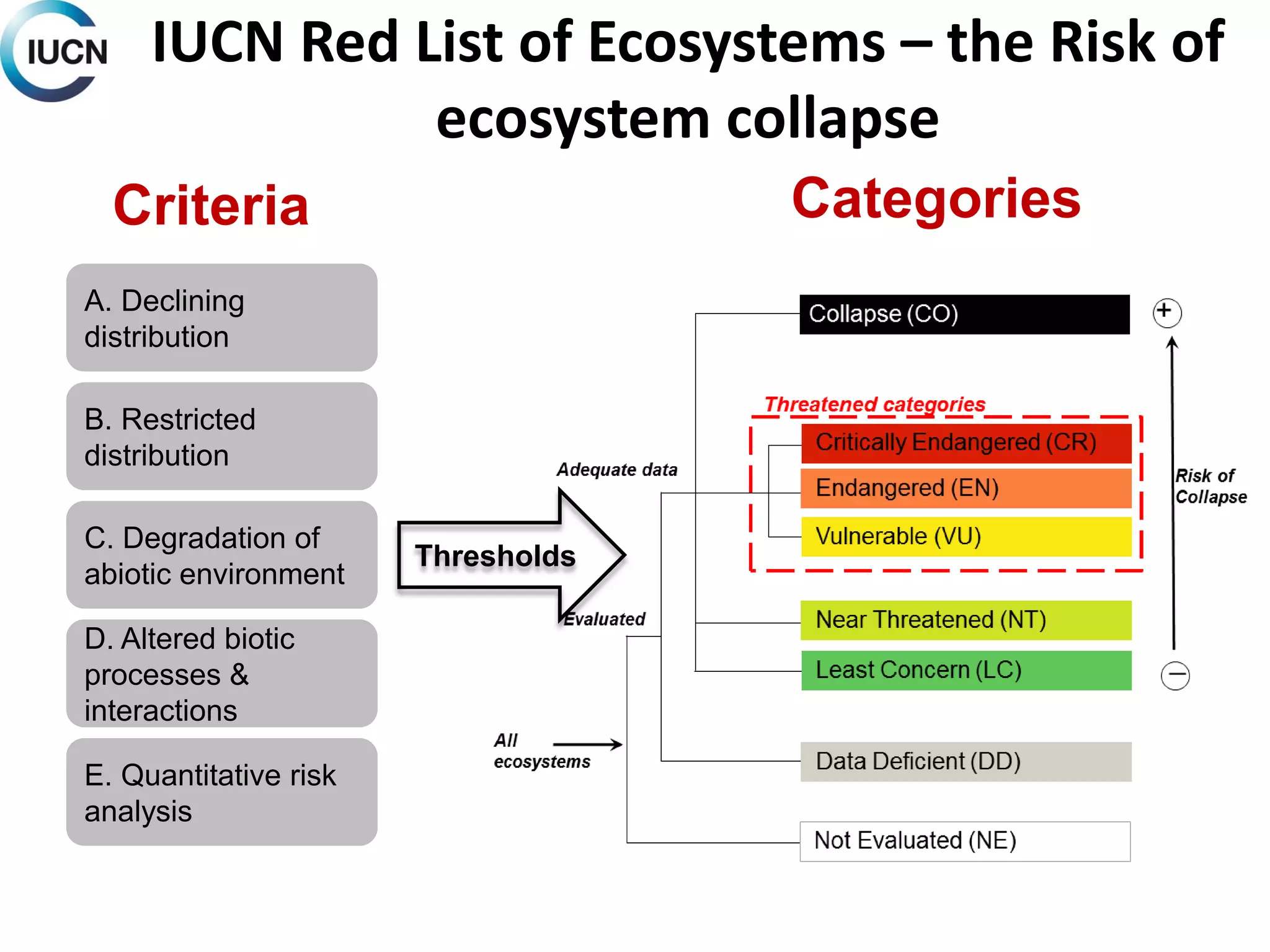
CategoriesCriteria
Thresholds
A. Declining
distribution
B. Restricted
distribution
C. Degradation of
abiotic environment
D. Altered biotic
processes &
interactions
E. Quantitative risk
analysis
IUCN Red List of Ecosystems – the Risk of
ecosystem collapse
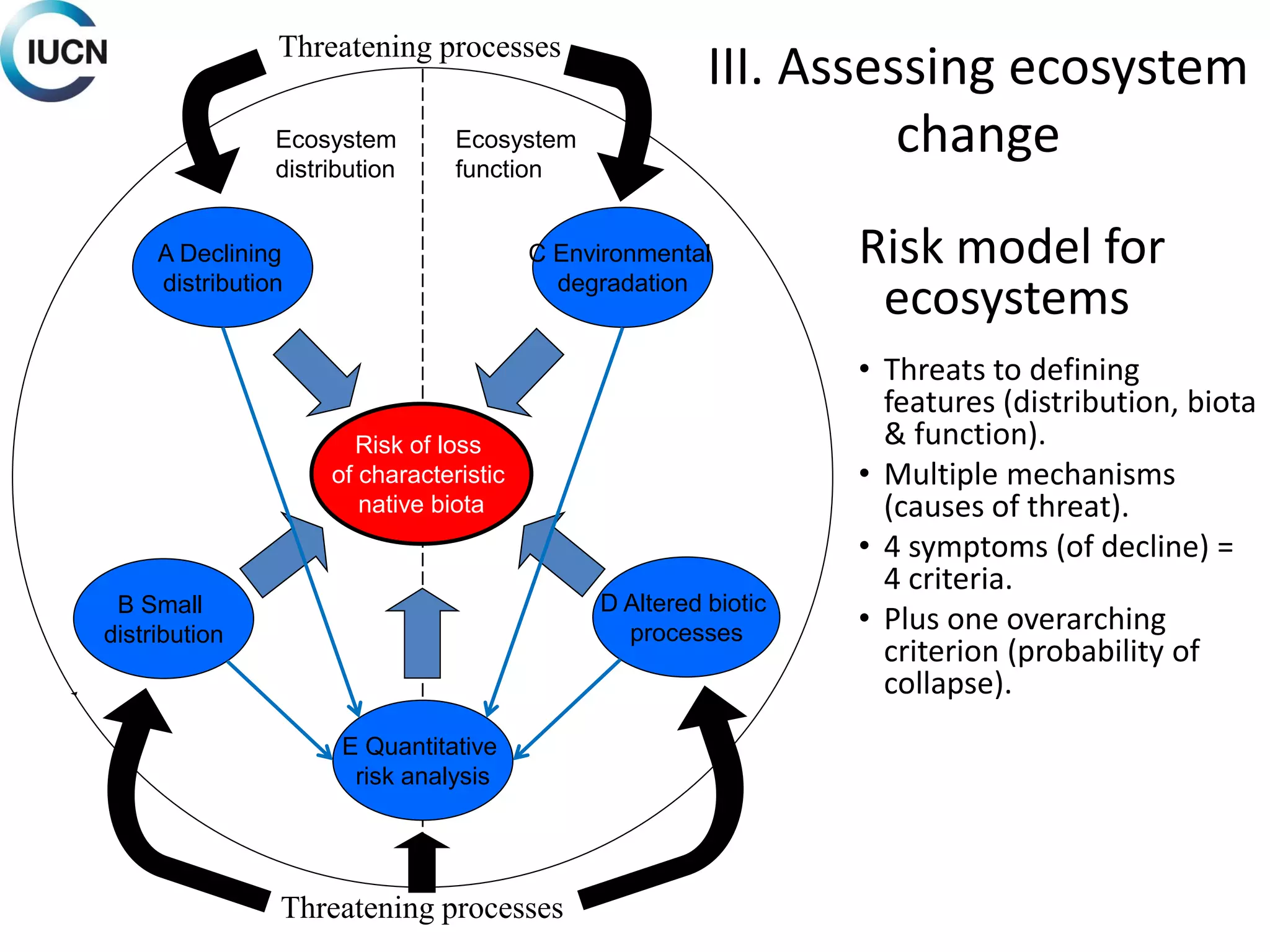
III. Assessing ecosystem
change
Risk model for
ecosystems
• Threats to defining
features (distribution, biota
& function).
• Multiple mechanisms
(causes of threat).
• 4 symptoms (of decline) =
4 criteria.
• Plus one overarching
criterion (probability of
collapse).
Threatening processes
Risk of loss
of characteristic
native biota
A Declining
distribution
C Environmental
degradation
D Altered biotic
processes
Ecosystem
distribution
Ecosystem
function
B Small
distribution
E Quantitative
risk analysis
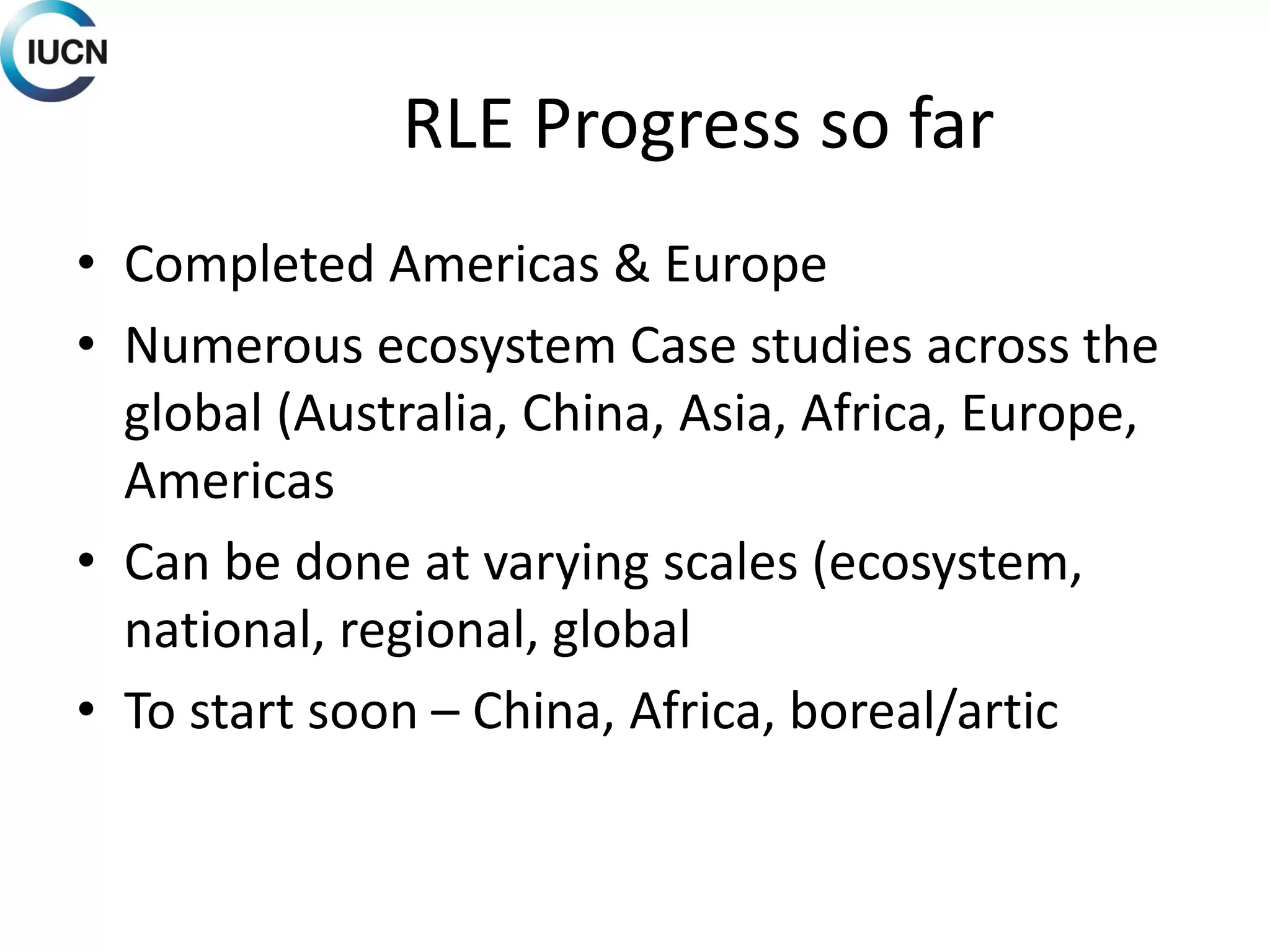
Key Drivers of change so far from RLE
• Degradation of hydrology & water quality,
& soil/air
• Climate change
• Invasive species impacts
• Loss of ecosystem structure, conversion
• Over-harvesting
RLE can identify drivers – but more often it is a
combination
RLE Progress so far
• Completed Americas & Europe
• Numerous ecosystem Case studies across the
global (Australia, China, Asia, Africa, Europe,
Americas
• Can be done at varying scales (ecosystem,
national, regional, global
• To start soon – China, Africa, boreal/artic
How can we help vulnerable ecosystems
adapt to climate change?
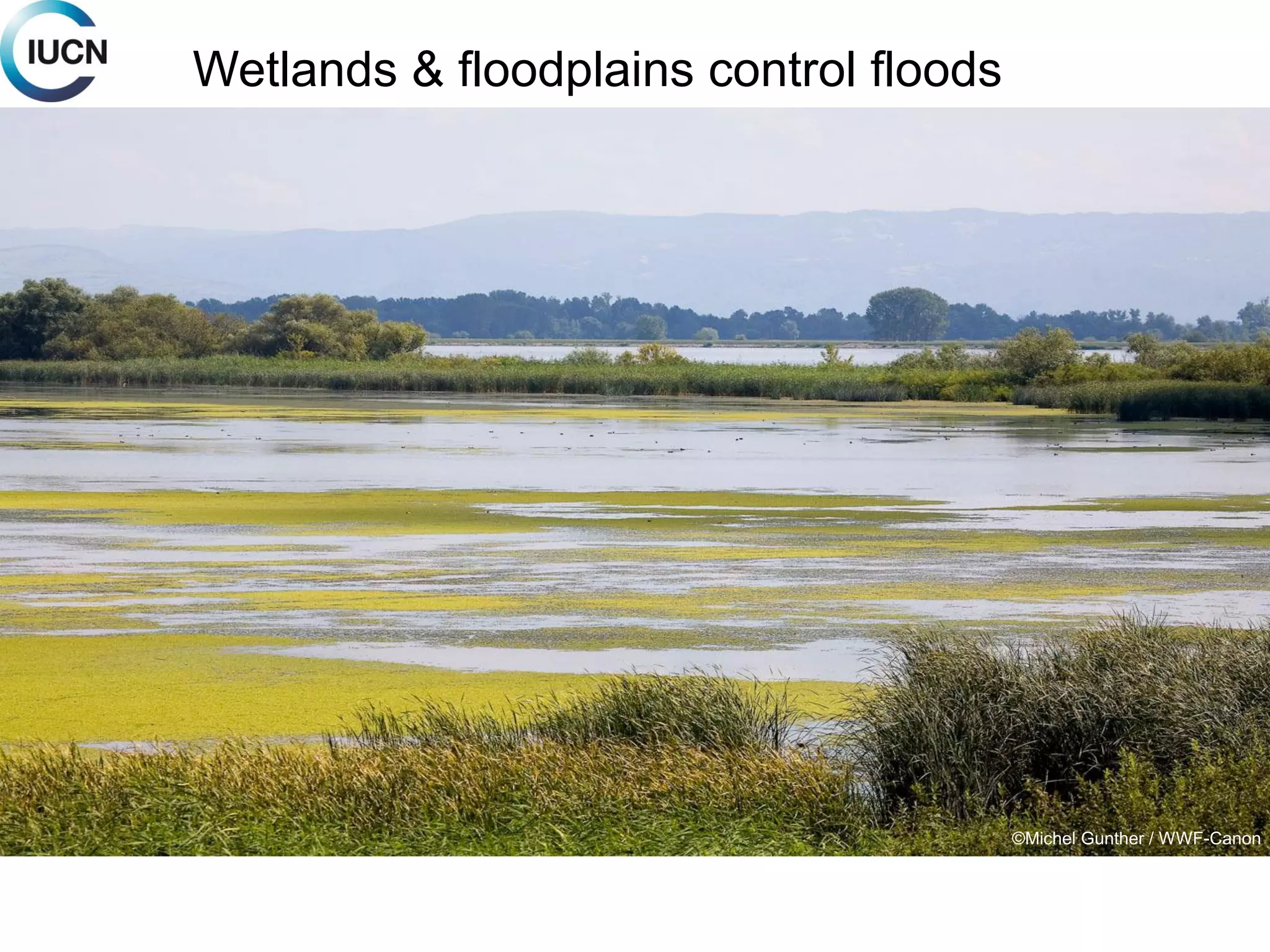
Mitigation: Wetlands &
floodplains control floods
©Michel Gunther / WWF-Canon
Wetlands & floodplains control floods
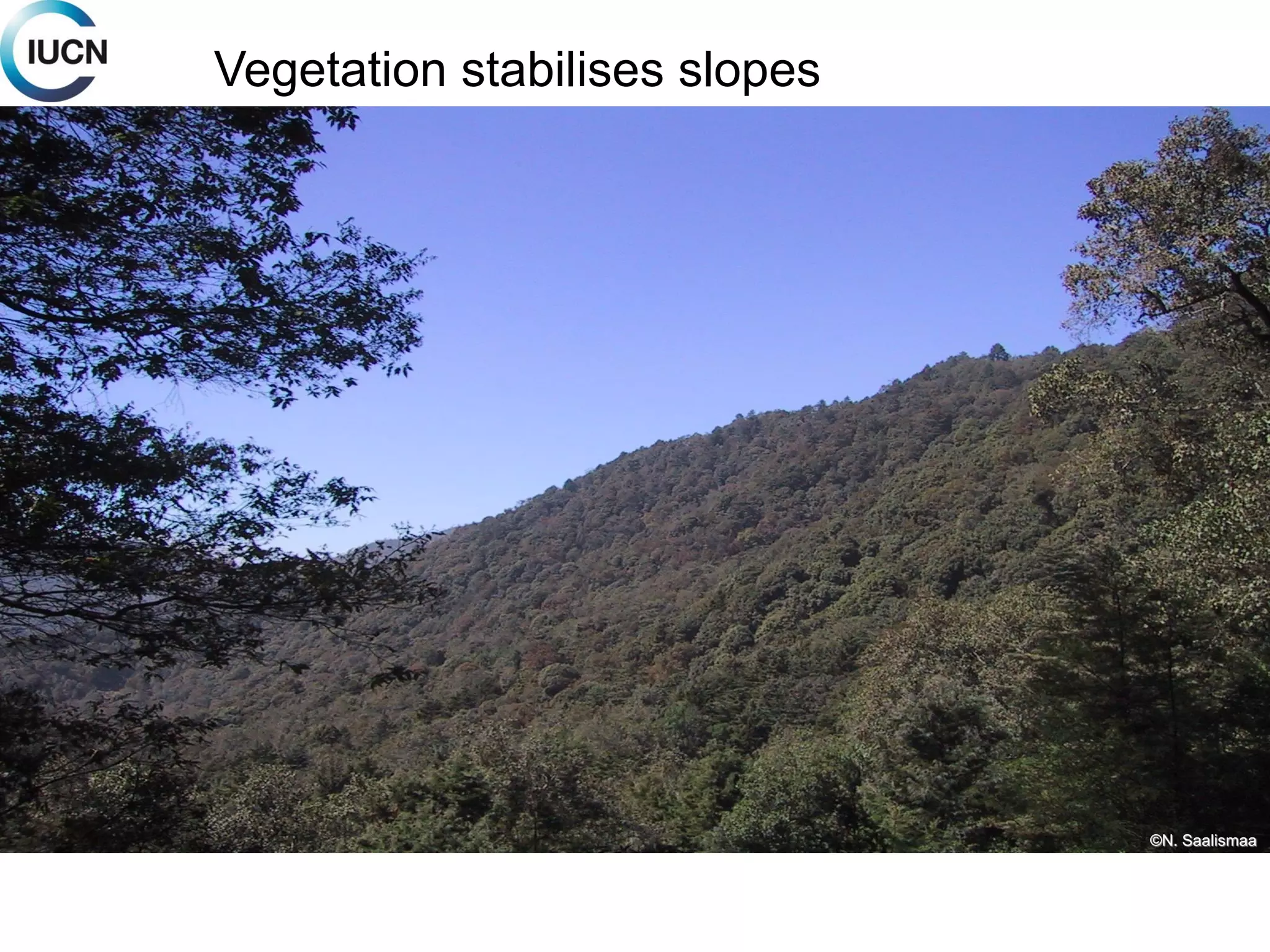
Mitigation: Vegetation
stabilises slopes
©N. Saalismaa
Vegetation stabilises slopes
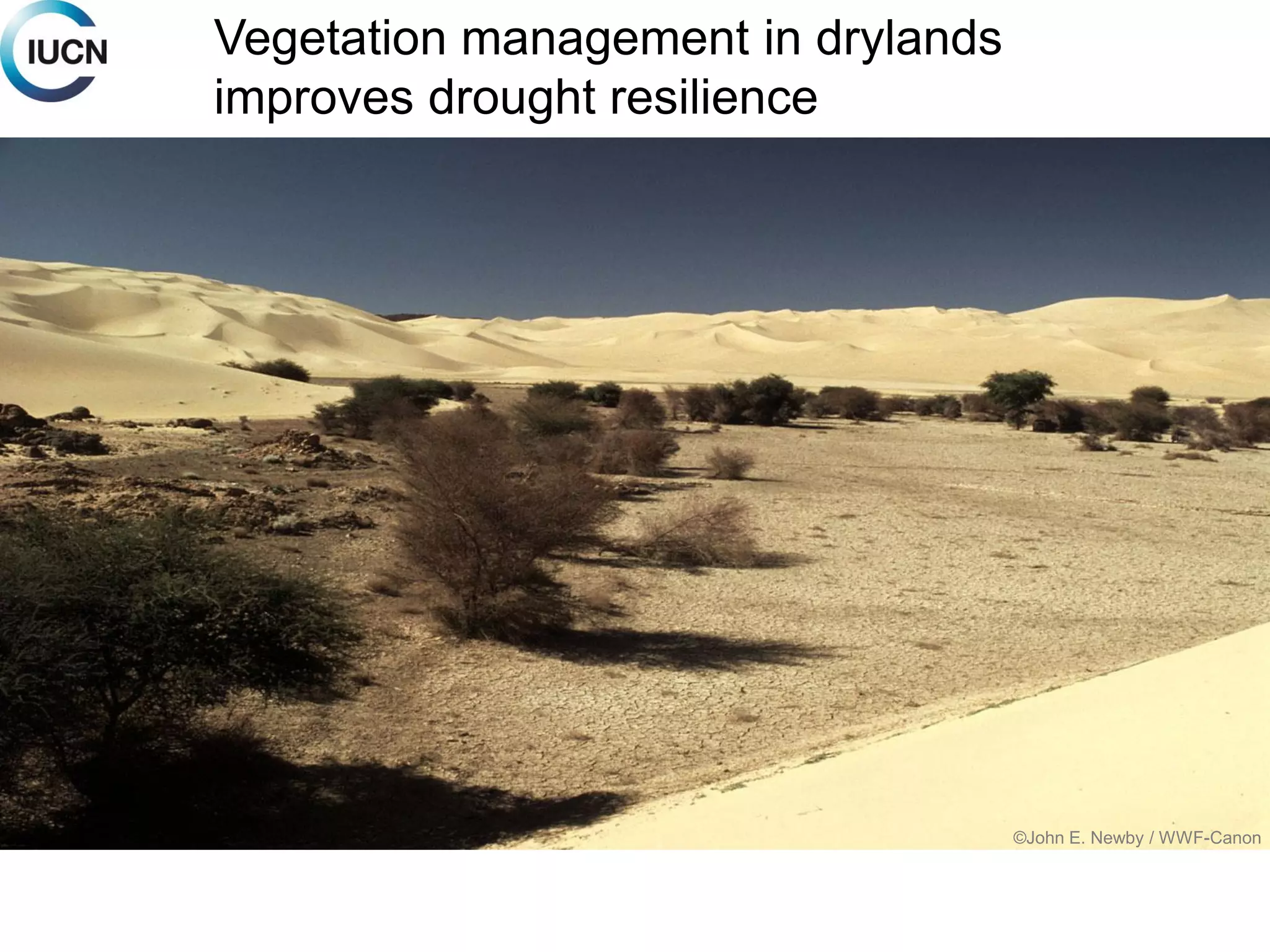
Mitigation: Vegetation management in drylands
improves drought resilience
©John E. Newby / WWF-Canon
Vegetation management in drylands
improves drought resilience
Other Methods
 Climate smart agriculture
 Restoration with climate smart species (trees,
grasslands)
 Diversified land (& water) use – increases
resilience
 Flood management trenches, contour grass
strips & tree planting
 River bank rehabilitation - restoration, &
planting appropriate indigenous trees
 Slope stabilization through soil & water
conservation, & planting of indigenous trees
How can we safeguard
ecosystems to help vulnerable
communities?
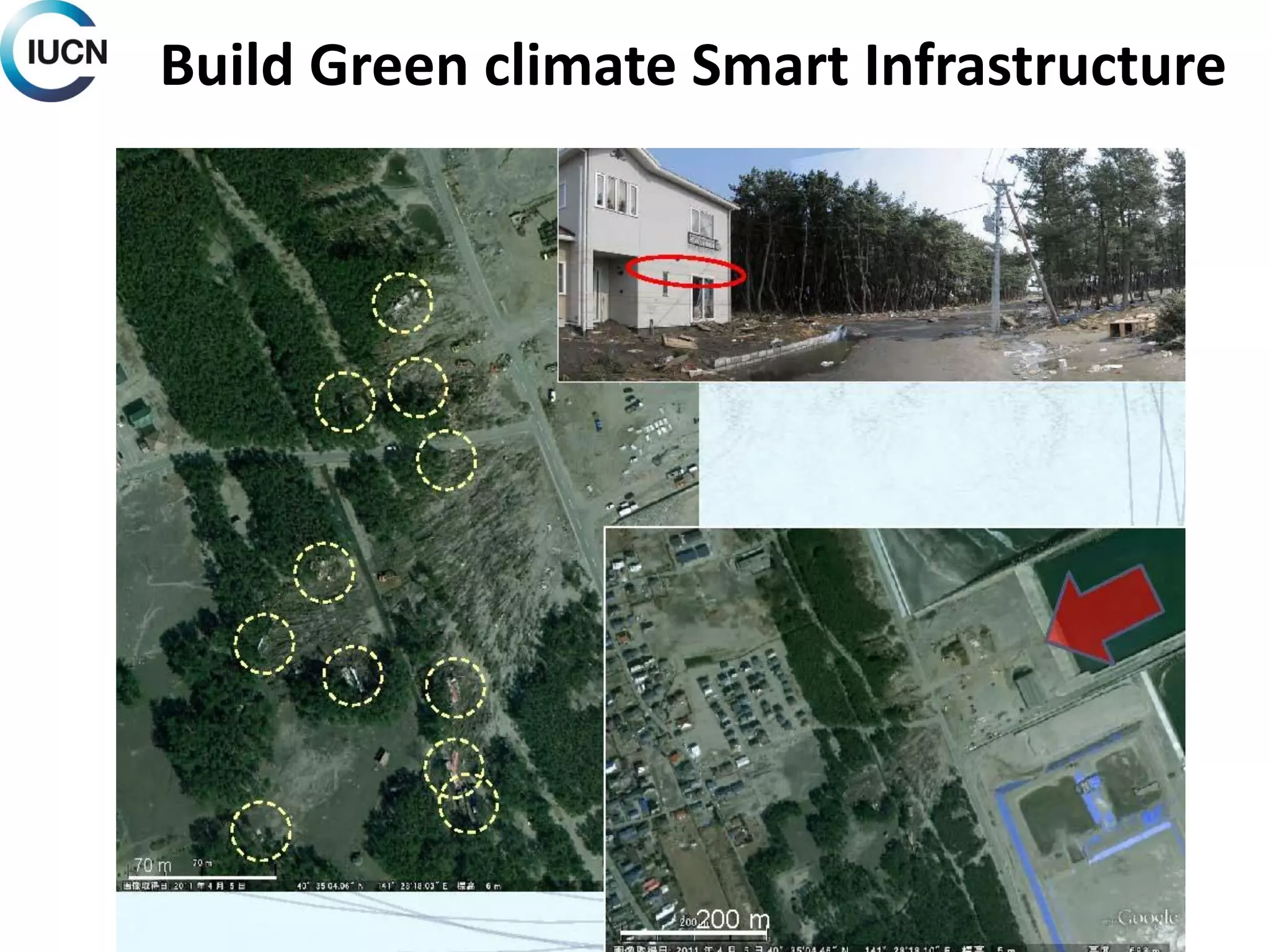
Build Green climate Smart Infrastructure
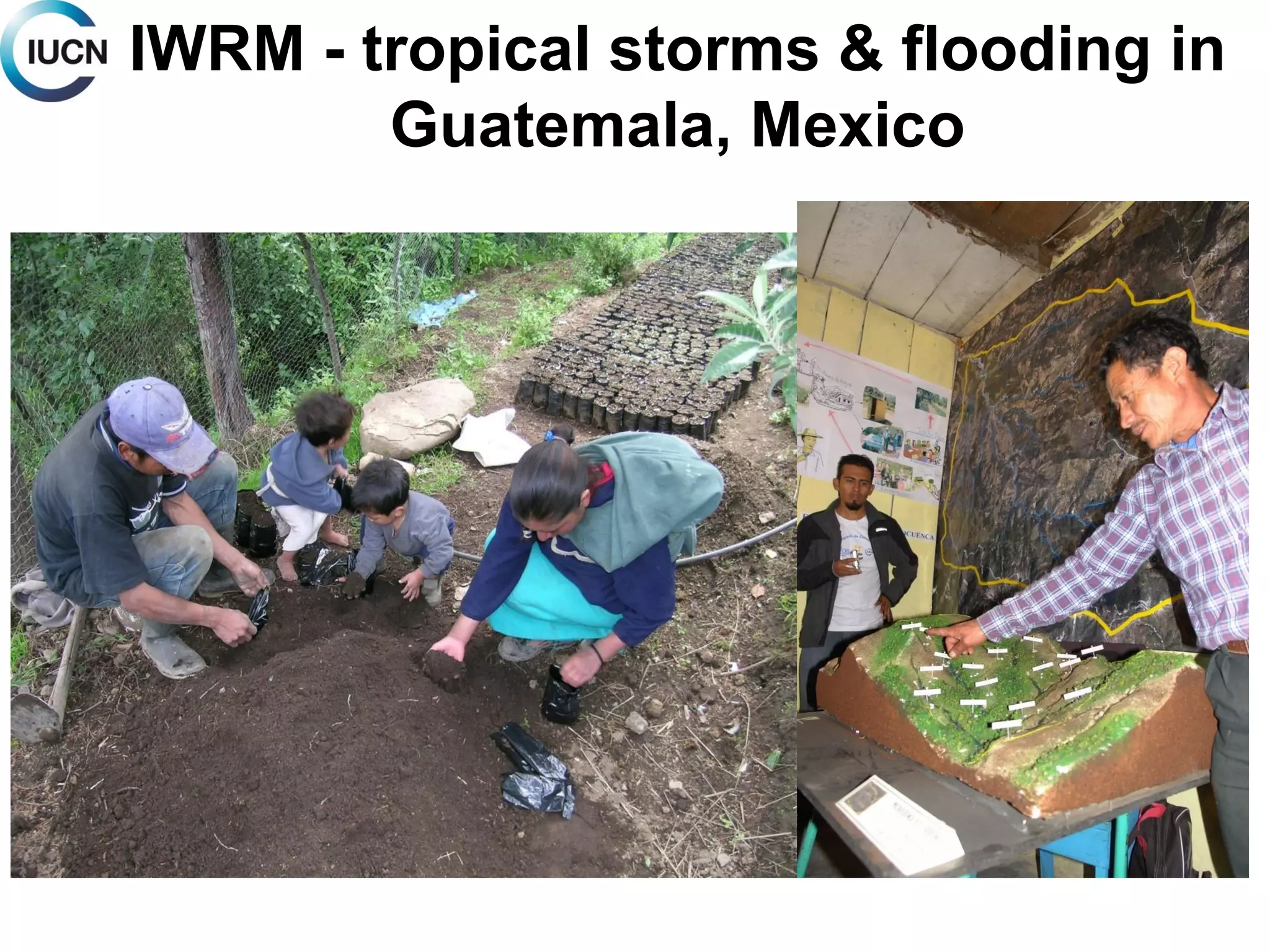
IWRM - tropical storms & flooding in
Guatemala, Mexico
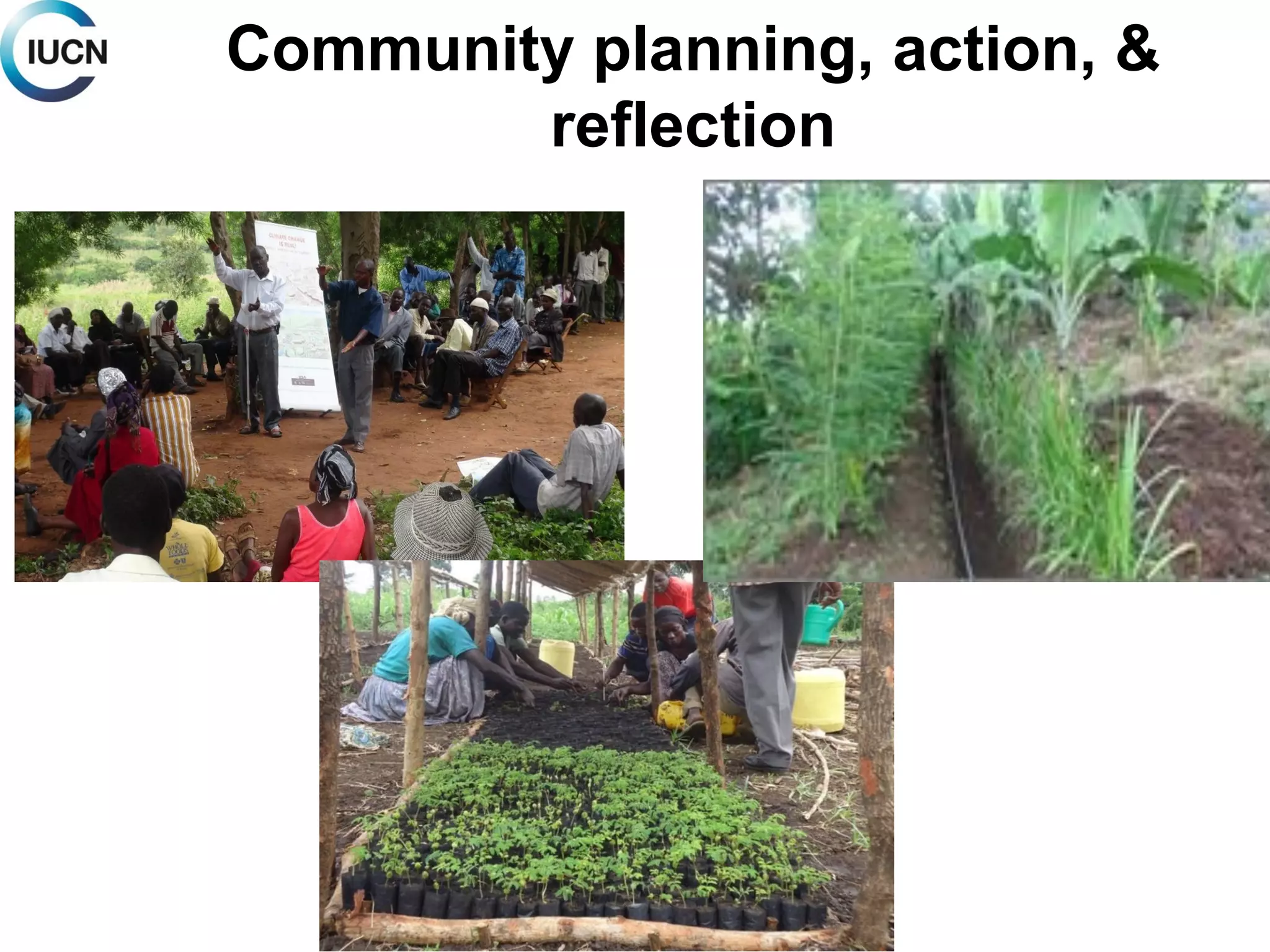
Community planning, action, &
reflection
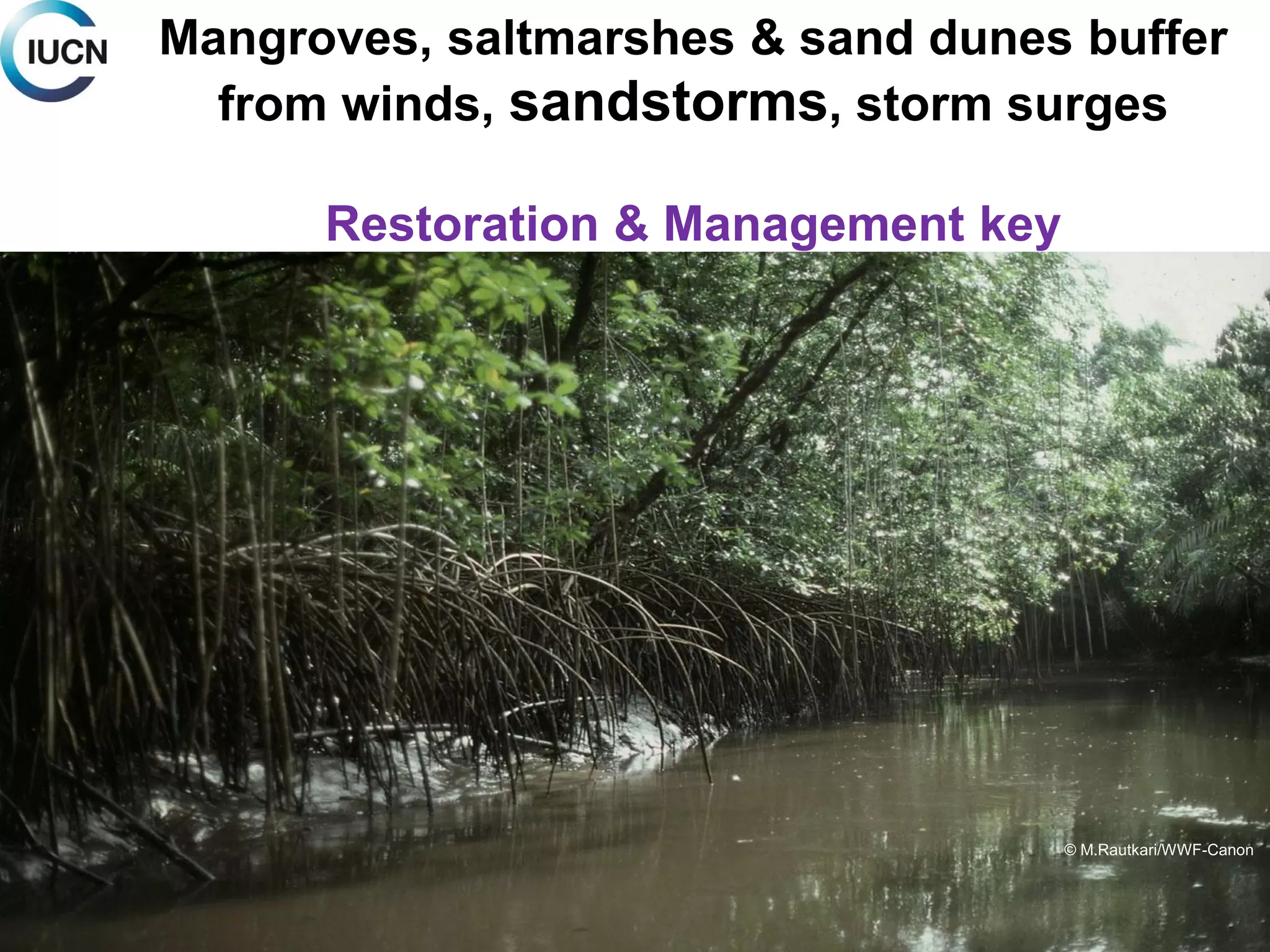
© UNEP© M.Rautkari/WWF-Canon
Mangroves, saltmarshes & sand dunes buffer
from winds, sandstorms, storm surges
Restoration & Management key
What are some key challenges for us
with respect to ecosystems?
• Why is it important to consider vulnerable
ecosystems in adaptation?
• What are the best methods for mapping risks?
• What are some examples for ensuring ecosystems
are properly considered in adaptation planning?
• What are some examples of how we can
implement, monitor, & evaluate our work?
• What are practical steps that countries can use?
• What are some practical next steps at regional &
global levels to support national efforts?
Conclusion
• Reduce risks to ecosystems, will reduce risks to
communities
• Its more than land (water) productivity – its about
ecosystem & community resilience
• At ecosystem level – difficulties of separating climate
from human induced changes – but does that
matter?
• & separating climate variability from Change
Key: Promote practical action that results in
increased ecosystem & human resilience

Vulnerable Ecosystems results in Vulnerable Communities

  • 1.
    Vulnerable Ecosystems results inVulnerable Communities Edmund Barrow Director Global Ecosystem Management Programme, IUCN
  • 2.
    Key elements • Whichare the Climate vulnerable ecosystems & why? • Which are vulnerable for different reasons? • How do we know? (tools, methods) • How can we help vulnerable ecosystems adapt to climate change • How can we safeguard ecosystems to help vulnerable communities • What are some key challenges for us?
  • 3.
    Which Ecosystems –vulnerable & Why?
  • 4.
    Which Ecosystems –vulnerable & Why? Due to climate change (temp increase) Due to more frequent & severe events (floods, droughts, hurricanes) These exacerbate & in turn exacerbated by Due to human influence – degradation, conversion, invasives As a result often hard to separate
  • 5.
    Vulnerable Ecosystems ofthe World I n t e r n a t i o n a l U n i o n f o r C o n s e r v a t i o n o f N a t u r e Cream – most affected by CC Orange – degraded by stable in CC terms  Grey/black – least affected by CC  Green intact but will be influenced by CC Source: James E. M. Watson, Takuya Iwamura & Nathalie Butt. (2013) Mapping vulnerability & conservation adaptation strategies under climate change. Nature Climate Change. doi:10.1038/nclimate2007
  • 6.
    Some examples CCvulnerable Ecosystems now • Mountains, alpine • Polar & tundra • Drylands & woodlands • Coral reefs
  • 7.
    Some Results ofclimate risk (& other risks) I n t e r n a t i o n a l U n i o n f o r C o n s e r v a t i o n o f N a t u r e
  • 8.
    Landslides Bury villages& kill • Poor agriculture & land use • Extreme events (excessive rainfall, floods) • Combination CC & land use
  • 9.
    Prosopis – wellmeaning development becoming an environmental disaster• Highly invasive • Management helps (e.g. cutting & use for charcoal, fuel) but not enough • Needs bio-control Droughts : Extended period due to deficiency in rainfall over extended period – usually 1+ seasons – impacts on people, livestock vegetation. Dry times are part of natural cycles – but now exacerbated by CC & poor land use (policy failures)
  • 11.
    Invasives: make greatuse of poor land use, & make optimal use of CC opportunities
  • 12.
    How do weknow that Ecosystems are at Risk & why??
  • 13.
    Levels of climatechange & need for action Large small small Large Consequences of Management decisions Predicted climate change Possibly important Possibly important Very important less important
  • 14.
    https://www.weadapt.org/knowle dge-base/vulnerability/climate- change-vulnerability-assessments There are Tools& Methods – here are two www.iucnrle.org  There are many other tools – esp for human vulnerabilities & exposures (e.g.. CRISTAL)
  • 15.
    CategoriesCriteria Thresholds A. Declining distribution B. Restricted distribution C.Degradation of abiotic environment D. Altered biotic processes & interactions E. Quantitative risk analysis IUCN Red List of Ecosystems – the Risk of ecosystem collapse
  • 16.
    III. Assessing ecosystem change Riskmodel for ecosystems • Threats to defining features (distribution, biota & function). • Multiple mechanisms (causes of threat). • 4 symptoms (of decline) = 4 criteria. • Plus one overarching criterion (probability of collapse). Threatening processes Threatening processes Risk of loss of characteristic native biota A Declining distribution C Environmental degradation D Altered biotic processes Ecosystem distribution Ecosystem function B Small distribution E Quantitative risk analysis
  • 17.
    Key Drivers ofchange so far from RLE • Degradation of hydrology & water quality, & soil/air • Climate change • Invasive species impacts • Loss of ecosystem structure, conversion • Over-harvesting RLE can identify drivers – but more often it is a combination
  • 18.
    RLE Progress sofar • Completed Americas & Europe • Numerous ecosystem Case studies across the global (Australia, China, Asia, Africa, Europe, Americas • Can be done at varying scales (ecosystem, national, regional, global • To start soon – China, Africa, boreal/artic
  • 19.
    How can wehelp vulnerable ecosystems adapt to climate change?
  • 20.
    Mitigation: Wetlands & floodplainscontrol floods ©Michel Gunther / WWF-Canon Wetlands & floodplains control floods
  • 21.
    Mitigation: Vegetation stabilises slopes ©N.Saalismaa Vegetation stabilises slopes
  • 22.
    Mitigation: Vegetation managementin drylands improves drought resilience ©John E. Newby / WWF-Canon Vegetation management in drylands improves drought resilience
  • 23.
    Other Methods  Climatesmart agriculture  Restoration with climate smart species (trees, grasslands)  Diversified land (& water) use – increases resilience  Flood management trenches, contour grass strips & tree planting  River bank rehabilitation - restoration, & planting appropriate indigenous trees  Slope stabilization through soil & water conservation, & planting of indigenous trees
  • 24.
    How can wesafeguard ecosystems to help vulnerable communities?
  • 25.
    Build Green climateSmart Infrastructure
  • 26.
    IWRM - tropicalstorms & flooding in Guatemala, Mexico
  • 27.
  • 28.
    © UNEP© M.Rautkari/WWF-Canon Mangroves,saltmarshes & sand dunes buffer from winds, sandstorms, storm surges Restoration & Management key
  • 29.
    What are somekey challenges for us with respect to ecosystems? • Why is it important to consider vulnerable ecosystems in adaptation? • What are the best methods for mapping risks? • What are some examples for ensuring ecosystems are properly considered in adaptation planning? • What are some examples of how we can implement, monitor, & evaluate our work? • What are practical steps that countries can use? • What are some practical next steps at regional & global levels to support national efforts?
  • 30.
    Conclusion • Reduce risksto ecosystems, will reduce risks to communities • Its more than land (water) productivity – its about ecosystem & community resilience • At ecosystem level – difficulties of separating climate from human induced changes – but does that matter? • & separating climate variability from Change Key: Promote practical action that results in increased ecosystem & human resilience