Soil Erosion Impacts on Flooding:
Lost water storage in Iowa uplands
Soil and Water Conservation Society
Annual Meeting, Madison, WI
2017
B. Sharmaa, B. Millerb, and R. Crusec
a*Post-doctoral Research Associate, Oak Ridge National Laboratory
b Assistant Professor, Department of Agronomy, Iowa State University
c Professor, Department of Agronomy, Iowa State University
Introduction Results ConclusionsMethodology
Erosion
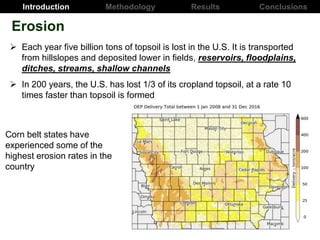
 Each year five billion tons of topsoil is lost in the U.S. It is transported
from hillslopes and deposited lower in fields, reservoirs, floodplains,
ditches, streams, shallow channels
 In 200 years, the U.S. has lost 1/3 of its cropland topsoil, at a rate 10
times faster than topsoil is formed
Corn belt states have
experienced some of the
highest erosion rates in the
country
Introduction Results ConclusionsMethodology
On-site
 Loss of fertile top soil
 Loss of nutrients
 Impairing crop productivity
Off-site
 Non-point source of pollution
 Filling of reservoirs and dams
 Degrading on water quality
 Reducing ability to buffer against environmental impacts
 Flooding
 Loss of upland water storage
Impact of erosion
Introduction Results ConclusionsMethodology
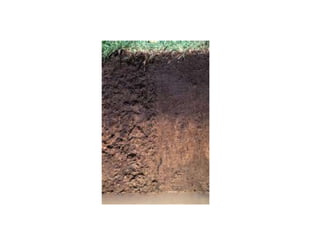
World’s largest sponge
 Topmost layer of mineral soil approximately
50% pore space
 It is the richest soil horizon and has the
most favorable effects on crop yield
[1]
Introduction Results ConclusionsMethodology
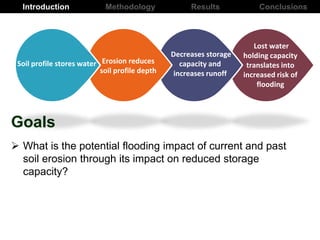
Goals
 What is the potential flooding impact of current and past
soil erosion through its impact on reduced storage
capacity?
Decreases storage
capacity and
increases runoff
Erosion reduces
soil profile depth
Soil profile stores water
Lost water
holding capacity
translates into
increased risk of
flooding
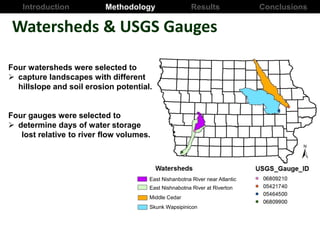
Watersheds & USGS Gauges
Introduction Results ConclusionsMethodology
Four watersheds were selected to
 capture landscapes with different
hillslope and soil erosion potential.
Four gauges were selected to
 determine days of water storage
lost relative to river flow volumes.
East Nishanbotna River near Atlantic
East Nishnabotna River at Riverton
Middle Cedar
Skunk Wapsipinicon
Scenarios and assumptions
Introduction Results ConclusionsMethodology
Scenarios Description
5T/A/yr Erosion rate: 5 tons/acre/year (Low)
DEP Erosion rate: From Daily Erosion Project (DEP) [9]
20T/A/yr Erosion rate: 20 tons/acre/year (High)
Scenarios represent range of erosion rates for Iowa landscape to understand the
impact of lost water storage capacity associated with soil erosion.
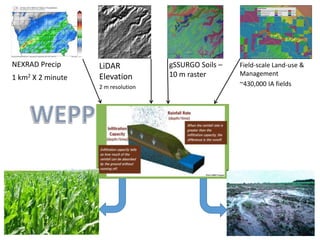
NEXRAD Precip
1 km2 X 2 minute
LiDAR
Elevation
2 m resolution
gSSURGO Soils –
10 m raster
Field-scale Land-use &
Management
~430,000 IA fields
Introduction Results ConclusionsMethodology
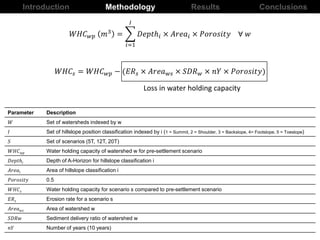
𝑊𝐻𝐶 𝑤𝑝 𝑚3
=
𝑖=1
𝐼
𝐷𝑒𝑝𝑡ℎ𝑖 × 𝐴𝑟𝑒𝑎𝑖 × 𝑃𝑜𝑟𝑜𝑠𝑖𝑡𝑦 ∀ 𝑤
𝑊𝐻𝐶𝑠 = 𝑊𝐻𝐶 𝑤𝑝 − (𝐸𝑅 𝑠 × 𝐴𝑟𝑒𝑎 𝑤𝑠 × 𝑆𝐷𝑅 𝑤 × 𝑛𝑌 × 𝑃𝑜𝑟𝑜𝑠𝑖𝑡𝑦)
Parameter Description
𝑊 Set of watersheds indexed by w
𝐼 Set of hillslope position classification indexed by i (1 = Summit, 2 = Shoulder, 3 = Backslope, 4= Footslope, 5 = Toeslope)
𝑆 Set of scenarios (5T, 12T, 20T)
𝑊𝐻𝐶 𝑤𝑝 Water holding capacity of watershed w for pre-settlement scenario
𝐷𝑒𝑝𝑡ℎ𝑖 Depth of A-Horizon for hillslope classification i
𝐴𝑟𝑒𝑎𝑖 Area of hillslope classification i
𝑃𝑜𝑟𝑜𝑠𝑖𝑡𝑦 0.5
𝑊𝐻𝐶 𝑠 Water holding capacity for scenario s compared to pre-settlement scenario
𝐸𝑅 𝑠 Erosion rate for a scenario s
𝐴𝑟𝑒𝑎 𝑤𝑠 Area of watershed w
𝑆𝐷𝑅𝑤 Sediment delivery ratio of watershed w
𝑛𝑌 Number of years (10 years)
Loss in water holding capacity
Introduction Results ConclusionsMethodology
Table 1: Loss in A-horizon water holding capacity after 10 years
Watersheds
Scenarios
5T (0.85 mm/year) DEP 20T (3.39 mm/year)
Cubic meters
East Nishnabotna_Riverton 1,930,402 4,451,507 7,721,608
East Nishnabotna_Atlantic 863,457 2,851,137 3,453,830
Middle Cedar 5,690,222 3,783,997 22,760,887
Skunk Wapsipinicon 1,381,204 860,490 5,524,814
Erosion rates (tons/acre/year) and depth lost (mm/year) for DEP scenario for
watersheds
East Nishnabotna_Riverton 11.5 (1.95 mm/year)
East Nishnabotna_Atlantic 16.51 (2.80 mm/year)
Middle Cedar 3.33 (0.56 mm/year)
Skunk Wapsipinicon 3.12 (0.53 mm/year)
Scenarios Description
5T Erosion rate: 5 tons/acre/year (Low)
DEP Erosion rate: From Daily Erosion Project (DEP) [9]
20T Erosion rate: 20 tons/acre/year (High)
Introduction Results ConclusionsMethodology
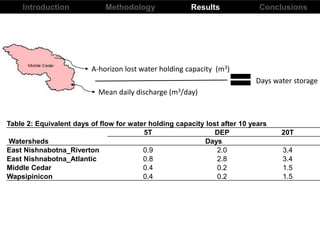
Table 2: Equivalent days of flow for water holding capacity lost after 10 years
Watersheds
5T DEP 20T
Days
East Nishnabotna_Riverton 0.9 2.0 3.4
East Nishnabotna_Atlantic 0.8 2.8 3.4
Middle Cedar 0.4 0.2 1.5
Wapsipinicon 0.4 0.2 1.5
A-horizon lost water holding capacity (m3)
Mean daily discharge (m3/day)
Days water storage
Introduction Results ConclusionsMethodology
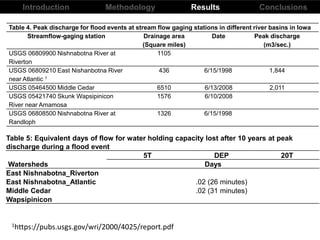
Table 5: Equivalent days of flow for water holding capacity lost after 10 years at peak
discharge during a flood event
Watersheds
5T DEP 20T
Days
East Nishnabotna_Riverton
East Nishnabotna_Atlantic .02 (26 minutes)
Middle Cedar .02 (31 minutes)
Wapsipinicon
Table 4. Peak discharge for flood events at stream flow gaging stations in different river basins in Iowa
Streamflow-gaging station Drainage area
(Square miles)
Date Peak discharge
(m3/sec.)
USGS 06809900 Nishnabotna River at
Riverton
1105
USGS 06809210 East Nishanbotna River
near Atlantic 1
436 6/15/1998 1,844
USGS 05464500 Middle Cedar 6510 6/13/2008 2,011
USGS 05421740 Skunk Wapsipinicon
River near Amamosa
1576 6/10/2008
USGS 06808500 Nishnabotna River at
Randloph
1326 6/15/1998
1https://pubs.usgs.gov/wri/2000/4025/report.pdf
Introduction Results ConclusionsMethodology
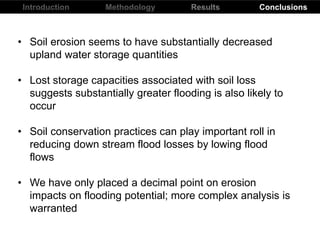
• Soil erosion seems to have substantially decreased
upland water storage quantities
• Lost storage capacities associated with soil loss
suggests substantially greater flooding is also likely to
occur
• Soil conservation practices can play important roll in
reducing down stream flood losses by lowing flood
flows
• We have only placed a decimal point on erosion
impacts on flooding potential; more complex analysis is
warranted
Thank you
Bhavna Sharma: sharmab@ornl.gov
Bradley Miller: millerba@iastate.edu
Richard Cruse: rmc@iastate.edu

Soil erosion and water storage

  • 1.
    Soil Erosion Impactson Flooding: Lost water storage in Iowa uplands Soil and Water Conservation Society Annual Meeting, Madison, WI 2017 B. Sharmaa, B. Millerb, and R. Crusec a*Post-doctoral Research Associate, Oak Ridge National Laboratory b Assistant Professor, Department of Agronomy, Iowa State University c Professor, Department of Agronomy, Iowa State University
  • 2.
    Introduction Results ConclusionsMethodology Erosion Each year five billion tons of topsoil is lost in the U.S. It is transported from hillslopes and deposited lower in fields, reservoirs, floodplains, ditches, streams, shallow channels  In 200 years, the U.S. has lost 1/3 of its cropland topsoil, at a rate 10 times faster than topsoil is formed Corn belt states have experienced some of the highest erosion rates in the country
  • 3.
    Introduction Results ConclusionsMethodology On-site Loss of fertile top soil  Loss of nutrients  Impairing crop productivity Off-site  Non-point source of pollution  Filling of reservoirs and dams  Degrading on water quality  Reducing ability to buffer against environmental impacts  Flooding  Loss of upland water storage Impact of erosion
  • 5.
    Introduction Results ConclusionsMethodology World’slargest sponge  Topmost layer of mineral soil approximately 50% pore space  It is the richest soil horizon and has the most favorable effects on crop yield [1]
  • 6.
    Introduction Results ConclusionsMethodology Goals What is the potential flooding impact of current and past soil erosion through its impact on reduced storage capacity? Decreases storage capacity and increases runoff Erosion reduces soil profile depth Soil profile stores water Lost water holding capacity translates into increased risk of flooding
  • 7.
    Watersheds & USGSGauges Introduction Results ConclusionsMethodology Four watersheds were selected to  capture landscapes with different hillslope and soil erosion potential. Four gauges were selected to  determine days of water storage lost relative to river flow volumes. East Nishanbotna River near Atlantic East Nishnabotna River at Riverton Middle Cedar Skunk Wapsipinicon
  • 8.
    Scenarios and assumptions IntroductionResults ConclusionsMethodology Scenarios Description 5T/A/yr Erosion rate: 5 tons/acre/year (Low) DEP Erosion rate: From Daily Erosion Project (DEP) [9] 20T/A/yr Erosion rate: 20 tons/acre/year (High) Scenarios represent range of erosion rates for Iowa landscape to understand the impact of lost water storage capacity associated with soil erosion.
  • 9.
    NEXRAD Precip 1 km2X 2 minute LiDAR Elevation 2 m resolution gSSURGO Soils – 10 m raster Field-scale Land-use & Management ~430,000 IA fields
  • 10.
    Introduction Results ConclusionsMethodology 𝑊𝐻𝐶𝑤𝑝 𝑚3 = 𝑖=1 𝐼 𝐷𝑒𝑝𝑡ℎ𝑖 × 𝐴𝑟𝑒𝑎𝑖 × 𝑃𝑜𝑟𝑜𝑠𝑖𝑡𝑦 ∀ 𝑤 𝑊𝐻𝐶𝑠 = 𝑊𝐻𝐶 𝑤𝑝 − (𝐸𝑅 𝑠 × 𝐴𝑟𝑒𝑎 𝑤𝑠 × 𝑆𝐷𝑅 𝑤 × 𝑛𝑌 × 𝑃𝑜𝑟𝑜𝑠𝑖𝑡𝑦) Parameter Description 𝑊 Set of watersheds indexed by w 𝐼 Set of hillslope position classification indexed by i (1 = Summit, 2 = Shoulder, 3 = Backslope, 4= Footslope, 5 = Toeslope) 𝑆 Set of scenarios (5T, 12T, 20T) 𝑊𝐻𝐶 𝑤𝑝 Water holding capacity of watershed w for pre-settlement scenario 𝐷𝑒𝑝𝑡ℎ𝑖 Depth of A-Horizon for hillslope classification i 𝐴𝑟𝑒𝑎𝑖 Area of hillslope classification i 𝑃𝑜𝑟𝑜𝑠𝑖𝑡𝑦 0.5 𝑊𝐻𝐶 𝑠 Water holding capacity for scenario s compared to pre-settlement scenario 𝐸𝑅 𝑠 Erosion rate for a scenario s 𝐴𝑟𝑒𝑎 𝑤𝑠 Area of watershed w 𝑆𝐷𝑅𝑤 Sediment delivery ratio of watershed w 𝑛𝑌 Number of years (10 years) Loss in water holding capacity
  • 11.
    Introduction Results ConclusionsMethodology Table1: Loss in A-horizon water holding capacity after 10 years Watersheds Scenarios 5T (0.85 mm/year) DEP 20T (3.39 mm/year) Cubic meters East Nishnabotna_Riverton 1,930,402 4,451,507 7,721,608 East Nishnabotna_Atlantic 863,457 2,851,137 3,453,830 Middle Cedar 5,690,222 3,783,997 22,760,887 Skunk Wapsipinicon 1,381,204 860,490 5,524,814 Erosion rates (tons/acre/year) and depth lost (mm/year) for DEP scenario for watersheds East Nishnabotna_Riverton 11.5 (1.95 mm/year) East Nishnabotna_Atlantic 16.51 (2.80 mm/year) Middle Cedar 3.33 (0.56 mm/year) Skunk Wapsipinicon 3.12 (0.53 mm/year) Scenarios Description 5T Erosion rate: 5 tons/acre/year (Low) DEP Erosion rate: From Daily Erosion Project (DEP) [9] 20T Erosion rate: 20 tons/acre/year (High)
  • 12.
    Introduction Results ConclusionsMethodology Table2: Equivalent days of flow for water holding capacity lost after 10 years Watersheds 5T DEP 20T Days East Nishnabotna_Riverton 0.9 2.0 3.4 East Nishnabotna_Atlantic 0.8 2.8 3.4 Middle Cedar 0.4 0.2 1.5 Wapsipinicon 0.4 0.2 1.5 A-horizon lost water holding capacity (m3) Mean daily discharge (m3/day) Days water storage
  • 13.
    Introduction Results ConclusionsMethodology Table5: Equivalent days of flow for water holding capacity lost after 10 years at peak discharge during a flood event Watersheds 5T DEP 20T Days East Nishnabotna_Riverton East Nishnabotna_Atlantic .02 (26 minutes) Middle Cedar .02 (31 minutes) Wapsipinicon Table 4. Peak discharge for flood events at stream flow gaging stations in different river basins in Iowa Streamflow-gaging station Drainage area (Square miles) Date Peak discharge (m3/sec.) USGS 06809900 Nishnabotna River at Riverton 1105 USGS 06809210 East Nishanbotna River near Atlantic 1 436 6/15/1998 1,844 USGS 05464500 Middle Cedar 6510 6/13/2008 2,011 USGS 05421740 Skunk Wapsipinicon River near Amamosa 1576 6/10/2008 USGS 06808500 Nishnabotna River at Randloph 1326 6/15/1998 1https://pubs.usgs.gov/wri/2000/4025/report.pdf
  • 14.
    Introduction Results ConclusionsMethodology •Soil erosion seems to have substantially decreased upland water storage quantities • Lost storage capacities associated with soil loss suggests substantially greater flooding is also likely to occur • Soil conservation practices can play important roll in reducing down stream flood losses by lowing flood flows • We have only placed a decimal point on erosion impacts on flooding potential; more complex analysis is warranted
  • 15.
    Thank you Bhavna Sharma:sharmab@ornl.gov Bradley Miller: millerba@iastate.edu Richard Cruse: rmc@iastate.edu

Editor's Notes

  • #3 In you discussion, I suggest indicating the soil is not exactly lost, but moved downslope. Much material is lost from uplands and deposited in ditches, flood plains, river bottoms, and reservoirs. Make sure the audience understands these are real time estimates based on field management, rainfall (for each one square kilometer we have a rainfall estimate every 2 minutes), and topography based on LiDAR. DEP uses remotely sensed rainfall and soil and crop management practices, a web-based soil database and modeling to calculate daily estimates of rainfall, runoff and soil erosion in every HUC 12 watershed in Iowa (subwatersheds that are 15-62 square miles in size). For the past three years the team has been working to provide more sophisticated estimates that incorporate data from 230,000 LiDAR-scanned and georeferenced Iowa hillslopes. 100 tons/A ~ 1 inch of topsoil
  • #4 On-siteReducing infiltration rate and water holding capacity Off-site-damages not appeared flood Eroded soil material not only fills water storage volumes in water bodies (flood plains and reservoirs for example), it reduces the thickness of the ‘Sponge’ that could absorb, hold and slowly release water to subsurface flows. Remember, soil is 50% pore space, a quite effective sponge for absorbing and holding water. A single ton of top soil typically holds about 93 gallons of water. Also, think it is important to indicate the amount of water that can be absorbed and held by soil is dependent on the depth of the soil above the water table, even though our focus is the topsoil. The greater the soil depth above the water table, the more pore volume exists to hold water. As erosion thins the topsoil, the soil depth above the water table also thins.
  • #6 Top soil is gone we also have absorbing soil when porosity is lower Large erosion will be removed we are dealing with other soils the characteristics would be different You might include that topsoil is approximately 50% pore space – space to hold water. All soil material has capacity to absorb and hold water. This study focuses on topsoil.
  • #7 I added the “past’ as I think we do that also. If we had kept our soil in place, the flooding damage we have experienced would have been much less as much of the water would have been stored in the uplands 10 years is what we have now. Simply assuming that 50% pose space. Losing soils at diiferent rates
  • #8 I know we were discussing use of peak flood flows to contrast with lost storage capacity. Did we use the peak flood flows on some sort of average daily value? This is important! We used average daily value. But I also did some calculations with peak flow rates. Last slide Atlantic change
  • #9 Important to make sure the audience understand these are the erosion rates on an annual basis Also, important to alert the audience that the DEP scenario reflects estimates made over the last 10 years in the particular watersheds. 5T /A is about 1/16 of an inch or about 1.6 mm
  • #11 http://www.esf.edu/for/briggs/FOR345/erosion.htm
  • #12 large water holding waster storage capacity we have lost. depth of soil lost(mm), 50% pore space every 1 mm lost depth of soil we have lost 0.5 mm of water storage. Probably should indicate Iowa was initially farmed in the mid 1800’s. For this project we assumed 150 years (is this correct?). In the Nishnabotna watershed, we likely experienced close to the 20 Tons/A/year across this time frame and in the Middle Cedar and Wapsipinicon closer to 5 tons/A/year (or even less than that). Lost storage capacity is expressed on the basis on days of ‘normal’ flow for a specific river to normalize the impact for different rivers in different landscapes. Checking for clarity, are these values that we estimated for the historical soil loss – since farming began – or only a ten year period? 10 year period We went with 10 years of erosion rate, it takes couple of years to see the meaningful impact. We did not consider150 years, as there is fixed amount of A-horizon material. After a point we are not only removing A-horizon but other layers and assumptions such as porosity are not valid. To put a decimal point/number and assuming porosity is valid. We can just multiple numbers with 15. A-horizon thickness: forest: 8-12 inches, prairie: 24-30 inches. 5 tons/acre we should never get through A-horizon. DEP, Daily erosion project only estimates erosion rates for small watersheds HUC-8. Extended the smaller watersheds number to big watersheds Potential flooding impact: volume to water storage lost, tons/acre, watershed mass, loss in a-horizon mass in 10 years/watershed area; lost in water capacity ; mass lost in watershed equivalent thickness in watershed; 50% porosity, mm of soil elevation, we are losing one half mm of water. 5 tons/acre: watershed mass: (loss in a-horizon mass in 10 years/watershed area);lost in water capacity is only half of the soil lost; depth it is half the change in soil height;
  • #13 Different watersheds have different areas and rivers within each watershed carry different volumes of water. We equate lost storage capacity from erosion to the volume of water flowing in the river of each watershed. It’s a way of normalizing the amount of water storage lost with days of normal flow of the river in that watershed. In east nishnabotna is greater than middle cedar because of different flow rates in rivers but looking at significance of erosion on water flow/discharge. For 5t/acre/year we are loosing a day worth of flow (storage equal to day worth of flow) and half a day in middle cedar. In loss of 20t/year soil loss scenarioin 10 year we are loosing 3.4 days storage (at high erosion rate). Based on our analysis over the last 6-8 years the amount of water storage we are losing is in the DEP column. Our best estimate at this time at current erosion rates we are going to loss in 10 years 3.4 days worth of flow of water storage in nishanbotna and fraction of day in middle cedar and wapsipion. Middle cedar and Wapsipinicon has lower erosion rate than in nishababotna. Probably should indicate Iowa was initially farmed in the mid 1800’s. For this project we assumed 150 years (is this correct?). In the Nishnabotna watershed, we likely experienced close to the 20 Tons/A/year across this time frame and in the Middle Cedar and Wapsipinicon closer to 5 tons/A/year (or even less than that). Lost storage capacity is expressed on the basis on days of ‘normal’ flow for a specific river to normalize the impact for different rivers in different landscapes. Checking for clarity, are these values that we estimated for the historical soil loss – since farming began – or only a ten year period? 10 year period We went with 10 years of erosion rate, it takes couple of years to see the meaningful impact. We did not consider150 years, as there is fixed amount of A-horizon material. After a point we are not only removing A-horizon but other layers and assumptions such as porosity are not valid. To put a decimal point/number and assuming porosity is valid. We can just multiple numbers with 15. A-horizon thickness: forest: 8-12 inches, prairie: 24-30 inches. 5 tons/acre we should never get through A-horizon. DEP, Daily erosion project only estimates erosion rates for small watersheds HUC-8. Extended the smaller watersheds number to big watersheds Potential flooding impact: volume to water storage lost, tons/acre, watershed mass, loss in a-horizon mass in 10 years/watershed area; lost in water capacity ; mass lost in watershed equivalent thickness in watershed; 50% porosity, mm of soil elevation, we are losing one half mm of water. 5 tons/acre: watershed mass: (loss in a-horizon mass in 10 years/watershed area);lost in water capacity is only half of the soil lost; depth it is half the change in soil height;
  • #14 Days of water storage relative to peak discharge during the flood event. soil losing 5 tons per acre per year would lose an inch in about 30 years; 0.033 inch per year; 8.4 mm in 10 years A horizon formation occurs at one inch in 30 years, slower rates of soil formation in the deeper layers (1 inch in 300 to 500 years) translate into loss of soil depth