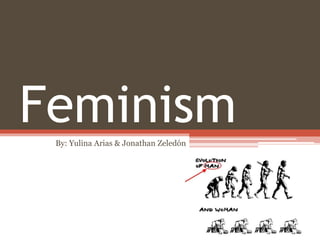
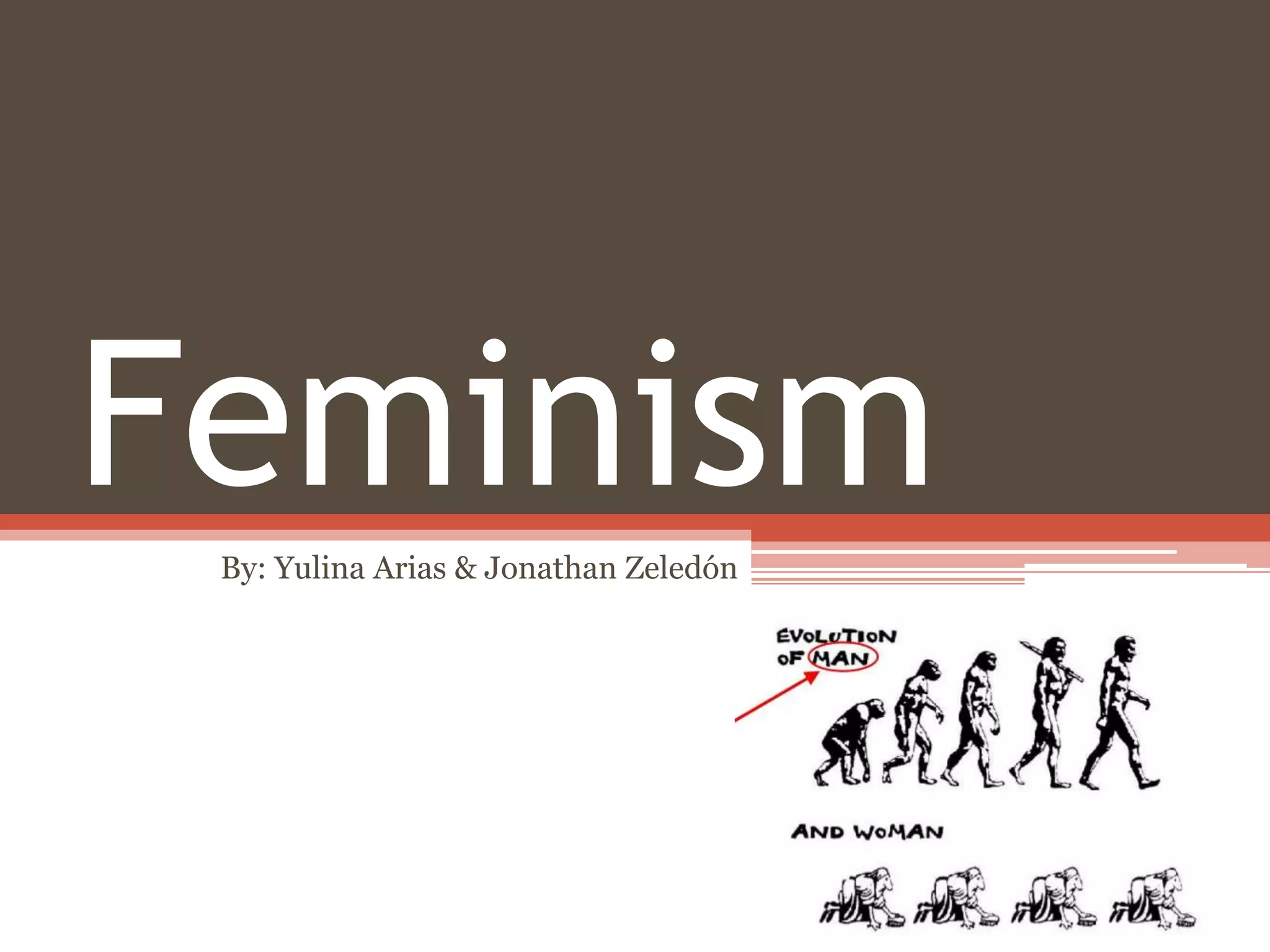
FeminismBy: Yulina Arias & Jonathan Zeledón
What is Feminism?
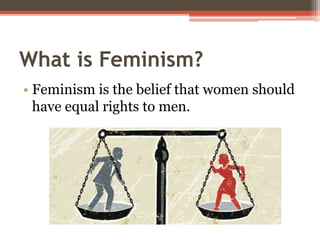
• Feminism is the belief that women should
have equal rights to men.
What is Phallocentrism?
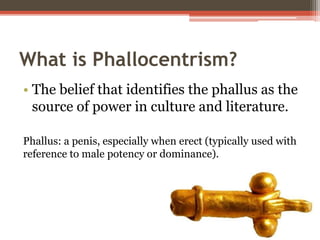
• The belief that identifies the phallus as the
source of power in culture and literature.
Phallus: a penis, especially when erect (typically used with
reference to male potency or dominance).
How has the male mind, with its
accompanying phallocentric belief
system, been implanted in us?
• Through its literature and its acclaimed writers,
philosophers, and scholars, most of whom are
male.
Examples of quotations by men
concerning women
• “Do not let a woman with a sexy rump deceive you with wheedling
and coaxing words; she is after your barn. The man who trusts a
woman trusts a deceiver.” Hesiod, poet 8th century B.C.E
• Plato thanks the gods for two things: that he had not been a slave
and that he had not been born a woman. Plato (c. 427-c. 347 B.C.E)
• “Silence gives the proper grace to woman.” Sophocles (497-406
B.C.E)
Examples of quotations by men
concerning women
• “The male is by nature superior, and female inferior; and the one
rules and the other is ruled….. Man consequently plays a major part
in reproduction; the woman is merely the passive incubator of his
seed.” Aristotle (384-322 B.C.E)
• Frailty, thy name is woman. Shakespeare (1564-1616).
Historical development of
Feminism:
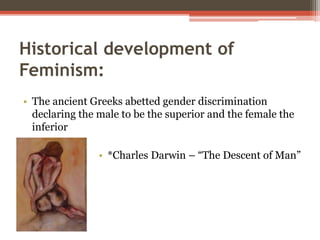
• The ancient Greeks abetted gender discrimination
declaring the male to be the superior and the female the
inferior
• *Charles Darwin – “The Descent of Man”
• A Century after, the defender of feminism, Christine
Pisan critiques some scholars like Jean de Meun’s
▫ God created men and woman as equal beings
• French revolution
▫ the woman should have a voice in the public arena
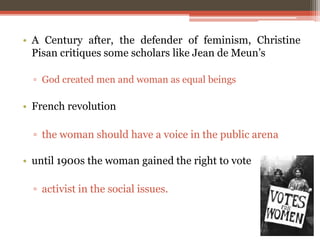
• until 1900s the woman gained the right to vote
▫ activist in the social issues.
Major Feminist criticism on the early
1900s:
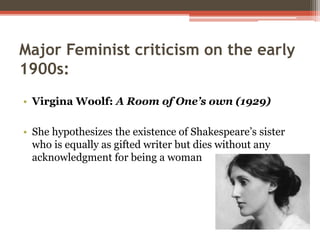
• Virgina Woolf: A Room of One’s own (1929)
• She hypothesizes the existence of Shakespeare’s sister
who is equally as gifted writer but dies without any
acknowledgment for being a woman
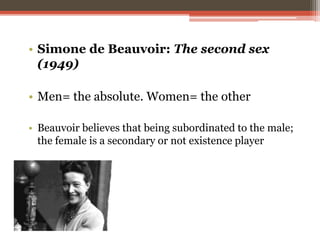
• Simone de Beauvoir: The second sex
(1949)
• Men= the absolute. Women= the other
• Beauvoir believes that being subordinated to the male;
the female is a secondary or not existence player
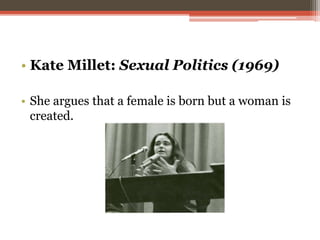
• Kate Millet: Sexual Politics (1969)
• She argues that a female is born but a woman is
created.
Feminist in the 1960’s, 1970’s, and
1980s:
• 1960’s: Women asserted political pressure in Congress and state
legislative houses across America for reforms.
• 1970’s: Feminists theorists and critics began to examine the literary
Canon.
• 1980’s: Elaine Showalter asserts that “feminist theorists must
construct new female models to analyze women’s literature.”
Geographical Strains of Feminism:
• Literary Canon: It is a term used widely to refer to a group of literary works
that are considered the most important of a particular time period or place.
• American: Stressing repression.
• feminism’s major concern:
• the restoration and inclusion of the writings of female writers to the
literary canon.
•British:
• Stressed oppression. Saw art, literature and life as
inseparable
• literature directly affects how women will be treated in
real life.
• the goal of feminist criticism is to change society, not
simply critique it
• French:
• Stressed female oppression
• French feminism is associated with the theoretical and
applications of psychoanalysis
• ultimately denied women the power of literature and
writing.
Examples of present –day
Feminist Criticism
• Anglo-American Feminisms.
• Poststructuralist Feminisms.
• Materialist Feminisms.
• Postmodern Feminisms.
Examples Feminist quotations:
• Feminism is the radical notion that women are
people.” Cheris Karamarae.
• “Feminism is an entire world view or gestalt, not
just a laundry list of women issues.” Charlotte
Bunch.
Examples Feminist quotations:
• “Feminism never harmed anybody unless it was some
feminist. The danger is that the study and contemplation
of ourselves may become so absorbing that it builds by
so slow degrees a high wall that shuts out the great world
of thought” Rheta Childe Dorr.”
Thanks

Feminism

  • 1.
    FeminismBy: Yulina Arias& Jonathan Zeledón
  • 2.
    What is Feminism? •Feminism is the belief that women should have equal rights to men.
  • 3.
    What is Phallocentrism? •The belief that identifies the phallus as the source of power in culture and literature. Phallus: a penis, especially when erect (typically used with reference to male potency or dominance).
  • 4.
    How has themale mind, with its accompanying phallocentric belief system, been implanted in us? • Through its literature and its acclaimed writers, philosophers, and scholars, most of whom are male.
  • 5.
    Examples of quotationsby men concerning women • “Do not let a woman with a sexy rump deceive you with wheedling and coaxing words; she is after your barn. The man who trusts a woman trusts a deceiver.” Hesiod, poet 8th century B.C.E • Plato thanks the gods for two things: that he had not been a slave and that he had not been born a woman. Plato (c. 427-c. 347 B.C.E) • “Silence gives the proper grace to woman.” Sophocles (497-406 B.C.E)
  • 6.
    Examples of quotationsby men concerning women • “The male is by nature superior, and female inferior; and the one rules and the other is ruled….. Man consequently plays a major part in reproduction; the woman is merely the passive incubator of his seed.” Aristotle (384-322 B.C.E) • Frailty, thy name is woman. Shakespeare (1564-1616).
  • 7.
    Historical development of Feminism: •The ancient Greeks abetted gender discrimination declaring the male to be the superior and the female the inferior • *Charles Darwin – “The Descent of Man”
  • 8.
    • A Centuryafter, the defender of feminism, Christine Pisan critiques some scholars like Jean de Meun’s ▫ God created men and woman as equal beings • French revolution ▫ the woman should have a voice in the public arena • until 1900s the woman gained the right to vote ▫ activist in the social issues.
  • 9.
    Major Feminist criticismon the early 1900s: • Virgina Woolf: A Room of One’s own (1929) • She hypothesizes the existence of Shakespeare’s sister who is equally as gifted writer but dies without any acknowledgment for being a woman
  • 10.
    • Simone deBeauvoir: The second sex (1949) • Men= the absolute. Women= the other • Beauvoir believes that being subordinated to the male; the female is a secondary or not existence player
  • 11.
    • Kate Millet:Sexual Politics (1969) • She argues that a female is born but a woman is created.
  • 12.
    Feminist in the1960’s, 1970’s, and 1980s: • 1960’s: Women asserted political pressure in Congress and state legislative houses across America for reforms. • 1970’s: Feminists theorists and critics began to examine the literary Canon. • 1980’s: Elaine Showalter asserts that “feminist theorists must construct new female models to analyze women’s literature.”
  • 13.
    Geographical Strains ofFeminism: • Literary Canon: It is a term used widely to refer to a group of literary works that are considered the most important of a particular time period or place. • American: Stressing repression. • feminism’s major concern: • the restoration and inclusion of the writings of female writers to the literary canon.
  • 14.
    •British: • Stressed oppression.Saw art, literature and life as inseparable • literature directly affects how women will be treated in real life. • the goal of feminist criticism is to change society, not simply critique it
  • 15.
    • French: • Stressedfemale oppression • French feminism is associated with the theoretical and applications of psychoanalysis • ultimately denied women the power of literature and writing.
  • 16.
    Examples of present–day Feminist Criticism • Anglo-American Feminisms. • Poststructuralist Feminisms. • Materialist Feminisms. • Postmodern Feminisms.
  • 17.
    Examples Feminist quotations: •Feminism is the radical notion that women are people.” Cheris Karamarae. • “Feminism is an entire world view or gestalt, not just a laundry list of women issues.” Charlotte Bunch.
  • 18.
    Examples Feminist quotations: •“Feminism never harmed anybody unless it was some feminist. The danger is that the study and contemplation of ourselves may become so absorbing that it builds by so slow degrees a high wall that shuts out the great world of thought” Rheta Childe Dorr.”
  • 19.