Friends Tweets & Change  THE CASE FOR GRASSROOTS COMMUNICATION
                                                                         J-TERM 2011


                           History - Definitions - Statistics
                                           Day 2


                                                            Instructor: Andrew Hoffman


Tuesday, January 4, 2011
Goals of Class

                  You Gain a Working Knowledge of Grassroots Marketing Techniques

                  You Understand the Power of Social Media

                  You Can Teach Someone Else

                  You Are More Qualified Than Your Peers for the Future

                  That We Have Fun


Tuesday, January 4, 2011
Social Media Defined
               We define social network sites as web-based services that allow individuals to

               (1) construct a public or semi-public profile within a bounded system,

               (2) articulate a list of other users with whom they share a connection, and

               (3) view and traverse their list of connections and those made by others within the system.
                                                  The nature and nomenclature of these connections may vary from site to site.


                                                                                   Social Network Sites: Definition, History, and Scholarship


Tuesday, January 4, 2011
Web 1.0
         Web 1.0 (1991-2003) is a retronym which refers to the state of the World
          Wide Web, and any website design style used before the advent of the
              Web 2.0 phenomenon. Web 1.0 began with the release of the WWW to the
              public in 1991, and is the general term that has been created to describe
              the Web before the "bursting of the Dot-com bubble" in 2001, which is
              seen by many as a turning point for the internet.

   Main Differences
    Static pages instead of dynamic user-generated content
    The rest is all things we can’t see on the surface


Tuesday, January 4, 2011
Web 2.0
         The term "Web 2.0" (2004–present) is commonly associated with web
              applications that facilitate interactive information sharing,
              interoperability, user-centered design[1] and collaboration on the World
              Wide Web.


   A Web 2.0 site allows its users to interact with other users or to change
        website content, in contrast to non-interactive websites where users are
        limited to the passive viewing of information that is provided to them.


Tuesday, January 4, 2011
Where Web 2.0 Came From
         The term "Web 2.0" was coined in 1999 by Darcy DiNucci. In her article,
           "Fragmented Future," DiNucci writes:


   “The Web we know now, which loads into a browser window in essentially static screenfulls, is
      only an embryo of the Web to come. The first glimmerings of Web 2.0 are beginning to appear,
      and we are just starting to see how that embryo might develop. The Web will be understood not
      as screenfulls of text and graphics but as a transport mechanism, the ether through which
      interactivity happens. It will [...] appear on your computer screen, [...] on your TV set [...] your
      car dashboard [...] your cell phone [...] hand-held game machines [...] maybe even your
      microwave oven.”


Tuesday, January 4, 2011
What Makes Social Media
                                     Sites Uniques
   What makes social network sites unique is not that they allow individuals to
    meet strangers, but rather that they enable users to articulate and make
    visible their social networks.

      This can result in connections between individuals that would not otherwise
       be made, but that is often not the goal, and these meetings are frequently
       between "latent ties" (Haythornthwaite, 2005) who share some offline
       connection.

      On many of the large SNSs, participants are not necessarily "networking" or
       looking to meet new people; instead, they are primarily communicating
       with people who are already a part of their extended social network.

      To emphasize this articulated social network as a critical organizing feature
       of these sites, we label them "social network sites."

                                                         Social Network Sites: Definition, History, and Scholarship


Tuesday, January 4, 2011
Examples of Social Media
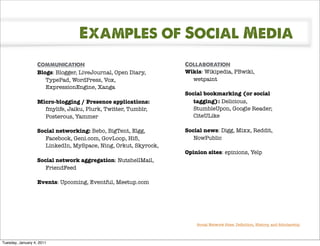
                   Communication                                 Collaboration
                   Blogs: Blogger, LiveJournal, Open Diary,      Wikis: Wikipedia, PBwiki,
                      TypePad, WordPress, Vox,                     wetpaint
                      ExpressionEngine, Xanga
                                                                 Social bookmarking (or social
                   Micro-blogging / Presence applications:          tagging): Delicious,
                     fmylife, Jaiku, Plurk, Twitter, Tumblr,        StumbleUpon, Google Reader,
                     Posterous, Yammer                              CiteULike

                   Social networking: Bebo, BigTent, Elgg,       Social news: Digg, Mixx, Reddit,
                      Facebook, Geni.com, GovLoop, Hi5,             NowPublic
                      LinkedIn, MySpace, Ning, Orkut, Skyrock,
                                                                 Opinion sites: epinions, Yelp
                   Social network aggregation: NutshellMail,
                      FriendFeed

                   Events: Upcoming, Eventful, Meetup.com


                                                                     Social Network Sites: Definition, History, and Scholarship


Tuesday, January 4, 2011
Examples of Social Media

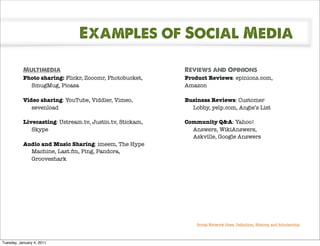
           Multimedia                                     Reviews and Opinions
           Photo sharing: Flickr, Zooomr, Photobucket,    Product Reviews: epinions.com,
             SmugMug, Picasa                              Amazon

           Video sharing: YouTube, Viddler, Vimeo,        Business Reviews: Customer
              sevenload                                     Lobby, yelp.com, Angie’s List

           Livecasting: Ustream.tv, Justin.tv, Stickam,   Community Q&A: Yahoo!
              Skype                                         Answers, WikiAnswers,
                                                            Askville, Google Answers
           Audio and Music Sharing: imeem, The Hype
             Machine, Last.fm, Ping, Pandora,
             Grooveshark


                                                              Social Network Sites: Definition, History, and Scholarship


Tuesday, January 4, 2011
History of Social Media
     Social Media Info Graphic

     Does having historic context really matter?


Tuesday, January 4, 2011
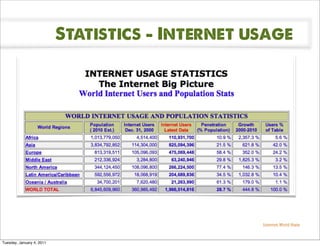
Statistics - Internet usage


                                                  Internet World Stats


Tuesday, January 4, 2011
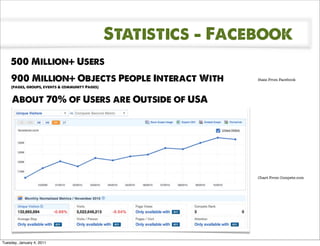
Statistics - Facebook
    500 Million+ Users
    900 Million+ Objects People Interact With                    Stats From Facebook
    (pages, groups, events & community Pages)


     About 70% of Users are Outside of USA


                                                                 Chart From Compete.com


Tuesday, January 4, 2011
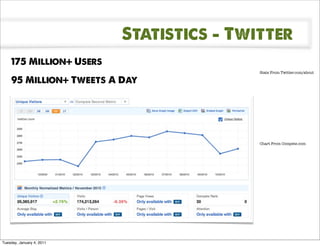
Statistics - Twitter
    175 Million+ Users
                                           Stats From Twitter.com/about

    95 Million+ Tweets A Day


                                           Chart From Compete.com


Tuesday, January 4, 2011
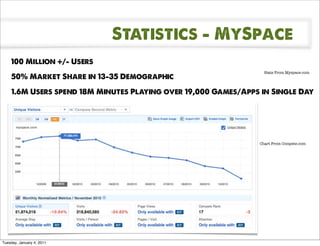
Statistics - MySpace
    100 Million +/- Users
                                                                 Stats From Myspace.com
    50% Market Share in 13-35 Demographic

    1.6M Users spend 18M Minutes Playing over 19,000 Games/Apps in Single Day


                                                               Chart From Compete.com


Tuesday, January 4, 2011
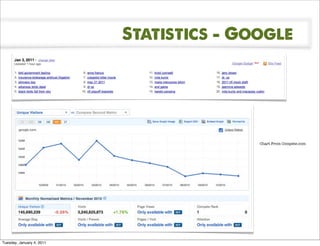
Statistics - Google


                                          Chart From Compete.com


Tuesday, January 4, 2011
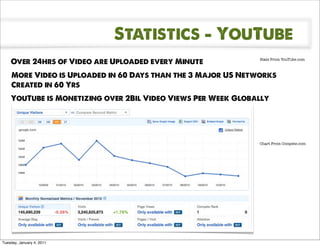
Statistics - YouTube
    Over 24hrs of Video are Uploaded every Minute             Stats From YouTube.com


    More Video is Uploaded in 60 Days than the 3 Major US Networks
    Created in 60 Yrs
    YouTube is Monetizing over 2Bil Video Views Per Week Globally


                                                              Chart From Compete.com


Tuesday, January 4, 2011
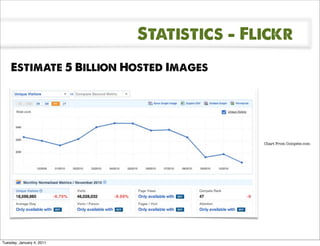
Statistics - Flickr
    Estimate 5 Billion Hosted Images


                                          Chart From Compete.com


Tuesday, January 4, 2011
Social Media Revolution


Tuesday, January 4, 2011
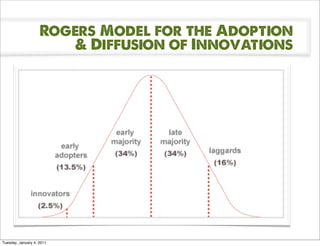
Rogers Model for the Adoption
                        & Diffusion of Innovations


Tuesday, January 4, 2011
Rogers Model for the Adoption
                        & Diffusion of Innovations
  Innovators
  Brave people, puling the change. Innovators are very important communication.

  Early Adopters
  Respectable people, opinion leaders, try out new ideas, but in a careful way.

  Early Majority
  Thoughtful people, careful but accepting change more quickly than the average.

  Late Majority
  Skeptic people, will use new ideas or products only when the majority is using it.

  Laggards
  Traditional people, caring for the "old ways", are critical towards new ideas and
    will only accept it if the new idea has become mainstream or even tradition.
                                                                     Innovation adoption curve of Rogers!


Tuesday, January 4, 2011

JTerm Day 2 - History, Definitions & Stats

  • 1.
    Friends Tweets &Change THE CASE FOR GRASSROOTS COMMUNICATION J-TERM 2011 History - Definitions - Statistics Day 2 Instructor: Andrew Hoffman Tuesday, January 4, 2011
  • 2.
    Goals of Class You Gain a Working Knowledge of Grassroots Marketing Techniques You Understand the Power of Social Media You Can Teach Someone Else You Are More Qualified Than Your Peers for the Future That We Have Fun Tuesday, January 4, 2011
  • 3.
    Social Media Defined We define social network sites as web-based services that allow individuals to (1) construct a public or semi-public profile within a bounded system, (2) articulate a list of other users with whom they share a connection, and (3) view and traverse their list of connections and those made by others within the system. The nature and nomenclature of these connections may vary from site to site. Social Network Sites: Definition, History, and Scholarship Tuesday, January 4, 2011
  • 4.
    Web 1.0 Web 1.0 (1991-2003) is a retronym which refers to the state of the World Wide Web, and any website design style used before the advent of the Web 2.0 phenomenon. Web 1.0 began with the release of the WWW to the public in 1991, and is the general term that has been created to describe the Web before the "bursting of the Dot-com bubble" in 2001, which is seen by many as a turning point for the internet. Main Differences Static pages instead of dynamic user-generated content The rest is all things we can’t see on the surface Tuesday, January 4, 2011
  • 5.
    Web 2.0 The term "Web 2.0" (2004–present) is commonly associated with web applications that facilitate interactive information sharing, interoperability, user-centered design[1] and collaboration on the World Wide Web. A Web 2.0 site allows its users to interact with other users or to change website content, in contrast to non-interactive websites where users are limited to the passive viewing of information that is provided to them. Tuesday, January 4, 2011
  • 6.
    Where Web 2.0Came From The term "Web 2.0" was coined in 1999 by Darcy DiNucci. In her article, "Fragmented Future," DiNucci writes: “The Web we know now, which loads into a browser window in essentially static screenfulls, is only an embryo of the Web to come. The first glimmerings of Web 2.0 are beginning to appear, and we are just starting to see how that embryo might develop. The Web will be understood not as screenfulls of text and graphics but as a transport mechanism, the ether through which interactivity happens. It will [...] appear on your computer screen, [...] on your TV set [...] your car dashboard [...] your cell phone [...] hand-held game machines [...] maybe even your microwave oven.” Tuesday, January 4, 2011
  • 7.
    What Makes SocialMedia Sites Uniques What makes social network sites unique is not that they allow individuals to meet strangers, but rather that they enable users to articulate and make visible their social networks. This can result in connections between individuals that would not otherwise be made, but that is often not the goal, and these meetings are frequently between "latent ties" (Haythornthwaite, 2005) who share some offline connection. On many of the large SNSs, participants are not necessarily "networking" or looking to meet new people; instead, they are primarily communicating with people who are already a part of their extended social network. To emphasize this articulated social network as a critical organizing feature of these sites, we label them "social network sites." Social Network Sites: Definition, History, and Scholarship Tuesday, January 4, 2011
  • 8.
    Examples of SocialMedia Communication Collaboration Blogs: Blogger, LiveJournal, Open Diary, Wikis: Wikipedia, PBwiki, TypePad, WordPress, Vox, wetpaint ExpressionEngine, Xanga Social bookmarking (or social Micro-blogging / Presence applications: tagging): Delicious, fmylife, Jaiku, Plurk, Twitter, Tumblr, StumbleUpon, Google Reader, Posterous, Yammer CiteULike Social networking: Bebo, BigTent, Elgg, Social news: Digg, Mixx, Reddit, Facebook, Geni.com, GovLoop, Hi5, NowPublic LinkedIn, MySpace, Ning, Orkut, Skyrock, Opinion sites: epinions, Yelp Social network aggregation: NutshellMail, FriendFeed Events: Upcoming, Eventful, Meetup.com Social Network Sites: Definition, History, and Scholarship Tuesday, January 4, 2011
  • 9.
    Examples of SocialMedia Multimedia Reviews and Opinions Photo sharing: Flickr, Zooomr, Photobucket, Product Reviews: epinions.com, SmugMug, Picasa Amazon Video sharing: YouTube, Viddler, Vimeo, Business Reviews: Customer sevenload Lobby, yelp.com, Angie’s List Livecasting: Ustream.tv, Justin.tv, Stickam, Community Q&A: Yahoo! Skype Answers, WikiAnswers, Askville, Google Answers Audio and Music Sharing: imeem, The Hype Machine, Last.fm, Ping, Pandora, Grooveshark Social Network Sites: Definition, History, and Scholarship Tuesday, January 4, 2011
  • 10.
    History of SocialMedia Social Media Info Graphic Does having historic context really matter? Tuesday, January 4, 2011
  • 11.
    Statistics - Internetusage Internet World Stats Tuesday, January 4, 2011
  • 12.
    Statistics - Facebook 500 Million+ Users 900 Million+ Objects People Interact With Stats From Facebook (pages, groups, events & community Pages) About 70% of Users are Outside of USA Chart From Compete.com Tuesday, January 4, 2011
  • 13.
    Statistics - Twitter 175 Million+ Users Stats From Twitter.com/about 95 Million+ Tweets A Day Chart From Compete.com Tuesday, January 4, 2011
  • 14.
    Statistics - MySpace 100 Million +/- Users Stats From Myspace.com 50% Market Share in 13-35 Demographic 1.6M Users spend 18M Minutes Playing over 19,000 Games/Apps in Single Day Chart From Compete.com Tuesday, January 4, 2011
  • 15.
    Statistics - Google Chart From Compete.com Tuesday, January 4, 2011
  • 16.
    Statistics - YouTube Over 24hrs of Video are Uploaded every Minute Stats From YouTube.com More Video is Uploaded in 60 Days than the 3 Major US Networks Created in 60 Yrs YouTube is Monetizing over 2Bil Video Views Per Week Globally Chart From Compete.com Tuesday, January 4, 2011
  • 17.
    Statistics - Flickr Estimate 5 Billion Hosted Images Chart From Compete.com Tuesday, January 4, 2011
  • 18.
  • 19.
    Rogers Model forthe Adoption & Diffusion of Innovations Tuesday, January 4, 2011
  • 20.
    Rogers Model forthe Adoption & Diffusion of Innovations Innovators Brave people, puling the change. Innovators are very important communication. Early Adopters Respectable people, opinion leaders, try out new ideas, but in a careful way. Early Majority Thoughtful people, careful but accepting change more quickly than the average. Late Majority Skeptic people, will use new ideas or products only when the majority is using it. Laggards Traditional people, caring for the "old ways", are critical towards new ideas and will only accept it if the new idea has become mainstream or even tradition. Innovation adoption curve of Rogers! Tuesday, January 4, 2011