


Engaging the Online Reader
          through Social Media
          Logan H. Aimone, executive director
          National Scholastic Press Association
          Online: slideshare.net/loganaimone


Tuesday, August 9, 2011
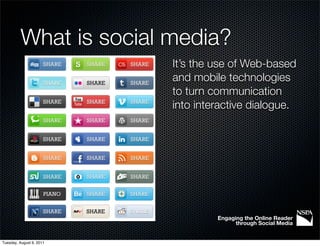
What is social media?
                          It’s the use of Web-based
                          and mobile technologies
                          to turn communication
                          into interactive dialogue.


                                   Engaging the Online Reader
                                         through Social Media


Tuesday, August 9, 2011
How journalists use
          social media
               Distribution: Sharing / referring content
               Crowdsourcing
               Searching for sources or subjects
               Interviewing
               Monitoring
               Story ideas
               User feedback / engagement
                                                           Engaging the Online Reader
                                                                 through Social Media


Tuesday, August 9, 2011
Primary social media
          journalists use:
               Facebook / LinkedIn
               Google+
               Twitter
               Vimeo / YouTube / Flickr
               Geolocating: Foursquare, Google Latitude/Maps,
               Gowalla, etc.


                                                   Engaging the Online Reader
                                                         through Social Media


Tuesday, August 9, 2011
Engaging the Online Reader
                                through Social Media


Tuesday, August 9, 2011
FACEBOOK: Definition and statistics
               Among world’s largest social media websites with more
               than 750 million monthly active users who create a
               network of friends
               250 million mobile users
               Average user has 130 friends
               50% of users return daily to the site
               Photos are most popular shared and viewed item
               280 million photos uploaded per day


           Source: Facebook + Journalists, July 2011   Engaging the Online Reader
                                                             through Social Media


Tuesday, August 9, 2011
FACEBOOK: Impact
               “If searching for the news was the most important
               development of the last decade, sharing the news may
               be among the most important of the next.”
               — “Navigating News Online, Pew Research Center’s
               Project for Excellence in Journalism, May 2011
               Facebook drove 3% of traffic to 21 of 25 news sites in
               study, and 8% of traffic to Huffington Post.
               Headlines have been organized by editors. Now they
               are organized by friends.


                                                    Engaging the Online Reader
                                                          through Social Media


Tuesday, August 9, 2011
FACEBOOK: Statistics
               Users are 3-4 times more likely to click “Like” for a
               story if they see a friend’s face as someone who “liked”
               the story.
               Journalists who post content on a page or profile are
               likely to get more traffic if they…
                     Use a 4- or 5-line post
                     Ask a question
                     Include a thumbnail or photo


           Source: Facebook + Journalists, July 2011   Engaging the Online Reader
                                                             through Social Media


Tuesday, August 9, 2011
FACEBOOK: Profiles & Pages
               A Facebook Profile is the standard user experience.
               An individual develops a personal network of friends
               (up to 5,000) and can share status updates, photos,
               links and videos.
               A Facebook Page is a more professional site where a
               journalist can share and interact while maintaining the
               traditional separation from sources and avoiding
               conflicts of interest. You can distribute, engage and
               have a public presence — and no limit to connections.


           Source: Facebook + Journalists, July 2011   Engaging the Online Reader
                                                             through Social Media


Tuesday, August 9, 2011
FACEBOOK: Pages
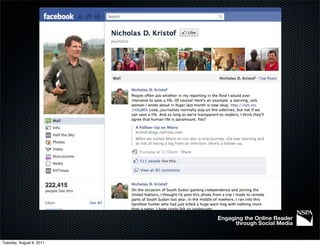
               Nicholas Kristof of the New York Times uses Facebook
               to tell microstories. He says a good story is a good
               story on Facebook.


           Source: Facebook + Journalists, July 2011   Engaging the Online Reader
                                                             through Social Media


Tuesday, August 9, 2011
Engaging the Online Reader
                                through Social Media


Tuesday, August 9, 2011
FACEBOOK: Pages
               During breaking news, post often. Readers expect it.
               Engagement increases.
               Be transparent about who’s posting. Tag the person
               posting, or indicate in the text.
               Pages allow targeted distribution based on gender,
               age, location, language, etc.
               Provide a behind-the-scenes look


           Source: Facebook + Journalists, July 2011   Engaging the Online Reader
                                                             through Social Media


Tuesday, August 9, 2011
FACEBOOK: Crowdsourcing
               Crowdsourcing is using the “crowd” to provide ideas,
               sources, information and leads.
               Submitted content
               Enlisting readers in the process
               Story ideas
               Direct access to the source (source available to
               respond to questions via Facebook, etc.)
               Using Questions feature for high engagement
               Let viewers decide content

           Source: Facebook + Journalists, July 2011   Engaging the Online Reader
                                                             through Social Media


Tuesday, August 9, 2011
FACEBOOK: Other items
               Feeds don’t work. They’re impersonal and automated.
               Readers engage when they know a person is behind
               the post.
               Find sources with Search.
                     Search public updates.
                     Search administrators of Groups.
               Videocalling (soon with Skype) for interviews
               facebook.com/journalists


           Source: Facebook + Journalists, July 2011    Engaging the Online Reader
                                                              through Social Media


Tuesday, August 9, 2011
Engaging the Online Reader
                                through Social Media


Tuesday, August 9, 2011
GOOGLE+: Definition and statistics
               Similar to Twitter, Google+ allows a Google user to both
               follow and be followed online.
               One significant difference is the ability to group
               followers in “circles” and to determine what pieces of
               information are shared with which circle. People are not
               told the circle in which they are grouped.
               Additional features include the ability to save items to
               read later (compared to a linear stream of information),
               video chat in “hangouts,” and integration with other
               Google products like Gmail, Google Docs or YouTube.


           Source: Facebook + Journalists, July 2011   Engaging the Online Reader
                                                             through Social Media


Tuesday, August 9, 2011
GOOGLE+: Definition and statistics
               The service launched June 28, 2011. In the first two
               weeks, it grew to 10 million users and within four
               weeks over 25 million users.
               Interestingly, only about 12.5% of users are women.
               The most popularly followed people on Google+ are
               Facebook CEO Mark Zuckerburg, Google founders
               Larry Page and Sergey Brin, and Mashable CEO Pete
               Cashmore.
               Oh, and Google hasn’t made an application
               programming interface (API), so there are no third-party
               programs. That means no FarmVille!

           Source: Facebook + Journalists, July 2011   Engaging the Online Reader
                                                             through Social Media


Tuesday, August 9, 2011
GOOGLE+: Uses
               Because of the selective sharing options with “Circles”
               in Google+, a journalist could share some information
               publicly while some only with close friends. This avoids
               having people create two profiles — one public and
               one private — to share with different audiences.
               “Hangouts” could become the next focus group, group
               interview or way to interact with reporters or sources.
               “Sparks” allows a user to identify interest areas, and
               Google will suggest items — like a pre-search.
               The +1 button allows users to recommend items.
               Content can be downloaded.
                                                       Engaging the Online Reader
                                                             through Social Media


Tuesday, August 9, 2011
GOOGLE+: Big questions
               Will it replace Facebook? Maybe — if users can
               migrate content from an established social network and
               if Facebook doesn’t develop selective sharing. (Skype
               chat is coming soon in Facebook.)
               Will it be more like Google Buzz or Wave? Those
               services never really caught on as expected. Maybe the
               expectations were too high? Or was the product not
               innovative?
               What is the impact of friends discovering in which
               “circles” they have been placed?


                                                      Engaging the Online Reader
                                                            through Social Media


Tuesday, August 9, 2011
Engaging the Online Reader
                                through Social Media


Tuesday, August 9, 2011
TWITTER: Definition and statistics
               Twitter is a microblogging website with mobile apps
               that provides 140-character updates. Users can have
               followers, follow others and be part of lists. Non-users
               can search or see public tweets.
               200 million users and 350 billion tweets per day
               A hashtag is a term used to tag a post for search. It
               includes the # sign and a word, phrase or abbreviation.
               According to the Pew study, Twitter drove about 1% of
               referrals to news sites (and 3% for the Los Angeles
               Times).


                                                       Engaging the Online Reader
                                                             through Social Media


Tuesday, August 9, 2011
TWITTER: Uses
               The main uses for Twitter are distribution, engagement
               and monitoring.
               Build a network of relevant followers (and people to
               follow). Interact with them in the ways below.
               Use Twitter to share content or refer users to content.
               Use Twitter to engage with users: ask/answer
               questions, clarify, respond to criticism, get ideas.
               Use Twitter to monitor what others are tweeting about
               to get leads, ideas and sources.
               Curate tweets as basis for a sidebar in print or online.
                                                        Engaging the Online Reader
                                                              through Social Media


Tuesday, August 9, 2011
TWITTER: More uses
               Go to http://media.twitter.com/newsrooms
               #TfN
               Report: Search, sources and mobile apps
               Engage: Effective writing, promotion and branding
               Publish: Tools and display guidelines
               Extras: Blogs, copyright and troubleshooting


                                                       Engaging the Online Reader
                                                             through Social Media


Tuesday, August 9, 2011
Engaging the Online Reader
                                through Social Media


Tuesday, August 9, 2011
VIMEO / YOUTUBE / FLICKR: Definition and statistics
               Vimeo and YouTube are video-sharing websites.
               Flickr is a photo/image-sharing site.


                                                       Engaging the Online Reader
                                                             through Social Media


Tuesday, August 9, 2011
VIMEO / YOUTUBE / FLICKR: Uses
               Vimeo and YouTube channels can be utilized for
               sharing extra video from a news story; a behind-the-
               scenes look at the journalist’s job; or to interact with
               users, like responding to queries.
               Flickr can be used in some of the same ways but with
               still images.
               All can also be used to search for sources or monitor
               what people are talking about or find interesting.


                                                        Engaging the Online Reader
                                                              through Social Media


Tuesday, August 9, 2011
Engaging the Online Reader
                                through Social Media


Tuesday, August 9, 2011
GEOLOCATION APPS: Definition and statistics
               Typically, geolocation apps do two things:
                     They report your location to other users.
                     They associate real-world locations (such as
                     restaurants and events) to your location.
               These apps use the GPS chip in a phone or mobile
               device to determine location.
               Apps like Foursquare allow users to “check in” at a
               location. Sometimes businesses will offer deals for
               checking in.


                                                          Engaging the Online Reader
                                                                through Social Media


Tuesday, August 9, 2011
GEOLOCATION: Uses
               Journalists can use geolocation apps to see who has
               checked in at a location or event.
               Use the apps to monitor buzz or develop story ideas.
               Some mobile apps like Yelp! allow users to post
               reviews of businesses.
               Combine geolocation with other mobile device-based
               tools such as QR codes or Groupons.


                                                     Engaging the Online Reader
                                                           through Social Media


Tuesday, August 9, 2011
Other digital media tools
               Delicious: Social bookmarking
               Tumblr: A place to post anything and everything
               Storify: A website that allows curation and combination
               of multiple elements from social media (like tweets,
               Facebook status updates, etc.)
               Instagr.am: Mobile photo sharing
               Evernote: Keep track of many bits of information from
               multiple formats
                                                     Engaging the Online Reader
                                                           through Social Media


Tuesday, August 9, 2011
How will you utilize these
          powerful new tools?
               They are evolving rapidly.
               Research data are becoming available, which will prove
               valuable to how journalists use the tools effectively.


                                                    Engaging the Online Reader
                                                          through Social Media


Tuesday, August 9, 2011
Questions?
               Find this presentation at slideshare.net/loganaimone
               Email me at logan@studentpress.org


                                                     Engaging the Online Reader
                                                           through Social Media


Tuesday, August 9, 2011

Engaging the Online Reader through Social Media

  • 1.
    Engaging the OnlineReader through Social Media Logan H. Aimone, executive director National Scholastic Press Association Online: slideshare.net/loganaimone Tuesday, August 9, 2011
  • 2.
    What is socialmedia? It’s the use of Web-based and mobile technologies to turn communication into interactive dialogue. Engaging the Online Reader through Social Media Tuesday, August 9, 2011
  • 3.
    How journalists use social media Distribution: Sharing / referring content Crowdsourcing Searching for sources or subjects Interviewing Monitoring Story ideas User feedback / engagement Engaging the Online Reader through Social Media Tuesday, August 9, 2011
  • 4.
    Primary social media journalists use: Facebook / LinkedIn Google+ Twitter Vimeo / YouTube / Flickr Geolocating: Foursquare, Google Latitude/Maps, Gowalla, etc. Engaging the Online Reader through Social Media Tuesday, August 9, 2011
  • 5.
    Engaging the OnlineReader through Social Media Tuesday, August 9, 2011
  • 6.
    FACEBOOK: Definition andstatistics Among world’s largest social media websites with more than 750 million monthly active users who create a network of friends 250 million mobile users Average user has 130 friends 50% of users return daily to the site Photos are most popular shared and viewed item 280 million photos uploaded per day Source: Facebook + Journalists, July 2011 Engaging the Online Reader through Social Media Tuesday, August 9, 2011
  • 7.
    FACEBOOK: Impact “If searching for the news was the most important development of the last decade, sharing the news may be among the most important of the next.” — “Navigating News Online, Pew Research Center’s Project for Excellence in Journalism, May 2011 Facebook drove 3% of traffic to 21 of 25 news sites in study, and 8% of traffic to Huffington Post. Headlines have been organized by editors. Now they are organized by friends. Engaging the Online Reader through Social Media Tuesday, August 9, 2011
  • 8.
    FACEBOOK: Statistics Users are 3-4 times more likely to click “Like” for a story if they see a friend’s face as someone who “liked” the story. Journalists who post content on a page or profile are likely to get more traffic if they… Use a 4- or 5-line post Ask a question Include a thumbnail or photo Source: Facebook + Journalists, July 2011 Engaging the Online Reader through Social Media Tuesday, August 9, 2011
  • 9.
    FACEBOOK: Profiles &Pages A Facebook Profile is the standard user experience. An individual develops a personal network of friends (up to 5,000) and can share status updates, photos, links and videos. A Facebook Page is a more professional site where a journalist can share and interact while maintaining the traditional separation from sources and avoiding conflicts of interest. You can distribute, engage and have a public presence — and no limit to connections. Source: Facebook + Journalists, July 2011 Engaging the Online Reader through Social Media Tuesday, August 9, 2011
  • 10.
    FACEBOOK: Pages Nicholas Kristof of the New York Times uses Facebook to tell microstories. He says a good story is a good story on Facebook. Source: Facebook + Journalists, July 2011 Engaging the Online Reader through Social Media Tuesday, August 9, 2011
  • 11.
    Engaging the OnlineReader through Social Media Tuesday, August 9, 2011
  • 12.
    FACEBOOK: Pages During breaking news, post often. Readers expect it. Engagement increases. Be transparent about who’s posting. Tag the person posting, or indicate in the text. Pages allow targeted distribution based on gender, age, location, language, etc. Provide a behind-the-scenes look Source: Facebook + Journalists, July 2011 Engaging the Online Reader through Social Media Tuesday, August 9, 2011
  • 13.
    FACEBOOK: Crowdsourcing Crowdsourcing is using the “crowd” to provide ideas, sources, information and leads. Submitted content Enlisting readers in the process Story ideas Direct access to the source (source available to respond to questions via Facebook, etc.) Using Questions feature for high engagement Let viewers decide content Source: Facebook + Journalists, July 2011 Engaging the Online Reader through Social Media Tuesday, August 9, 2011
  • 14.
    FACEBOOK: Other items Feeds don’t work. They’re impersonal and automated. Readers engage when they know a person is behind the post. Find sources with Search. Search public updates. Search administrators of Groups. Videocalling (soon with Skype) for interviews facebook.com/journalists Source: Facebook + Journalists, July 2011 Engaging the Online Reader through Social Media Tuesday, August 9, 2011
  • 15.
    Engaging the OnlineReader through Social Media Tuesday, August 9, 2011
  • 16.
    GOOGLE+: Definition andstatistics Similar to Twitter, Google+ allows a Google user to both follow and be followed online. One significant difference is the ability to group followers in “circles” and to determine what pieces of information are shared with which circle. People are not told the circle in which they are grouped. Additional features include the ability to save items to read later (compared to a linear stream of information), video chat in “hangouts,” and integration with other Google products like Gmail, Google Docs or YouTube. Source: Facebook + Journalists, July 2011 Engaging the Online Reader through Social Media Tuesday, August 9, 2011
  • 17.
    GOOGLE+: Definition andstatistics The service launched June 28, 2011. In the first two weeks, it grew to 10 million users and within four weeks over 25 million users. Interestingly, only about 12.5% of users are women. The most popularly followed people on Google+ are Facebook CEO Mark Zuckerburg, Google founders Larry Page and Sergey Brin, and Mashable CEO Pete Cashmore. Oh, and Google hasn’t made an application programming interface (API), so there are no third-party programs. That means no FarmVille! Source: Facebook + Journalists, July 2011 Engaging the Online Reader through Social Media Tuesday, August 9, 2011
  • 18.
    GOOGLE+: Uses Because of the selective sharing options with “Circles” in Google+, a journalist could share some information publicly while some only with close friends. This avoids having people create two profiles — one public and one private — to share with different audiences. “Hangouts” could become the next focus group, group interview or way to interact with reporters or sources. “Sparks” allows a user to identify interest areas, and Google will suggest items — like a pre-search. The +1 button allows users to recommend items. Content can be downloaded. Engaging the Online Reader through Social Media Tuesday, August 9, 2011
  • 19.
    GOOGLE+: Big questions Will it replace Facebook? Maybe — if users can migrate content from an established social network and if Facebook doesn’t develop selective sharing. (Skype chat is coming soon in Facebook.) Will it be more like Google Buzz or Wave? Those services never really caught on as expected. Maybe the expectations were too high? Or was the product not innovative? What is the impact of friends discovering in which “circles” they have been placed? Engaging the Online Reader through Social Media Tuesday, August 9, 2011
  • 20.
    Engaging the OnlineReader through Social Media Tuesday, August 9, 2011
  • 21.
    TWITTER: Definition andstatistics Twitter is a microblogging website with mobile apps that provides 140-character updates. Users can have followers, follow others and be part of lists. Non-users can search or see public tweets. 200 million users and 350 billion tweets per day A hashtag is a term used to tag a post for search. It includes the # sign and a word, phrase or abbreviation. According to the Pew study, Twitter drove about 1% of referrals to news sites (and 3% for the Los Angeles Times). Engaging the Online Reader through Social Media Tuesday, August 9, 2011
  • 22.
    TWITTER: Uses The main uses for Twitter are distribution, engagement and monitoring. Build a network of relevant followers (and people to follow). Interact with them in the ways below. Use Twitter to share content or refer users to content. Use Twitter to engage with users: ask/answer questions, clarify, respond to criticism, get ideas. Use Twitter to monitor what others are tweeting about to get leads, ideas and sources. Curate tweets as basis for a sidebar in print or online. Engaging the Online Reader through Social Media Tuesday, August 9, 2011
  • 23.
    TWITTER: More uses Go to http://media.twitter.com/newsrooms #TfN Report: Search, sources and mobile apps Engage: Effective writing, promotion and branding Publish: Tools and display guidelines Extras: Blogs, copyright and troubleshooting Engaging the Online Reader through Social Media Tuesday, August 9, 2011
  • 24.
    Engaging the OnlineReader through Social Media Tuesday, August 9, 2011
  • 25.
    VIMEO / YOUTUBE/ FLICKR: Definition and statistics Vimeo and YouTube are video-sharing websites. Flickr is a photo/image-sharing site. Engaging the Online Reader through Social Media Tuesday, August 9, 2011
  • 26.
    VIMEO / YOUTUBE/ FLICKR: Uses Vimeo and YouTube channels can be utilized for sharing extra video from a news story; a behind-the- scenes look at the journalist’s job; or to interact with users, like responding to queries. Flickr can be used in some of the same ways but with still images. All can also be used to search for sources or monitor what people are talking about or find interesting. Engaging the Online Reader through Social Media Tuesday, August 9, 2011
  • 27.
    Engaging the OnlineReader through Social Media Tuesday, August 9, 2011
  • 28.
    GEOLOCATION APPS: Definitionand statistics Typically, geolocation apps do two things: They report your location to other users. They associate real-world locations (such as restaurants and events) to your location. These apps use the GPS chip in a phone or mobile device to determine location. Apps like Foursquare allow users to “check in” at a location. Sometimes businesses will offer deals for checking in. Engaging the Online Reader through Social Media Tuesday, August 9, 2011
  • 29.
    GEOLOCATION: Uses Journalists can use geolocation apps to see who has checked in at a location or event. Use the apps to monitor buzz or develop story ideas. Some mobile apps like Yelp! allow users to post reviews of businesses. Combine geolocation with other mobile device-based tools such as QR codes or Groupons. Engaging the Online Reader through Social Media Tuesday, August 9, 2011
  • 30.
    Other digital mediatools Delicious: Social bookmarking Tumblr: A place to post anything and everything Storify: A website that allows curation and combination of multiple elements from social media (like tweets, Facebook status updates, etc.) Instagr.am: Mobile photo sharing Evernote: Keep track of many bits of information from multiple formats Engaging the Online Reader through Social Media Tuesday, August 9, 2011
  • 31.
    How will youutilize these powerful new tools? They are evolving rapidly. Research data are becoming available, which will prove valuable to how journalists use the tools effectively. Engaging the Online Reader through Social Media Tuesday, August 9, 2011
  • 32.
    Questions? Find this presentation at slideshare.net/loganaimone Email me at logan@studentpress.org Engaging the Online Reader through Social Media Tuesday, August 9, 2011