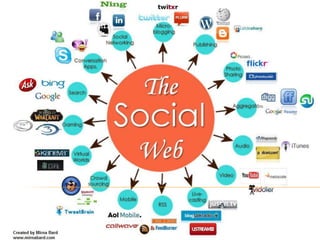
This can be via email, blogs,
microblogs, wikis, media sharing
sites, chat rooms, discussion
boards, texting, social news
sites, bookmarking sites, and
other social networks.
E-MAIL COMMUNICATION

E-mail was one of the first
 uses of the Internet and is still the
  most popular use, accounting for most of
  the traffic on the Internet.
 Mail sent through the Postal Office is now

 referred to as „snail mail‟,       because
 e-mail is delivered within minutes.
E-MAIL COMMUNICATION

Spam is advertisements delivered to
 your e-mail inbox through mass mailings
 (mailing millions of people at once with a
 computer).

Listserv is an automated mailing list
 that a person can subscribe to get more
 information. (Chariho PTO for example)
SOCIAL NETWORK
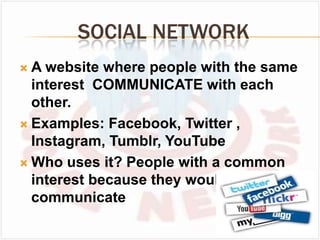
A  website where people with the same
  interest COMMUNICATE with each
  other.
 Examples: Facebook, Twitter ,
  Instagram, Tumblr, YouTube
 Who uses it? People with a common
  interest because they would like to
  communicate
WEB BLOG


A  blog (a blend of the term web and log)
  is a type of website or part of a website.
  Blogs are short, frequently updated
  postings by an individual and are
  entered in reverse chronological order
  (by date) (Wikipedia)
 Examples : People can have a blog
  about almost any interest
COOKING BLOG
HTTP://COOKINGWITHAMY.BLOGSPOT.COM/
BLOG ON AUTOMOBILES
HTTP://WWW.AUTOBLOG.COM/
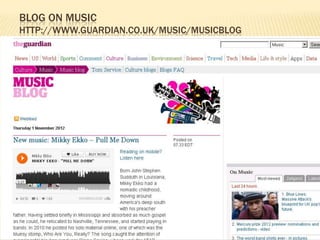
BLOG ON MUSIC
HTTP://WWW.GUARDIAN.CO.UK/MUSIC/MUSICBLOG
WEB BLOG
 People read blogs for their personal
  enjoyment or interest.
 People update their blog daily, weekly or
  monthly.
FACTS ABOUT BLOGS

               120,000 new blogs
    Approximately

 pop up on the Internet every day.

Tagging is defining what type of
    information is in a blog so that others may
    find it when searching.
MICRO BLOG

 A micro blog differs from traditional blog in
  that its content is typically much smaller, in
  both actual size and file size.
 It is basically a blog where people post
  short entries.

   Example of a micro blog:   Twitter
TWITTER

   You have to subscribe to receive a tweet
    from one of your friends or from a celebrity or
    movie star you follow
   You   „follow‟ their tweets by subscribing.
 Twitterwas invented only 6
  years ago
 Over 500 million users today
 Maximum number of
  characters allowed for a
 Tweet is 140
Facts About
  Twitter
   A wiki is website where the online
    community of users can add to or
    edit the entries
   Examples: www.Wikipedia.com ,
    www.Wiki.Answers.com
MEDIA SHARING SITE
A media sharing site is a web
site that enables users to store
and share their multimedia file
(photos, videos, music, etc.)
Examples:
 Where you can chat with your
  friends or colleagues online
 Examples; Facebook instant
  messenger, on CLE (collaborative
  learning environment)
 Who uses it? A group of friends or
  colleagues at work can talk through
  instant messaging.
OTHER TYPES OF SOCIAL MEDIA
                   -- 600 million active
Facebook users access via Mobile devices
          -- Texting a vote from your cell
phone for your favorite singer on American
Idol is a form of social media.
                       -- post entries on a
discussion board for all the members to
read. This might be used by students who
are part of a university Chemistry class
and want to help each other study.
OTHER TYPES OF SOCIAL MEDIA
                    – Users vote for the
news items they find most interesting. The
news that gets the most votes is found at
the top of the page.
http://www.1stwebdesigner.com/freebies/g
et-more-traffic-social-news-websites/
                     – Users can add and
share bookmarks of websites.
Delicious.com, founded in 2003,
popularized the terms "social
bookmarking" and "tagging".
   The continent with the largest number of
  Internet users is Asia.
  http://www.internetworldstats.com/stats.htm
 There are 7 billion people in the world, and of

  those 7 billion,one-third     have access
  to the Internet.
http://www.thedailystar.net/newDesign/latest_n
ews.php?nid=41094
FACTS ABOUT WORLDWIDE USE OF
         SOCIAL MEDIA

 Revolutionaries have used social
  media to get their followers to take action
  in the streets. In Egypt and Libya, those
  who wanted to overthrow the dictator,
  used social media to organize their
  protests.
http://www.wired.com/business/2011/02/egy
pts-revolutionary-fire/
OTHER INTERESTING
             FACTS
YouTube is now the second
 largest search engine on the
 Internet.
First largest is Google -- the
 most visited website on the
 Internet.
FACTS ABOUT FACEBOOK
   Facebook now has 1     billion Facebook
    pages.    It is the most popular social
    media hot spot.
Less than 20% of Facebook users are
 in the United States.
   That means that 80% of Facebook users
    are in   other countries.
CONCERNS ABOUT F ACEBOOK
  Care  should be taken about what you
  post on Facebook (or any social media
  site) because “What you post on
  Facebook stays on Facebook” – Even
  if you delete a picture or post from your
  Facebook page, others have already
  tagged it and saved it; though the picture
  is deleted on your page, it still exists on
  other pages and history.
QUESTIONS

How  has social media changed
 the way people interact with
 each other?
How does this differ from the
 way people interacted with each
 other prior to social media?
COMPARE

 Human               Human
  interaction          interaction with
  before online        online social
  social media         media
1.                   1.
2.                   2.
3.                   3.
ADVANTAGES AND DISADVANTAGES OF
       ONLINE SOCIAL MEDIA
Advantages      Disadvantages
1.              1.
2.              2.
3.              3.