DENTAL CARIES RUBAB HAIDER RABIA IQBAL
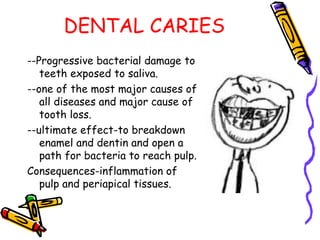
DENTAL CARIES --Progressive bacterial damage to teeth exposed to saliva. --one of the most major causes of all diseases and major cause of tooth loss. --ultimate effect-to breakdown enamel and dentin and open a path for bacteria to reach pulp. Consequences-inflammation of pulp and periapical tissues.
AETIOLOGY Four major factors involved in etiology:- Cariogenic bacteria Bacterial plaque Susceptible tooth surface Fermentable bacterial substrate (sugar)
 
Bacteriology of Dental Caries Major organisms responsible for caries are:- Strep mutans Lactobacilli Other strains of streptocooci
Cariogenic prop of strep mutans Produces lactic acid from sucrose Can live at ph as low as 4.2 Forms large amounts of extracellular,sticky,insoluble glucan plaque matrix. Adheres to pellicle and contributes to plaque formation.
BACTERIAL PLAQUE Adherent deposit on the teeth. BIOFILM-consists of viscous phase formed from bacteria and extracellular polysaccharide matrices. In stagnation areas,plaque bacteria can form acid from sugars over long periods to attcack tooth surfaces. Production of high acid concentration contributes to low ph.
SUCROSE Colonisation by cariogenic bacteria is highly dependant on sucrose content of diet. In absence of sucrose-S mutans cannot be made to colonise the mouth. Severe reduction in dietary sucrose-causes S mutans to decline in number or disappear from the plaque. Frequent feeds of small quantities are more cariogenic.
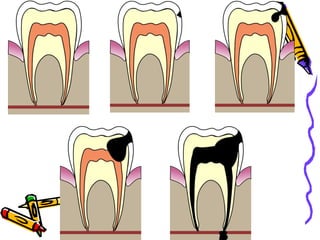
CARIES SPREAD TO ENAMEL Acids formed by bacterial fermentation from dietary sugars leads to a pH fall in the plaque which dissolve tooth enamel, initiating the development of carious lesions.  The progression of demineralization in enamel continues to the point  where dissolution of hydroxyapatite exeeds remineralization. Bacteria cant invade enamel until demineralization provides them pathways  to enter.
CARIES SPREAD TO DENTIN Non bacterial pre-cavitation,acid softening of the matrix. Migration of bacteria along the tubules. Distortion of tubules Breakdown of intervening matrix forming liquefaction foci. Progressive disintegration of remaining matrix
PULPAL RESPONSE Pulpal tissue subjacent to deep caries lesions often shows the presence of chronic inflammation, including lymphocytes, macrophages and plasma cells. Formation of tertiary dentin is usually visible on the pulpal aspect and the increase in dentin thickness.
 
CLINICAL Symptoms and Signs Caries initially involves only the enamel and produces no symptoms. A cavity that invades the dentin causes  pain , first when  hot, cold, or sweet foods  or beverages contact the involved tooth, and  later with chewing or percussion . Pain can be intense and persistent when the pulp is severely involved
CLINICAL Direct inspection Sometimes use of  x-rays  or special testing instruments Routine, frequent (q 6 to 12 mo) clinical evaluation identifies early caries at a time when minimal intervention prevents its progression. A thin probe, sometimes special dyes, and  transillumination by fiberoptic lights  are used, frequently supplemented by new devices that detect caries by changes in electrical conductivity or laser reflectivity. However, x-rays are still important for detecting caries, determining the depth of involvement, and identifying caries under existing restorations SIGNIFICANSE
CLINICAL SIGNIFICANCE Pulp involvement? Reversible or irreversible pulpitis? Spread?
Consequences of Dental Caries Possible facial cellulitis requiring hospitalization Impaired language development Reduced self-esteem Possible systemic illness for children with special health care needs
Consequences of Dental Caries
ORAL HEALTH CONSEQUENCES apical periodontitis, periapical abscess, cellulitis, and osteomyelitis of the jaw
Spread from maxillary teeth  may cause purulent sinusitis, meningitis,  brain abscess, orbital cellulitis, and cavernous sinus thrombosis.
Spread from mandibular teeth may cause  Spread from mandibular teeth may cause  Ludwig's angina, parapharyngeal abscess, mediastinitis, pericarditis,  empyema, and jugular thrombophlebitis.

Dental caries ppt

  • 1.
    DENTAL CARIES RUBABHAIDER RABIA IQBAL
  • 2.
    DENTAL CARIES --Progressivebacterial damage to teeth exposed to saliva. --one of the most major causes of all diseases and major cause of tooth loss. --ultimate effect-to breakdown enamel and dentin and open a path for bacteria to reach pulp. Consequences-inflammation of pulp and periapical tissues.
  • 3.
    AETIOLOGY Four majorfactors involved in etiology:- Cariogenic bacteria Bacterial plaque Susceptible tooth surface Fermentable bacterial substrate (sugar)
  • 4.
  • 5.
    Bacteriology of DentalCaries Major organisms responsible for caries are:- Strep mutans Lactobacilli Other strains of streptocooci
  • 6.
    Cariogenic prop ofstrep mutans Produces lactic acid from sucrose Can live at ph as low as 4.2 Forms large amounts of extracellular,sticky,insoluble glucan plaque matrix. Adheres to pellicle and contributes to plaque formation.
  • 7.
    BACTERIAL PLAQUE Adherentdeposit on the teeth. BIOFILM-consists of viscous phase formed from bacteria and extracellular polysaccharide matrices. In stagnation areas,plaque bacteria can form acid from sugars over long periods to attcack tooth surfaces. Production of high acid concentration contributes to low ph.
  • 8.
    SUCROSE Colonisation bycariogenic bacteria is highly dependant on sucrose content of diet. In absence of sucrose-S mutans cannot be made to colonise the mouth. Severe reduction in dietary sucrose-causes S mutans to decline in number or disappear from the plaque. Frequent feeds of small quantities are more cariogenic.
  • 9.
    CARIES SPREAD TOENAMEL Acids formed by bacterial fermentation from dietary sugars leads to a pH fall in the plaque which dissolve tooth enamel, initiating the development of carious lesions. The progression of demineralization in enamel continues to the point where dissolution of hydroxyapatite exeeds remineralization. Bacteria cant invade enamel until demineralization provides them pathways to enter.
  • 10.
    CARIES SPREAD TODENTIN Non bacterial pre-cavitation,acid softening of the matrix. Migration of bacteria along the tubules. Distortion of tubules Breakdown of intervening matrix forming liquefaction foci. Progressive disintegration of remaining matrix
  • 11.
    PULPAL RESPONSE Pulpaltissue subjacent to deep caries lesions often shows the presence of chronic inflammation, including lymphocytes, macrophages and plasma cells. Formation of tertiary dentin is usually visible on the pulpal aspect and the increase in dentin thickness.
  • 12.
  • 13.
    CLINICAL Symptoms andSigns Caries initially involves only the enamel and produces no symptoms. A cavity that invades the dentin causes pain , first when hot, cold, or sweet foods or beverages contact the involved tooth, and later with chewing or percussion . Pain can be intense and persistent when the pulp is severely involved
  • 14.
    CLINICAL Direct inspectionSometimes use of x-rays or special testing instruments Routine, frequent (q 6 to 12 mo) clinical evaluation identifies early caries at a time when minimal intervention prevents its progression. A thin probe, sometimes special dyes, and transillumination by fiberoptic lights are used, frequently supplemented by new devices that detect caries by changes in electrical conductivity or laser reflectivity. However, x-rays are still important for detecting caries, determining the depth of involvement, and identifying caries under existing restorations SIGNIFICANSE
  • 15.
    CLINICAL SIGNIFICANCE Pulpinvolvement? Reversible or irreversible pulpitis? Spread?
  • 16.
    Consequences of DentalCaries Possible facial cellulitis requiring hospitalization Impaired language development Reduced self-esteem Possible systemic illness for children with special health care needs
  • 17.
  • 18.
    ORAL HEALTH CONSEQUENCESapical periodontitis, periapical abscess, cellulitis, and osteomyelitis of the jaw
  • 19.
    Spread from maxillaryteeth may cause purulent sinusitis, meningitis, brain abscess, orbital cellulitis, and cavernous sinus thrombosis.
  • 20.
    Spread from mandibularteeth may cause Spread from mandibular teeth may cause Ludwig's angina, parapharyngeal abscess, mediastinitis, pericarditis, empyema, and jugular thrombophlebitis.