LOW-LEVEL LASER THERAPY FOR
MANAGEMENT OF LARGE PERIAPICAL
LESIONS ASSOCIATED WITH OPEN APEX
CASES
A CASE REPORT
Sudha Yadav, Ruchika R. Nawal, Sangeeta Talwar, Mahesh Verma
Department of Conservative Dentistry and Endodontics,
Journal Club Presentation
By
Dr Abdul Kadir
MDS 3rd
year
CONTENTS
• INTRODUCTION
• SUBJECTS AND METHODS
• DISCUSSION
• CONCLUSION
INTRODUCTION
Low level laser therapy (LLLT), also known as therapeutic laser treatment, is a
‑
new but well accepted tool in regenerative medicine and dentistry.
‑
When used at an appropriate dose, LLLT has the ability to stimulate wound
healing.
It produces a biostimulative effect on body cells as it is readily absorbed by the
cellular photoreceptors resulting in increased ATP production, mast cell
activation, and fibroblast production.
 Because of these properties, it can reduce inflammation and promote faster
resolution of periapical lesions by nonsurgical means.
 The following case reports highlight the nonsurgical management of
symptomatic teeth with immature apices and large periapical radiolucencies
using disinfection ability and biostimulative property of 980 nm diode laser to
‑
promote periapical healing.
 An 18 year old female patient reported with a chief complaint of pus drainage
‑ ‑
and discolored maxillary right central incisor with a history of trauma at the age
of 6 years.
 Radiographic examination showed an immature tooth with a wide open apex wrt
11 and diffuse periapical radiolucency in relation to right maxillary central and
lateral incisor of approximate size 35 × 30 mm.
SUBJECTS AND METHODS
Case Presentation 1
 Endodontic access opening was done after rubber dam application.
 Working length was assessed radiographically
 Biomechanical preparation was done using hand K files (Dentsply Maillefer,
Ballaigues, Switzerland) for tooth 12 in a step back fashion.
 After completing apical preparation till 40 no hand K file (Dentsply Maillefer),
the rest of the canal was flared using progressively larger files to achieve a
tapered canal shape.
 Root canal walls were gently cleaned for right maxillary central incisor and
copious irrigation was performed with 1% NaOCl using 30 G Max i Probe
‑ ‑
needle (Dentsply Rinn, Elgin, IL, USA) during the treatment.
‑
 Root canal was dried with paper points (Dentsply/Tulsa Dental, Tulsa, OK, USA).
 Next, the root canals were disinfected using 940 nm diode laser (Epic 10 Diode
‑
Laser; Biolase Inc., USA) applied with the wave length of 940 nm, output power of
2.5 W, continuous wave mode, 10 ms pulse duration, and 10 ms pulse interval.
‑ ‑
 The laser was irradiated into the canals to a depth of 1 mm shorter than the actual
root canal length, using an optical fiber with a diameter of 200 μm.
 Calcium hydroxide (Dento Kem, Faridabad, India) was mixed with saline to get
a creamy consistency and was placed in the canal.
 The access cavity was sealed with a temporary restorative material, Cavit.
 One week later, the calcium hydroxide dressing was removed, and irrigation was
done with 1% NaOCl and 17% liquid EDTA Smear Clear
The root canal was then dried with sterile paper points followed by placement of
platelet rich fibrin (PRF) into the periapical tissue with the help of an endodontic
‑
plugger wrt tooth no. 11.
MTA was applied to the apical portion of the canal using a calibrated measured
plugger.
MTA placement was assessed radiographically; it illustrated appropriate obturation
of the apical third of the root canal.
 A sterile cotton pellet moistened with water was placed over the material within
the root canal and the access cavity was sealed temporarily.
 Right maxillary lateral incisor was obturated using cold lateral condensation
technique using gutta percha and AH Plus sealer.
 The patient was recalled after 1 week for clinical and radiographic examination.
 Gutta percha backfill was performed using Obtura wrt right maxillary central
incisor and the access cavity was sealed using composite resin.
 The patient was given seven sessions of LLLT (940 nm, 50 mW, continuous
emission; Epic 10 Diode Laser, Biolase Inc.)
 Transcutaneous irradiation was performed around the apices of involved teeth at
four points equidistant from each other around the periapical lesion for 9 s
delivering a total of 16 J/cm2 in each session.
 Application was repeated every 48 h for 15 days.
 The clinical follow up at 1 year showed the patient functioning well with no
‑
reportable clinical symptoms.
 The radiograph showed complete healing of the periapical radiolucency.
Case Presentation 2
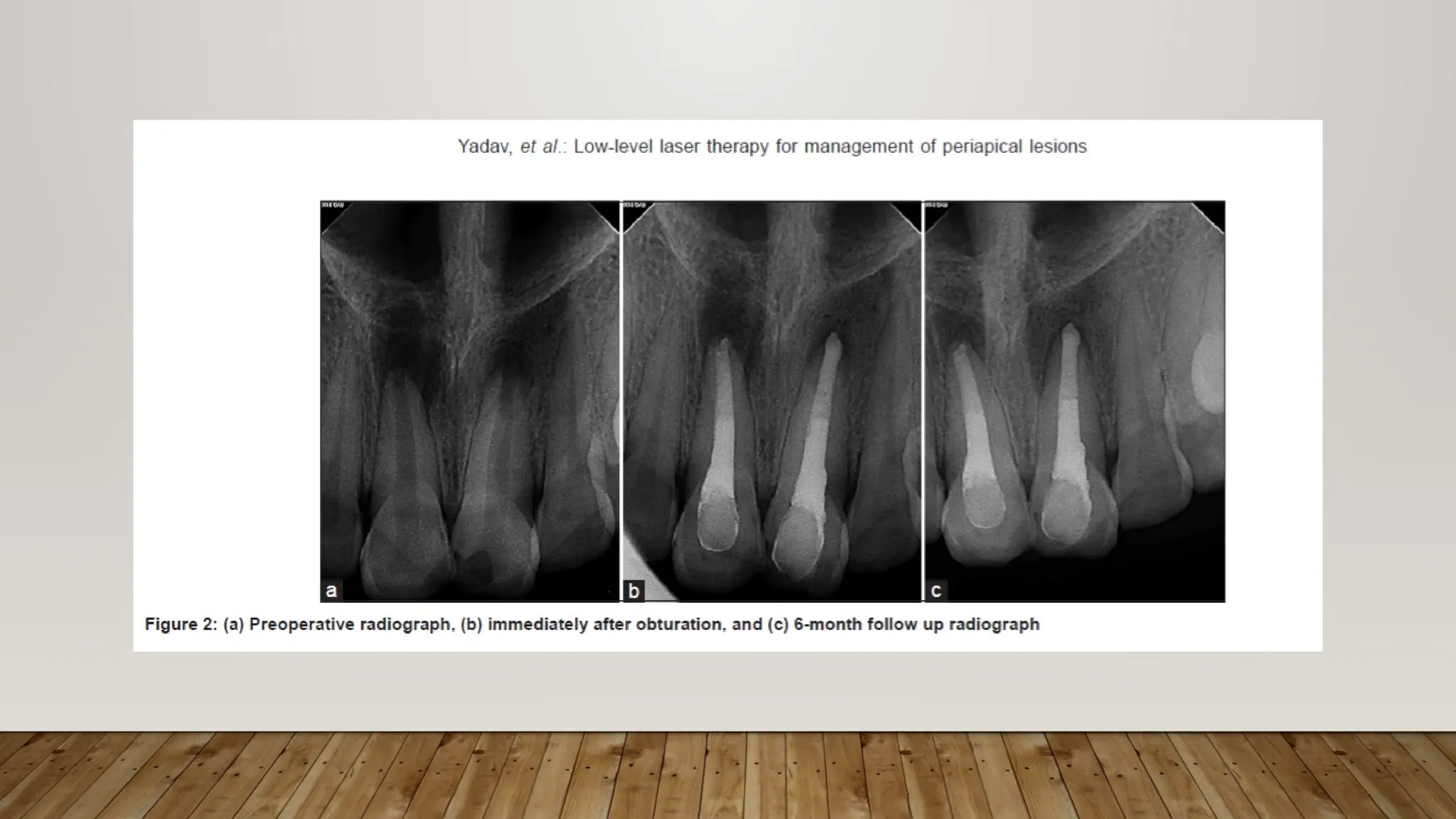
 A 17 year old patient reported with a chief complaint of discolored and
‑ ‑
fractured front teeth.
 History of trauma was present around 10 years back.
 On radiographic examination, open apex was seen wrt maxillary right and left
central incisor along with periapical radiolucency.
 A diagnosis of pulp necrosis with asymptomatic apical periodontitis was
made.
 Endodontic access opening was done wrt teeth no. 11 and 21 under rubber
dam isolation.
 Working length was assessed radiographically and root canal walls were
gently cleaned for both the teeth.
 Copious irrigation was performed with 1% NaOCl using 30 G Max i Probe
‑ ‑
needle during the treatment.
 Next, the root canals were disinfected using 940 nm diode laser and calcium
‑
hydroxide was placed in the canal for 1 week.
 One week later, calcium hydroxide dressing was removed, and irrigation
was done with 1% NaOCl and 17% liquid EDTA Smear Clear.
 PRF was placed into the periapical tissue with the help of an endodontic plugger
wrt teeth no. 11 and 21.
 The tooth colored ProRoot MTA (Dentsply) was applied to the apical portion of
‑
the canal using a calibrated measured plugger.
 A sterile cotton pellet moistened with water was placed over the material within
the root canal and the access cavity was sealed temporarily.
 After 1 week, gutta percha backfill was performed using Obtura (Obtura/
Spartan) and the access cavity was sealed using composite resin.
 Follow up examination on 6 months showed that the patient was asymptomatic
‑
and healing of periapical lesions was evident on radiograph.
 The biggest challenge while treating nonvital teeth with open apices is
achieving complete elimination of the microbes from the root canal system.
 As aggressive mechanical instrumentation can weaken the already fragile
root canal walls, disinfection of the root canal system is mainly achieved by
irrigants like NaOCl and intracanal medicaments like calcium hydroxide.
 In addition to NaOCl, diode laser was used for achieving thorough
disinfection.
DISCUSSION
 A study done by Moritz et al. showed that 890 mm diode laser has a
‑
bactericidal action and could disinfect the root canal.
 When compared with common irrigants, diode laser has a greater depth of
penetration into the dentinal tubules (up to 1000 μm).
 Hence, lasers used in conjugation with conservative endodontic treatment
can offer new possibilities regarding the difficulties faced during cleaning
of root canal system.
To accelerate periapical healing, LLLT was used in both the above cases.
LLLT has been shown to accelerate the process of osseous healing by several
mechanisms such as:
 decreasing the inflammatory mediators,
 increasing cellular proliferation,
 increasing neovascularization,
 Upregulating bone morphogenic protein, and
 transforming growth factor beta,
and thus increasing the differentiation of mesenchymal cells into osteoblasts.
 All these events result in accelerated osteogenesis.
 LLLT protocols for bone regeneration show a large variety in literature, most
of them involving daily or alternate days application for 15–21 days.
 Repetitive sessions were used in this study in accordance with the protocol
used in previous studies on bone regeneration.
This case report is first of its kind in which diode lasers have been successfully
used at low level to induce faster healing of periapical lesion associated with
open apex cases.
Therefore, it is recommended that lasers should be used in future studies to
evaluate and further confirm its biostimulative properties.
CONCLUSION
low level laser therapy for management for apical lesions

low level laser therapy for management for apical lesions

  • 1.
    LOW-LEVEL LASER THERAPYFOR MANAGEMENT OF LARGE PERIAPICAL LESIONS ASSOCIATED WITH OPEN APEX CASES A CASE REPORT Sudha Yadav, Ruchika R. Nawal, Sangeeta Talwar, Mahesh Verma Department of Conservative Dentistry and Endodontics, Journal Club Presentation By Dr Abdul Kadir MDS 3rd year
  • 2.
    CONTENTS • INTRODUCTION • SUBJECTSAND METHODS • DISCUSSION • CONCLUSION
  • 3.
    INTRODUCTION Low level lasertherapy (LLLT), also known as therapeutic laser treatment, is a ‑ new but well accepted tool in regenerative medicine and dentistry. ‑ When used at an appropriate dose, LLLT has the ability to stimulate wound healing. It produces a biostimulative effect on body cells as it is readily absorbed by the cellular photoreceptors resulting in increased ATP production, mast cell activation, and fibroblast production.
  • 4.
     Because ofthese properties, it can reduce inflammation and promote faster resolution of periapical lesions by nonsurgical means.  The following case reports highlight the nonsurgical management of symptomatic teeth with immature apices and large periapical radiolucencies using disinfection ability and biostimulative property of 980 nm diode laser to ‑ promote periapical healing.
  • 5.
     An 18year old female patient reported with a chief complaint of pus drainage ‑ ‑ and discolored maxillary right central incisor with a history of trauma at the age of 6 years.  Radiographic examination showed an immature tooth with a wide open apex wrt 11 and diffuse periapical radiolucency in relation to right maxillary central and lateral incisor of approximate size 35 × 30 mm. SUBJECTS AND METHODS Case Presentation 1
  • 7.
     Endodontic accessopening was done after rubber dam application.  Working length was assessed radiographically  Biomechanical preparation was done using hand K files (Dentsply Maillefer, Ballaigues, Switzerland) for tooth 12 in a step back fashion.
  • 8.
     After completingapical preparation till 40 no hand K file (Dentsply Maillefer), the rest of the canal was flared using progressively larger files to achieve a tapered canal shape.  Root canal walls were gently cleaned for right maxillary central incisor and copious irrigation was performed with 1% NaOCl using 30 G Max i Probe ‑ ‑ needle (Dentsply Rinn, Elgin, IL, USA) during the treatment. ‑
  • 9.
     Root canalwas dried with paper points (Dentsply/Tulsa Dental, Tulsa, OK, USA).  Next, the root canals were disinfected using 940 nm diode laser (Epic 10 Diode ‑ Laser; Biolase Inc., USA) applied with the wave length of 940 nm, output power of 2.5 W, continuous wave mode, 10 ms pulse duration, and 10 ms pulse interval. ‑ ‑  The laser was irradiated into the canals to a depth of 1 mm shorter than the actual root canal length, using an optical fiber with a diameter of 200 μm.
  • 10.
     Calcium hydroxide(Dento Kem, Faridabad, India) was mixed with saline to get a creamy consistency and was placed in the canal.  The access cavity was sealed with a temporary restorative material, Cavit.  One week later, the calcium hydroxide dressing was removed, and irrigation was done with 1% NaOCl and 17% liquid EDTA Smear Clear
  • 11.
    The root canalwas then dried with sterile paper points followed by placement of platelet rich fibrin (PRF) into the periapical tissue with the help of an endodontic ‑ plugger wrt tooth no. 11. MTA was applied to the apical portion of the canal using a calibrated measured plugger. MTA placement was assessed radiographically; it illustrated appropriate obturation of the apical third of the root canal.
  • 12.
     A sterilecotton pellet moistened with water was placed over the material within the root canal and the access cavity was sealed temporarily.  Right maxillary lateral incisor was obturated using cold lateral condensation technique using gutta percha and AH Plus sealer.  The patient was recalled after 1 week for clinical and radiographic examination.
  • 13.
     Gutta perchabackfill was performed using Obtura wrt right maxillary central incisor and the access cavity was sealed using composite resin.  The patient was given seven sessions of LLLT (940 nm, 50 mW, continuous emission; Epic 10 Diode Laser, Biolase Inc.)  Transcutaneous irradiation was performed around the apices of involved teeth at four points equidistant from each other around the periapical lesion for 9 s delivering a total of 16 J/cm2 in each session.
  • 14.
     Application wasrepeated every 48 h for 15 days.  The clinical follow up at 1 year showed the patient functioning well with no ‑ reportable clinical symptoms.  The radiograph showed complete healing of the periapical radiolucency.
  • 15.
  • 16.
     A 17year old patient reported with a chief complaint of discolored and ‑ ‑ fractured front teeth.  History of trauma was present around 10 years back.  On radiographic examination, open apex was seen wrt maxillary right and left central incisor along with periapical radiolucency.
  • 18.
     A diagnosisof pulp necrosis with asymptomatic apical periodontitis was made.  Endodontic access opening was done wrt teeth no. 11 and 21 under rubber dam isolation.  Working length was assessed radiographically and root canal walls were gently cleaned for both the teeth.
  • 19.
     Copious irrigationwas performed with 1% NaOCl using 30 G Max i Probe ‑ ‑ needle during the treatment.  Next, the root canals were disinfected using 940 nm diode laser and calcium ‑ hydroxide was placed in the canal for 1 week.  One week later, calcium hydroxide dressing was removed, and irrigation was done with 1% NaOCl and 17% liquid EDTA Smear Clear.
  • 20.
     PRF wasplaced into the periapical tissue with the help of an endodontic plugger wrt teeth no. 11 and 21.  The tooth colored ProRoot MTA (Dentsply) was applied to the apical portion of ‑ the canal using a calibrated measured plugger.  A sterile cotton pellet moistened with water was placed over the material within the root canal and the access cavity was sealed temporarily.
  • 21.
     After 1week, gutta percha backfill was performed using Obtura (Obtura/ Spartan) and the access cavity was sealed using composite resin.  Follow up examination on 6 months showed that the patient was asymptomatic ‑ and healing of periapical lesions was evident on radiograph.
  • 22.
     The biggestchallenge while treating nonvital teeth with open apices is achieving complete elimination of the microbes from the root canal system.  As aggressive mechanical instrumentation can weaken the already fragile root canal walls, disinfection of the root canal system is mainly achieved by irrigants like NaOCl and intracanal medicaments like calcium hydroxide.  In addition to NaOCl, diode laser was used for achieving thorough disinfection. DISCUSSION
  • 23.
     A studydone by Moritz et al. showed that 890 mm diode laser has a ‑ bactericidal action and could disinfect the root canal.  When compared with common irrigants, diode laser has a greater depth of penetration into the dentinal tubules (up to 1000 μm).  Hence, lasers used in conjugation with conservative endodontic treatment can offer new possibilities regarding the difficulties faced during cleaning of root canal system.
  • 24.
    To accelerate periapicalhealing, LLLT was used in both the above cases. LLLT has been shown to accelerate the process of osseous healing by several mechanisms such as:  decreasing the inflammatory mediators,  increasing cellular proliferation,  increasing neovascularization,  Upregulating bone morphogenic protein, and  transforming growth factor beta, and thus increasing the differentiation of mesenchymal cells into osteoblasts.  All these events result in accelerated osteogenesis.
  • 25.
     LLLT protocolsfor bone regeneration show a large variety in literature, most of them involving daily or alternate days application for 15–21 days.  Repetitive sessions were used in this study in accordance with the protocol used in previous studies on bone regeneration.
  • 26.
    This case reportis first of its kind in which diode lasers have been successfully used at low level to induce faster healing of periapical lesion associated with open apex cases. Therefore, it is recommended that lasers should be used in future studies to evaluate and further confirm its biostimulative properties. CONCLUSION