Data, Evidence and
Outcomes
Joe Matthews
American Library Association
Sponsored by Counting Opinions
June 28, 2014
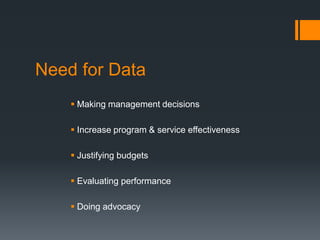
Need for Data
 Making management decisions
 Increase program & service effectiveness
 Justifying budgets
 Evaluating performance
 Doing advocacy
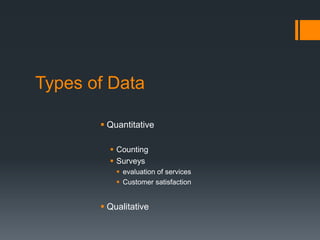
Types of Data
 Quantitative
 Counting
 Surveys
 evaluation of services
 Customer satisfaction
 Qualitative
Purpose
The purpose of any data gathering activity
& analysis is to INFORM
Strategies
 User versus library’s perspective
 Examining trends
 Comparing libraries
 Social context
 Outcomes
User’s Perspective
 How well?
 How courteous?
 How responsive?
 How satisfied?
How courteous?
 Welcoming
 Attentive
How responsive?
 Anticipatory
 Helpful
 Empathetic
How satisfied?
 Expectations met
 Materials obtained
 Personal interaction
 Ease of use
 Equipment used
 Environment
 Comfort
 Willingness to return
Library’s Perspective
 How much?
 How many?
 How prompt?
 How economical?
How much?
 Magnitude
 Percent of change from last year
 Percent of overall change
 Cost
How many?
 Magnitude
 Change
How prompt?
 Cycle times
 Turnaround time
 Wait times
 Anticipatory
How economical?
 Resources used
 Units processed
 Productivity
Library & Customers Perspective
 How valuable?
 How reliable?
 How accurate?
 How well?
How valuable?
 Effort expended
 Costs
 Benefits obtained
How reliable?
 Dependability/Consistency
 Access
 Accuracy
How accurate?
 Completeness
 Comprehensiveness
 Currency
How well?
 Accuracy
 Promptness
 Courtesy
 Expertise
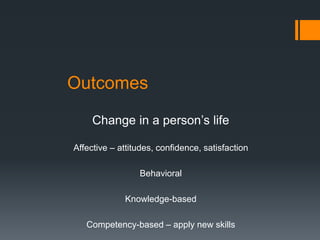
Outcomes
Change in a person’s life
Affective – attitudes, confidence, satisfaction
Behavioral
Knowledge-based
Competency-based – apply new skills
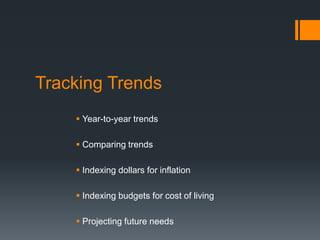
Tracking Trends
 Year-to-year trends
 Comparing trends
 Indexing dollars for inflation
 Indexing budgets for cost of living
 Projecting future needs
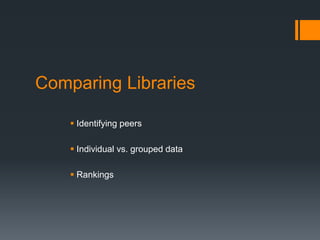
Comparing Libraries
 Identifying peers
 Individual vs. grouped data
 Rankings
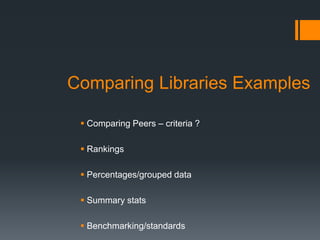
Comparing Libraries Examples
 Comparing Peers – criteria ?
 Rankings
 Percentages/grouped data
 Summary stats
 Benchmarking/standards
Libraries in Social Context
 Social, political, & economic environment
 Focusing on decision-makers’ concerns
 Finding the right data
 Creating the “hook”
Social Context Examples
 PLs rank 2nd behind fire protection among local
government services
 Visits to PLs outnumber professional football
attendance of X annually by a factor of Y
 PLs loan 4.5 million items per day – FedEx delivers
about 1.75 million packages each day
Evidence
 How can evidence contribute to the quality
of the decision making process?
 What are the risks, costs, and benefits of an
evidence-based approach?
 Ensure that objective evidence is reflected
in the decision making process.
Evidence
 Depends on the need
 BIG DATA
 Combine data
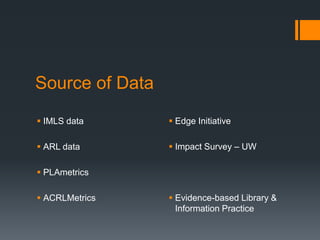
Source of Data
 IMLS data
 ARL data
 PLAmetrics
 ACRLMetrics
 Edge Initiative
 Impact Survey – UW
 Evidence-based Library &
Information Practice
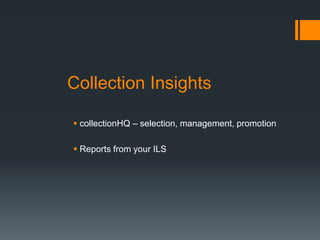
Collection Insights
 collectionHQ – selection, management, promotion
 Reports from your ILS
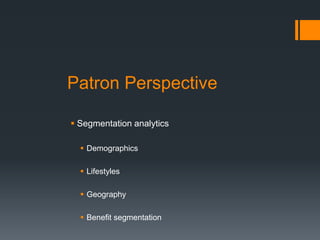
Patron Perspective
 Segmentation analytics
 Demographics
 Lifestyles
 Geography
 Benefit segmentation
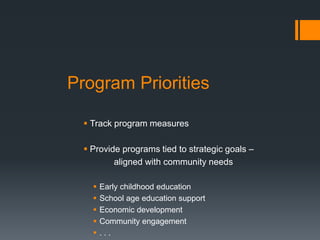
Program Priorities
 Track program measures
 Provide programs tied to strategic goals –
aligned with community needs
 Early childhood education
 School age education support
 Economic development
 Community engagement
 . . .
Advocacy Hooks
 Use data for presentations
 Use data to target likely voters
 Use data to demonstrate value in the
life of your customers
Outcomes
Libraries cannot demonstrate value
until they define outcomes
of institutional relevance
and then measure the degree
to which they attain them
Outcomes
 Focus on the end results
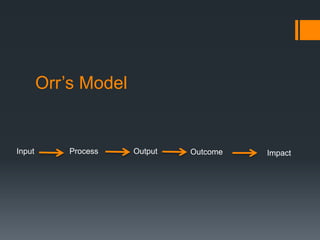
 Logic Model
 Orr’s Input-Process-Output-Outcomes Model
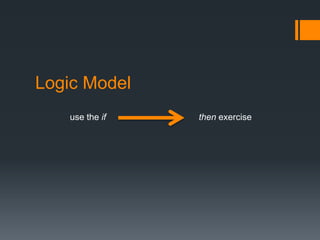
Logic Model
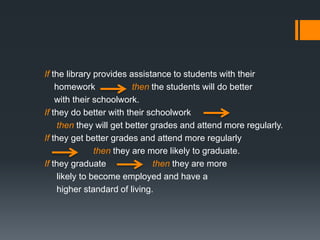
use the if then exercise
If the library provides assistance to students with their
homework then the students will do better
with their schoolwork.
If they do better with their schoolwork
then they will get better grades and attend more regularly.
If they get better grades and attend more regularly
then they are more likely to graduate.
If they graduate then they are more
likely to become employed and have a
higher standard of living.
Orr’s Model
Input Process Output Outcome Impact
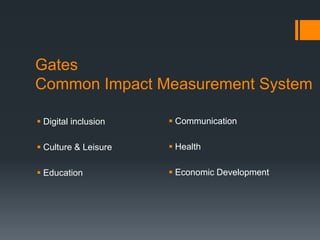
Gates
Common Impact Measurement System
 Digital inclusion
 Culture & Leisure
 Education
 Communication
 Health
 Economic Development
Academic Library Outcomes
 Student Learning
 Teaching Effectiveness
 Research
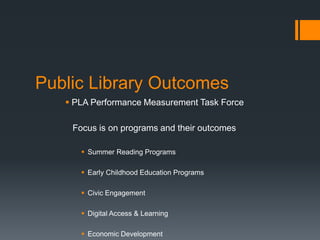
Public Library Outcomes
 PLA Performance Measurement Task Force
Focus is on programs and their outcomes
 Summer Reading Programs
 Early Childhood Education Programs
 Civic Engagement
 Digital Access & Learning
 Economic Development
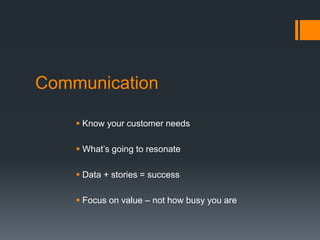
Communication
 Know your customer needs
 What’s going to resonate
 Data + stories = success
 Focus on value – not how busy you are
Data, Evidence and Outcomes
Joe AT JoeMatthews.Org

Data, evidence and outcomes

Editor's Notes

  • #23 Size of budget, size of collections, size (# of) buildings, same state, recognized peers, aspirational peers, Athletic conference, geography