Movements of Human
Body (Basic Intro)
PREPARED BY
SOMA BALAJI PT
MSK & SPORTS
 The human body is capable of a wide range of
movements.
 It is because of its complex structure of bones, joints,
muscles, and tendons.
 Below in this PPT there is a comprehensive list of the major
types of movements that can occur in the human body,
divided by the type of joint and the direction of movement:
1. Flexion
•Definition: Decreasing the angle between two body parts.
•Example: Bending the elbow or knee.
2. Extension
•Definition: Increasing the angle between two body parts,
essentially straightening a joint.
•Example: Straightening the elbow or knee.
3. Hyperextension
•Definition: Extending a joint beyond its normal range of
motion.
•Example: Knee hyperextension, Bending the head
backward.
4. Abduction
•Definition: Movement of a limb away from the midline of
the body.
•Example: Raising the arm sideways away from the body.
5. Adduction
•Definition: Movement of a limb toward the midline of the
body.
•Example: Bringing the arm back down to the side of the body.
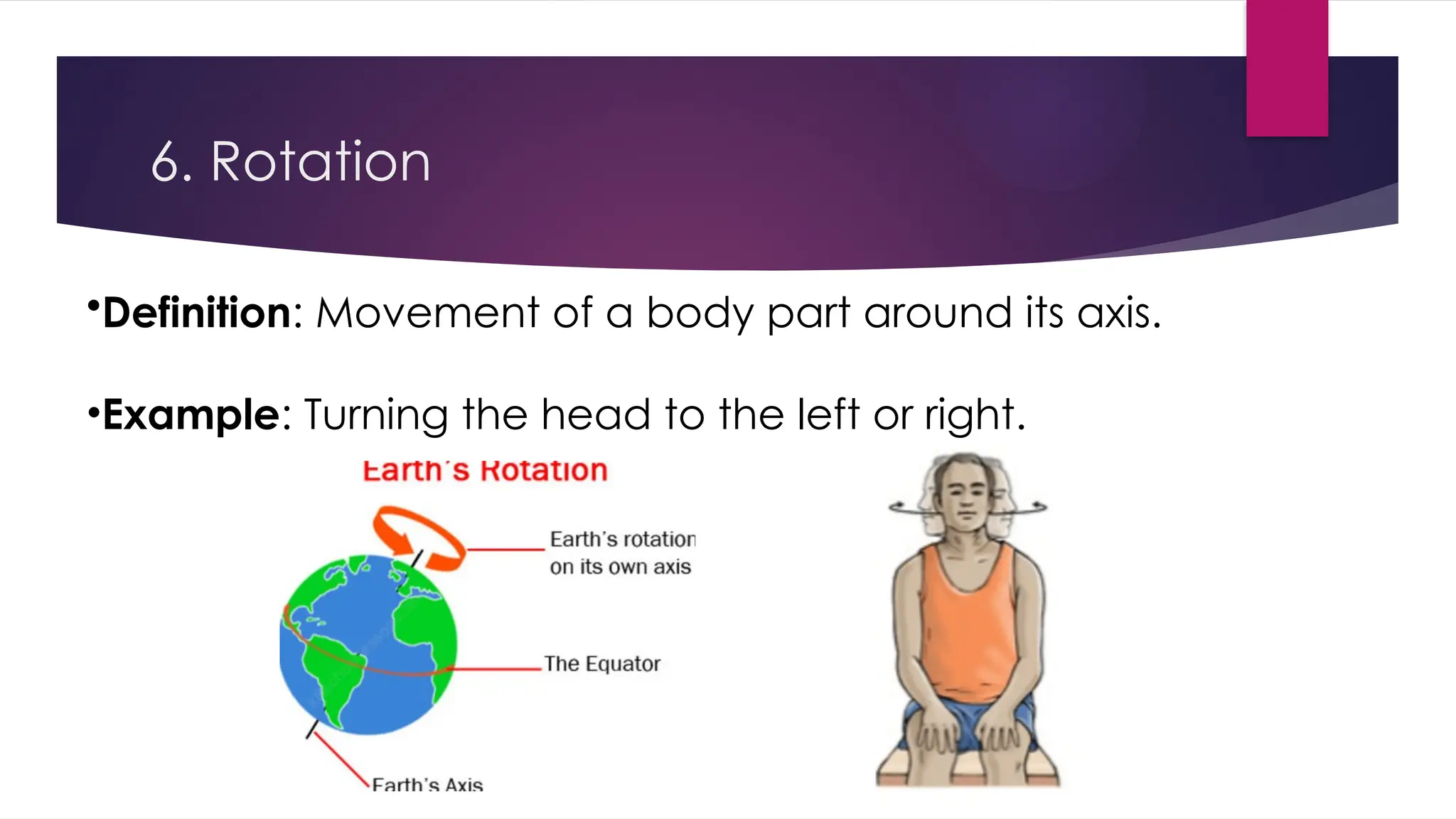
6. Rotation
•Definition: Movement of a body part around its axis.
•Example: Turning the head to the left or right.
7. Medial Rotation (Internal Rotation)
•Definition: Rotating a body part toward the midline of the
body.
•Example: Turning the arm inward so the palm faces the
body.
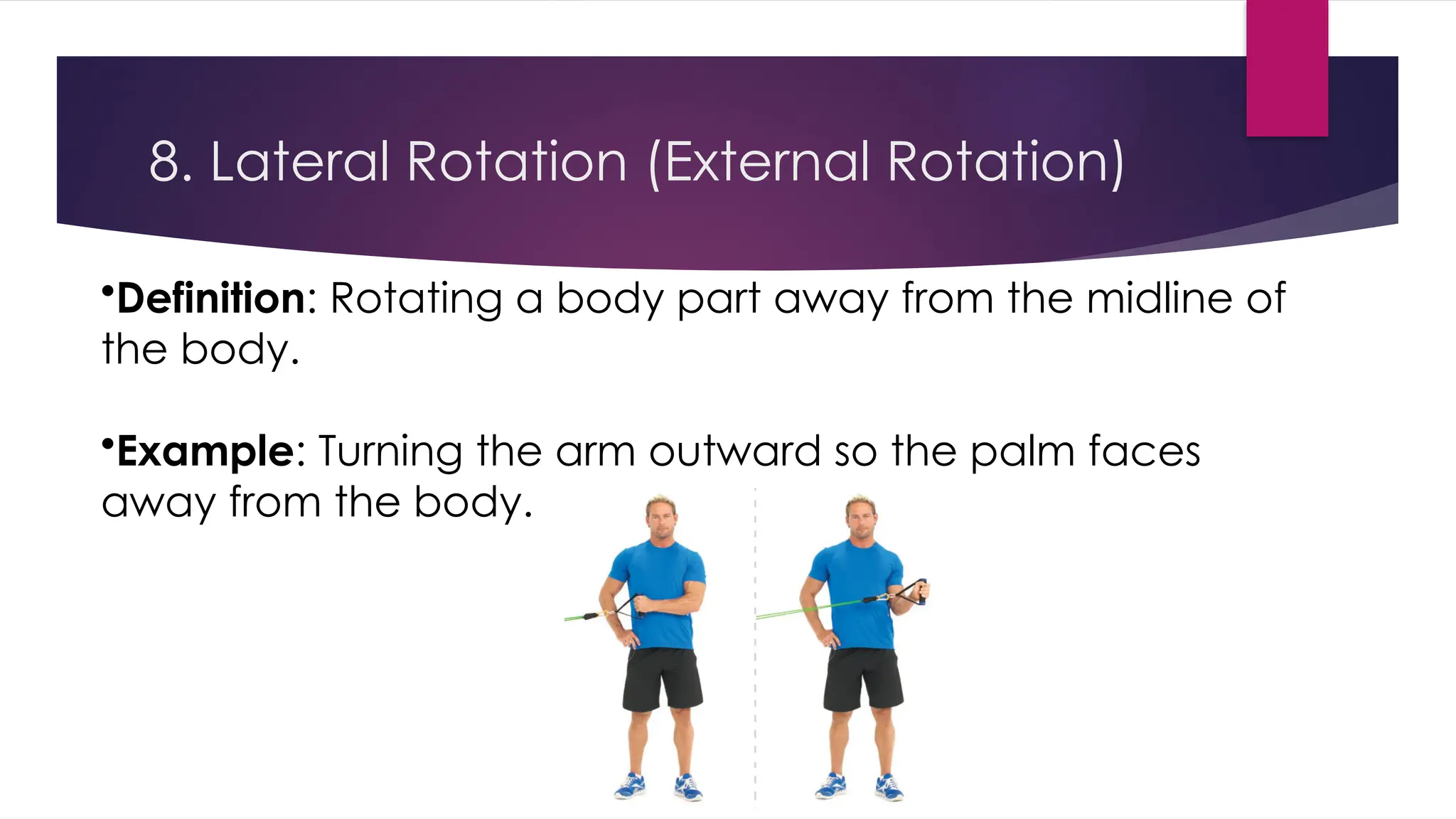
8. Lateral Rotation (External Rotation)
•Definition: Rotating a body part away from the midline of
the body.
•Example: Turning the arm outward so the palm faces
away from the body.
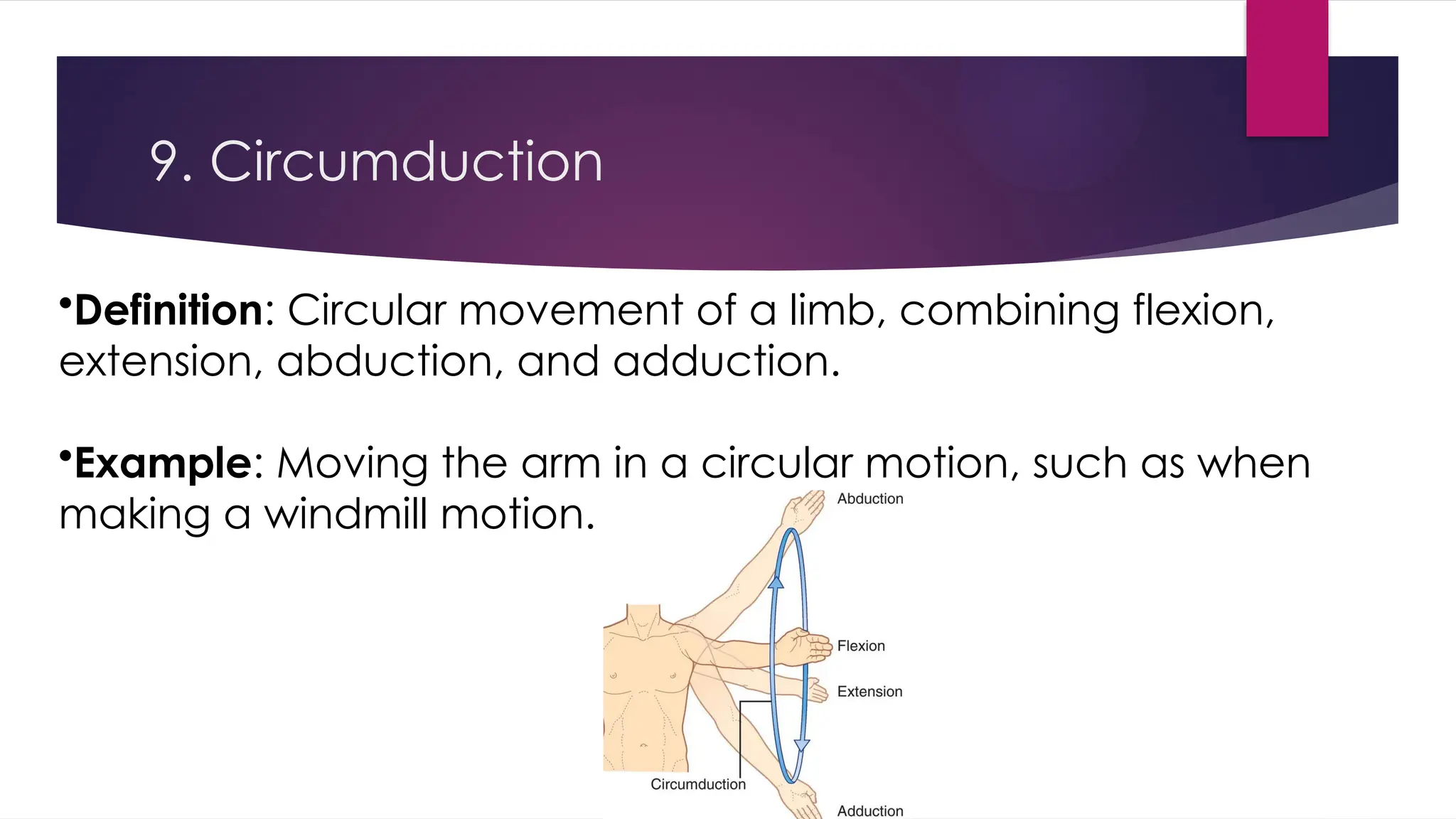
9. Circumduction
•Definition: Circular movement of a limb, combining flexion,
extension, abduction, and adduction.
•Example: Moving the arm in a circular motion, such as when
making a windmill motion.
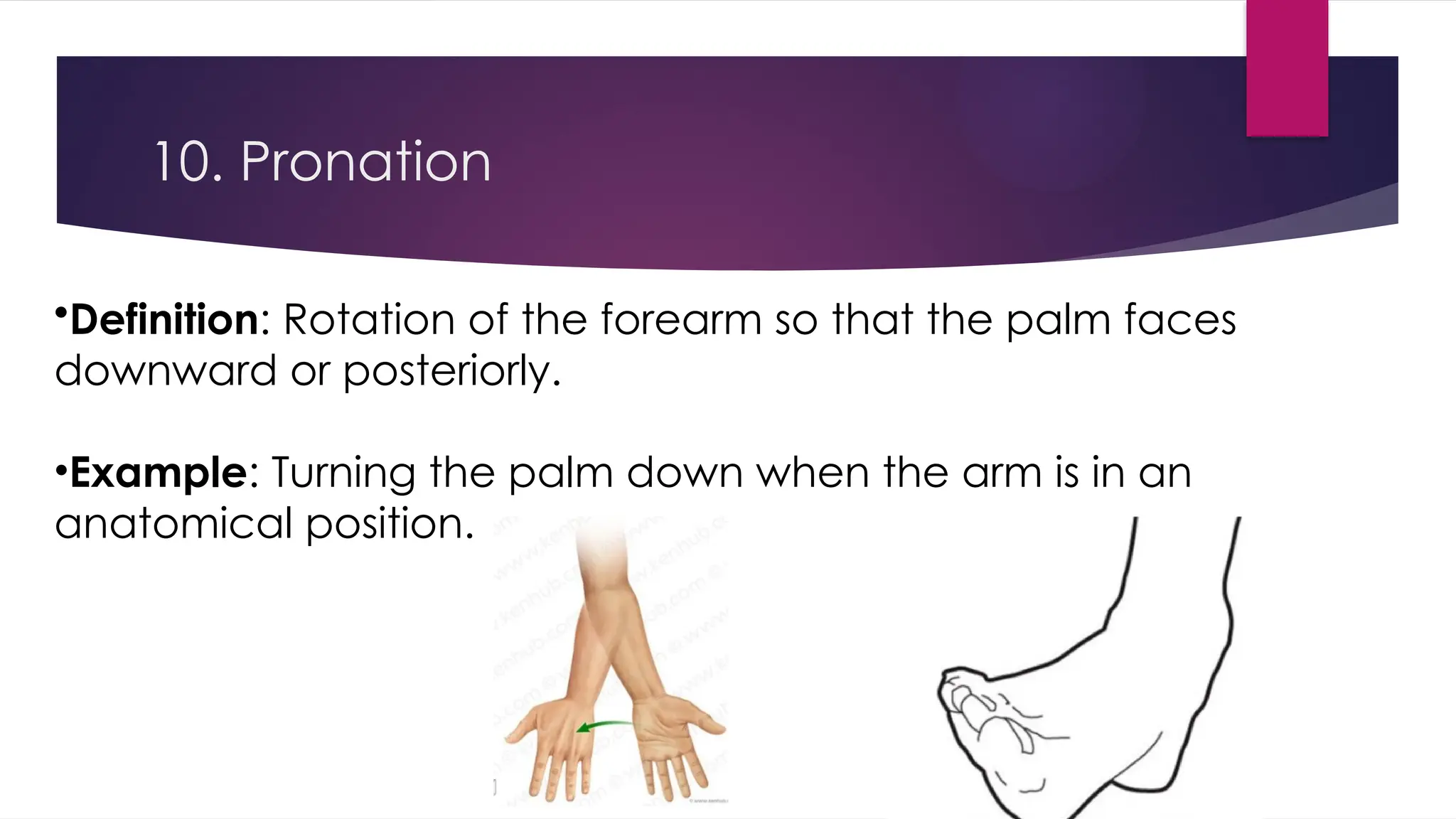
10. Pronation
•Definition: Rotation of the forearm so that the palm faces
downward or posteriorly.
•Example: Turning the palm down when the arm is in an
anatomical position.
11. Supination
•Definition: Rotation of the forearm so that the palm faces
upward or anteriorly.
•Example: Turning the palm up when the arm is in an
anatomical position.
12 & 13 . Inversion and Eversion
 Type of supination (Foot towards midline) and
pronation (Foot away to midline) in foot.
 Refer to 10 & 11.
 Example: Rolling the ankle inward and outward.
14. Dorsiflexion
•Definition: Movement of the foot upwards, decreasing the
angle between the foot and the shin.
•Example: Lifting the toes upwards towards the shin.
15. Plantarflexion
•Definition: Movement of the foot downward, increasing the angle
between the foot and the shin.
•Example: Pointing the toes downward, as in standing on tiptoe.
16. Elevation
•Definition: Moving a body part upward.
•Example: Raising the shoulders (shrugging).
17. Depression
•Definition: Moving a body part downward.
•Example: Lowering the shoulders back down after a shrug.
18. Protraction
•Definition: Moving a body part forward, away from the midline of
the body.
•Example: Moving the jaw forward (protrusion) or shoulder blade
protraction.
19. Retraction
•Definition: Moving a body part backward, toward the midline of
the body.
•Example: Pulling the jaw back or retracting the scapula
(shoulder blades).
20. Opposition
•Definition: Movement of the thumb to touch the tip of another
finger, allowing grasping and manipulation.
•Example: Bringing the thumb across the palm.
21. Reposition
• Definition: Movement that returns the thumb to its normal
position from opposition.
• Example: Moving the thumb back to its resting position
alongside the other fingers.
22. Lateral Flexion
•Definition: Bending of the trunk or neck to the side.
•Example: Bending the torso or head sideways.
Movements of Human Body (Basic Intro).pptx

Movements of Human Body (Basic Intro).pptx

  • 1.
    Movements of Human Body(Basic Intro) PREPARED BY SOMA BALAJI PT MSK & SPORTS
  • 2.
     The humanbody is capable of a wide range of movements.  It is because of its complex structure of bones, joints, muscles, and tendons.  Below in this PPT there is a comprehensive list of the major types of movements that can occur in the human body, divided by the type of joint and the direction of movement:
  • 3.
    1. Flexion •Definition: Decreasingthe angle between two body parts. •Example: Bending the elbow or knee.
  • 4.
    2. Extension •Definition: Increasingthe angle between two body parts, essentially straightening a joint. •Example: Straightening the elbow or knee.
  • 5.
    3. Hyperextension •Definition: Extendinga joint beyond its normal range of motion. •Example: Knee hyperextension, Bending the head backward.
  • 6.
    4. Abduction •Definition: Movementof a limb away from the midline of the body. •Example: Raising the arm sideways away from the body.
  • 7.
    5. Adduction •Definition: Movementof a limb toward the midline of the body. •Example: Bringing the arm back down to the side of the body.
  • 8.
    6. Rotation •Definition: Movementof a body part around its axis. •Example: Turning the head to the left or right.
  • 9.
    7. Medial Rotation(Internal Rotation) •Definition: Rotating a body part toward the midline of the body. •Example: Turning the arm inward so the palm faces the body.
  • 10.
    8. Lateral Rotation(External Rotation) •Definition: Rotating a body part away from the midline of the body. •Example: Turning the arm outward so the palm faces away from the body.
  • 11.
    9. Circumduction •Definition: Circularmovement of a limb, combining flexion, extension, abduction, and adduction. •Example: Moving the arm in a circular motion, such as when making a windmill motion.
  • 12.
    10. Pronation •Definition: Rotationof the forearm so that the palm faces downward or posteriorly. •Example: Turning the palm down when the arm is in an anatomical position.
  • 13.
    11. Supination •Definition: Rotationof the forearm so that the palm faces upward or anteriorly. •Example: Turning the palm up when the arm is in an anatomical position.
  • 14.
    12 & 13. Inversion and Eversion  Type of supination (Foot towards midline) and pronation (Foot away to midline) in foot.  Refer to 10 & 11.  Example: Rolling the ankle inward and outward.
  • 15.
    14. Dorsiflexion •Definition: Movementof the foot upwards, decreasing the angle between the foot and the shin. •Example: Lifting the toes upwards towards the shin.
  • 16.
    15. Plantarflexion •Definition: Movementof the foot downward, increasing the angle between the foot and the shin. •Example: Pointing the toes downward, as in standing on tiptoe.
  • 17.
    16. Elevation •Definition: Movinga body part upward. •Example: Raising the shoulders (shrugging).
  • 18.
    17. Depression •Definition: Movinga body part downward. •Example: Lowering the shoulders back down after a shrug.
  • 19.
    18. Protraction •Definition: Movinga body part forward, away from the midline of the body. •Example: Moving the jaw forward (protrusion) or shoulder blade protraction.
  • 20.
    19. Retraction •Definition: Movinga body part backward, toward the midline of the body. •Example: Pulling the jaw back or retracting the scapula (shoulder blades).
  • 21.
    20. Opposition •Definition: Movementof the thumb to touch the tip of another finger, allowing grasping and manipulation. •Example: Bringing the thumb across the palm.
  • 22.
    21. Reposition • Definition:Movement that returns the thumb to its normal position from opposition. • Example: Moving the thumb back to its resting position alongside the other fingers.
  • 23.
    22. Lateral Flexion •Definition:Bending of the trunk or neck to the side. •Example: Bending the torso or head sideways.