Introduction
Ultrasonic welding is an industrial technique whereby high-
frequency ultrasonic acoustic vibrations are locally applied to workpieces being held
together under pressure to create a solid-state weld. It is commonly used for plastics,
and especially for joining dissimilarmaterials. In ultrasonic welding, there are no
connective bolts, nails, soldering materials, or adhesives necessary to bind the
materials together .
Principle
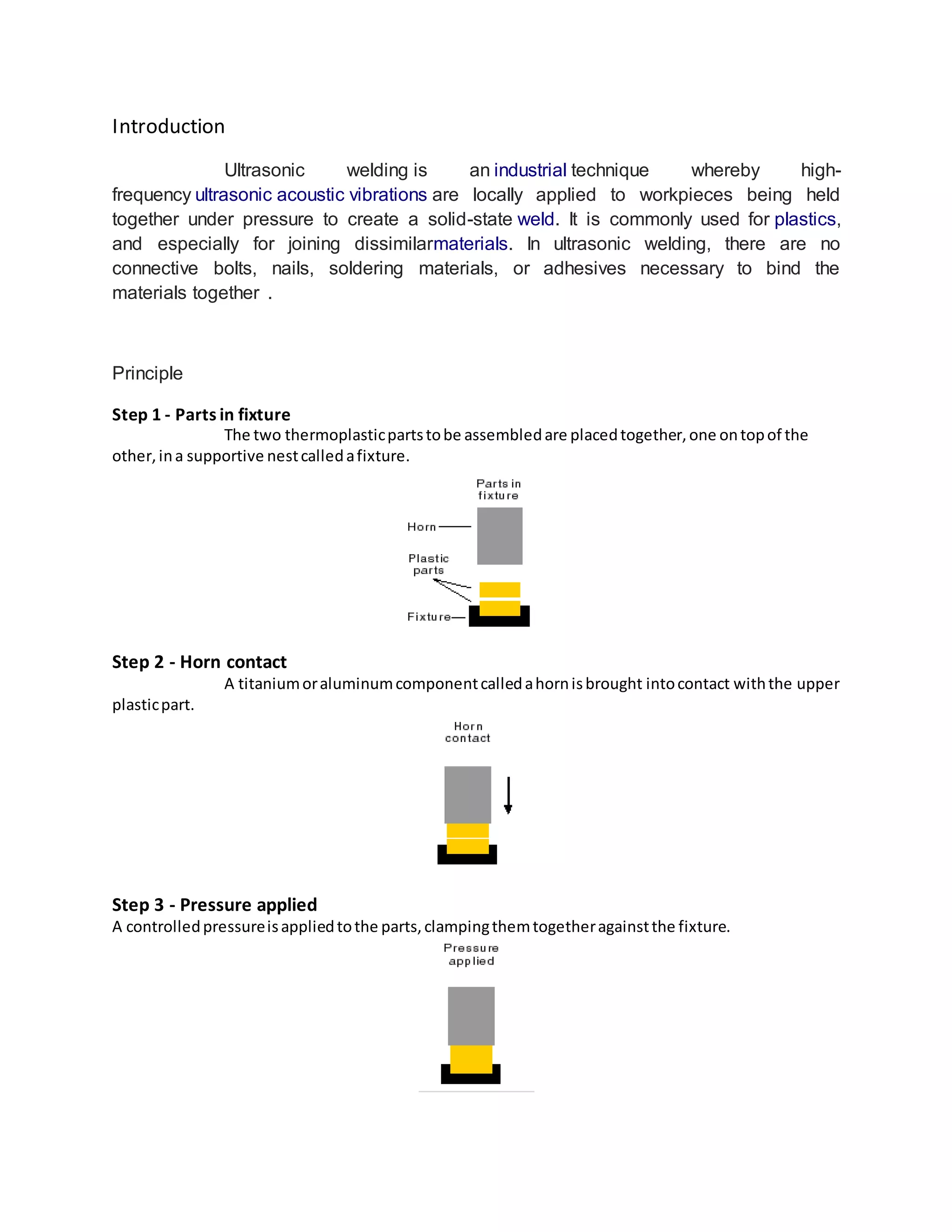
Step 1 - Parts in fixture
The two thermoplasticpartstobe assembledare placedtogether,one ontopof the
other,ina supportive nestcalledafixture.
Step 2 - Horn contact
A titaniumoraluminumcomponentcalledahornisbrought intocontact withthe upper
plasticpart.
Step 3 - Pressure applied
A controlledpressureisappliedtothe parts,clampingthemtogetheragainstthe fixture.
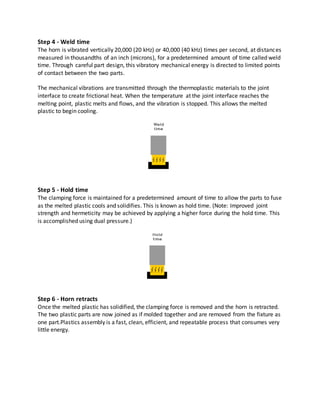
Step 4 - Weld time
The horn is vibrated vertically 20,000 (20 kHz) or 40,000 (40 kHz) times per second, at distances
measured in thousandths of an inch (microns), for a predetermined amount of time called weld
time. Through careful part design, this vibratory mechanical energy is directed to limited points
of contact between the two parts.
The mechanical vibrations are transmitted through the thermoplastic materials to the joint
interface to create frictional heat. When the temperature at the joint interface reaches the
melting point, plastic melts and flows, and the vibration is stopped. This allows the melted
plastic to begin cooling.
Step 5 - Hold time
The clamping force is maintained for a predetermined amount of time to allow the parts to fuse
as the melted plastic cools and solidifies. This is known as hold time. (Note: Improved joint
strength and hermeticity may be achieved by applying a higher force during the hold time. This
is accomplished using dual pressure.)
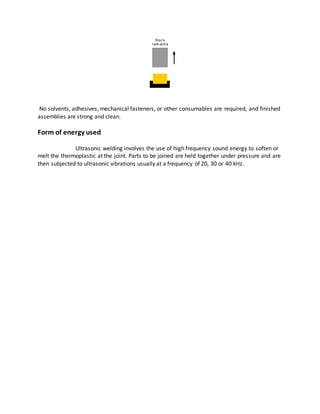
Step 6 - Horn retracts
Once the melted plastic has solidified, the clamping force is removed and the horn is retracted.
The two plastic parts are now joined as if molded together and are removed from the fixture as
one part.Plastics assembly is a fast, clean, efficient, and repeatable process that consumes very
little energy.
No solvents, adhesives, mechanical fasteners, or other consumables are required, and finished
assemblies are strong and clean.
Form of energy used
Ultrasonic welding involves the use of high frequency sound energy to soften or
melt the thermoplastic at the joint. Parts to be joined are held together under pressure and are
then subjected to ultrasonic vibrations usually at a frequency of 20, 30 or 40 kHz.

ULTRASONIC WELDING

  • 1.
    Introduction Ultrasonic welding isan industrial technique whereby high- frequency ultrasonic acoustic vibrations are locally applied to workpieces being held together under pressure to create a solid-state weld. It is commonly used for plastics, and especially for joining dissimilarmaterials. In ultrasonic welding, there are no connective bolts, nails, soldering materials, or adhesives necessary to bind the materials together . Principle Step 1 - Parts in fixture The two thermoplasticpartstobe assembledare placedtogether,one ontopof the other,ina supportive nestcalledafixture. Step 2 - Horn contact A titaniumoraluminumcomponentcalledahornisbrought intocontact withthe upper plasticpart. Step 3 - Pressure applied A controlledpressureisappliedtothe parts,clampingthemtogetheragainstthe fixture.
  • 2.
    Step 4 -Weld time The horn is vibrated vertically 20,000 (20 kHz) or 40,000 (40 kHz) times per second, at distances measured in thousandths of an inch (microns), for a predetermined amount of time called weld time. Through careful part design, this vibratory mechanical energy is directed to limited points of contact between the two parts. The mechanical vibrations are transmitted through the thermoplastic materials to the joint interface to create frictional heat. When the temperature at the joint interface reaches the melting point, plastic melts and flows, and the vibration is stopped. This allows the melted plastic to begin cooling. Step 5 - Hold time The clamping force is maintained for a predetermined amount of time to allow the parts to fuse as the melted plastic cools and solidifies. This is known as hold time. (Note: Improved joint strength and hermeticity may be achieved by applying a higher force during the hold time. This is accomplished using dual pressure.) Step 6 - Horn retracts Once the melted plastic has solidified, the clamping force is removed and the horn is retracted. The two plastic parts are now joined as if molded together and are removed from the fixture as one part.Plastics assembly is a fast, clean, efficient, and repeatable process that consumes very little energy.
  • 3.
    No solvents, adhesives,mechanical fasteners, or other consumables are required, and finished assemblies are strong and clean. Form of energy used Ultrasonic welding involves the use of high frequency sound energy to soften or melt the thermoplastic at the joint. Parts to be joined are held together under pressure and are then subjected to ultrasonic vibrations usually at a frequency of 20, 30 or 40 kHz.