

Realising the value of RiLIES: the Research in
      Librarianship Impact Evaluation Study

Professor Hazel Hall, Peter Cruickshank & Ella Taylor-Smith
          Edinburgh Napier University, Scotland
RiLIES1 project team


• Centre for Social Informatics, Institute for
  Informatics and Digital Innovation, Edinburgh
  Napier University
  – Professor Hazel Hall
  – Peter Cruickshank
  – Ella Taylor-Smith
  – Jenny Gebel
Impact in the context of RiLIES


• To what extent do funded research projects in
  library and information science influence
  practice in the UK?
• Which factors help/hinder the impact of
  research findings on those who deliver library
  and information services?
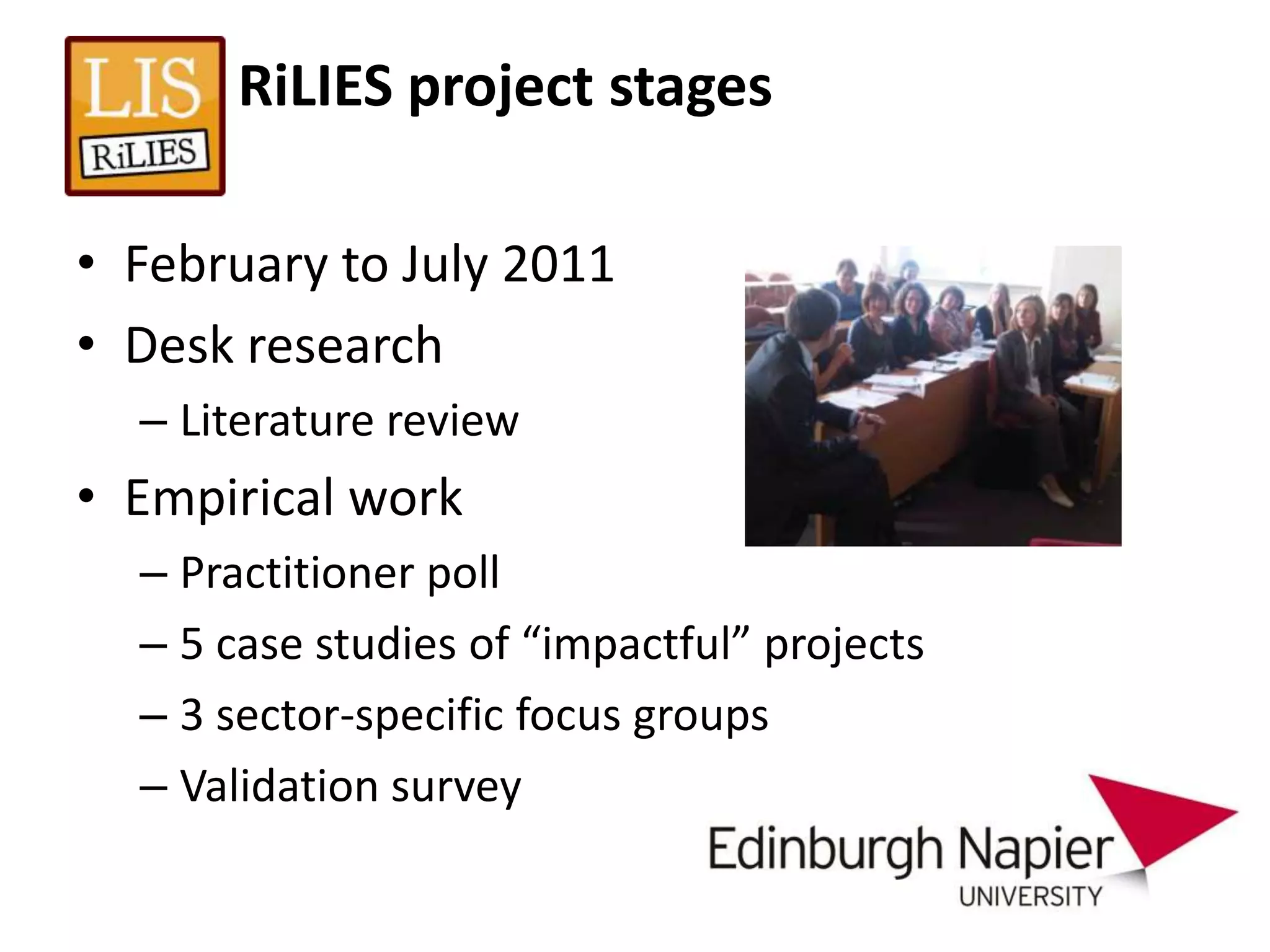
RiLIES project stages

• February to July 2011
• Desk research
  – Literature review
• Empirical work
  – Practitioner poll
  – 5 case studies of “impactful” projects
  – 3 sector-specific focus groups
  – Validation survey
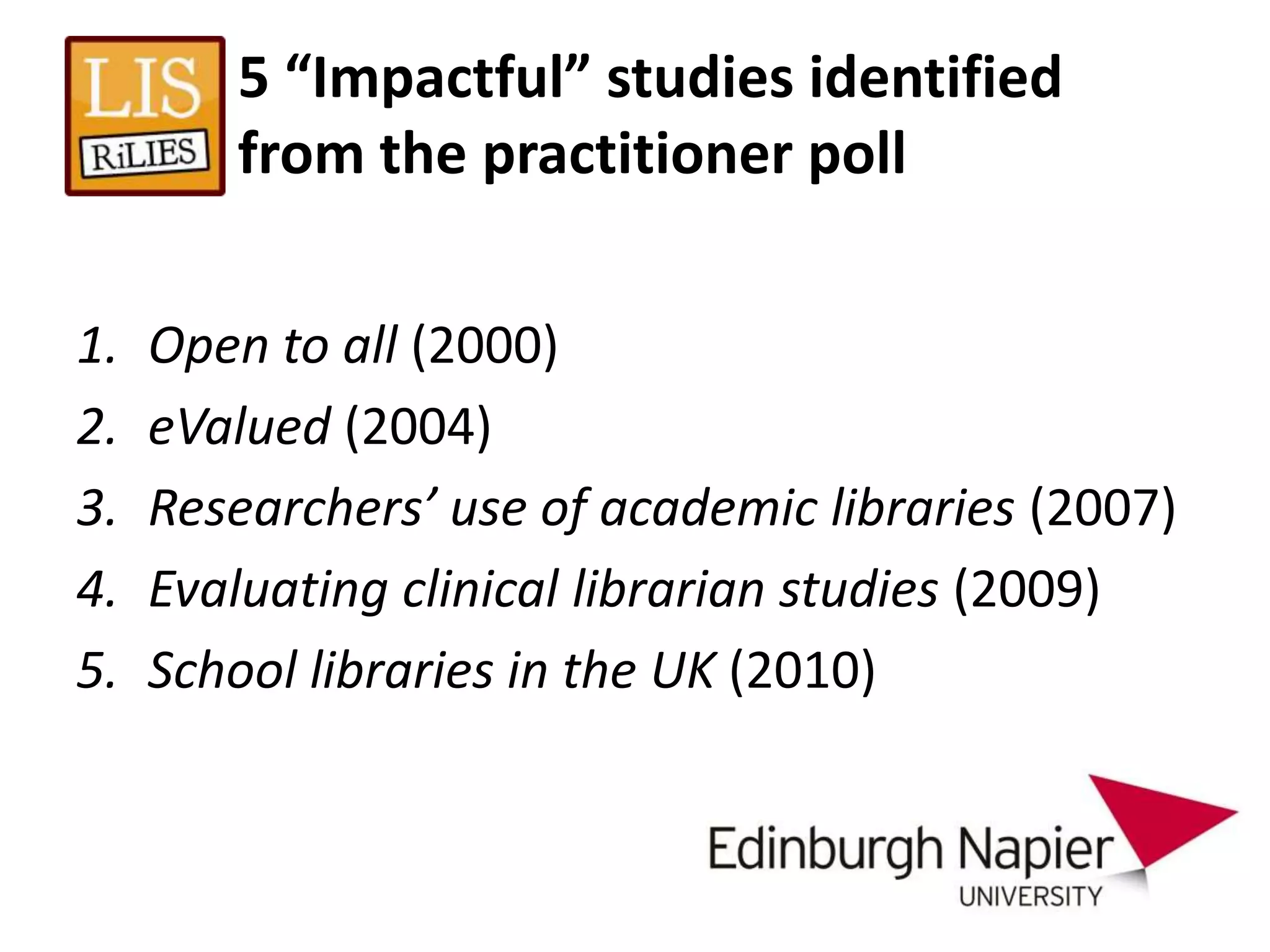
5 “Impactful” studies identified
        from the practitioner poll

1.   Open to all (2000)
2.   eValued (2004)
3.   Researchers’ use of academic libraries (2007)
4.   Evaluating clinical librarian studies (2009)
5.   School libraries in the UK (2010)
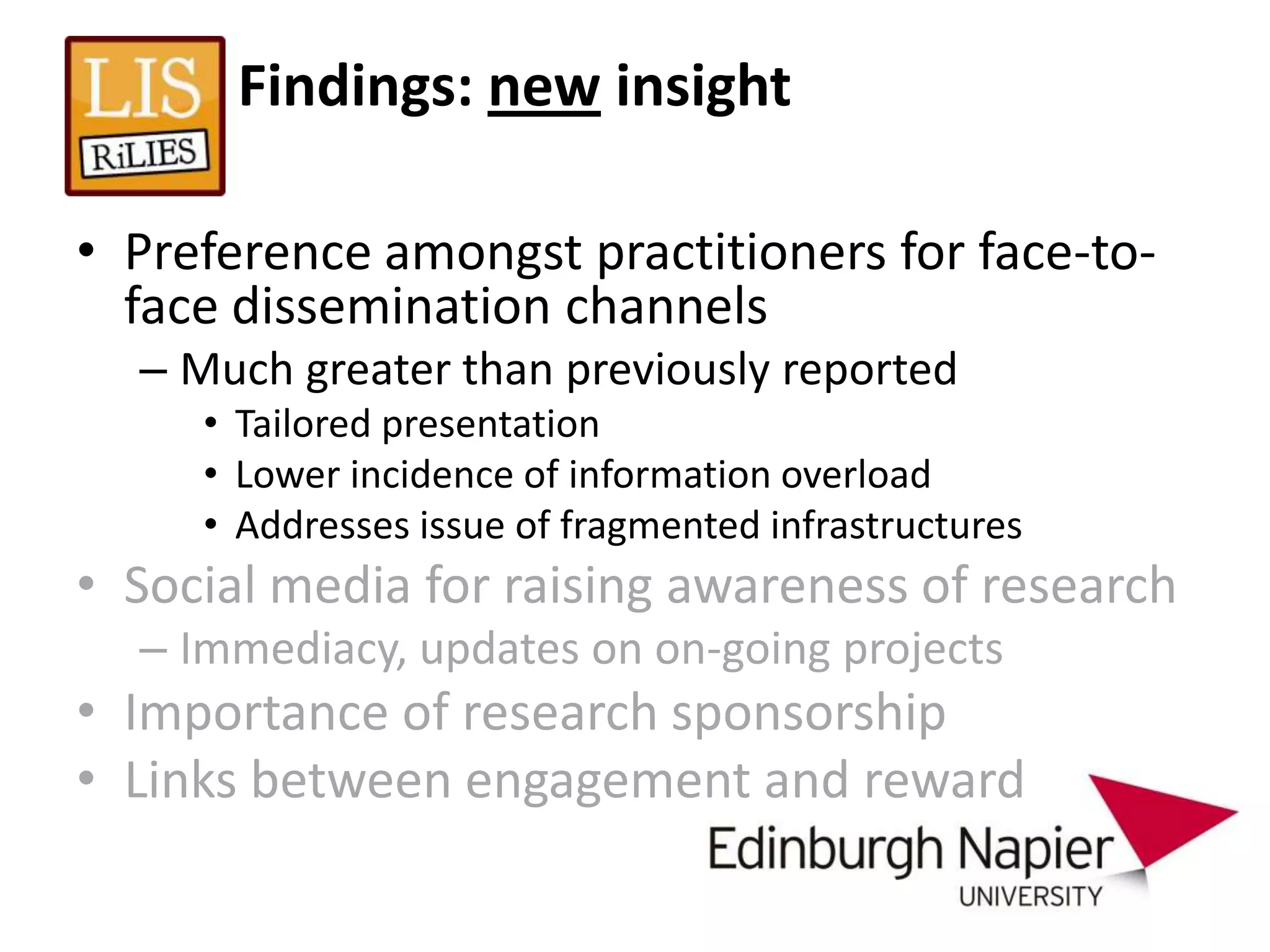
Findings: new insight

• Preference amongst practitioners for face-to-
  face dissemination channels
  – Much greater than previously reported
     • Tailored presentation
     • Lower incidence of information overload
     • Addresses issue of fragmented infrastructures
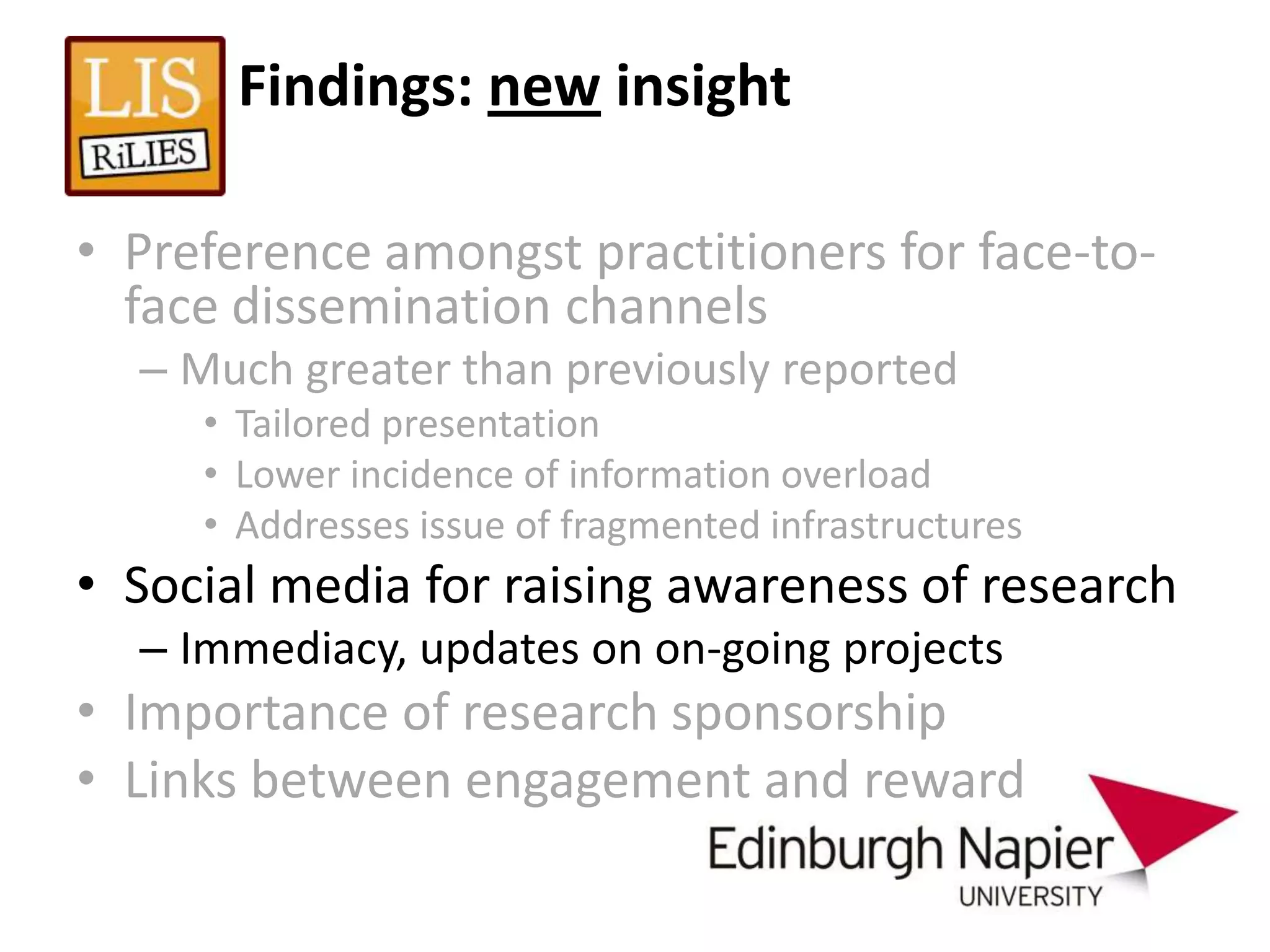
• Social media for raising awareness of research
  – Immediacy, updates on on-going projects
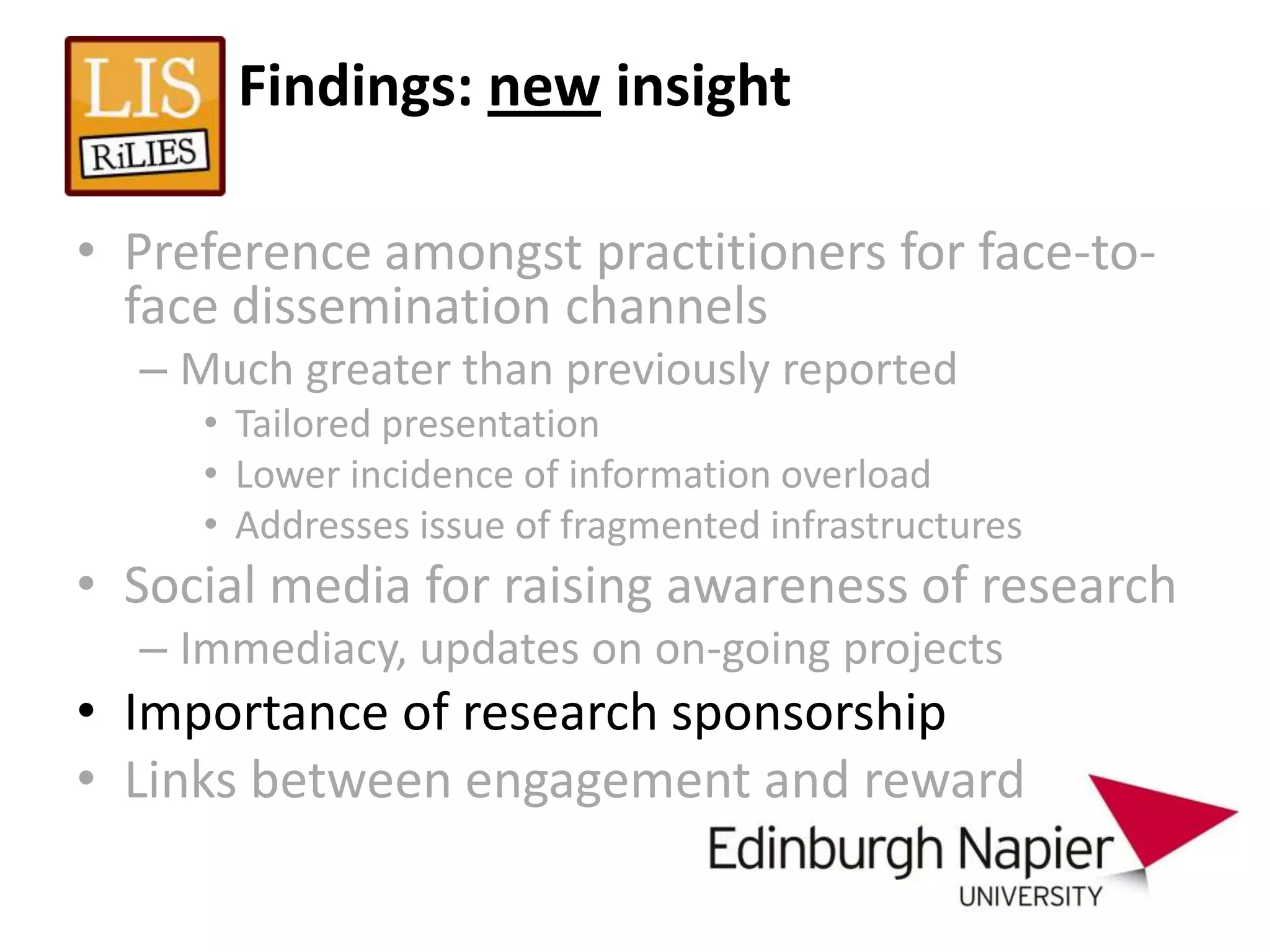
• Importance of research sponsorship
• Links between engagement and reward
Findings: new insight

• Preference amongst practitioners for face-to-
  face dissemination channels
  – Much greater than previously reported
     • Tailored presentation
     • Lower incidence of information overload
     • Addresses issue of fragmented infrastructures
• Social media for raising awareness of research
  – Immediacy, updates on on-going projects
• Importance of research sponsorship
• Links between engagement and reward
Findings: new insight

• Preference amongst practitioners for face-to-
  face dissemination channels
  – Much greater than previously reported
     • Tailored presentation
     • Lower incidence of information overload
     • Addresses issue of fragmented infrastructures
• Social media for raising awareness of research
  – Immediacy, updates on on-going projects
• Importance of research sponsorship
• Links between engagement and reward
Findings: new insight

• Preference amongst practitioners for face-to-
  face dissemination channels
  – Much greater than previously reported
     • Tailored presentation
     • Lower incidence of information overload
     • Addresses issue of fragmented infrastructures
• Social media for raising awareness of research
  – Immediacy, updates on on-going projects
• Importance of research sponsorship
• Links between engagement and reward
Project conception and plans for
       impact
• Practitioners need to be involved in research
  design
• Funders need to support research relevant to
  the needs of the practitioner community
  – Allied to this, explicit goal of research should be to
    influence practice
• Research undertaken needs to have high level
  support
  – Steering committees, influential stakeholders
Project conception and plans for
       impact
• Practitioners need to be involved in research
  design
• Funders need to support research relevant to
  the needs of the practitioner community
  – Allied to this, explicit goal of research should be to
    influence practice
• Research undertaken needs to have high level
  support
  – Steering committees, influential stakeholders
Project conception and plans for
       impact
• Practitioners need to be involved in research
  design
• Funders need to support research relevant to
  the needs of the practitioner community
  – Allied to this, explicit goal of research should be to
    influence practice
• Research undertaken needs to have high level
  support
  – Steering committees, influential stakeholders
Project execution for impact


• Practitioners need to participate in the
  research from the outset, with appropriate
  – Methods
  – Approaches
  – Dissemination strategies
Project reporting for impact


• LIS research output needs to be accessible to
  the target audience
  – Where?
     • Best in teaching and community support materials
• Researchers need to take into account
  practitioner preferences for consuming
  research output
  – What and how?
     • Explicit recommendations in accessible language,
       delivered face-to-face
Project reporting for impact


• LIS research output needs to be accessible to
  the target audience
  – Where?
     • Best in teaching and community support materials
• Researchers need to take into account
  practitioner preferences for consuming
  research output
  – What and how?
     • Explicit recommendations in accessible language,
       delivered face-to-face
Receptive audiences for impact


• Librarians and information scientists from less
  research-active sectors can learn from those
  where there is greater engagement
  – e.g. healthcare librarians
• There is a need for training to support interest
  in research, and raise awareness of resources
• A CPD requirement related to research would
  encourage greater participation
Receptive audiences for impact


• Librarians and information scientists from less
  research-active sectors can learn from those
  where there is greater engagement
  – e.g. healthcare librarians
• There is a need for training to support interest
  in research, and raise awareness of resources
• A CPD requirement related to research would
  encourage greater participation
Receptive audiences for impact


• Librarians and information scientists from less
  research-active sectors can learn from those
  where there is greater engagement
  – e.g. healthcare librarians
• There is a need for training to support interest
  in research, and raise awareness of resources
• A CPD requirement related to research would
  encourage greater participation
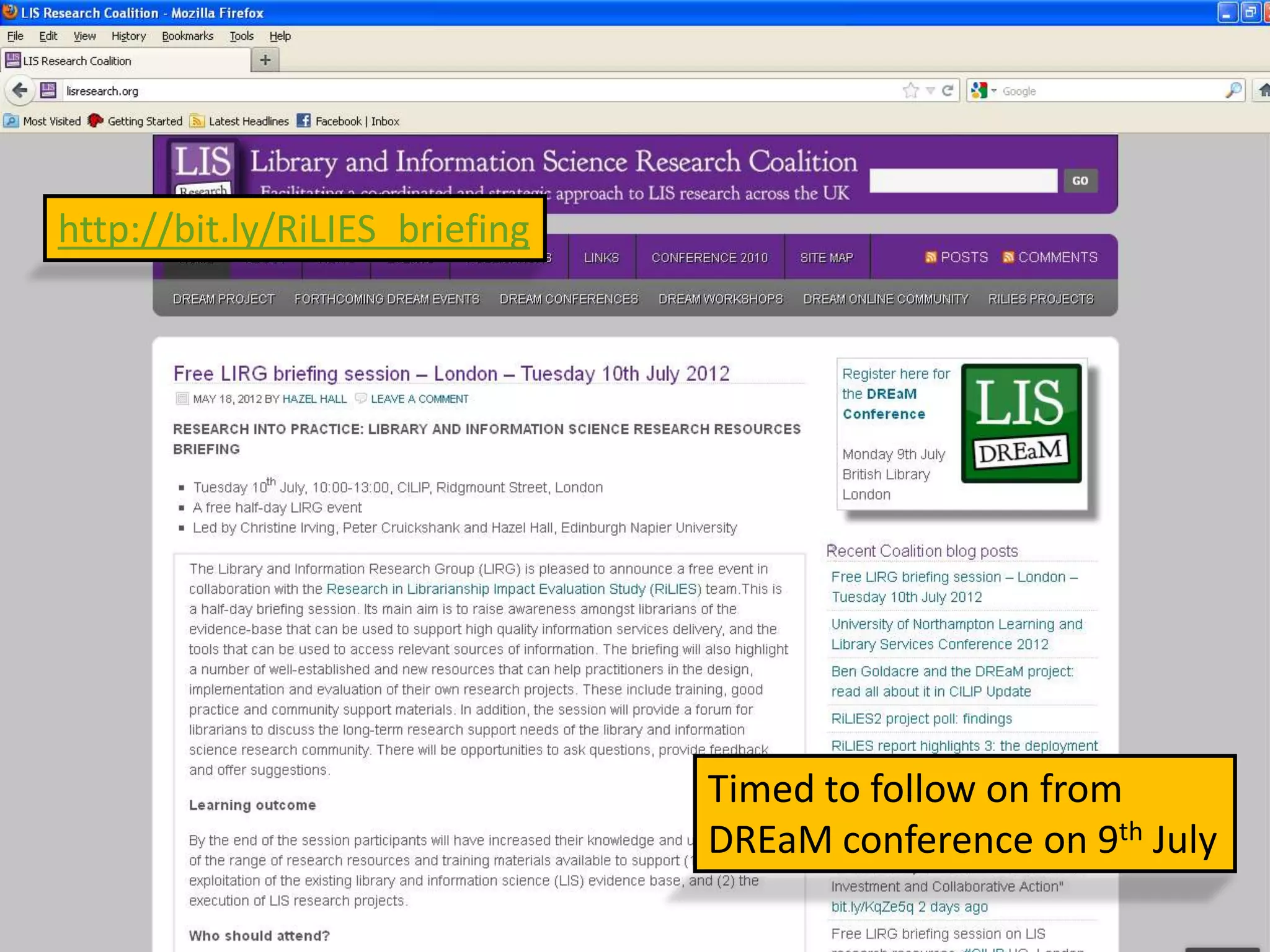
http://bit.ly/RiLIES_briefing


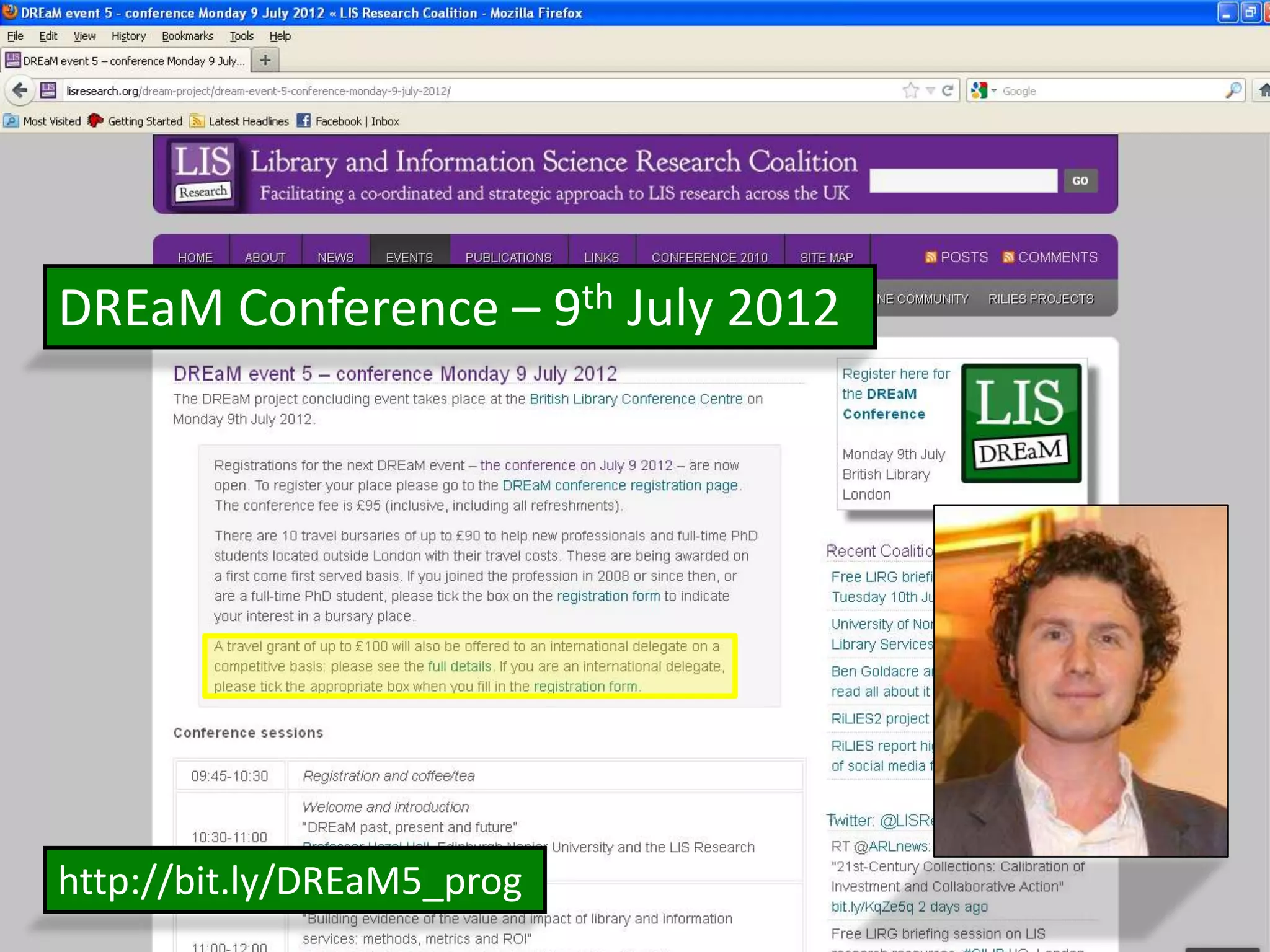
                                Timed to follow on from
                                DREaM conference on 9th July
DREaM Conference – 9th July 2012


http://bit.ly/DREaM5_prog
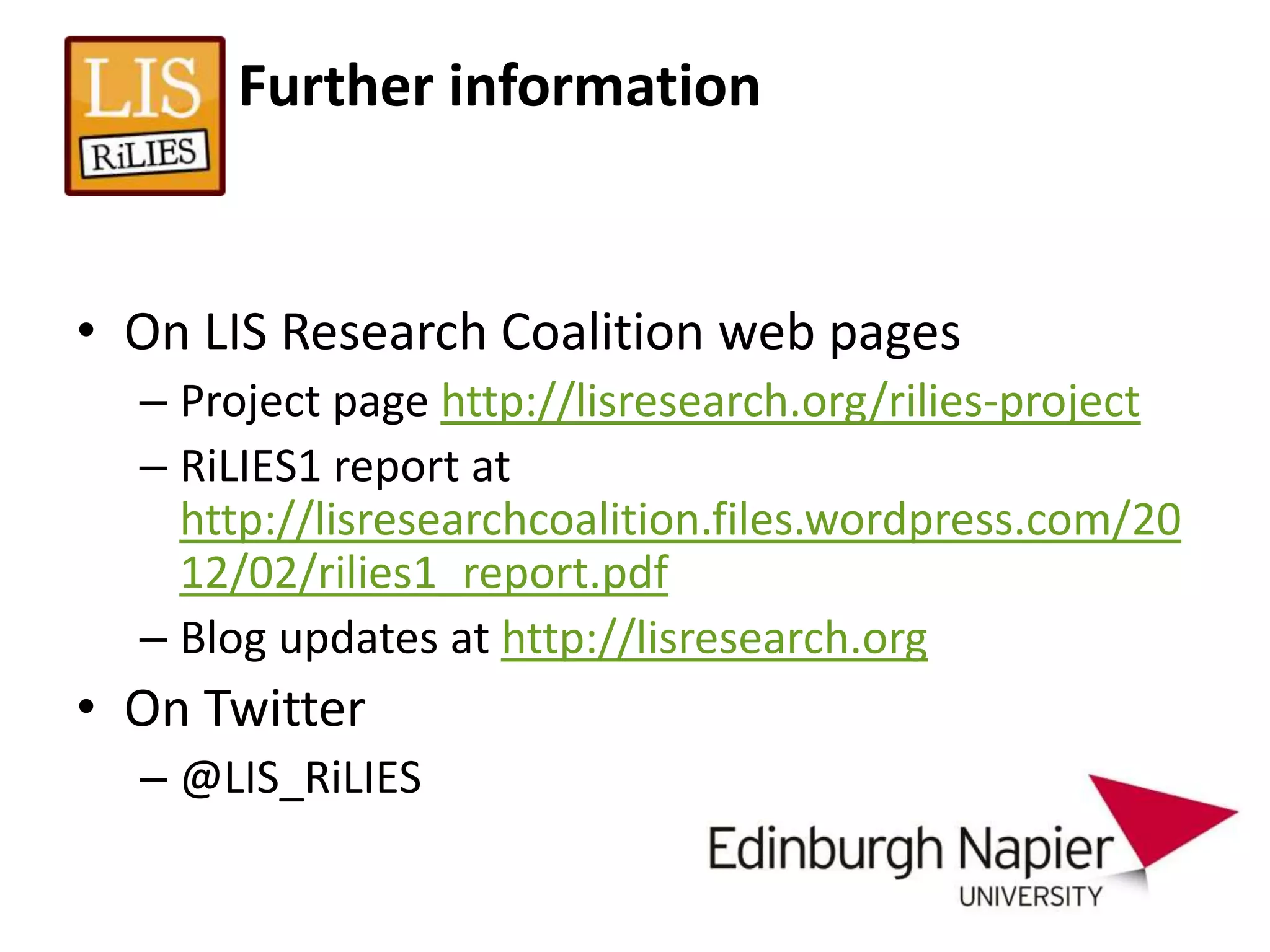
Further information


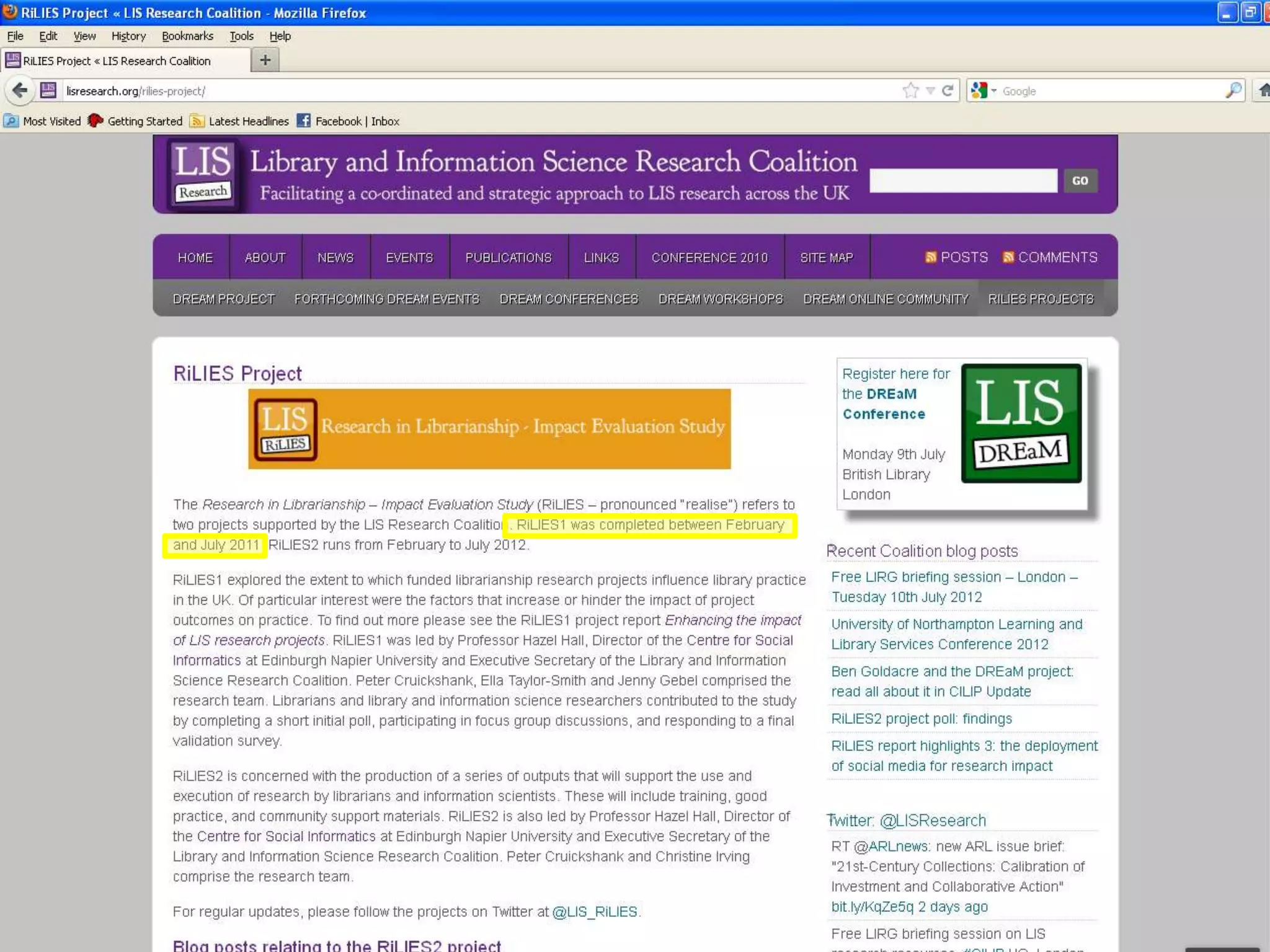
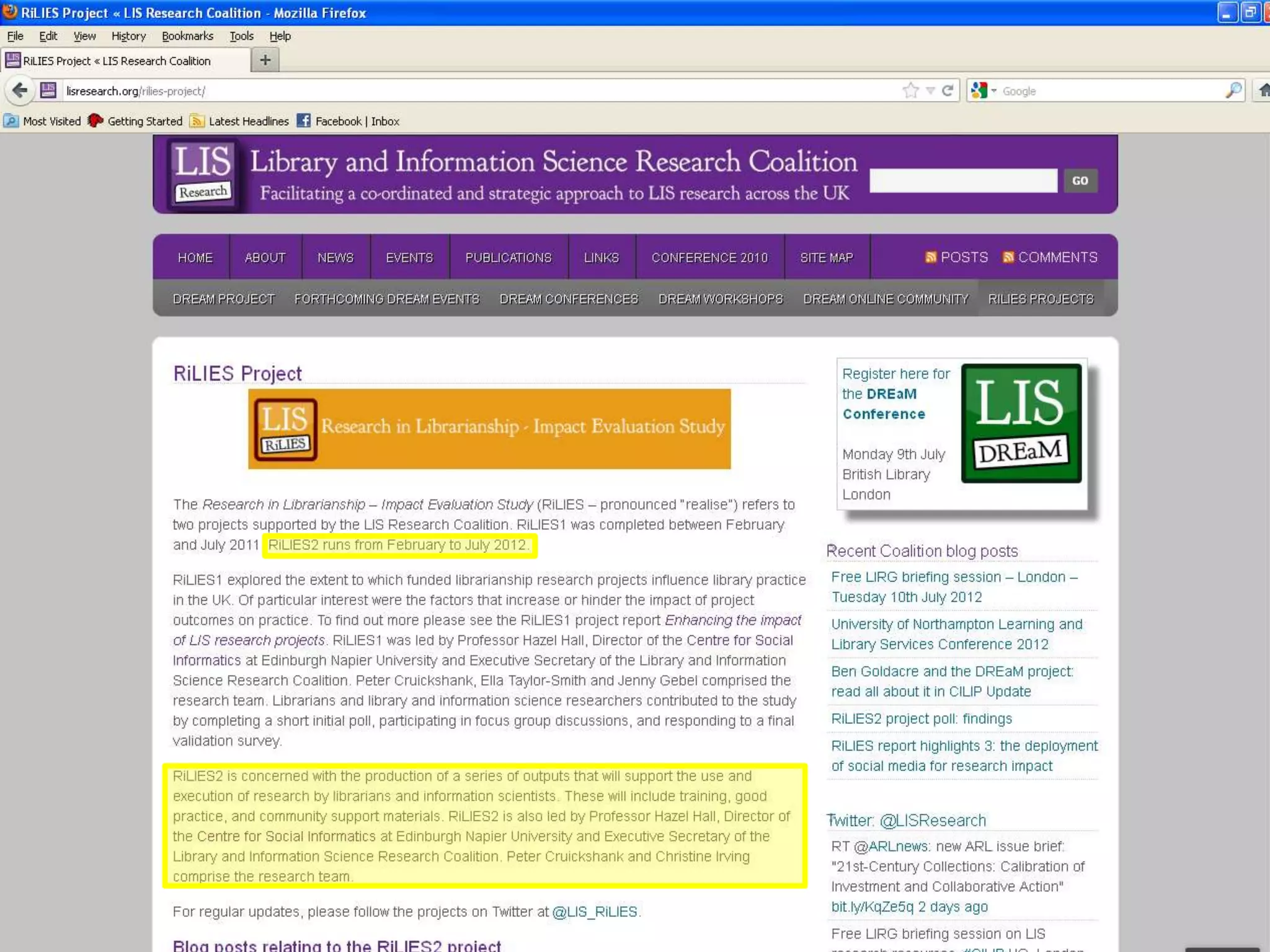
• On LIS Research Coalition web pages
  – Project page http://lisresearch.org/rilies-project
  – RiLIES1 report at
    http://lisresearchcoalition.files.wordpress.com/20
    12/02/rilies1_report.pdf
  – Blog updates at http://lisresearch.org
• On Twitter
  – @LIS_RiLIES
Realising the value of RiLIES: the Research in
      Librarianship Impact Evaluation Study

Professor Hazel Hall, Peter Cruickshank & Ella Taylor-Smith
          Edinburgh Napier University, Scotland

Presentation on the RiLIES projects at QQML2012

  • 1.
    Realising the valueof RiLIES: the Research in Librarianship Impact Evaluation Study Professor Hazel Hall, Peter Cruickshank & Ella Taylor-Smith Edinburgh Napier University, Scotland
  • 3.
    RiLIES1 project team •Centre for Social Informatics, Institute for Informatics and Digital Innovation, Edinburgh Napier University – Professor Hazel Hall – Peter Cruickshank – Ella Taylor-Smith – Jenny Gebel
  • 4.
    Impact in thecontext of RiLIES • To what extent do funded research projects in library and information science influence practice in the UK? • Which factors help/hinder the impact of research findings on those who deliver library and information services?
  • 5.
    RiLIES project stages •February to July 2011 • Desk research – Literature review • Empirical work – Practitioner poll – 5 case studies of “impactful” projects – 3 sector-specific focus groups – Validation survey
  • 6.
    5 “Impactful” studiesidentified from the practitioner poll 1. Open to all (2000) 2. eValued (2004) 3. Researchers’ use of academic libraries (2007) 4. Evaluating clinical librarian studies (2009) 5. School libraries in the UK (2010)
  • 7.
    Findings: new insight •Preference amongst practitioners for face-to- face dissemination channels – Much greater than previously reported • Tailored presentation • Lower incidence of information overload • Addresses issue of fragmented infrastructures • Social media for raising awareness of research – Immediacy, updates on on-going projects • Importance of research sponsorship • Links between engagement and reward
  • 8.
    Findings: new insight •Preference amongst practitioners for face-to- face dissemination channels – Much greater than previously reported • Tailored presentation • Lower incidence of information overload • Addresses issue of fragmented infrastructures • Social media for raising awareness of research – Immediacy, updates on on-going projects • Importance of research sponsorship • Links between engagement and reward
  • 9.
    Findings: new insight •Preference amongst practitioners for face-to- face dissemination channels – Much greater than previously reported • Tailored presentation • Lower incidence of information overload • Addresses issue of fragmented infrastructures • Social media for raising awareness of research – Immediacy, updates on on-going projects • Importance of research sponsorship • Links between engagement and reward
  • 10.
    Findings: new insight •Preference amongst practitioners for face-to- face dissemination channels – Much greater than previously reported • Tailored presentation • Lower incidence of information overload • Addresses issue of fragmented infrastructures • Social media for raising awareness of research – Immediacy, updates on on-going projects • Importance of research sponsorship • Links between engagement and reward
  • 11.
    Project conception andplans for impact • Practitioners need to be involved in research design • Funders need to support research relevant to the needs of the practitioner community – Allied to this, explicit goal of research should be to influence practice • Research undertaken needs to have high level support – Steering committees, influential stakeholders
  • 12.
    Project conception andplans for impact • Practitioners need to be involved in research design • Funders need to support research relevant to the needs of the practitioner community – Allied to this, explicit goal of research should be to influence practice • Research undertaken needs to have high level support – Steering committees, influential stakeholders
  • 13.
    Project conception andplans for impact • Practitioners need to be involved in research design • Funders need to support research relevant to the needs of the practitioner community – Allied to this, explicit goal of research should be to influence practice • Research undertaken needs to have high level support – Steering committees, influential stakeholders
  • 14.
    Project execution forimpact • Practitioners need to participate in the research from the outset, with appropriate – Methods – Approaches – Dissemination strategies
  • 15.
    Project reporting forimpact • LIS research output needs to be accessible to the target audience – Where? • Best in teaching and community support materials • Researchers need to take into account practitioner preferences for consuming research output – What and how? • Explicit recommendations in accessible language, delivered face-to-face
  • 16.
    Project reporting forimpact • LIS research output needs to be accessible to the target audience – Where? • Best in teaching and community support materials • Researchers need to take into account practitioner preferences for consuming research output – What and how? • Explicit recommendations in accessible language, delivered face-to-face
  • 17.
    Receptive audiences forimpact • Librarians and information scientists from less research-active sectors can learn from those where there is greater engagement – e.g. healthcare librarians • There is a need for training to support interest in research, and raise awareness of resources • A CPD requirement related to research would encourage greater participation
  • 18.
    Receptive audiences forimpact • Librarians and information scientists from less research-active sectors can learn from those where there is greater engagement – e.g. healthcare librarians • There is a need for training to support interest in research, and raise awareness of resources • A CPD requirement related to research would encourage greater participation
  • 19.
    Receptive audiences forimpact • Librarians and information scientists from less research-active sectors can learn from those where there is greater engagement – e.g. healthcare librarians • There is a need for training to support interest in research, and raise awareness of resources • A CPD requirement related to research would encourage greater participation
  • 21.
    http://bit.ly/RiLIES_briefing Timed to follow on from DREaM conference on 9th July
  • 22.
    DREaM Conference –9th July 2012 http://bit.ly/DREaM5_prog
  • 23.
    Further information • OnLIS Research Coalition web pages – Project page http://lisresearch.org/rilies-project – RiLIES1 report at http://lisresearchcoalition.files.wordpress.com/20 12/02/rilies1_report.pdf – Blog updates at http://lisresearch.org • On Twitter – @LIS_RiLIES
  • 24.
    Realising the valueof RiLIES: the Research in Librarianship Impact Evaluation Study Professor Hazel Hall, Peter Cruickshank & Ella Taylor-Smith Edinburgh Napier University, Scotland