





Seizing the opportunity of research-led practice Dr Hazel Hall Library and Information Science Research Coalition
About Hazel Hall and the Library and Information Science Research Coalition…
Hazel Hall in her seconded role
 
 
bring together information about LIS research opportunities and results  encourage dialogue between research funders promote LIS practitioner research and the translation of research outcomes into practice  articulate a strategic approach to LIS research promote the development of research capacity in LIS The LIS Research Coalition aims to:
bring together information about LIS research opportunities and results  encourage dialogue between research funders promote LIS practitioner research and the translation of research outcomes into practice  articulate a strategic approach to LIS research promote the development of research capacity in LIS The LIS Research Coalition aims to: Support research-led practice of librarians and information scientists
About research-led practice: making use of published research in services delivery…
To exploit the existing knowledge base for services improvement To improve decision making for services delivery To enhance the value of prior work To capitalise on significant investment in previous studies To raise the value of previous studies through reuse To demonstrate the value and impact of service delivery Why research-led practice?
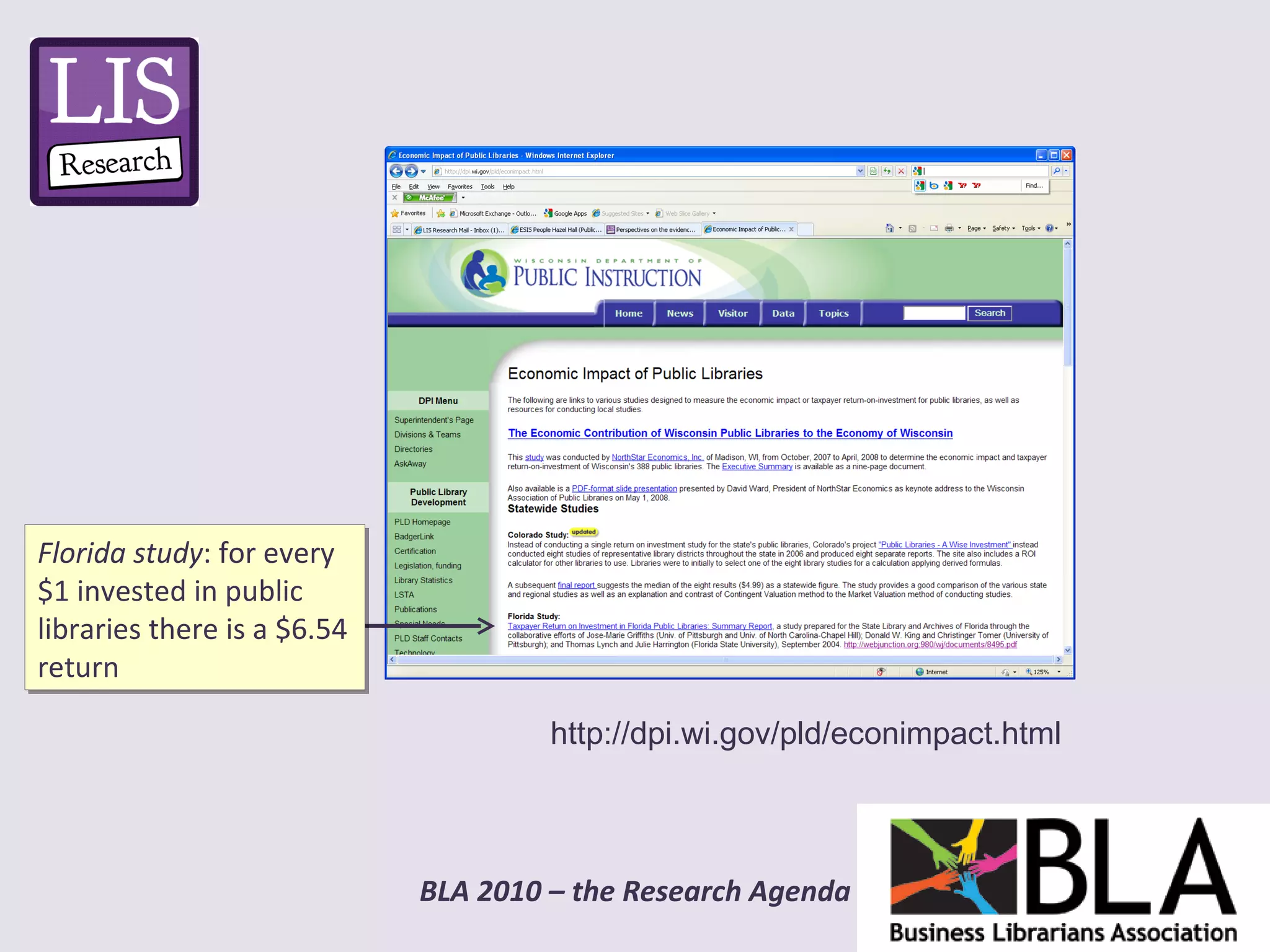
http://dpi.wi.gov/pld/econimpact.html Florida study : for every $1 invested in public libraries there is a $6.54 return
Improves decision-making   services delivery, yet… Exploitation of existing knowledge base for services improvement …  librarians tend to be action-oriented, relying on… experience and professional judgment to make decisions.  (SLA, 2001)
Multi-disciplinary nature of LIS literature Across publications of various domains Grey sources Straightforward access not always obvious, e.g. unpublished internal studies, summaries on listservs Valuable work is often not published at all We suffer “evaluation by-pass” (Booth, 2006)
Multi-disciplinary nature of LIS literature Across publications of various domains Grey sources Straightforward access not always obvious, e.g. unpublished internal studies, summaries on listservs Valuable work is often not published at all We suffer “evaluation by-pass” (Booth, 2006) TIME
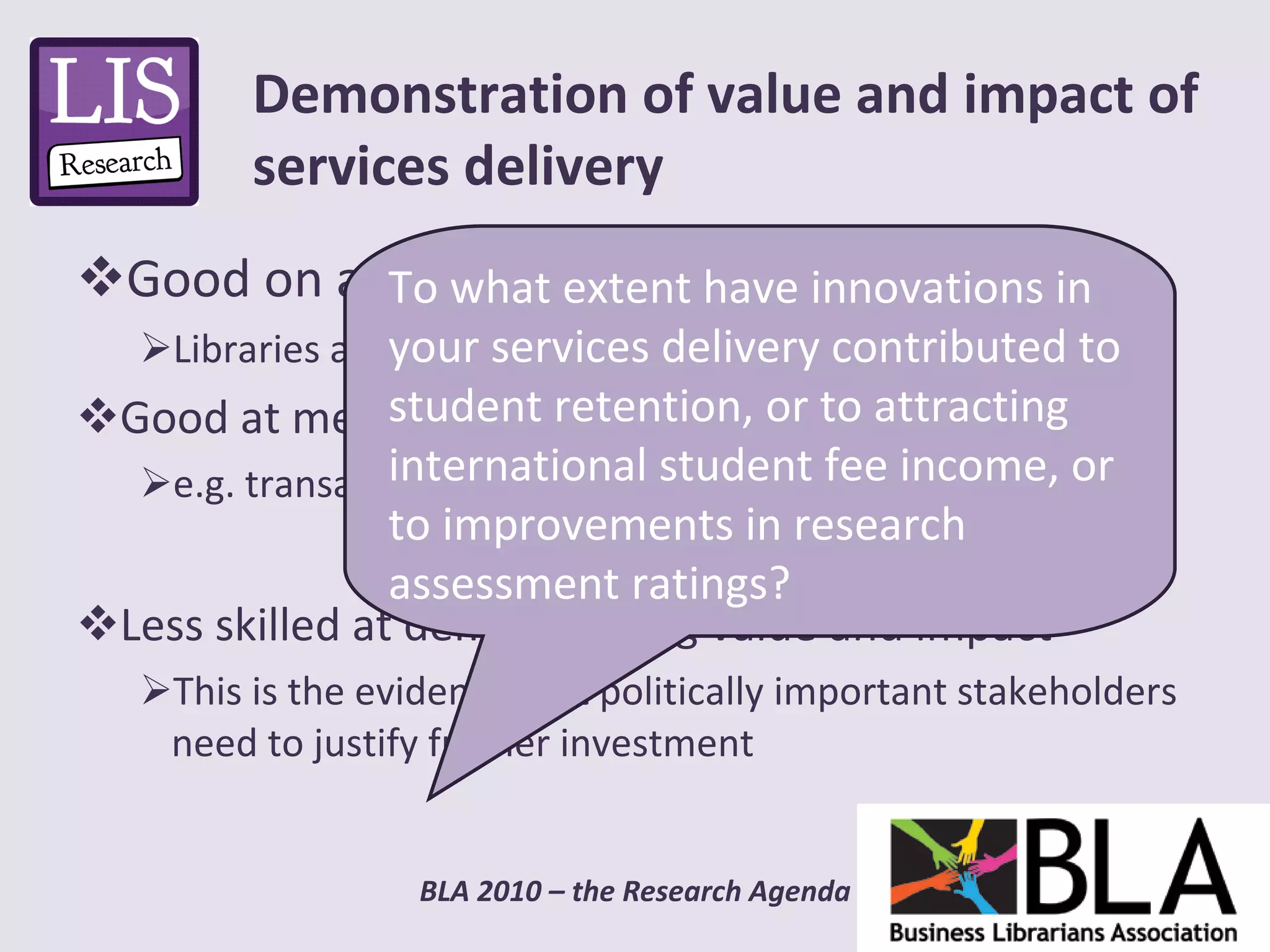
Good on advocacy Libraries are a “good thing” Good at measuring tangibles e.g. transactions  Demonstration of value and impact of services delivery
Good on advocacy Libraries are a “good thing” Good at measuring tangibles e.g. transactions  Less skilled at demonstrating value and impact This is the evidence that politically important stakeholders need to justify further investment Demonstration of value and impact of services delivery
Good on advocacy Libraries are a “good thing” Good at measuring tangibles e.g. transactions  Less skilled at demonstrating value and impact This is the evidence that politically important stakeholders need to justify further investment Demonstration of value and impact of services delivery To what extent have innovations in your services delivery contributed to student retention, or to attracting international student fee income, or to improvements in research assessment ratings?
About  practitioner-led  research (as opposed to  research-led  practice): LIS practitioners as researchers…
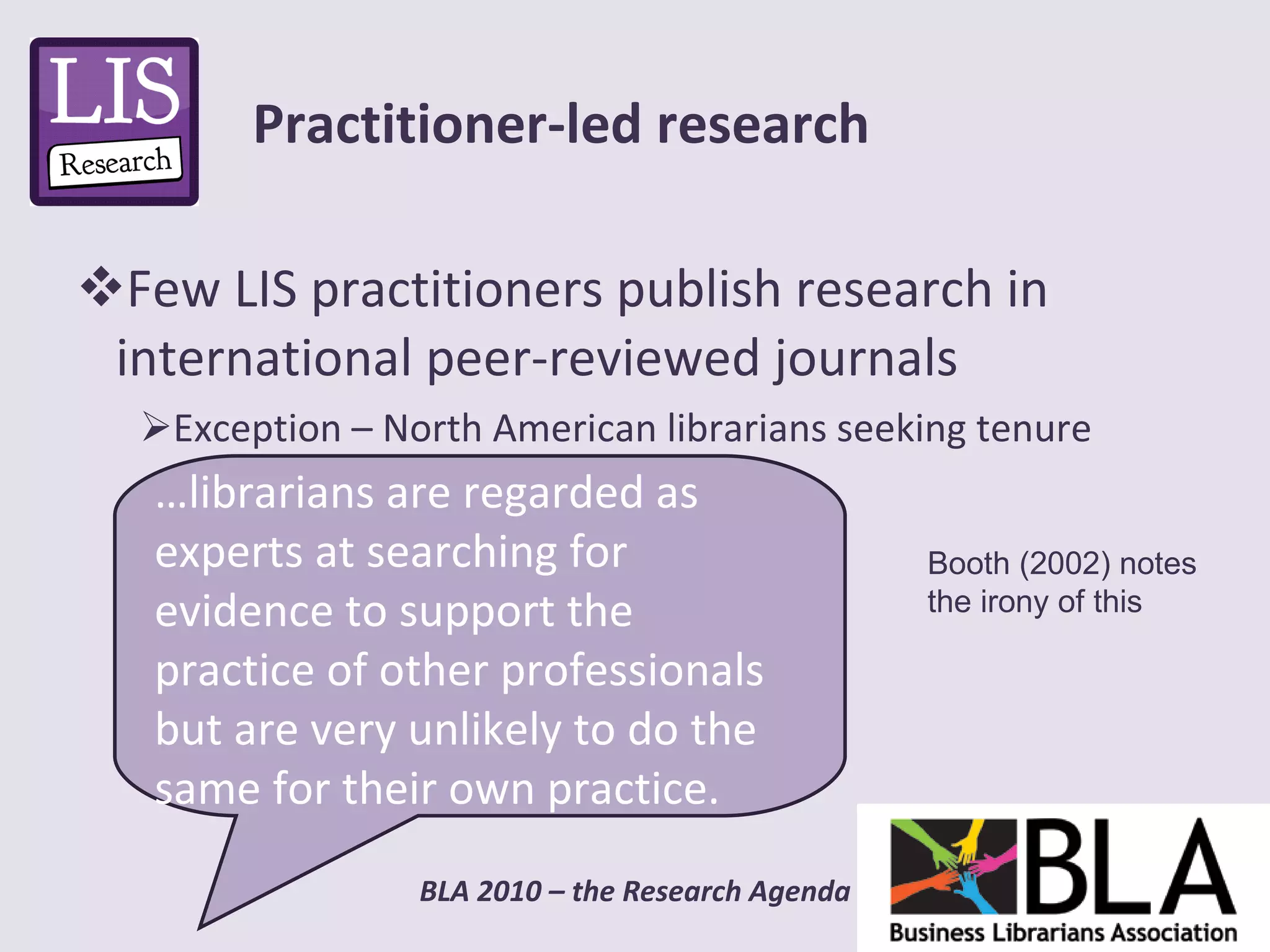
Few LIS practitioners publish research in international peer-reviewed journals Exception – North American librarians seeking tenure Practitioner-led research
Few LIS practitioners publish research in international peer-reviewed journals Exception – North American librarians seeking tenure Practitioner-led research … librarians are regarded as experts at searching for evidence to support the practice of other professionals but are very unlikely to do the same for their own practice. Booth (2002) notes  the irony of this
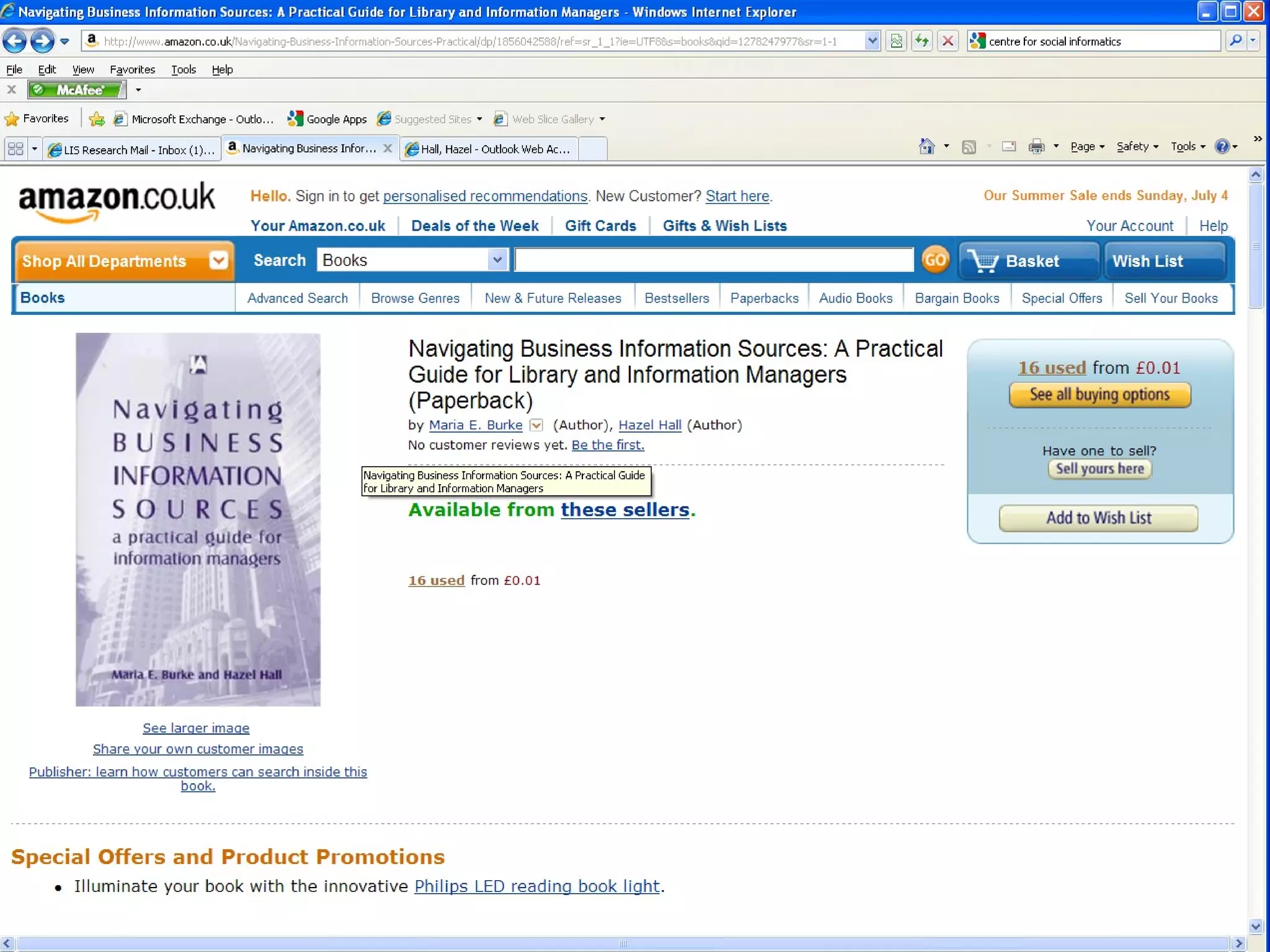
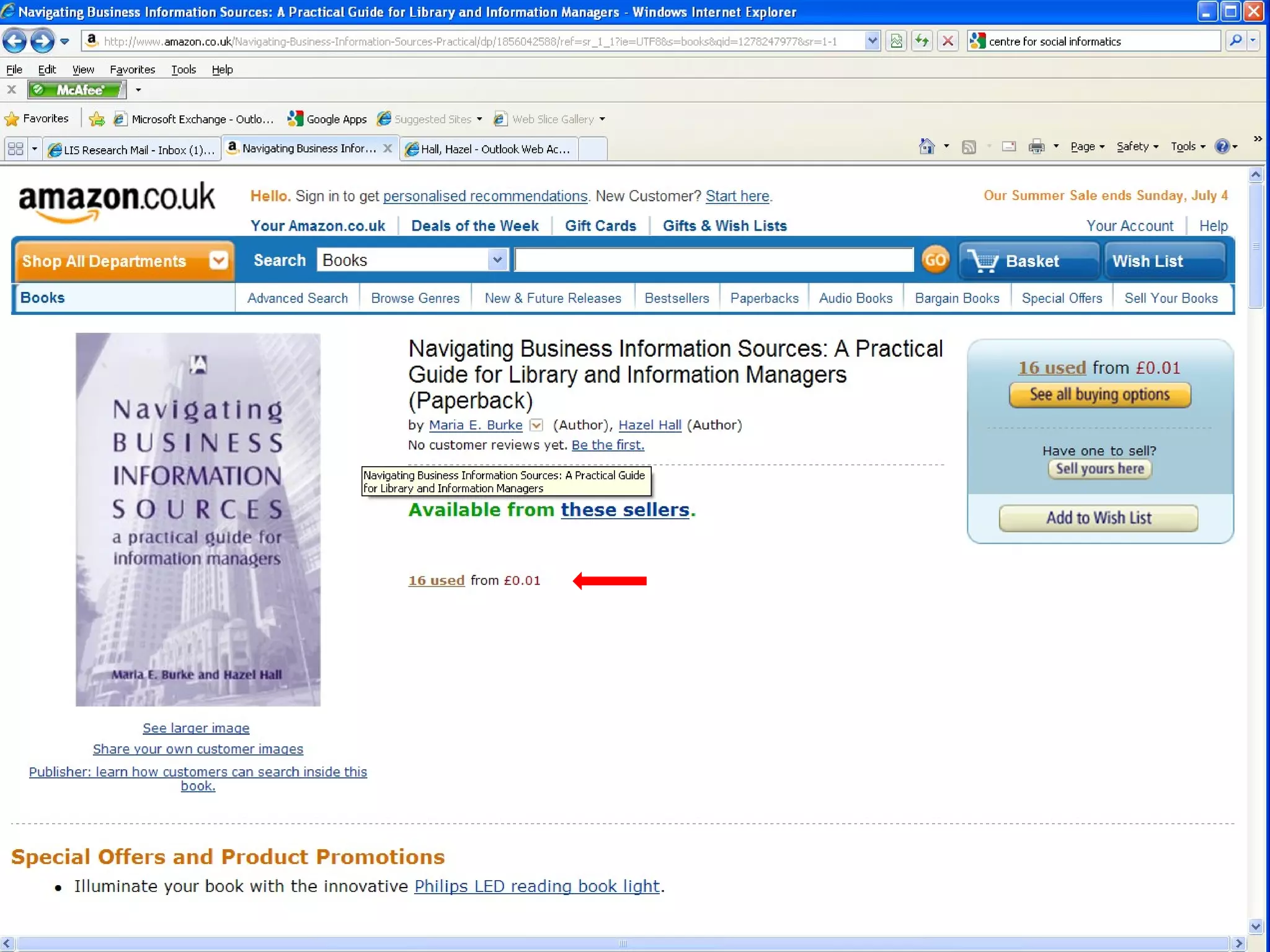
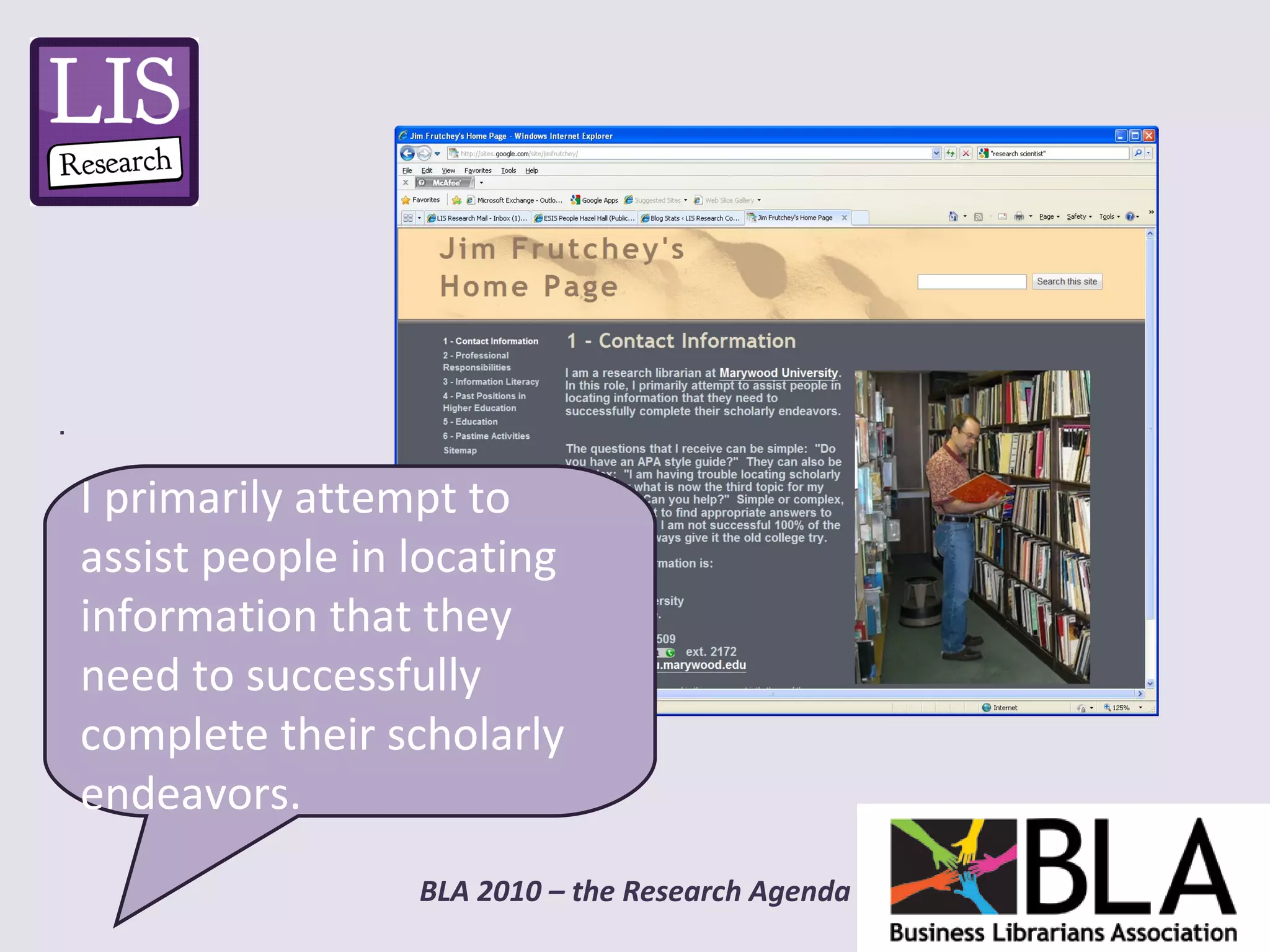
No ambiguity in job title of “research scientist” This person engages in research Ambiguity in the job title “research librarian” Professional who engages in research? Professional who supports the research of others? The understanding of job titles is also indicative of the irony
.    I primarily attempt to assist people in locating information that they need to successfully complete their scholarly endeavors.
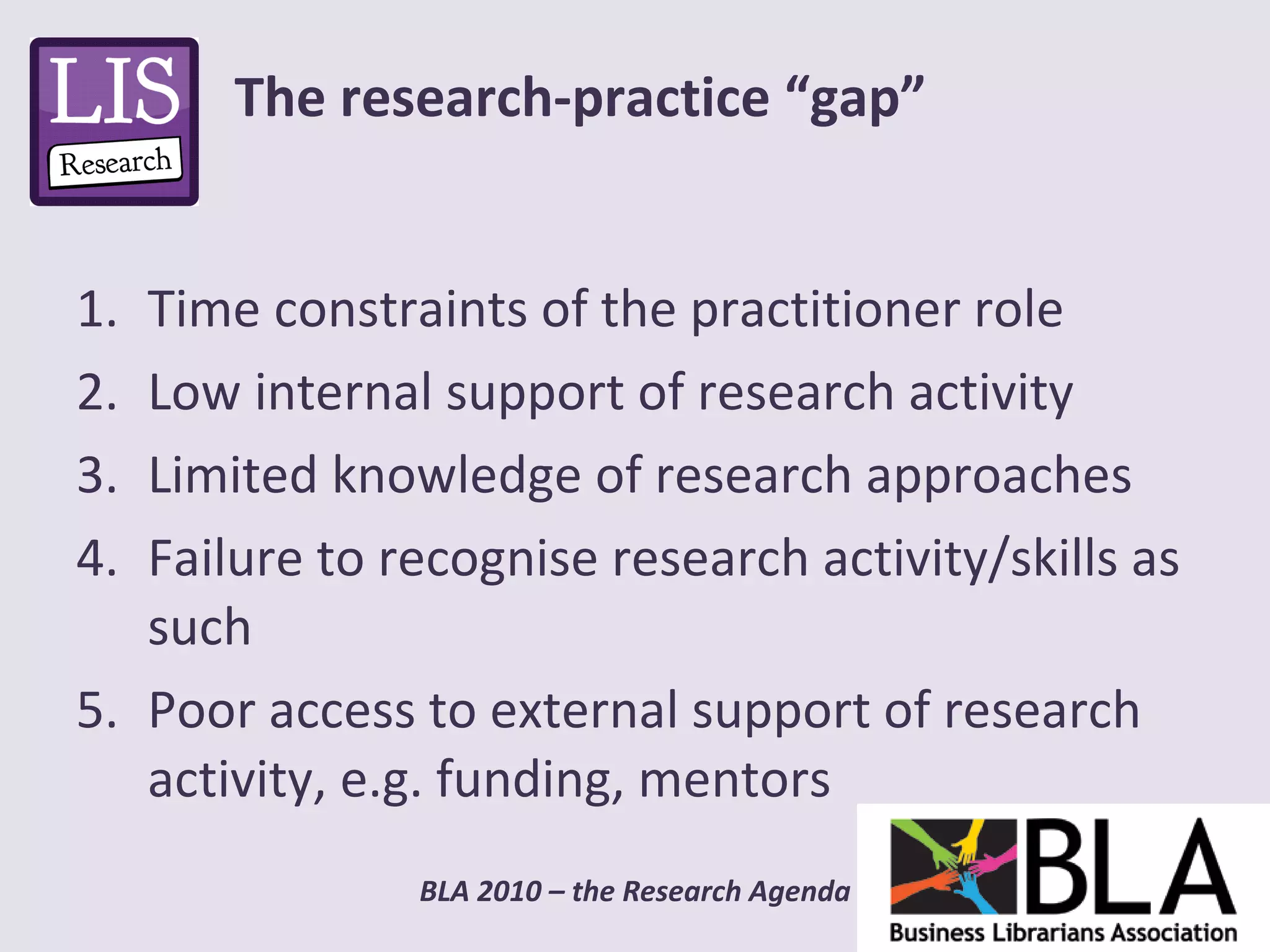
Time constraints of the practitioner role Low internal support of research activity Limited knowledge of research approaches Failure to recognise research activity/skills as such Poor access to external support of research activity, e.g. funding, mentors The research-practice “gap”
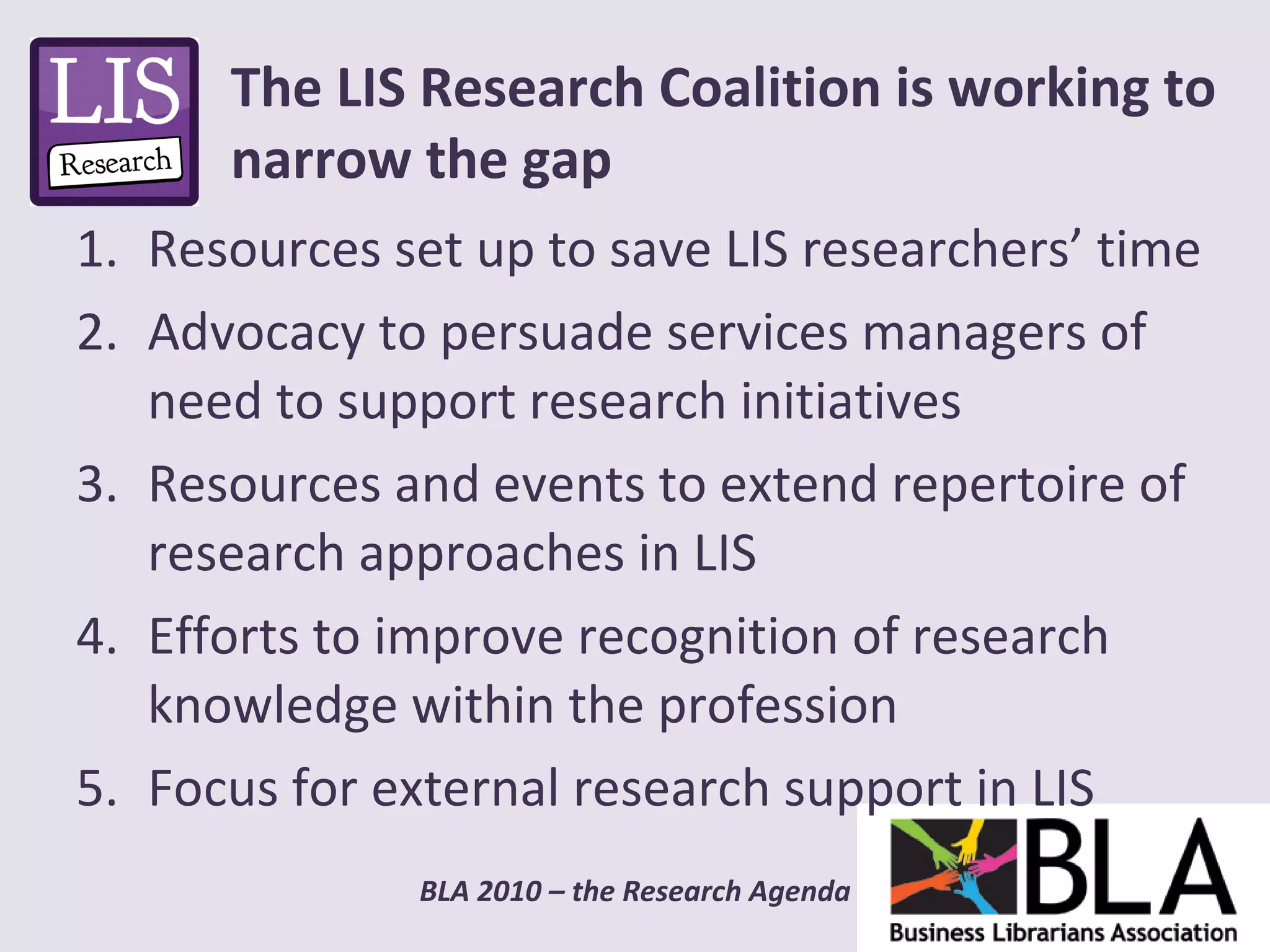
Resources set up to save LIS researchers’ time Advocacy to persuade services managers of need to support research initiatives Resources and events to extend repertoire of research approaches in LIS Efforts to improve recognition of research knowledge within the profession Focus for external research support in LIS The LIS Research Coalition is working to narrow the gap
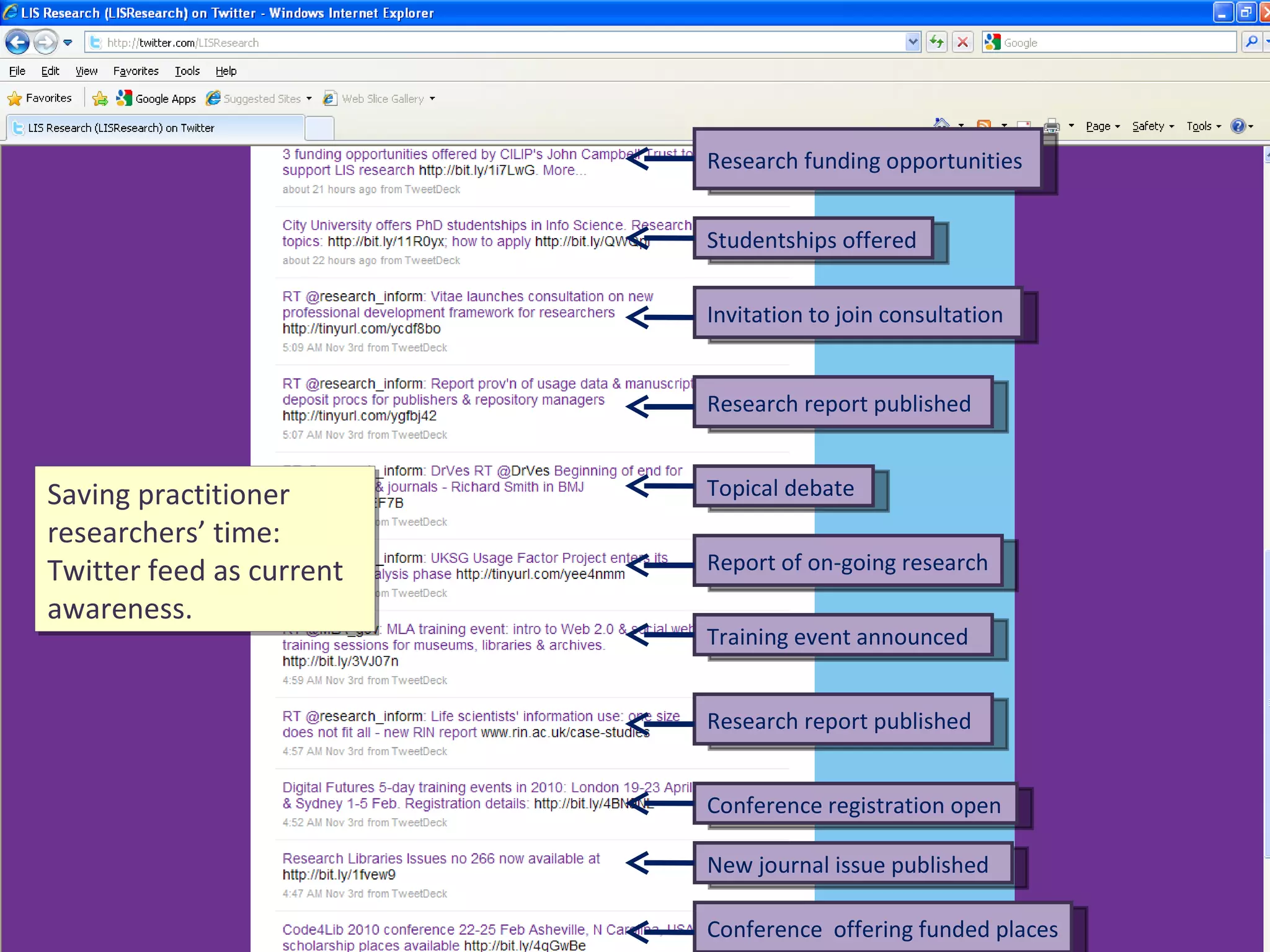
Research funding opportunities Studentships offered Invitation to join consultation Research report published Topical debate Report of on-going research Training event announced Conference registration open New journal issue published  Conference  offering funded places Research report published Saving practitioner researchers’ time: Twitter feed as current awareness.
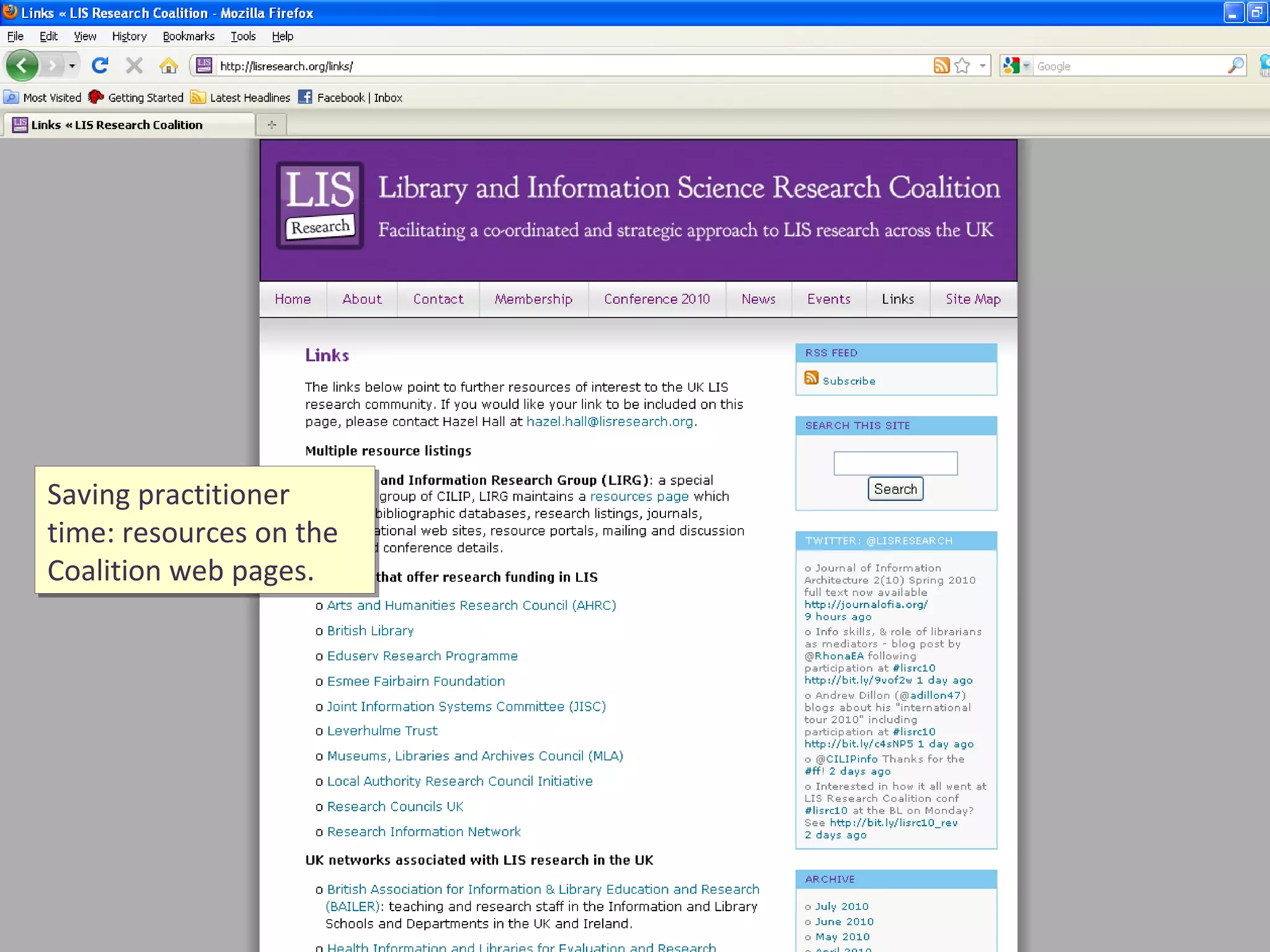
Saving practitioner time: resources on the Coalition web pages.
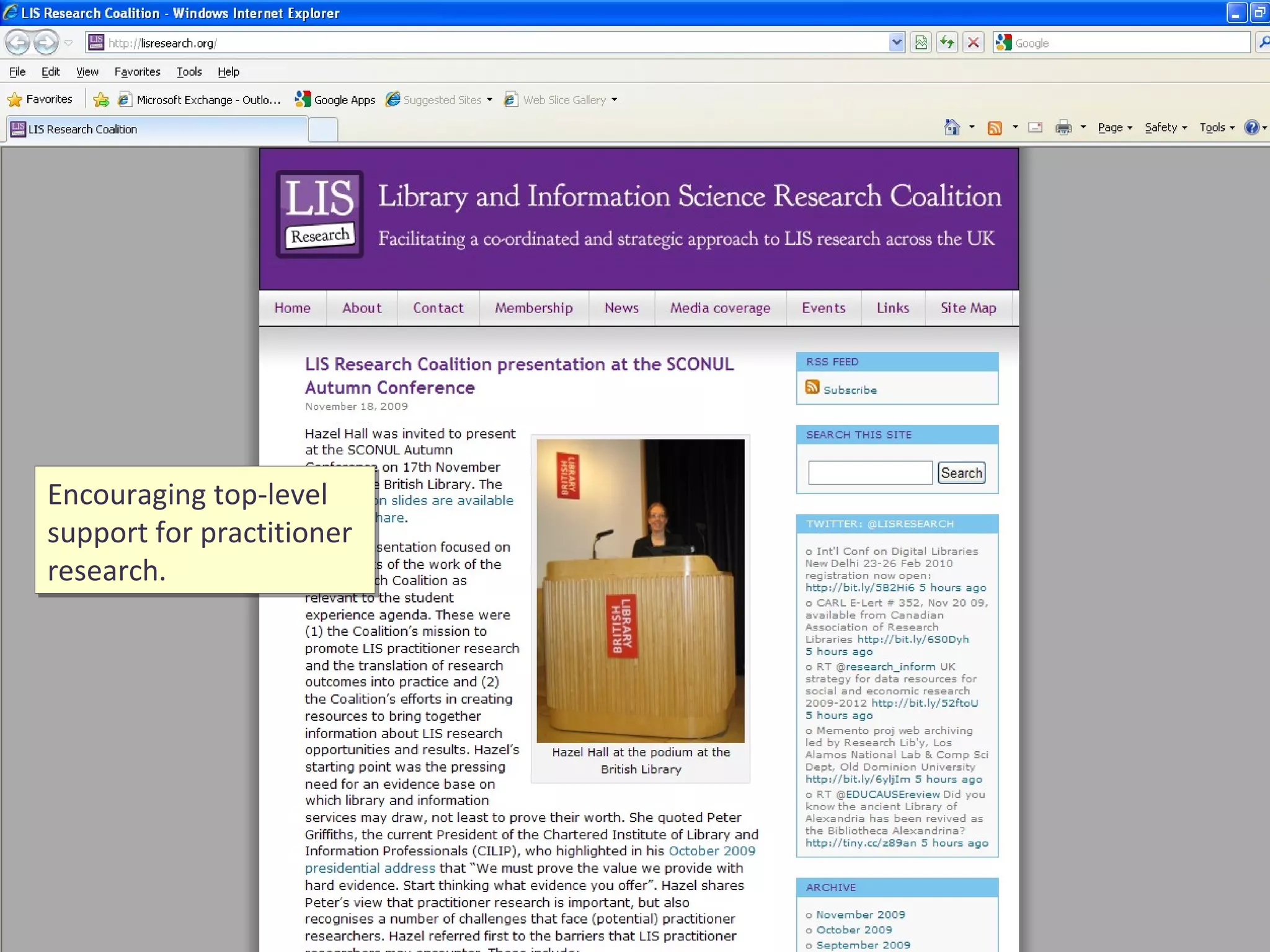
Encouraging top-level support for practitioner research.
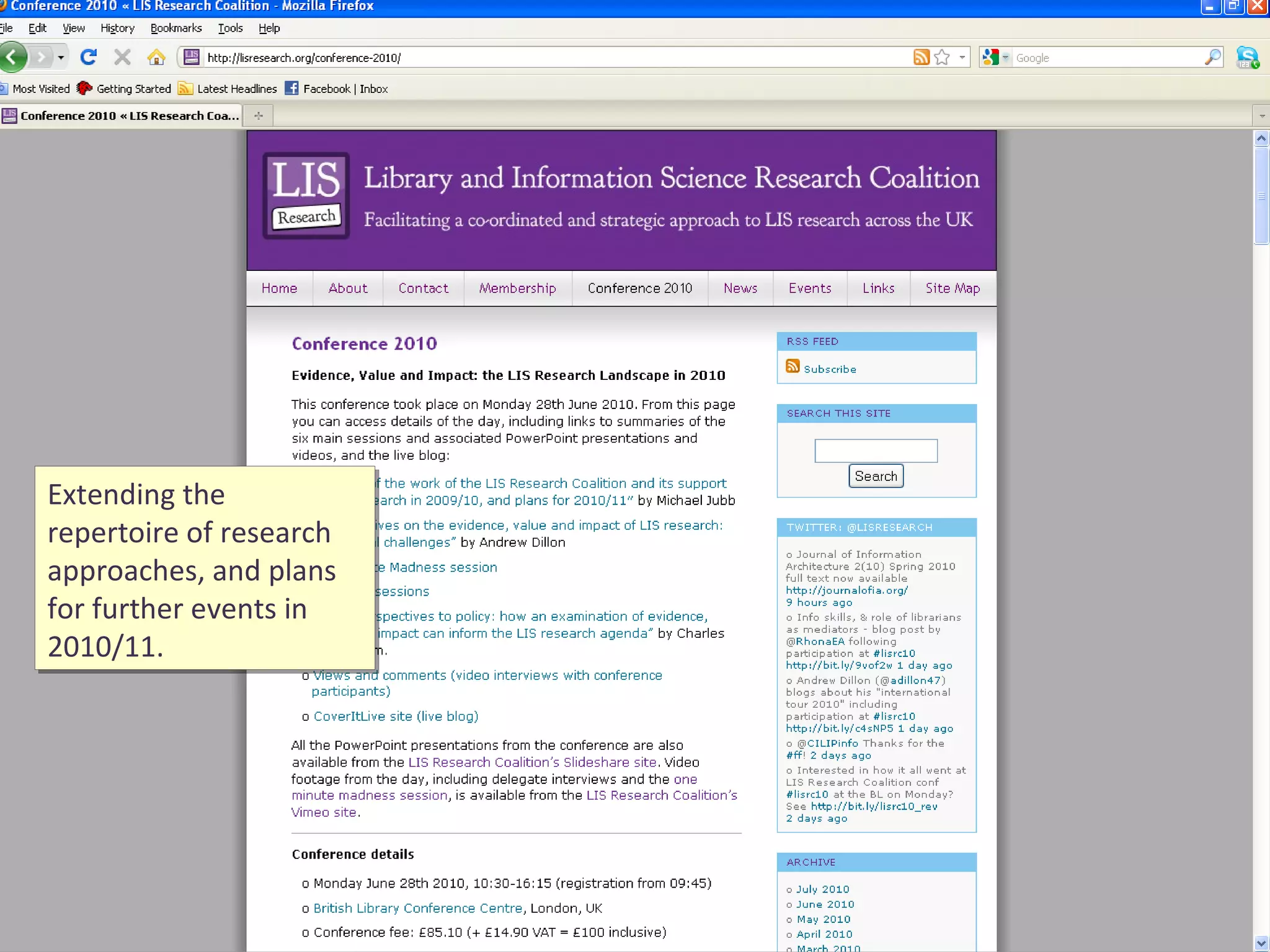
Extending the repertoire of research approaches, and plans for further events in 2010/11.
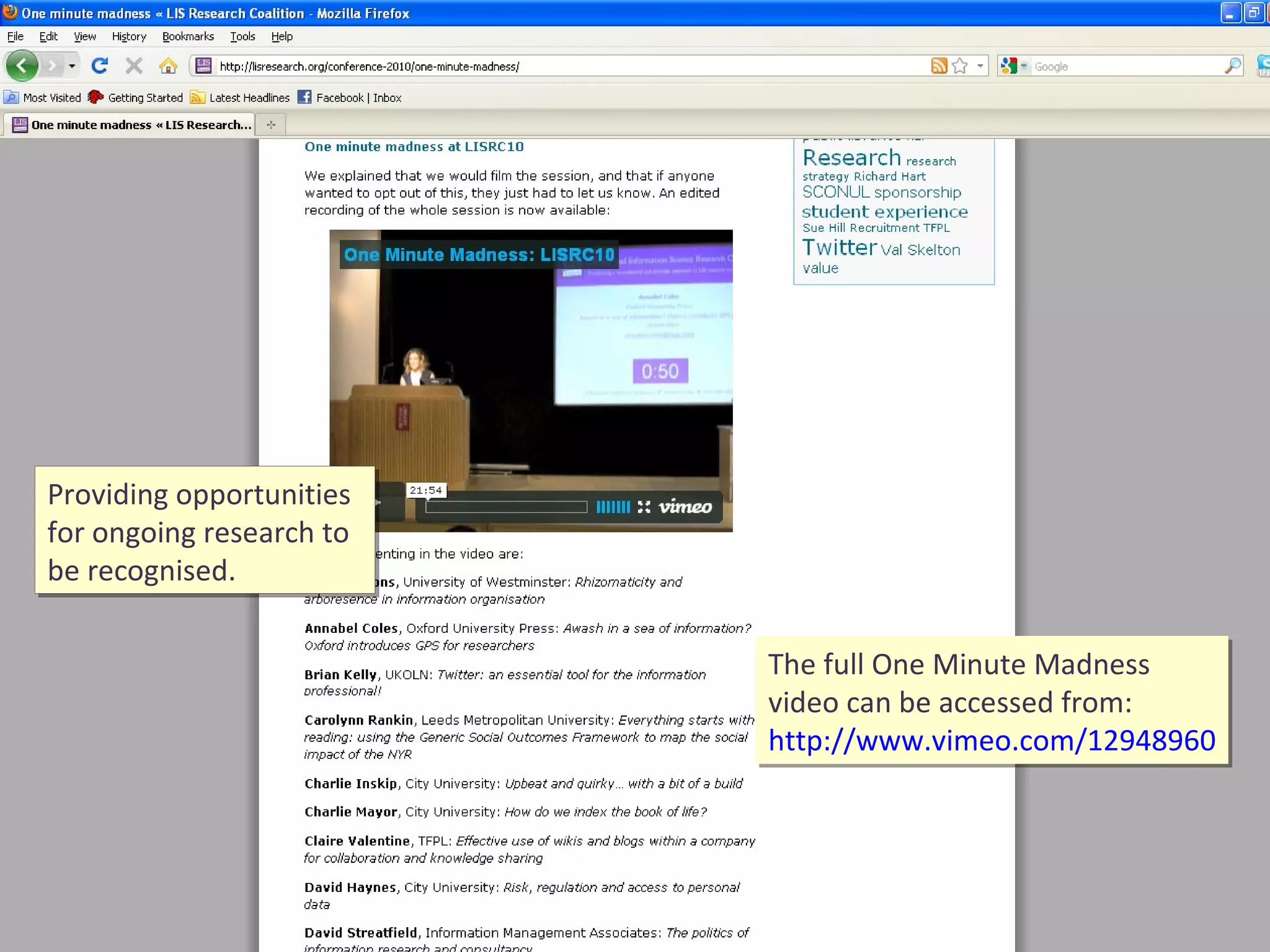
Providing opportunities for ongoing research to be recognised. The full One Minute Madness  video can be accessed from: http://www.vimeo.com/12948960
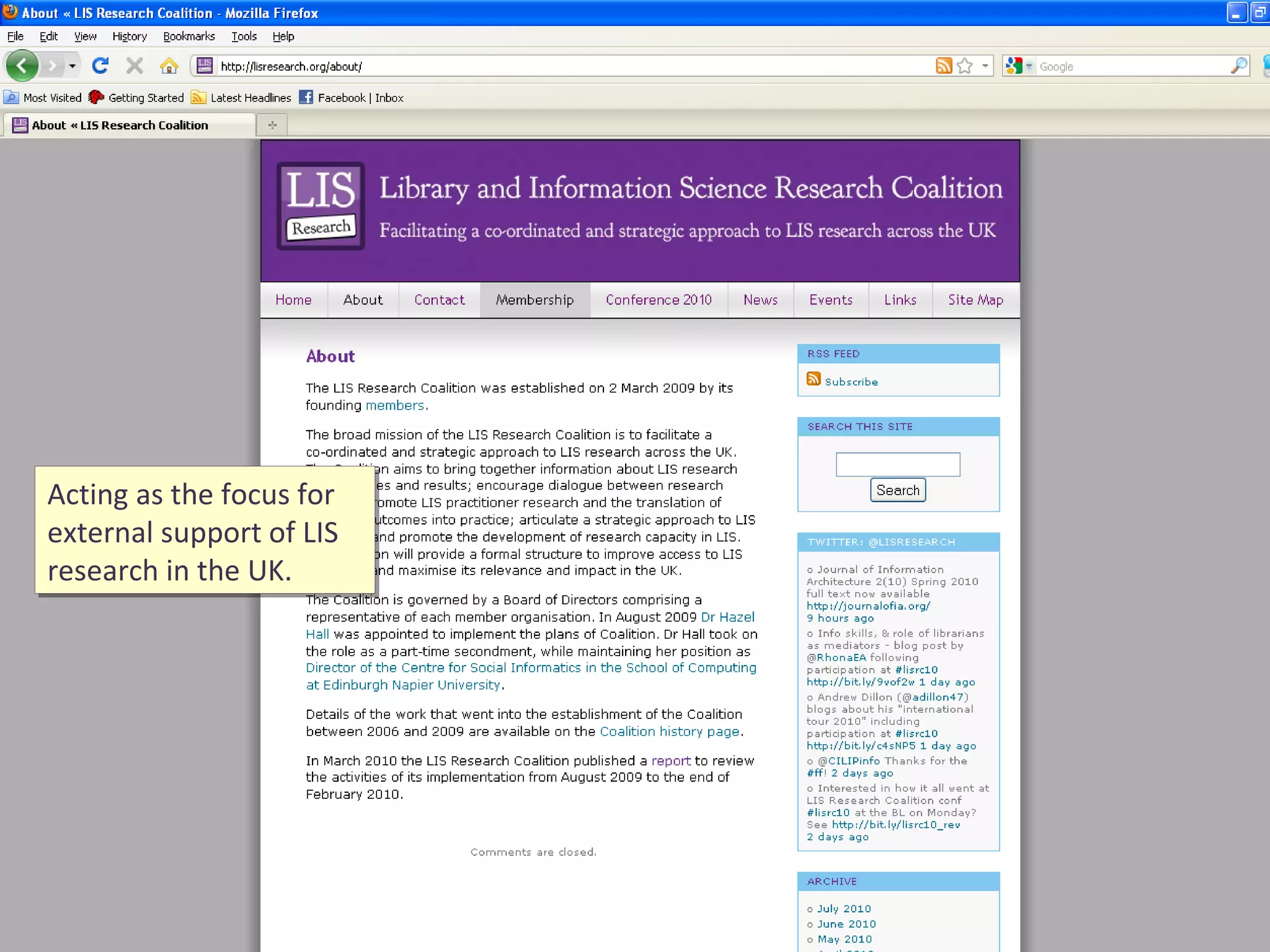
Acting as the focus for external support of LIS research in the UK.
The hard sell: increase your engagement in LIS research with the support of the LIS Research Coalition…
Organisational priorities Inform practice, decisions on future services developments Demonstrate impact and value Personal priorities Job satisfaction: intellectual stimulation & enjoyment of learning, pride in enhancing work practice, (retention) Enhance “peer” relationships, e.g. academia  Career benefits: profile/reputation, leadership development, CPD    career progression Increased engagement in research supports
Share good practice beyond  individual  services Raise profile of LIS Evidence-based profession, like others – support role  plus Support claims of LIS value To individuals: e.g. education, social mobility To citizens/society: e.g. enhanced local communities, contribution to culture and heritage To specialist user groups: e.g. information provision to business to support economic development  Priorities at level of profession or discipline
Find out more at  http://lisresearch.org   Suggestions for content welcomed Follow @LISResearch on Twitter @LISResearch will tweet your research-related news, queries... Review materials from the conference held at the British Library on 28 th  June See  http://lisresearch.org/conference-2010   Join us and help build the  evidence base Seize the opportunities of research-led practice  and practitioner-led  research
Booth, A. (2002). Mirage or reality?  Health Information Libraries Journal 19 , 56-58. Booth, A. (2006). Clear and present questions: formulating questions for evidence based practice.  Library Hi Tech 24 (3), 355-368.  Special Libraries Association (2001, June).  SLA research statement . URL  http://www.sla.org/content/resources/research/rsrchstatement.cfm  (accessed 4 July 2010). References
LIS Research Coalition http://lisresearch.org @LISResearch Dr Hazel Hall [email_address] +44 (0)7969 078181
Seizing the opportunity of research-led practice Dr Hazel Hall Library and Information Science Research Coalition

Seizing the opportunity of research-led practice

  • 1.
    Seizing the opportunityof research-led practice Dr Hazel Hall Library and Information Science Research Coalition
  • 2.
    About Hazel Halland the Library and Information Science Research Coalition…
  • 3.
    Hazel Hall inher seconded role
  • 4.
  • 5.
  • 6.
    bring together informationabout LIS research opportunities and results encourage dialogue between research funders promote LIS practitioner research and the translation of research outcomes into practice articulate a strategic approach to LIS research promote the development of research capacity in LIS The LIS Research Coalition aims to:
  • 7.
    bring together informationabout LIS research opportunities and results encourage dialogue between research funders promote LIS practitioner research and the translation of research outcomes into practice articulate a strategic approach to LIS research promote the development of research capacity in LIS The LIS Research Coalition aims to:
  • 8.
    bring together informationabout LIS research opportunities and results encourage dialogue between research funders promote LIS practitioner research and the translation of research outcomes into practice articulate a strategic approach to LIS research promote the development of research capacity in LIS The LIS Research Coalition aims to: Support research-led practice of librarians and information scientists
  • 9.
    About research-led practice:making use of published research in services delivery…
  • 10.
    To exploit theexisting knowledge base for services improvement To improve decision making for services delivery To enhance the value of prior work To capitalise on significant investment in previous studies To raise the value of previous studies through reuse To demonstrate the value and impact of service delivery Why research-led practice?
  • 11.
    http://dpi.wi.gov/pld/econimpact.html Florida study: for every $1 invested in public libraries there is a $6.54 return
  • 12.
    Improves decision-making  services delivery, yet… Exploitation of existing knowledge base for services improvement … librarians tend to be action-oriented, relying on… experience and professional judgment to make decisions. (SLA, 2001)
  • 13.
    Multi-disciplinary nature ofLIS literature Across publications of various domains Grey sources Straightforward access not always obvious, e.g. unpublished internal studies, summaries on listservs Valuable work is often not published at all We suffer “evaluation by-pass” (Booth, 2006)
  • 14.
    Multi-disciplinary nature ofLIS literature Across publications of various domains Grey sources Straightforward access not always obvious, e.g. unpublished internal studies, summaries on listservs Valuable work is often not published at all We suffer “evaluation by-pass” (Booth, 2006) TIME
  • 15.
    Good on advocacyLibraries are a “good thing” Good at measuring tangibles e.g. transactions Demonstration of value and impact of services delivery
  • 16.
    Good on advocacyLibraries are a “good thing” Good at measuring tangibles e.g. transactions Less skilled at demonstrating value and impact This is the evidence that politically important stakeholders need to justify further investment Demonstration of value and impact of services delivery
  • 17.
    Good on advocacyLibraries are a “good thing” Good at measuring tangibles e.g. transactions Less skilled at demonstrating value and impact This is the evidence that politically important stakeholders need to justify further investment Demonstration of value and impact of services delivery To what extent have innovations in your services delivery contributed to student retention, or to attracting international student fee income, or to improvements in research assessment ratings?
  • 18.
    About practitioner-led research (as opposed to research-led practice): LIS practitioners as researchers…
  • 19.
    Few LIS practitionerspublish research in international peer-reviewed journals Exception – North American librarians seeking tenure Practitioner-led research
  • 20.
    Few LIS practitionerspublish research in international peer-reviewed journals Exception – North American librarians seeking tenure Practitioner-led research … librarians are regarded as experts at searching for evidence to support the practice of other professionals but are very unlikely to do the same for their own practice. Booth (2002) notes the irony of this
  • 21.
    No ambiguity injob title of “research scientist” This person engages in research Ambiguity in the job title “research librarian” Professional who engages in research? Professional who supports the research of others? The understanding of job titles is also indicative of the irony
  • 22.
    I primarily attempt to assist people in locating information that they need to successfully complete their scholarly endeavors.
  • 23.
    Time constraints ofthe practitioner role Low internal support of research activity Limited knowledge of research approaches Failure to recognise research activity/skills as such Poor access to external support of research activity, e.g. funding, mentors The research-practice “gap”
  • 24.
    Resources set upto save LIS researchers’ time Advocacy to persuade services managers of need to support research initiatives Resources and events to extend repertoire of research approaches in LIS Efforts to improve recognition of research knowledge within the profession Focus for external research support in LIS The LIS Research Coalition is working to narrow the gap
  • 25.
    Research funding opportunitiesStudentships offered Invitation to join consultation Research report published Topical debate Report of on-going research Training event announced Conference registration open New journal issue published Conference offering funded places Research report published Saving practitioner researchers’ time: Twitter feed as current awareness.
  • 26.
    Saving practitioner time:resources on the Coalition web pages.
  • 27.
    Encouraging top-level supportfor practitioner research.
  • 28.
    Extending the repertoireof research approaches, and plans for further events in 2010/11.
  • 29.
    Providing opportunities forongoing research to be recognised. The full One Minute Madness video can be accessed from: http://www.vimeo.com/12948960
  • 30.
    Acting as thefocus for external support of LIS research in the UK.
  • 31.
    The hard sell:increase your engagement in LIS research with the support of the LIS Research Coalition…
  • 32.
    Organisational priorities Informpractice, decisions on future services developments Demonstrate impact and value Personal priorities Job satisfaction: intellectual stimulation & enjoyment of learning, pride in enhancing work practice, (retention) Enhance “peer” relationships, e.g. academia Career benefits: profile/reputation, leadership development, CPD  career progression Increased engagement in research supports
  • 33.
    Share good practicebeyond individual services Raise profile of LIS Evidence-based profession, like others – support role plus Support claims of LIS value To individuals: e.g. education, social mobility To citizens/society: e.g. enhanced local communities, contribution to culture and heritage To specialist user groups: e.g. information provision to business to support economic development Priorities at level of profession or discipline
  • 34.
    Find out moreat http://lisresearch.org Suggestions for content welcomed Follow @LISResearch on Twitter @LISResearch will tweet your research-related news, queries... Review materials from the conference held at the British Library on 28 th June See http://lisresearch.org/conference-2010 Join us and help build the evidence base Seize the opportunities of research-led practice and practitioner-led research
  • 35.
    Booth, A. (2002).Mirage or reality? Health Information Libraries Journal 19 , 56-58. Booth, A. (2006). Clear and present questions: formulating questions for evidence based practice. Library Hi Tech 24 (3), 355-368. Special Libraries Association (2001, June). SLA research statement . URL http://www.sla.org/content/resources/research/rsrchstatement.cfm (accessed 4 July 2010). References
  • 36.
    LIS Research Coalitionhttp://lisresearch.org @LISResearch Dr Hazel Hall [email_address] +44 (0)7969 078181
  • 37.
    Seizing the opportunityof research-led practice Dr Hazel Hall Library and Information Science Research Coalition