NEO-CLASSICAL AGE
TOPIC- JOHN LOCKE AND HIS WORKS
PRESENTED BY – HINABA D.SRAVAIYA.
EMAIL ID-
HINABASARVAIYA1711@GMAIL.COM.
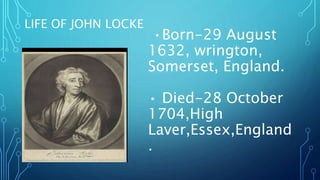
LIFE OF JOHN LOCKE
•Born-29 August
1632, wrington,
Somerset, England.
• Died-28 October
1704,High
Laver,Essex,England
.
•He was english philosopher and physician.
• Enlightenment Thinker.
What is Enlightenment?
In Europe this was the period of Elightenment. The enlightenment
tried to do alway with the ignorance and misteaching of the previous
age. They wanted to reform Knowledge. They wanted to undo the
mistake done by religion. They wanted to promote religious tolerance.
The Enlightenment Philosophers included, in France, Diderot, Voltaire,
Rousseau. In England, there was John Locke and before that, Thomas
Hobbes Who wrote leviathan.
• He knows as the 'Father of Liberalism’. As he propounded the
the cardinal principles of modern day liberalism like recognition
of Right, Democracy, limited state, Toleration ect,.
• According to Locke nature as gifted us with three inalienable
rights like:
1. Right of Life,
2. Right of Liberty, and
3. Right of property.
HIS NOTABLE WORKS ARE:
1) ‘Two Treatises of Government’(1689)
2) ‘An Essay concerning Human Understanding’ (1689-
90)
3) ‘ Letter Concerning Toleration’ (1689)
AN ESSAY CONCERNING HUMAN
UNDERSTANDING
• The foundation of human knowledge and understanding.
• it first appeared in 1689 with the printed title ‘an essay
concerning Human Understanding’.
•He describes the mind at birth as a blank slate (tabula rasa)
filled later through experience.
• the essay was one of the principal sources of empiricism in
modern philosophy.
• it influenced many enlightenment philosophers, such as David
Hume and George Berkeley.
DIVIDED IN FOUR BOOKS:
• Book I of the essay is locke’s attempt to refute the rationalist
notion of innate idea.he confronts the theory of innate idea and
argues that ideas often cited as innate are so comlex and
confusing that much schooling and thought are required to
grasp their meaning.
• Book II set out locke’s theory of ideas, including his distinction
between passively acquired simple idea. Such as shape and
size.
•Book III ideas emerging from reflection. He discusses absteact
general ideas. Everything that exists in the world is a particular
•Book IV ideas arising from a
combination Of sensation and
reflection, such as unity,
existence, pleasure. It means
addresses the nature of
knowledge itself.
SOCIAL CONTRACT THEORY OF JOHN
LOCKE
THOMAS HOBBES
• Human are nuturally Cruel,
greedy and Selfish.
•To escape this 'brutish’ Life
People entered into a social
contract.
•Only a powerful government
could ensure an ordinary society.
•belived only an absolute
monarchy could keep a society
completely orderly.
JOHN LOCKE
• Humans are naturally
reasonable,moral and good.
• Humans have natural rights; life,
liberty, and property.
•Poeple from government to
protect natural rights.
• Best government was one with
limited power.
•if a government violates people’s
CONCLUSION:-
“Wherever law ends
Tyrranny begins”.
- John Locke.
The equality of all citizens under the law is lynch-pin of the
modern notion of the rule of law in a democratic state. John
Locke developed his theory of ideas and his account of the
origins of human knowledge in experience.
WORKS CITED:-
• Kalyani.net English Complete,Udemy MOOC.2019.
• https://www.quora.com.
• https://Google.images.

Neo classical presentation.pptx

  • 1.
    NEO-CLASSICAL AGE TOPIC- JOHNLOCKE AND HIS WORKS PRESENTED BY – HINABA D.SRAVAIYA. EMAIL ID- HINABASARVAIYA1711@GMAIL.COM.
  • 2.
    LIFE OF JOHNLOCKE •Born-29 August 1632, wrington, Somerset, England. • Died-28 October 1704,High Laver,Essex,England .
  • 3.
    •He was englishphilosopher and physician. • Enlightenment Thinker. What is Enlightenment? In Europe this was the period of Elightenment. The enlightenment tried to do alway with the ignorance and misteaching of the previous age. They wanted to reform Knowledge. They wanted to undo the mistake done by religion. They wanted to promote religious tolerance. The Enlightenment Philosophers included, in France, Diderot, Voltaire, Rousseau. In England, there was John Locke and before that, Thomas Hobbes Who wrote leviathan.
  • 4.
    • He knowsas the 'Father of Liberalism’. As he propounded the the cardinal principles of modern day liberalism like recognition of Right, Democracy, limited state, Toleration ect,. • According to Locke nature as gifted us with three inalienable rights like: 1. Right of Life, 2. Right of Liberty, and 3. Right of property.
  • 5.
    HIS NOTABLE WORKSARE: 1) ‘Two Treatises of Government’(1689) 2) ‘An Essay concerning Human Understanding’ (1689- 90) 3) ‘ Letter Concerning Toleration’ (1689)
  • 6.
    AN ESSAY CONCERNINGHUMAN UNDERSTANDING • The foundation of human knowledge and understanding. • it first appeared in 1689 with the printed title ‘an essay concerning Human Understanding’. •He describes the mind at birth as a blank slate (tabula rasa) filled later through experience. • the essay was one of the principal sources of empiricism in modern philosophy. • it influenced many enlightenment philosophers, such as David Hume and George Berkeley.
  • 7.
    DIVIDED IN FOURBOOKS: • Book I of the essay is locke’s attempt to refute the rationalist notion of innate idea.he confronts the theory of innate idea and argues that ideas often cited as innate are so comlex and confusing that much schooling and thought are required to grasp their meaning. • Book II set out locke’s theory of ideas, including his distinction between passively acquired simple idea. Such as shape and size. •Book III ideas emerging from reflection. He discusses absteact general ideas. Everything that exists in the world is a particular
  • 8.
    •Book IV ideasarising from a combination Of sensation and reflection, such as unity, existence, pleasure. It means addresses the nature of knowledge itself.
  • 9.
    SOCIAL CONTRACT THEORYOF JOHN LOCKE THOMAS HOBBES • Human are nuturally Cruel, greedy and Selfish. •To escape this 'brutish’ Life People entered into a social contract. •Only a powerful government could ensure an ordinary society. •belived only an absolute monarchy could keep a society completely orderly. JOHN LOCKE • Humans are naturally reasonable,moral and good. • Humans have natural rights; life, liberty, and property. •Poeple from government to protect natural rights. • Best government was one with limited power. •if a government violates people’s
  • 10.
    CONCLUSION:- “Wherever law ends Tyrrannybegins”. - John Locke. The equality of all citizens under the law is lynch-pin of the modern notion of the rule of law in a democratic state. John Locke developed his theory of ideas and his account of the origins of human knowledge in experience.
  • 12.
    WORKS CITED:- • Kalyani.netEnglish Complete,Udemy MOOC.2019. • https://www.quora.com. • https://Google.images.