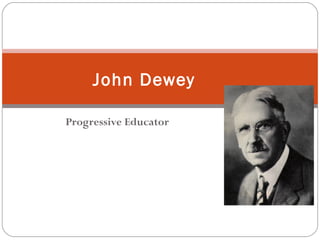
Progressive Educator
John Dewey
Agenda
Finish up interviews
Who is John Dewey? - Discussion
Identify the philosopher activity
What is Progressive Education?
Play a Role Activity
Assignment - Read Bloom’s Taxonomy Handout and be
prepared to discuss it.
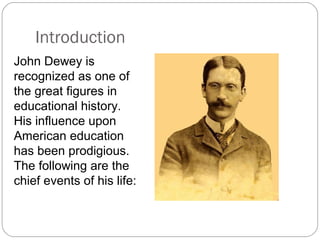
John Dewey is
recognized as one of
the great figures in
educational history.
His influence upon
American education
has been prodigious.
The following are the
chief events of his life:
Introduction
Who was John Dewey
 Summary of Dewey's Biography
 Born 1859, Burlington, Vermont, USA.  Died 1952.
 American philosopher and regarded as the foremost educator of his day.
 Major books include
Democracy and Education (1916)
Logic (1938)
Experience and Education (1938).
 Had a profound impact on progressive education
 Rejected authoritarian teaching methods.
 His educational theories were based on his primary ethical value of democracy.
 Education in a democracy is a tool to enable the citizen to think, and integrate
his or her culture and vocation usefully.
 To accomplish these aims, Dewey said radical reform was need of both
pedagogical methods and curricula.
Copyright © 2007 Answers Corporation.
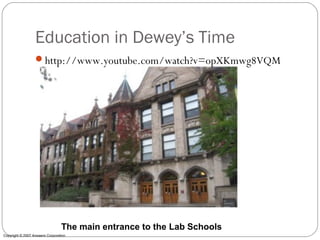
The main entrance to the Lab Schools
Education in Dewey’s Time
http://www.youtube.com/watch?v=opXKmwg8VQM
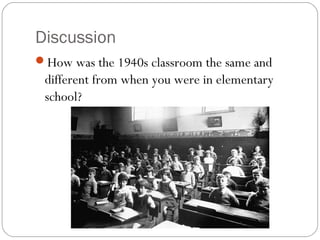
Discussion
How was the 1940s classroom the same and
different from when you were in elementary
school?
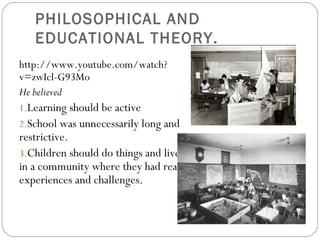
PHILOSOPHICAL AND
EDUCATIONAL THEORY.
http://www.youtube.com/watch?
v=zwIcl-G93Mo
He believed
1.Learning should be active
2.School was unnecessarily long and
restrictive. 
3.Children should do things and live
in a community where they had real
experiences and challenges.
Instrumentalism
Influenced by the theory of evolution.
Dewey believed that the mind as well as the body evolved.
Ideas arose from experience and led to learning.
We have an experience. We get an idea. We adjust.
Instrumentalism
Human thinking is social in that it occurs in a community of
others.
If the solution works, it becomes the truth.
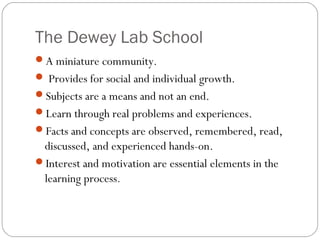
The Dewey Lab School
A miniature community.
 Provides for social and individual growth.
Subjects are a means and not an end.
Learn through real problems and experiences.
Facts and concepts are observed, remembered, read,
discussed, and experienced hands-on.
Interest and motivation are essential elements in the
learning process.
Self-Discipline
Discipline is internal and
positive.
A pupil must be taught to
consider his actions.
• A pupil is disciplined when he knows what he
must do and is moved to undertake the
action quickly, using the means necessary.
• When the pupil possesses the power to
pursue a course of action in the face of
obstacles, he is disciplined
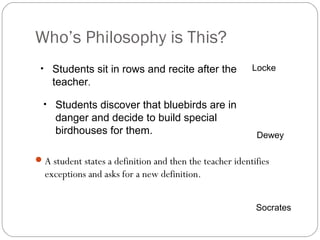
Who’s Philosophy is This?
A student states a definition and then the teacher identifies
exceptions and asks for a new definition.
• Students sit in rows and recite after the
teacher.
Locke
• Students discover that bluebirds are in
danger and decide to build special
birdhouses for them. Dewey
Socrates
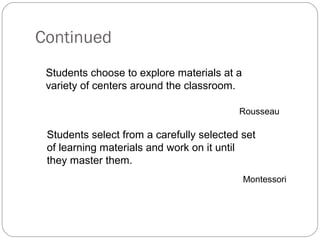
Continued
Students choose to explore materials at a
variety of centers around the classroom.
Students select from a carefully selected set
of learning materials and work on it until
they master them.
Rousseau
Montessori
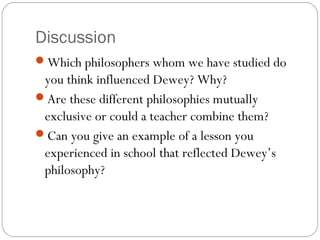
Discussion
Which philosophers whom we have studied do
you think influenced Dewey? Why?
Are these different philosophies mutually
exclusive or could a teacher combine them?
Can you give an example of a lesson you
experienced in school that reflected Dewey’s
philosophy?
Progressive Education
Schools that follow Dewey’s Philosophy EMPHASIZE:
(Can you think of an example for each?)
Learning by doing – hands-on projects, expeditionary
learning, experiential learning
Student choice
Integrated curriculum focused on thematic units
Problem solving and critical thinking
Group work and development of social skills
Collaborative and cooperative learning projects
Progressive Education
Schools that follow Dewey’s Philosophy EMPHASIZE:
(Can you think of an example for each?)
Education for social responsibility and democracy
Integration of community service and service learning
projects into the daily curriculum
Rejection of textbooks in favor of varied learning resources
Life-long learning and social skills
Assessment by evaluation of child’s projects and production –
portfolios, not tests
Play a Role
Draw a card out of a hat. You will imagine you are that person
• Parent
• Math teacher
• Art teacher
• Social Studies teacher
• P.E. teacher
• Preschool teacher
• Principal
• School Board Member
• Grocery Store Owner
• Elementary student
• High School student
• College student
• Common CoreTest Designer
• Member Board of Regents
• Private Charter School Owner
• College Admissions Officer
1. Which of Dewey’s ideas would you like in your local school?
2. Which ideas would you reject based on what role you are?
3. Would you send your child to a progressive school or one
that emphasizes rote ‘by-the-textbook’ learning?
4. How has Dewey influenced the way I teach this course?
Reminder
Next Class: Read Bloom Handout and be
ready to discuss.
“Education, therefore, is a process of living and not a preparation
for future living.”
John Dewey

The Child-Centered Classroom

  • 1.
  • 2.
    Agenda Finish up interviews Whois John Dewey? - Discussion Identify the philosopher activity What is Progressive Education? Play a Role Activity Assignment - Read Bloom’s Taxonomy Handout and be prepared to discuss it.
  • 3.
    John Dewey is recognizedas one of the great figures in educational history. His influence upon American education has been prodigious. The following are the chief events of his life: Introduction
  • 4.
    Who was JohnDewey  Summary of Dewey's Biography  Born 1859, Burlington, Vermont, USA.  Died 1952.  American philosopher and regarded as the foremost educator of his day.  Major books include Democracy and Education (1916) Logic (1938) Experience and Education (1938).  Had a profound impact on progressive education  Rejected authoritarian teaching methods.  His educational theories were based on his primary ethical value of democracy.  Education in a democracy is a tool to enable the citizen to think, and integrate his or her culture and vocation usefully.  To accomplish these aims, Dewey said radical reform was need of both pedagogical methods and curricula.
  • 5.
    Copyright © 2007Answers Corporation. The main entrance to the Lab Schools Education in Dewey’s Time http://www.youtube.com/watch?v=opXKmwg8VQM
  • 6.
    Discussion How was the1940s classroom the same and different from when you were in elementary school?
  • 7.
    PHILOSOPHICAL AND EDUCATIONAL THEORY. http://www.youtube.com/watch? v=zwIcl-G93Mo Hebelieved 1.Learning should be active 2.School was unnecessarily long and restrictive.  3.Children should do things and live in a community where they had real experiences and challenges.
  • 8.
    Instrumentalism Influenced by thetheory of evolution. Dewey believed that the mind as well as the body evolved. Ideas arose from experience and led to learning. We have an experience. We get an idea. We adjust.
  • 9.
    Instrumentalism Human thinking issocial in that it occurs in a community of others. If the solution works, it becomes the truth.
  • 10.
    The Dewey LabSchool A miniature community.  Provides for social and individual growth. Subjects are a means and not an end. Learn through real problems and experiences. Facts and concepts are observed, remembered, read, discussed, and experienced hands-on. Interest and motivation are essential elements in the learning process.
  • 11.
    Self-Discipline Discipline is internaland positive. A pupil must be taught to consider his actions. • A pupil is disciplined when he knows what he must do and is moved to undertake the action quickly, using the means necessary. • When the pupil possesses the power to pursue a course of action in the face of obstacles, he is disciplined
  • 12.
    Who’s Philosophy isThis? A student states a definition and then the teacher identifies exceptions and asks for a new definition. • Students sit in rows and recite after the teacher. Locke • Students discover that bluebirds are in danger and decide to build special birdhouses for them. Dewey Socrates
  • 13.
    Continued Students choose toexplore materials at a variety of centers around the classroom. Students select from a carefully selected set of learning materials and work on it until they master them. Rousseau Montessori
  • 14.
    Discussion Which philosophers whomwe have studied do you think influenced Dewey? Why? Are these different philosophies mutually exclusive or could a teacher combine them? Can you give an example of a lesson you experienced in school that reflected Dewey’s philosophy?
  • 15.
    Progressive Education Schools thatfollow Dewey’s Philosophy EMPHASIZE: (Can you think of an example for each?) Learning by doing – hands-on projects, expeditionary learning, experiential learning Student choice Integrated curriculum focused on thematic units Problem solving and critical thinking Group work and development of social skills Collaborative and cooperative learning projects
  • 16.
    Progressive Education Schools thatfollow Dewey’s Philosophy EMPHASIZE: (Can you think of an example for each?) Education for social responsibility and democracy Integration of community service and service learning projects into the daily curriculum Rejection of textbooks in favor of varied learning resources Life-long learning and social skills Assessment by evaluation of child’s projects and production – portfolios, not tests
  • 17.
    Play a Role Drawa card out of a hat. You will imagine you are that person • Parent • Math teacher • Art teacher • Social Studies teacher • P.E. teacher • Preschool teacher • Principal • School Board Member • Grocery Store Owner • Elementary student • High School student • College student • Common CoreTest Designer • Member Board of Regents • Private Charter School Owner • College Admissions Officer 1. Which of Dewey’s ideas would you like in your local school? 2. Which ideas would you reject based on what role you are? 3. Would you send your child to a progressive school or one that emphasizes rote ‘by-the-textbook’ learning? 4. How has Dewey influenced the way I teach this course?
  • 18.
    Reminder Next Class: ReadBloom Handout and be ready to discuss. “Education, therefore, is a process of living and not a preparation for future living.” John Dewey