Recruiting Analytics
                        How Do You Stack Up?


                          DAVID EARLE, CEO
                           STAFFING.ORG


STAFFING.ORG © 2011
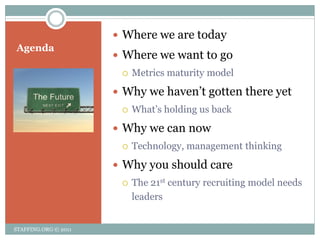
 Where we are today
Agenda
                       Where we want to go
                          Metrics maturity model
                       Why we haven’t gotten there yet
                          What’s holding us back
                       Why we can now
                          Technology, management thinking
                       Why you should care
                          The 21st century recruiting model needs
                           leaders


STAFFING.ORG © 2011
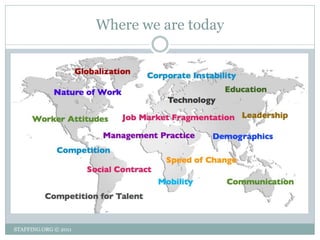
Where we are today


STAFFING.ORG © 2011
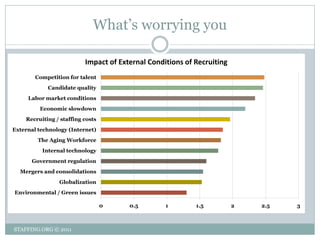
What’s worrying you

                          Impact of External Conditions of Recruiting
        Competition for talent
            Candidate quality
     Labor market conditions
         Economic slowdown
    Recruiting / staffing costs
External technology (Internet)
         The Aging Workforce
          Internal technology
      Government regulation
  Mergers and consolidations
                Globalization
Environmental / Green issues

                                  0    0.5        1        1.5          2   2.5   3


STAFFING.ORG © 2011
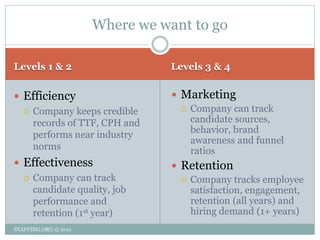
Where we want to go

Levels 1 & 2                     Levels 3 & 4


 Efficiency                      Marketing
   Company keeps credible          Company can track

    records of TTF, CPH and          candidate sources,
                                     behavior, brand
    performs near industry
                                     awareness and funnel
    norms                            ratios
 Effectiveness                   Retention
   Company can track               Company tracks employee
    candidate quality, job           satisfaction, engagement,
    performance and                  retention (all years) and
    retention (1st year)             hiring demand (1+ years)
STAFFING.ORG © 2011
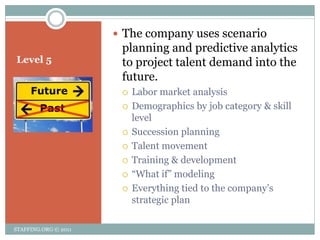
 The company uses scenario
                       planning and predictive analytics
Level 5                to project talent demand into the
                       future.
                          Labor market analysis
                          Demographics by job category & skill
                           level
                          Succession planning
                          Talent movement
                          Training & development
                          ―What if‖ modeling
                          Everything tied to the company’s
                           strategic plan

STAFFING.ORG © 2011
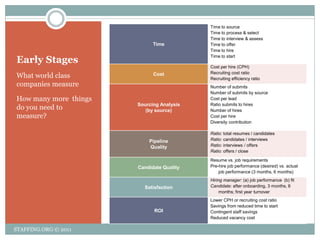
Time to source
                                           Time to process & select
                                           Time to interview & assess
                             Time          Time to offer
                                           Time to hire

Early Stages
                                           Time to start

                                           Cost per hire (CPH)
                                           Recruiting cost ratio
What world class             Cost
                                           Recruiting efficiency ratio
companies measure                          Number of submits
                                           Number of submits by source
How many more things                       Cost per lead
                       Sourcing Analysis   Ratio submits to hires
do you need to            (by source)      Number of hires
measure?                                   Cost per hire
                                           Diversity contribution

                                           Ratio: total resumes / candidates
                           Pipeline        Ratio: candidates / interviews
                           Quality         Ratio: interviews / offers
                                           Ratio: offers / close

                                           Resume vs. job requirements
                       Candidate Quality   Pre-hire job performance (desired) vs. actual
                                               job performance (3 months, 6 months)
                                           Hiring manager: (a) job performance (b) fit
                         Satisfaction      Candidate: after onboarding, 3 months, 6
                                                months; first year turnover
                                           Lower CPH or recruiting cost ratio
                                           Savings from reduced time to start
                             ROI           Contingent staff savings
                                           Reduced vacancy cost

STAFFING.ORG © 2011
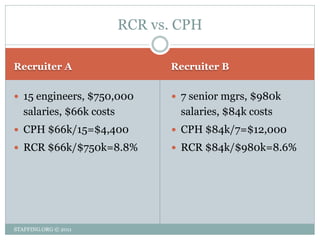
RCR vs. CPH

Recruiter A                     Recruiter B


 15 engineers, $750,000         7 senior mgrs, $980k
   salaries, $66k costs           salaries, $84k costs
 CPH $66k/15=$4,400             CPH $84k/7=$12,000
 RCR $66k/$750k=8.8%            RCR $84k/$980k=8.6%


STAFFING.ORG © 2011
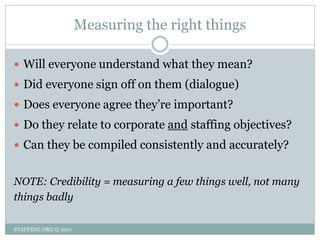
Measuring the right things

 Will everyone understand what they mean?
 Did everyone sign off on them (dialogue)
 Does everyone agree they’re important?
 Do they relate to corporate and staffing objectives?
 Can they be compiled consistently and accurately?


NOTE: Credibility = measuring a few things well, not many
things badly

STAFFING.ORG © 2011
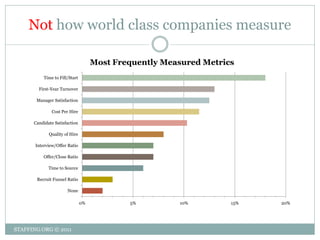
Not how world class companies measure

                                     Most Frequently Measured Metrics
           Time to Fill/Start

        First-Year Turnover

       Manager Satisfaction

               Cost Per Hire

      Candidate Satisfaction

             Quality of Hire

       Interview/Offer Ratio

           Offer/Close Ratio

             Time to Source

       Recruit Funnel Ratio

                       None

                                0%           5%         10%         15%   20%


STAFFING.ORG © 2011
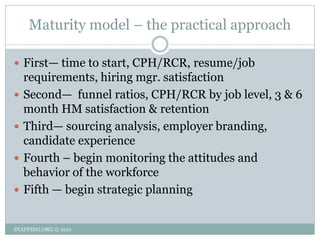
Maturity model – the practical approach

 First— time to start, CPH/RCR, resume/job
    requirements, hiring mgr. satisfaction
   Second— funnel ratios, CPH/RCR by job level, 3 & 6
    month HM satisfaction & retention
   Third— sourcing analysis, employer branding,
    candidate experience
   Fourth – begin monitoring the attitudes and
    behavior of the workforce
   Fifth — begin strategic planning


STAFFING.ORG © 2011
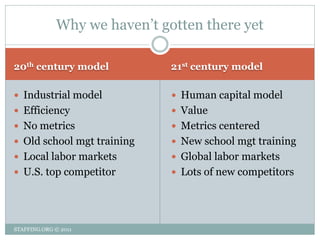
Why we haven’t gotten there yet

20th century model            21st century model

 Industrial model             Human capital model
 Efficiency                   Value
 No metrics                   Metrics centered
 Old school mgt training      New school mgt training
 Local labor markets          Global labor markets
 U.S. top competitor          Lots of new competitors


STAFFING.ORG © 2011
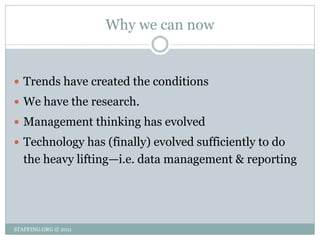
Why we can now


 Trends have created the conditions
 We have the research.
 Management thinking has evolved
 Technology has (finally) evolved sufficiently to do
   the heavy lifting—i.e. data management & reporting


STAFFING.ORG © 2011
A quick note about technology

 It’s a big, complex topic
 It’s now central to all TA and TM
 It has been frustrating forever, but it’s getting better
    very rapidly
   It needs HR ownership, not HR ―usership‖
   You don’t have to become a geek, just an educated
    user. Know what it can do and what you want it to do
   The aim isn’t complexity, it’s simplicity
   The best metrics are simple and relevant

STAFFING.ORG © 2011
Recruiting Intelligence
Using Jobvite for real-time insights into what works
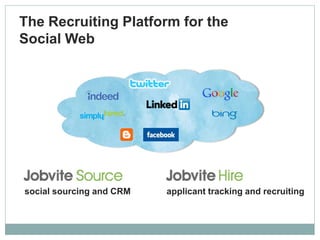
The Recruiting Platform for the
Social Web


social sourcing and CRM   applicant tracking and recruiting
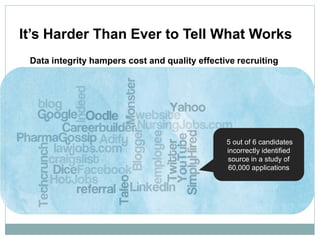
It’s Harder Than Ever to Tell What Works
 Data integrity hampers cost and quality effective recruiting


                                                5 out of 6 candidates
                                                incorrectly identified
                                                source in a study of
                                                 60,000 applications
Insights to Drive Quality, Cost and Speed

 Source performance throughout the pipeline
  for all candidate sources
 Social recruiting performance

 Career site benchmarking

 Standard and custom reporting – with drag
  and drop interface
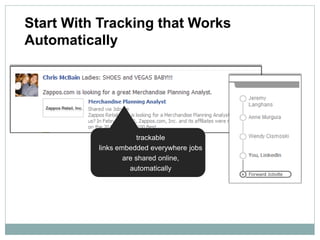
Start With Tracking that Works
Automatically


                       trackable
          links embedded everywhere jobs
                  are shared online,
                    automatically
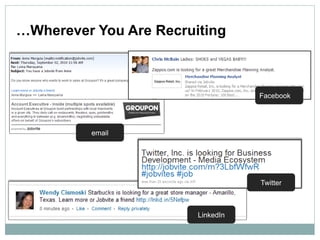
…Wherever You Are Recruiting


                                   Facebook


          email


                                   Twitter


                        LinkedIn
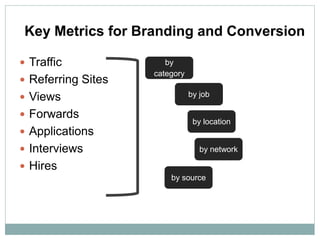
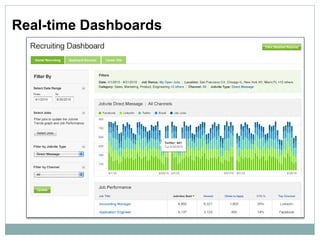
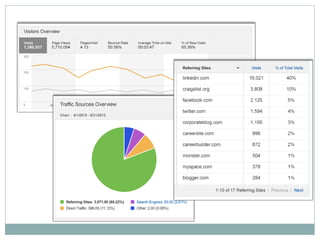
Key Metrics for Branding and Conversion

 Traffic              by
                    category
 Referring Sites
 Views                        by job

 Forwards
                                by location
 Applications
 Interviews                      by network

 Hires
                        by source
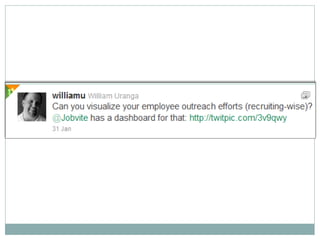
Real-time Dashboards
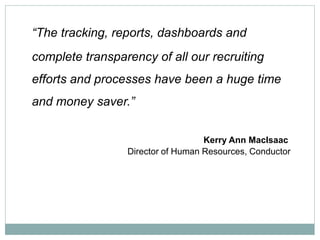
“The tracking, reports, dashboards and
complete transparency of all our recruiting
efforts and processes have been a huge time
and money saver.”


                                   Kerry Ann MacIsaac
                 Director of Human Resources, Conductor
twitter.com/jobvite
facebook.com/jobvite
linkedin.com/company/jobvite
www.jobvite.com

Jobvite Webcast: Recruiting Analytics - How Do You Stack Up?

  • 1.
    Recruiting Analytics How Do You Stack Up? DAVID EARLE, CEO STAFFING.ORG STAFFING.ORG © 2011
  • 2.
     Where weare today Agenda  Where we want to go  Metrics maturity model  Why we haven’t gotten there yet  What’s holding us back  Why we can now  Technology, management thinking  Why you should care  The 21st century recruiting model needs leaders STAFFING.ORG © 2011
  • 3.
    Where we aretoday STAFFING.ORG © 2011
  • 4.
    What’s worrying you Impact of External Conditions of Recruiting Competition for talent Candidate quality Labor market conditions Economic slowdown Recruiting / staffing costs External technology (Internet) The Aging Workforce Internal technology Government regulation Mergers and consolidations Globalization Environmental / Green issues 0 0.5 1 1.5 2 2.5 3 STAFFING.ORG © 2011
  • 5.
    Where we wantto go Levels 1 & 2 Levels 3 & 4  Efficiency  Marketing  Company keeps credible  Company can track records of TTF, CPH and candidate sources, behavior, brand performs near industry awareness and funnel norms ratios  Effectiveness  Retention  Company can track  Company tracks employee candidate quality, job satisfaction, engagement, performance and retention (all years) and retention (1st year) hiring demand (1+ years) STAFFING.ORG © 2011
  • 6.
     The companyuses scenario planning and predictive analytics Level 5 to project talent demand into the future.  Labor market analysis  Demographics by job category & skill level  Succession planning  Talent movement  Training & development  ―What if‖ modeling  Everything tied to the company’s strategic plan STAFFING.ORG © 2011
  • 7.
    Time to source Time to process & select Time to interview & assess Time Time to offer Time to hire Early Stages Time to start Cost per hire (CPH) Recruiting cost ratio What world class Cost Recruiting efficiency ratio companies measure Number of submits Number of submits by source How many more things Cost per lead Sourcing Analysis Ratio submits to hires do you need to (by source) Number of hires measure? Cost per hire Diversity contribution Ratio: total resumes / candidates Pipeline Ratio: candidates / interviews Quality Ratio: interviews / offers Ratio: offers / close Resume vs. job requirements Candidate Quality Pre-hire job performance (desired) vs. actual job performance (3 months, 6 months) Hiring manager: (a) job performance (b) fit Satisfaction Candidate: after onboarding, 3 months, 6 months; first year turnover Lower CPH or recruiting cost ratio Savings from reduced time to start ROI Contingent staff savings Reduced vacancy cost STAFFING.ORG © 2011
  • 8.
    RCR vs. CPH RecruiterA Recruiter B  15 engineers, $750,000  7 senior mgrs, $980k salaries, $66k costs salaries, $84k costs  CPH $66k/15=$4,400  CPH $84k/7=$12,000  RCR $66k/$750k=8.8%  RCR $84k/$980k=8.6% STAFFING.ORG © 2011
  • 9.
    Measuring the rightthings  Will everyone understand what they mean?  Did everyone sign off on them (dialogue)  Does everyone agree they’re important?  Do they relate to corporate and staffing objectives?  Can they be compiled consistently and accurately? NOTE: Credibility = measuring a few things well, not many things badly STAFFING.ORG © 2011
  • 10.
    Not how worldclass companies measure Most Frequently Measured Metrics Time to Fill/Start First-Year Turnover Manager Satisfaction Cost Per Hire Candidate Satisfaction Quality of Hire Interview/Offer Ratio Offer/Close Ratio Time to Source Recruit Funnel Ratio None 0% 5% 10% 15% 20% STAFFING.ORG © 2011
  • 11.
    Maturity model –the practical approach  First— time to start, CPH/RCR, resume/job requirements, hiring mgr. satisfaction  Second— funnel ratios, CPH/RCR by job level, 3 & 6 month HM satisfaction & retention  Third— sourcing analysis, employer branding, candidate experience  Fourth – begin monitoring the attitudes and behavior of the workforce  Fifth — begin strategic planning STAFFING.ORG © 2011
  • 12.
    Why we haven’tgotten there yet 20th century model 21st century model  Industrial model  Human capital model  Efficiency  Value  No metrics  Metrics centered  Old school mgt training  New school mgt training  Local labor markets  Global labor markets  U.S. top competitor  Lots of new competitors STAFFING.ORG © 2011
  • 13.
    Why we cannow  Trends have created the conditions  We have the research.  Management thinking has evolved  Technology has (finally) evolved sufficiently to do the heavy lifting—i.e. data management & reporting STAFFING.ORG © 2011
  • 14.
    A quick noteabout technology  It’s a big, complex topic  It’s now central to all TA and TM  It has been frustrating forever, but it’s getting better very rapidly  It needs HR ownership, not HR ―usership‖  You don’t have to become a geek, just an educated user. Know what it can do and what you want it to do  The aim isn’t complexity, it’s simplicity  The best metrics are simple and relevant STAFFING.ORG © 2011
  • 15.
    Recruiting Intelligence Using Jobvitefor real-time insights into what works
  • 16.
    The Recruiting Platformfor the Social Web social sourcing and CRM applicant tracking and recruiting
  • 17.
    It’s Harder ThanEver to Tell What Works Data integrity hampers cost and quality effective recruiting 5 out of 6 candidates incorrectly identified source in a study of 60,000 applications
  • 18.
    Insights to DriveQuality, Cost and Speed  Source performance throughout the pipeline for all candidate sources  Social recruiting performance  Career site benchmarking  Standard and custom reporting – with drag and drop interface
  • 19.
    Start With Trackingthat Works Automatically trackable links embedded everywhere jobs are shared online, automatically
  • 20.
    …Wherever You AreRecruiting Facebook email Twitter LinkedIn
  • 21.
    Key Metrics forBranding and Conversion  Traffic by category  Referring Sites  Views by job  Forwards by location  Applications  Interviews by network  Hires by source
  • 23.
  • 25.
    “The tracking, reports,dashboards and complete transparency of all our recruiting efforts and processes have been a huge time and money saver.” Kerry Ann MacIsaac Director of Human Resources, Conductor
  • 26.