© 2013 IBM Corporation 1
Building a business case to support your Recruitment Process
Outsourcing (RPO) decision
Dawn Pellar
dpellar@us.ibm.com
+1 248 979 5950
As an IBM solution architect and certified personnel
consultant, Dawn brings 25 years of experience in the HR
industry.
Dawn acts as a worldwide consultant designing global
recruiting solutions, working with a network of global
colleagues and clients. She has developed and leads a
global RPO exchange that shares best practices and
lessons learned from around the world. This powerful
global RPO “think tank” meets regularly with RPO subject
matter experts to discuss RPO trends.
Dawn is a graduate of Ferris State University and has
completed the executive training course at the Fuqua
School of Business at Duke University. She also has a
Global Business Management degree from the University
of Phoenix. Dawn and her family reside in Murrells Inlet,
South Carolina.
Val Egan
valerie.egan@linde.com
+1 908-771-1915
Valerie Egan is Head of Resourcing, North America for
Linde, formerly BOC, a leading gases and engineering
company. In this role, she manages the staffing function
as well as provides oversight to an outsourced vendor.
Prior to Linde, Valerie Egan was AVP, Employment
Operations with Aon Human Capital Services. In this
capacity, she supported AT&T for 7 years and specialized
in management recruitment, college/university relations and
non management staffing. Prior to joining AT&T, Valerie
worked for Merrill Lynch in New York City for 18 years in
various human resources capacities, primarily specializing
in technology recruitment, college recruiting and employee
relations.
She holds a B.S. in Marketing Management from St.
Peter's College and a Masters of Business Administration
from Pace University.
Valerie has been a member of the Morris County New
Jersey Chapter of SHRM for the past 10 years where she
has held various leadership positions. She currently holds
the Board position of Past President.
She has also spent many years as a tutor for Literacy
Volunteers of America.
Welcome to today’s
webinar hosted by the
HROA!
We’ll get started in a few minutes
© 2013 IBM Corporation 2
Building a business case to support your Recruitment Process
Outsourcing (RPO) decision
Dawn Pellar
dpellar@us.ibm.com
+1 248 979 5950
As an IBM solution architect and certified personnel
consultant, Dawn brings 25 years of experience in the HR
industry.
Dawn acts as a worldwide consultant designing global
recruiting solutions, working with a network of global
colleagues and clients. She has developed and leads a
global RPO exchange that shares best practices and
lessons learned from around the world. This powerful
global RPO “think tank” meets regularly with RPO subject
matter experts to discuss RPO trends.
Dawn is a graduate of Ferris State University and has
completed the executive training course at the Fuqua
School of Business at Duke University. She also has a
Global Business Management degree from the University
of Phoenix. Dawn and her family reside in Murrells Inlet,
South Carolina.
Val Egan
valerie.egan@linde.com
+1 908-771-1915
Valerie Egan is Head of Resourcing, North America for
Linde, formerly BOC, a leading gases and engineering
company. In this role, she manages the staffing function
as well as provides oversight to an outsourced vendor.
Prior to Linde, Valerie Egan was AVP, Employment
Operations with Aon Human Capital Services. In this
capacity, she supported AT&T for 7 years and specialized
in management recruitment, college/university relations and
non management staffing. Prior to joining AT&T, Valerie
worked for Merrill Lynch in New York City for 18 years in
various human resources capacities, primarily specializing
in technology recruitment, college recruiting and employee
relations.
She holds a B.S. in Marketing Management from St.
Peter's College and a Masters of Business Administration
from Pace University.
Valerie has been a member of the Morris County New
Jersey Chapter of SHRM for the past 10 years where she
has held various leadership positions. She currently holds
the Board position of Past President.
She has also spent many years as a tutor for Literacy
Volunteers of America.
© 2013 IBM Corporation 3
Agenda
► Welcome and introductions
► Talent acquisition trends
► Challenges in building a business case
► Collecting and understanding your data
► Goal alignment and sponsorship
► Effective communication
© 2013 IBM Corporation 4
Registration questions summarized:
Thank you for your answers!
► 69% of Attendees are RPO or HRO providers
► 31% of Attendees are HR practitioners, of these:
o 8% are 1st
generation RPO buyers
o 11% are 2nd
generation RPO buyers
o 19% have a hybrid talent acquisition model
o 62% have not participated in an RPO in the past but are
considering one
© 2013 IBM Corporation 5
Polling question
► What is the total number of annual
hires for your organization (exempt,
non-exempt, university and
executive)?
1. 0-500
2. 501-1000
3. 1001-2000
4. 2001-5000
5. 5001+
© 2013 IBM Corporation 6
Recruitment transformation: client trends (from 1st
time RPO Buyers)
► Client conversations
– Discussions HRO and RPO buyers
► Conversation RPO trends
– Recruiting “noise”
• Not the right talent (quality and quantity)
• Process is flawed (time, steps, technology, etc)
• Candidate campaigns inadequate for focus skills (critical jobs going unfilled)
• Employment brand inconsistencies (consistent, extension of culture)
• Are candidates finding us versus are we finding candidates?
– RFI / RFP initiative
– Embedded in larger initiative
• Process is imperfect
• Talent Management is broader interest
• Business case is not developed
• Lack of sponsorship
• No decision
© 2013 IBM Corporation 7
Recruitment transformation: client solution
► Response
– Provide a guideline
• White paper and recruiting cost modeler
– Smarter workforce initative
► Preparation
– Understand your business costs
– Goal alignment
– Executive sponsorship
– Implications for TA team members
– Impact on your business and geographical units
► How do you create and evaluate a business case to address these issues?
© 2013 IBM Corporation 8
► Your business case has a direct impact on your RFP
► Prospective providers need appropriate levels of information on how business
needs are connected to the broader strategic vision
► When objectives lack specificity, RFP responses are not as refined as they
should be
► Providers resort to submitting basic answers with generic lessons learned, as
opposed to more dynamic solutions tailored to your business needs
► What will your recruiting organization look like in 5 or 10 years? The impact of your
decisions today will shape your processes in the future.
► What roles will my key players have after transformation?
► Am I aligned with senior executives vision of my organization’s future?
The importance of a holistic business case for
recruitment transformation
© 2013 IBM Corporation 9
Ten factors to consider when developing an RPO
business case
1. Set realistic expectations around the time and budget commitments needed to develop a
business case
2. Identify an executive sponsor for the project
a) An executive sponsor for the project or
b) A Steering Committee of Key Stakeholders
i. Design & Implement a Mini Voice of the Customer to define key issues
ii. Involve Steering Committee in the key issues to be addressed in the RFP
iii. After down selecting to finalists, have them present to Steering Committee
iv. Allow Steering Committee to take part in the final decision
3. Recruiting is more than just technology
4. Understand how your retained organization’s role will evolve
5. Consider the impact of RPO across multiple business units and geographies
6. Ask yourself detailed questions to arrive at detailed objectives
7. Utilize an RPO cost analysis modeler
8. Use industry best practices to help evaluate what processes to retain vs. what processes to
outsource
9. Align the ultimate goals of your business case align with the C-suite’s business objectives
10. Internal support for your business case increases the likelihood for a successful conclusion to
your RFP
© 2013 IBM Corporation 10
Understanding your data – the IBM Recruiting
Cost Modeler
► How can you improve what you haven’t
or can’t measure?
– Provides a holistic analysis of your
current-state recruiting program
– Contributes to the development of a solid
recruitment process outsourcing
business case
– Provides unique data (yours) to measure
against in a credible process in which to
base decisions for recruiting
– Leverages intellectual capital and solution
architect expertise gained over numerous
engagements
© 2013 IBM Corporation 11
Overview and demonstration of the IBM Recruiting
Cost Modeler
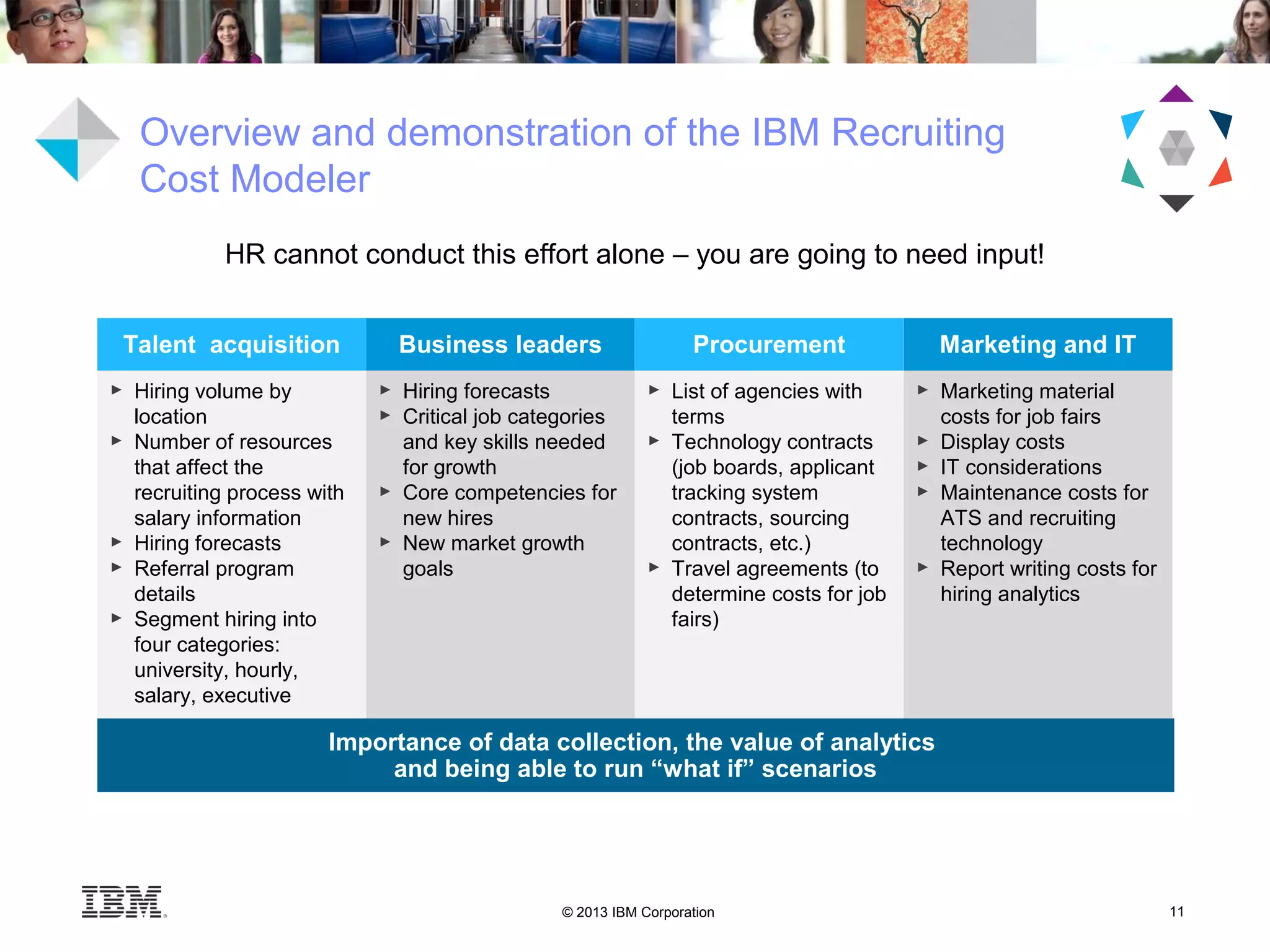
HR cannot conduct this effort alone – you are going to need input!
Importance of data collection, the value of analytics
and being able to run “what if” scenarios
Talent acquisition Business leaders Procurement Marketing and IT
► Hiring volume by
location
► Number of resources
that affect the
recruiting process with
salary information
► Hiring forecasts
► Referral program
details
► Segment hiring into
four categories:
university, hourly,
salary, executive
► Hiring forecasts
► Critical job categories
and key skills needed
for growth
► Core competencies for
new hires
► New market growth
goals
► List of agencies with
terms
► Technology contracts
(job boards, applicant
tracking system
contracts, sourcing
contracts, etc.)
► Travel agreements (to
determine costs for job
fairs)
► Marketing material
costs for job fairs
► Display costs
► IT considerations
► Maintenance costs for
ATS and recruiting
technology
► Report writing costs for
hiring analytics
© 2013 IBM Corporation 12
Polling question
► Do you know the cost per hire for
your organization?
1. Yes
2. No
© 2013 IBM Corporation 13
Demonstration of the IBM Recruiting Cost Modeler
© 2013 IBM Corporation 14
Summary of benefits to the IBM Recruiting
Cost Modeler
► Provides a holistic analysis of your current recruiting program
► Contributes to the development of a solid recruitment process outsourcing
business case
► Leverages intellectual capital and solution architect expertise gained over
numerous engagements
► Logically analyzes costs in your recruiting organization
– Hiring data
– Recruiting costs
– Staffing
► Provides you internal and external benchmarking options
► Builds a detailed view of people, process and technology
► Presents actionable outcomes
© 2013 IBM Corporation 15
Polling question
► How do you benchmark your costs per
hire?
1. We benchmark internally
2. We benchmark with external research
3. We do not benchmark
© 2013 IBM Corporation 16
Talent acquisition transformation: How good do I need
to be?
1. Talent acquisition process
– Meeting the needs of the business
– Adjust for varying business needs (white glove, volume hiring projects)
– Cost per hire
1. Talent acquisition staff
– The right resource for the activity
– Strategic versus tactical
– Involvement with business decisions
1. Technology
– Enablement for recruiting
– Create a technology eco-system that helps you run talent acquisition
© 2013 IBM Corporation 17
1. Aligning talent acquisition to company goals
– Do we have a sustainable / flexible talent acquisition model?
– Do we have an integrated technology platform?
– Have we leveraged innovation to streamline processes?
1. Cost savings
– Do we have a clear understanding of where are costs are today?
– Do we understand the impact of building a new infrastructure?
– Can we show year-over-year cost savings as the new model is implemented?
1. Process efficiency
– Do we have the “right” resources doing the work?
– Do we have harmonized systems?
– Are we leveraging technology and innovation?
How to present efficiencies and cost savings
to leadership
© 2013 IBM Corporation 18
Val Egan
Dawn Pellar
dpellar@us.ibm.com
+1 248 979 5950
Question and answer exchange
Questions?
‫أسئلة؟‬
问题吗 ?
Fragen?
Le domande?
¿Las preguntas?
Frågor?
© 2013 IBM Corporation 19
About HROA
► Founded in 2003 - Global association
► Open to anyone in the HR Outsourcing and
Transformation industry anywhere in the world:
practitioner, buyer, provider, technology firm, advisor,
consultant, or academic.
► Mission to be the single recognized community for
improving the quality, effectiveness, and efficiency
of outsourcing as part of an overall HR service delivery
strategy.
► www.hroa.org

Building a Business Case to Support Your RPO Decision

  • 1.
    © 2013 IBMCorporation 1 Building a business case to support your Recruitment Process Outsourcing (RPO) decision Dawn Pellar dpellar@us.ibm.com +1 248 979 5950 As an IBM solution architect and certified personnel consultant, Dawn brings 25 years of experience in the HR industry. Dawn acts as a worldwide consultant designing global recruiting solutions, working with a network of global colleagues and clients. She has developed and leads a global RPO exchange that shares best practices and lessons learned from around the world. This powerful global RPO “think tank” meets regularly with RPO subject matter experts to discuss RPO trends. Dawn is a graduate of Ferris State University and has completed the executive training course at the Fuqua School of Business at Duke University. She also has a Global Business Management degree from the University of Phoenix. Dawn and her family reside in Murrells Inlet, South Carolina. Val Egan valerie.egan@linde.com +1 908-771-1915 Valerie Egan is Head of Resourcing, North America for Linde, formerly BOC, a leading gases and engineering company. In this role, she manages the staffing function as well as provides oversight to an outsourced vendor. Prior to Linde, Valerie Egan was AVP, Employment Operations with Aon Human Capital Services. In this capacity, she supported AT&T for 7 years and specialized in management recruitment, college/university relations and non management staffing. Prior to joining AT&T, Valerie worked for Merrill Lynch in New York City for 18 years in various human resources capacities, primarily specializing in technology recruitment, college recruiting and employee relations. She holds a B.S. in Marketing Management from St. Peter's College and a Masters of Business Administration from Pace University. Valerie has been a member of the Morris County New Jersey Chapter of SHRM for the past 10 years where she has held various leadership positions. She currently holds the Board position of Past President. She has also spent many years as a tutor for Literacy Volunteers of America. Welcome to today’s webinar hosted by the HROA! We’ll get started in a few minutes
  • 2.
    © 2013 IBMCorporation 2 Building a business case to support your Recruitment Process Outsourcing (RPO) decision Dawn Pellar dpellar@us.ibm.com +1 248 979 5950 As an IBM solution architect and certified personnel consultant, Dawn brings 25 years of experience in the HR industry. Dawn acts as a worldwide consultant designing global recruiting solutions, working with a network of global colleagues and clients. She has developed and leads a global RPO exchange that shares best practices and lessons learned from around the world. This powerful global RPO “think tank” meets regularly with RPO subject matter experts to discuss RPO trends. Dawn is a graduate of Ferris State University and has completed the executive training course at the Fuqua School of Business at Duke University. She also has a Global Business Management degree from the University of Phoenix. Dawn and her family reside in Murrells Inlet, South Carolina. Val Egan valerie.egan@linde.com +1 908-771-1915 Valerie Egan is Head of Resourcing, North America for Linde, formerly BOC, a leading gases and engineering company. In this role, she manages the staffing function as well as provides oversight to an outsourced vendor. Prior to Linde, Valerie Egan was AVP, Employment Operations with Aon Human Capital Services. In this capacity, she supported AT&T for 7 years and specialized in management recruitment, college/university relations and non management staffing. Prior to joining AT&T, Valerie worked for Merrill Lynch in New York City for 18 years in various human resources capacities, primarily specializing in technology recruitment, college recruiting and employee relations. She holds a B.S. in Marketing Management from St. Peter's College and a Masters of Business Administration from Pace University. Valerie has been a member of the Morris County New Jersey Chapter of SHRM for the past 10 years where she has held various leadership positions. She currently holds the Board position of Past President. She has also spent many years as a tutor for Literacy Volunteers of America.
  • 3.
    © 2013 IBMCorporation 3 Agenda ► Welcome and introductions ► Talent acquisition trends ► Challenges in building a business case ► Collecting and understanding your data ► Goal alignment and sponsorship ► Effective communication
  • 4.
    © 2013 IBMCorporation 4 Registration questions summarized: Thank you for your answers! ► 69% of Attendees are RPO or HRO providers ► 31% of Attendees are HR practitioners, of these: o 8% are 1st generation RPO buyers o 11% are 2nd generation RPO buyers o 19% have a hybrid talent acquisition model o 62% have not participated in an RPO in the past but are considering one
  • 5.
    © 2013 IBMCorporation 5 Polling question ► What is the total number of annual hires for your organization (exempt, non-exempt, university and executive)? 1. 0-500 2. 501-1000 3. 1001-2000 4. 2001-5000 5. 5001+
  • 6.
    © 2013 IBMCorporation 6 Recruitment transformation: client trends (from 1st time RPO Buyers) ► Client conversations – Discussions HRO and RPO buyers ► Conversation RPO trends – Recruiting “noise” • Not the right talent (quality and quantity) • Process is flawed (time, steps, technology, etc) • Candidate campaigns inadequate for focus skills (critical jobs going unfilled) • Employment brand inconsistencies (consistent, extension of culture) • Are candidates finding us versus are we finding candidates? – RFI / RFP initiative – Embedded in larger initiative • Process is imperfect • Talent Management is broader interest • Business case is not developed • Lack of sponsorship • No decision
  • 7.
    © 2013 IBMCorporation 7 Recruitment transformation: client solution ► Response – Provide a guideline • White paper and recruiting cost modeler – Smarter workforce initative ► Preparation – Understand your business costs – Goal alignment – Executive sponsorship – Implications for TA team members – Impact on your business and geographical units ► How do you create and evaluate a business case to address these issues?
  • 8.
    © 2013 IBMCorporation 8 ► Your business case has a direct impact on your RFP ► Prospective providers need appropriate levels of information on how business needs are connected to the broader strategic vision ► When objectives lack specificity, RFP responses are not as refined as they should be ► Providers resort to submitting basic answers with generic lessons learned, as opposed to more dynamic solutions tailored to your business needs ► What will your recruiting organization look like in 5 or 10 years? The impact of your decisions today will shape your processes in the future. ► What roles will my key players have after transformation? ► Am I aligned with senior executives vision of my organization’s future? The importance of a holistic business case for recruitment transformation
  • 9.
    © 2013 IBMCorporation 9 Ten factors to consider when developing an RPO business case 1. Set realistic expectations around the time and budget commitments needed to develop a business case 2. Identify an executive sponsor for the project a) An executive sponsor for the project or b) A Steering Committee of Key Stakeholders i. Design & Implement a Mini Voice of the Customer to define key issues ii. Involve Steering Committee in the key issues to be addressed in the RFP iii. After down selecting to finalists, have them present to Steering Committee iv. Allow Steering Committee to take part in the final decision 3. Recruiting is more than just technology 4. Understand how your retained organization’s role will evolve 5. Consider the impact of RPO across multiple business units and geographies 6. Ask yourself detailed questions to arrive at detailed objectives 7. Utilize an RPO cost analysis modeler 8. Use industry best practices to help evaluate what processes to retain vs. what processes to outsource 9. Align the ultimate goals of your business case align with the C-suite’s business objectives 10. Internal support for your business case increases the likelihood for a successful conclusion to your RFP
  • 10.
    © 2013 IBMCorporation 10 Understanding your data – the IBM Recruiting Cost Modeler ► How can you improve what you haven’t or can’t measure? – Provides a holistic analysis of your current-state recruiting program – Contributes to the development of a solid recruitment process outsourcing business case – Provides unique data (yours) to measure against in a credible process in which to base decisions for recruiting – Leverages intellectual capital and solution architect expertise gained over numerous engagements
  • 11.
    © 2013 IBMCorporation 11 Overview and demonstration of the IBM Recruiting Cost Modeler HR cannot conduct this effort alone – you are going to need input! Importance of data collection, the value of analytics and being able to run “what if” scenarios Talent acquisition Business leaders Procurement Marketing and IT ► Hiring volume by location ► Number of resources that affect the recruiting process with salary information ► Hiring forecasts ► Referral program details ► Segment hiring into four categories: university, hourly, salary, executive ► Hiring forecasts ► Critical job categories and key skills needed for growth ► Core competencies for new hires ► New market growth goals ► List of agencies with terms ► Technology contracts (job boards, applicant tracking system contracts, sourcing contracts, etc.) ► Travel agreements (to determine costs for job fairs) ► Marketing material costs for job fairs ► Display costs ► IT considerations ► Maintenance costs for ATS and recruiting technology ► Report writing costs for hiring analytics
  • 12.
    © 2013 IBMCorporation 12 Polling question ► Do you know the cost per hire for your organization? 1. Yes 2. No
  • 13.
    © 2013 IBMCorporation 13 Demonstration of the IBM Recruiting Cost Modeler
  • 14.
    © 2013 IBMCorporation 14 Summary of benefits to the IBM Recruiting Cost Modeler ► Provides a holistic analysis of your current recruiting program ► Contributes to the development of a solid recruitment process outsourcing business case ► Leverages intellectual capital and solution architect expertise gained over numerous engagements ► Logically analyzes costs in your recruiting organization – Hiring data – Recruiting costs – Staffing ► Provides you internal and external benchmarking options ► Builds a detailed view of people, process and technology ► Presents actionable outcomes
  • 15.
    © 2013 IBMCorporation 15 Polling question ► How do you benchmark your costs per hire? 1. We benchmark internally 2. We benchmark with external research 3. We do not benchmark
  • 16.
    © 2013 IBMCorporation 16 Talent acquisition transformation: How good do I need to be? 1. Talent acquisition process – Meeting the needs of the business – Adjust for varying business needs (white glove, volume hiring projects) – Cost per hire 1. Talent acquisition staff – The right resource for the activity – Strategic versus tactical – Involvement with business decisions 1. Technology – Enablement for recruiting – Create a technology eco-system that helps you run talent acquisition
  • 17.
    © 2013 IBMCorporation 17 1. Aligning talent acquisition to company goals – Do we have a sustainable / flexible talent acquisition model? – Do we have an integrated technology platform? – Have we leveraged innovation to streamline processes? 1. Cost savings – Do we have a clear understanding of where are costs are today? – Do we understand the impact of building a new infrastructure? – Can we show year-over-year cost savings as the new model is implemented? 1. Process efficiency – Do we have the “right” resources doing the work? – Do we have harmonized systems? – Are we leveraging technology and innovation? How to present efficiencies and cost savings to leadership
  • 18.
    © 2013 IBMCorporation 18 Val Egan Dawn Pellar dpellar@us.ibm.com +1 248 979 5950 Question and answer exchange Questions? ‫أسئلة؟‬ 问题吗 ? Fragen? Le domande? ¿Las preguntas? Frågor?
  • 19.
    © 2013 IBMCorporation 19 About HROA ► Founded in 2003 - Global association ► Open to anyone in the HR Outsourcing and Transformation industry anywhere in the world: practitioner, buyer, provider, technology firm, advisor, consultant, or academic. ► Mission to be the single recognized community for improving the quality, effectiveness, and efficiency of outsourcing as part of an overall HR service delivery strategy. ► www.hroa.org

Editor's Notes

  • #2 Dawn
  • #3 Dawn
  • #4 Dawn
  • #5 Dawn
  • #6 Dawn
  • #7 Dawn
  • #8 Dawn
  • #9 Dawn
  • #10 Val
  • #11 Val
  • #12 Val
  • #13 Val
  • #14 Dawn
  • #15 Dawn
  • #16 Dawn Presenter
  • #17 Dawn Presenter Most organizations measure your TA transformation in three categories…Process, people and technology. Your process can be measured by your internal clients…your business leaders, your hiring managers, your candidate experience and your new employee satisfaction. These client groups may not have the same processes – some may require white glove or a concierge type service, while others may have a more automated process that is technology driven. Measure your cost per hire – which is an important data point to consider when evaluating your job families and the value to the organization – but not everyone within your organization will focus on the cost per hire, they may focus on the quality of hire…how long does the employee stay with the organization, what level of contribution do they make? This type of data can provide more insight for a CFO or Business Leader to plan for growth. Measure your resources – is the appropriate resource doing the appropriate job. Not just from a cost standpoint, but from a job satisfaction standpoint…do you want your TA team focused on tactical recruiting activities or strategic activities? How often is the TA team involved with business staff meetings, are they presenting helpful TA data to business leaders that can drive growth? Measure your technology – as Dave mentioned – technology enables the process, but is it adequate? Do you have a technology eco-system that meets all your TA needs? Do you have technologies that will enable your organization’s Smarter Recruiting efforts? A TA technology eco-system may include providers for an applicant tracking system, social media campaigns, employee surveys, onboarding, performance management, talent management, etc. Is your eco-system meeting today’s needs and the needs of your business in the future?
  • #18 Dawn Presenter To summarize; we have talked about some key topics to building a business case for evaluating your Recruiting Organization…when you have done the work, you have followed the guideline and have worked through the cost modeler to establish your baseline costs – you need to present your information to your executives. Formulate your message into these three categories, Alignment to corp goals – make the link – show how your initiative supports the org’s goals. Make this specific, align each of your leader’s goals with a goal related to talent. Cost Savings – can we objectively measure cost savings? Is there an ROI? Where you can, be very specific – if an RPO solution is the right course – show where the efficiency will occur – lowering your cost for agency usage, improving your corporate brand, reducing the attrition in key roles. Process efficiency – resource allocation, harmonized systems, does this solution create a Smarter Recruiting strategy that positions your organization to attract the best talent in your industry? Well – we hope we were successful in providing you with a clear outline on how to streamline your RPO RFP by building an effective business case. We will open it up for a few questions. If we are not able to address all the questions – feel free to email us with your question and we will be sure to provide you a response.
  • #19 Dawn and Val Wrap up