Designing a
Training
Program
 To determine what the organization needs in terms of
training. It involves analyzing the organization’s
needs: the knowledge, skills and ability needed to
perform the job; and the person or job holders needs.
 The organizational needs assessment requires an
examination of the long and short term objectives of
the organization, the financial, social, human
resource, growth and market objectives need to be
matched with the organization’s human talent,
structure, climate and efficiency.
 Typically, objectives, ratios, organization charts,
historical records on absenteeism, quality of
production, efficiency and performance appraisal will
be carefully reviewed.
1. Determining Needs and Objectives
What are the tasks? What skills are
needed to perform well? Data from
current employees, supervisors and
experts must be collected to
complete this part of assessment.
The employee’s need must also be considered.
Asking people what their needs are on the job and
asking them to perform tasks can provide
information and data. Examining the employee’s
performance against a standard or compared with
that of co-workers can help identify strengths,
weaknesses and needs
Determining if a person can do
the job is an important step in
improving the organization’s
ability to match the person with
the best job for him/her
Focus on the person’s need is especially important. It
is at the individual or group level that training is
conducted. Reviewing the HR strategic plan and
various job analyses may help you see what kind of
training should be developed for specific job titles in
your organization.
The process of analyzing needs and
developing a training program can be
accomplished by the organization’s
trainers. HR specialist or hired
consultants who reports to HR
manager or other top managers are
also used to perform needs analysis
and to the conduct the training.
Personal characteristics such as ability to speak well,
to write convincingly, to organize the work of others, to be
inventive, and to inspire others to greater are important
factors in the selection of trainers. Although formal training
is performed by professional trainers. Often, managers may
be the best trainers. Technically, especially, if a qualified
trainer helps them prepare the material.
2. Choosing Trainers and Trainees
The success of the
training program depends on
proper selection of the person
who performs the training
task
Another planning factor is the selection of
trainees who will participate in the programs.
The program maybe designed to train
particular new employees in certain skills.
In some cases, the
training program is
designed to help attain
goals, in others, those
who will attend maybe
provided or receive
higher wages or salaries
as a result
a. On the job training. Probably the most
used method of raining (formal and informal).
The employee is placed into the real work
situation and shown the job by experienced
employee or supervisor. Although the OJT is
relatively simple and cost less. If it is not
handled properly the cost can be high like:
damaged machinery, unsatisfied customers,
misfiled forms, and poor taught workers.
3. Selection of Content and Methods
to be Used.
b. Case method. Case method which uses a written
description of a real decision making situation or a
situation that occurred in another organization.
Managers are asked to study the case to identify the
problem, analyze the problem for their significance,
propose solutions, choose the best solutions to
implement.
The instructor role is that of a catalyst and facilitator. A
good facilitator is able to get everyone involved in solving
the problem. With good instructors and good cases, the
case method is a very effective device for improving and
clarifying rational decision making.]
This a cross between the case method and an
attitude development program. Each person is
assigned a role in a situation and asked to play the
role and to react to other players’ role playing.
Usually, a brief script is provided to participants.
Sometimes the role playing is videotaped and
reanalyzed as part of the development situation.
Often, Role playing is done in a small group. The
success of this method depends on the ability of the
players to play the assigned roles believably. If done
well, role playing can help a manager become more
aware of and more sensitive to the feelings of others.
c. Role Playing
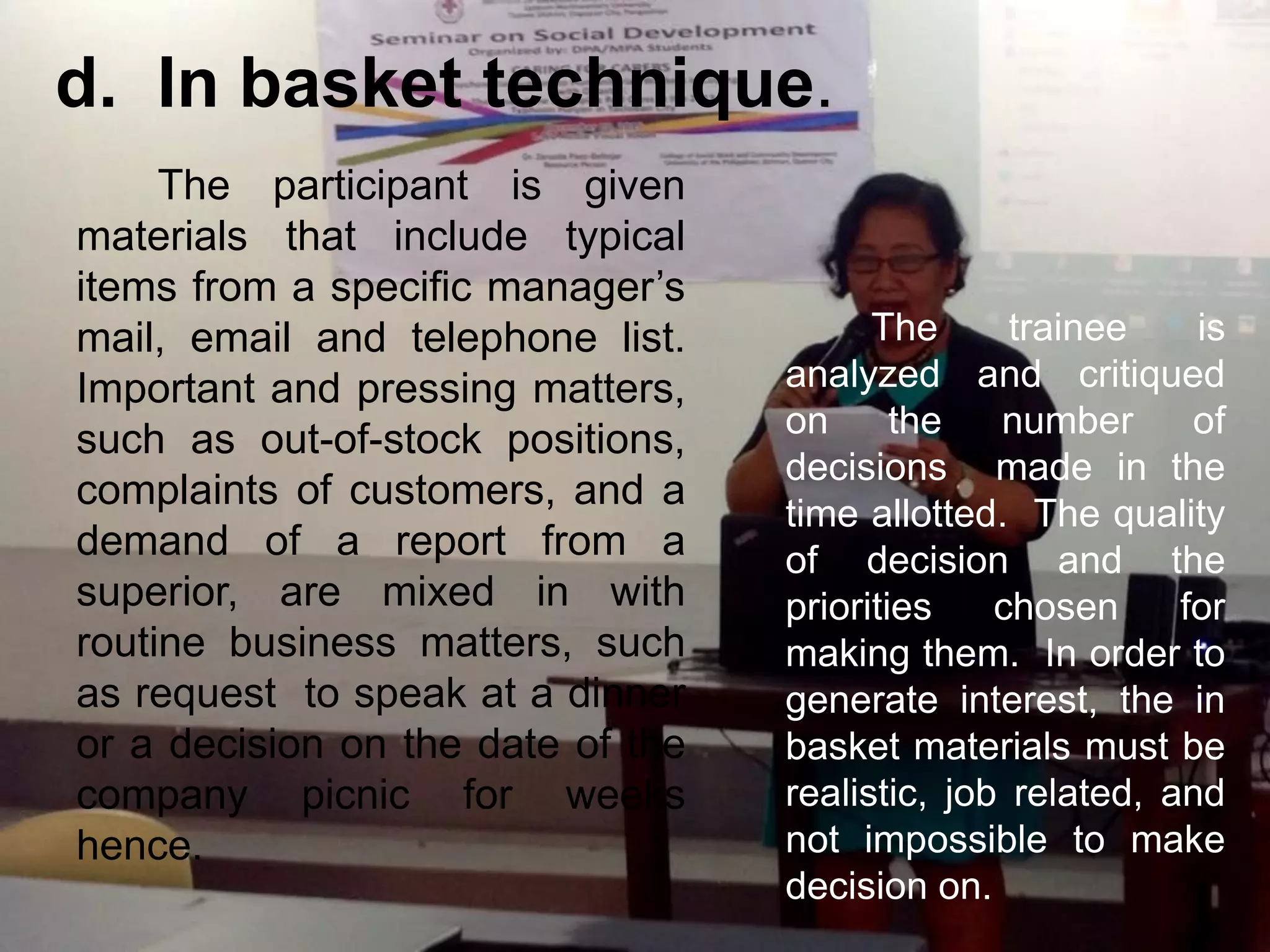
The participant is given
materials that include typical
items from a specific manager’s
mail, email and telephone list.
Important and pressing matters,
such as out-of-stock positions,
complaints of customers, and a
demand of a report from a
superior, are mixed in with
routine business matters, such
as request to speak at a dinner
or a decision on the date of the
company picnic for weeks
hence.
d. In basket technique.
The trainee is
analyzed and critiqued
on the number of
decisions made in the
time allotted. The quality
of decision and the
priorities chosen for
making them. In order to
generate interest, the in
basket materials must be
realistic, job related, and
not impossible to make
decision on.
e. Management Games
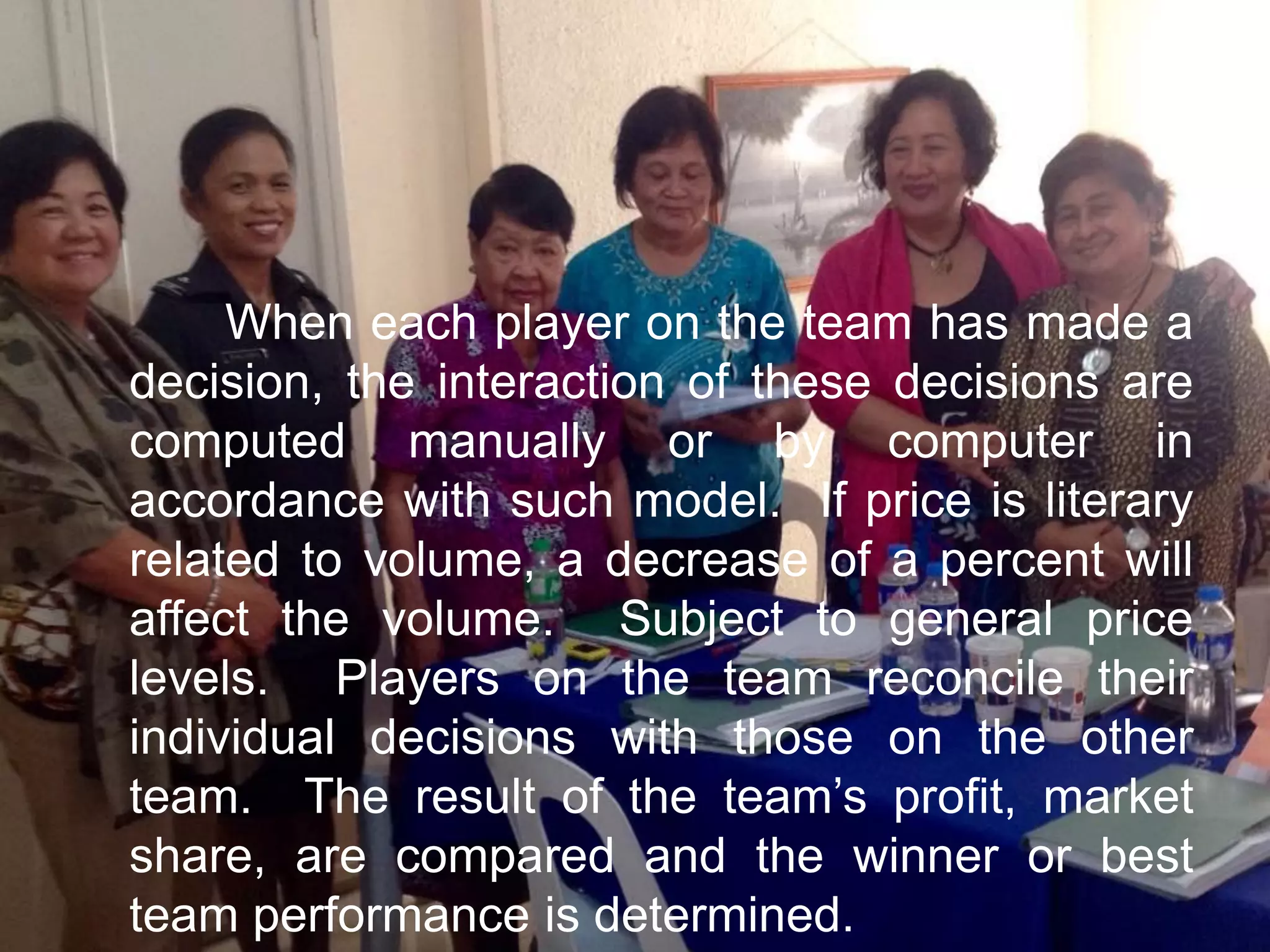
When each player on the team has made
a decision, the interaction of these decisions are
computed manually or by computer in accordance
with such model. If price is literary related to volume, a decrease of a percent will
affect the volume. Subject to general price levels. Players on the team reconcile
their individual decisions with those on the other team. The result of the team’s
profit, market share, are compared and the winner or best team performance is
determined
Essentially, management games describe the operating
characteristics of a company, industry or enterprise. These
descriptions take the form of equations that are manipulated
after decision have been made. In a typical computerized
management game procedure, teams of players are asked to
make a series of operating for top management decisions. In
one game, the players are asked to decide on the process of
product, purchase of materials, production, scheduling, fund
borrowing, marketing, and R & D expenditures.
When each player on the team has made a
decision, the interaction of these decisions are
computed manually or by computer in
accordance with such model. If price is literary
related to volume, a decrease of a percent will
affect the volume. Subject to general price
levels. Players on the team reconcile their
individual decisions with those on the other
team. The result of the team’s profit, market
share, are compared and the winner or best
team performance is determined.
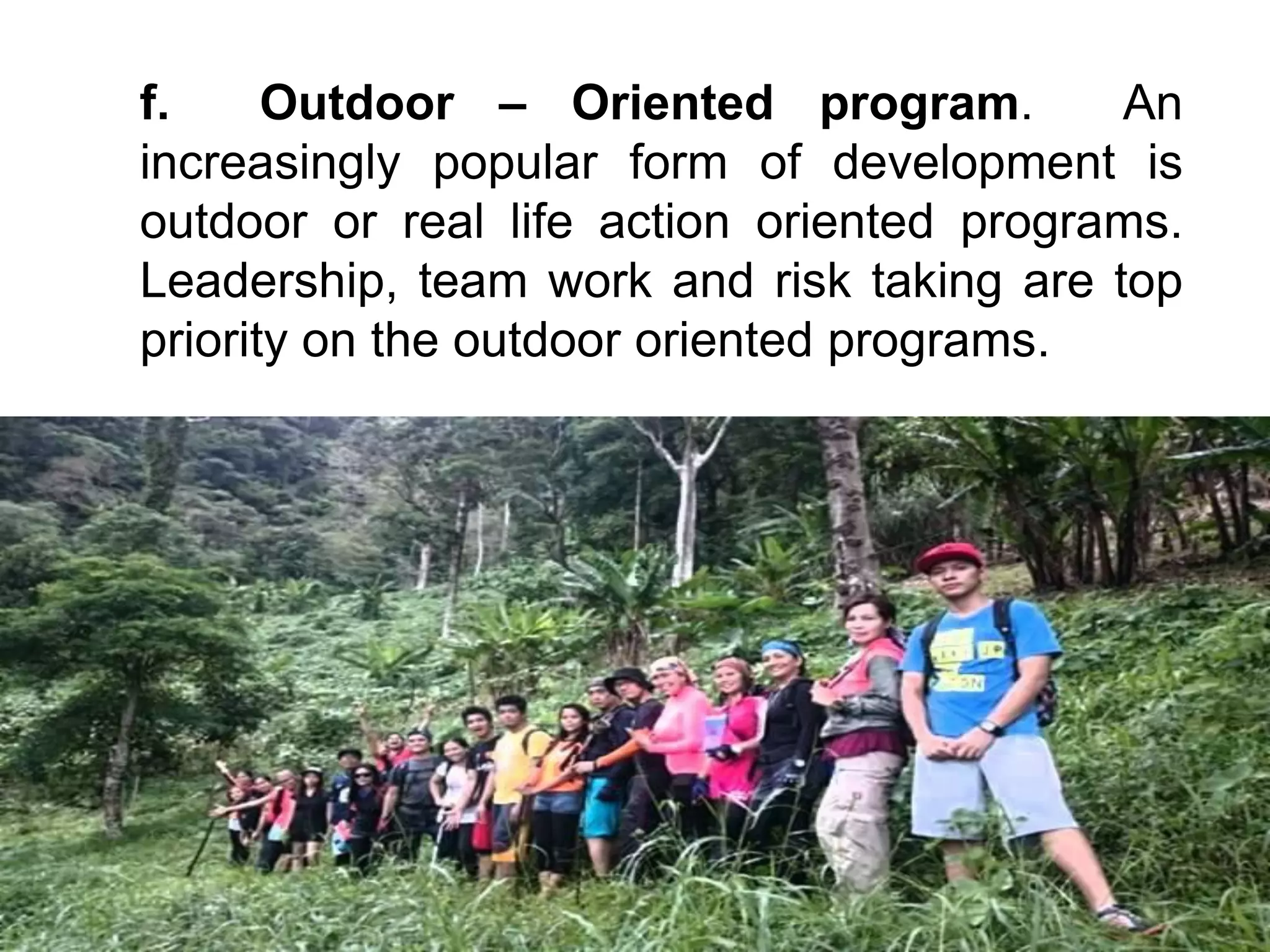
f. Outdoor – Oriented program. An
increasingly popular form of development is
outdoor or real life action oriented programs.
Leadership, team work and risk taking are top
priority on the outdoor oriented programs.
The most frequently used
training method is for the trainer
to give a lecture and involve the
trainee in a discussion of the
materials to be learned.
Effective classroom presentation
supplements lecture with audio
visual aids such as blackboards,
slides and mock ups.
g. Lecture Discussion Approach
The nature of corporate training is
changing. The trainer is quickly evolving
into someone who facilitates, guides,
and acts a mentor for employers and
employees, helping them to find and use
the best and most timely training
available from SUCs, or training
providers.
h. Distance Training or Distance Learning
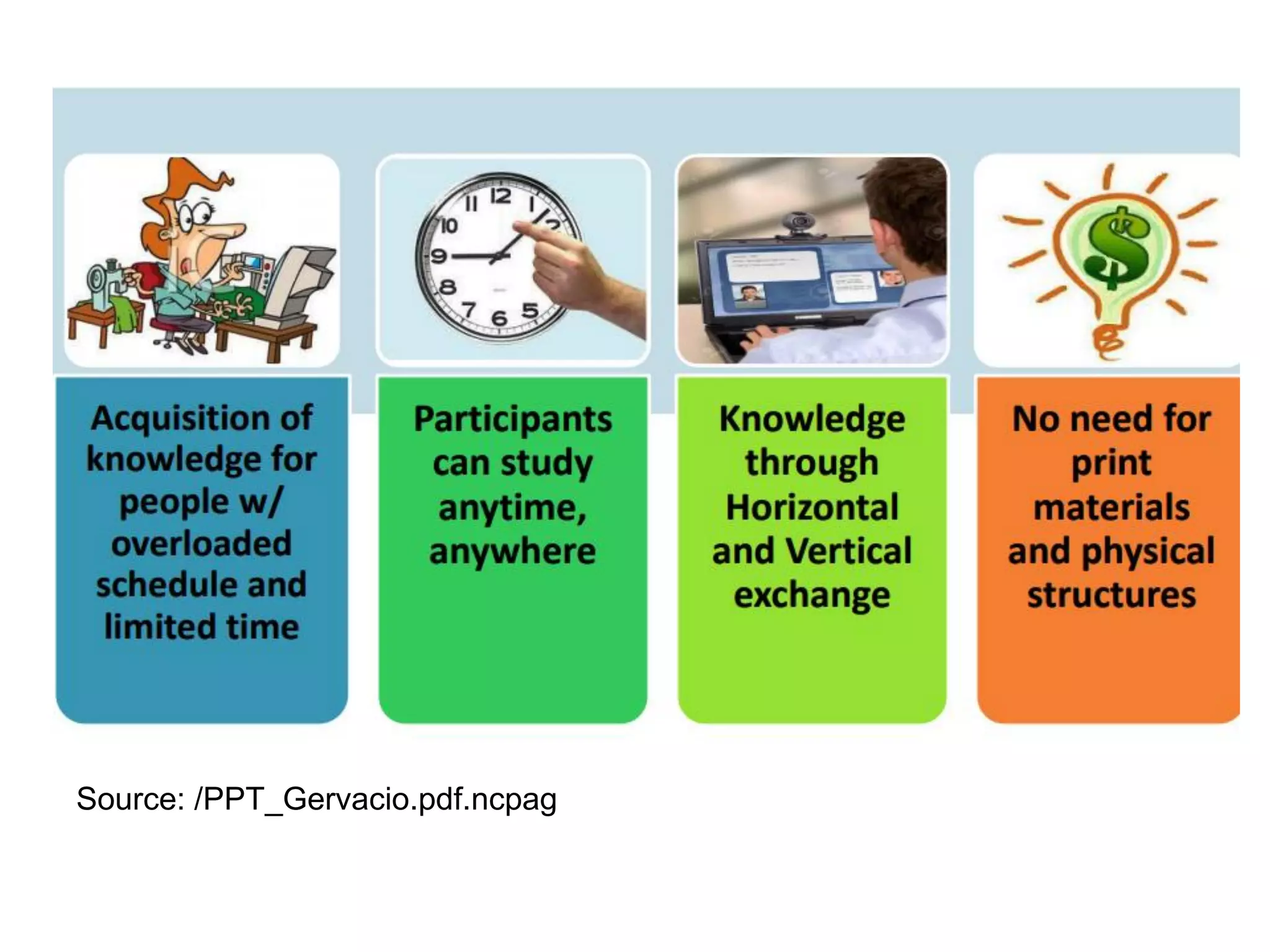
E-learning is the
process of acquiring
knowledge and applying that
information in potentially
unanticipated ways. While
training teaches employees
protocol for specific
situations, learning enables
staff members to overcome
non-specific issues that
suddenly arise on their own.
i. e-learning and e-training
In essence, training
may ready
employees for
expected situations,
while learning
prepares workers for
the unexpected (e-
learning, obviously,
does this in an
online setting
E-training on the other hand, focuses on helping
employees develop the skills they need to
perform specific tasks. This includes providing
information regarding certain processes and day-
to-day operations. E-training does this in an
online environment
Source: /PPT_Gervacio.pdf.ncpag
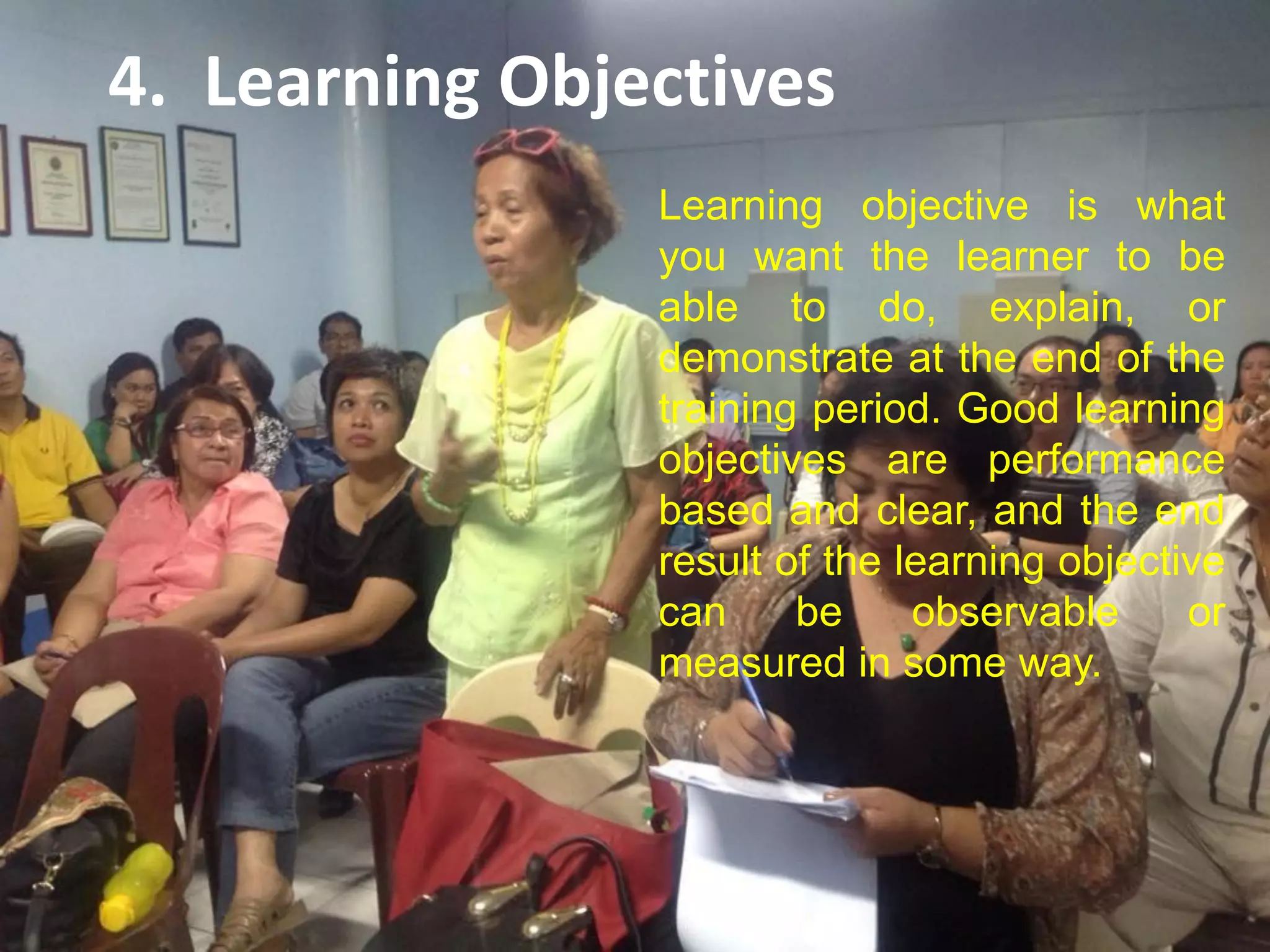
4. Learning Objectives
Learning objective is what
you want the learner to be
able to do, explain, or
demonstrate at the end of the
training period. Good learning
objectives are performance
based and clear, and the end
result of the learning objective
can be observable or
measured in some way.
5. Budget
The type of training performed will depend greatly on
the budget. If you decide that web-based training is the right
delivery mode, but you don’t have the budget to pay the
user fee for the platform, this wouldn’t be the best option.
Besides the actual cost of training, another cost
consideration is people’s time. If employees are in training
for two hours, what is the cost to the organization while they
are not able to perform their job? A spreadsheet should be
developed that lists the actual cost for materials, snacks,
and other direct costs, but also the indirect costs, such as
people’s time.
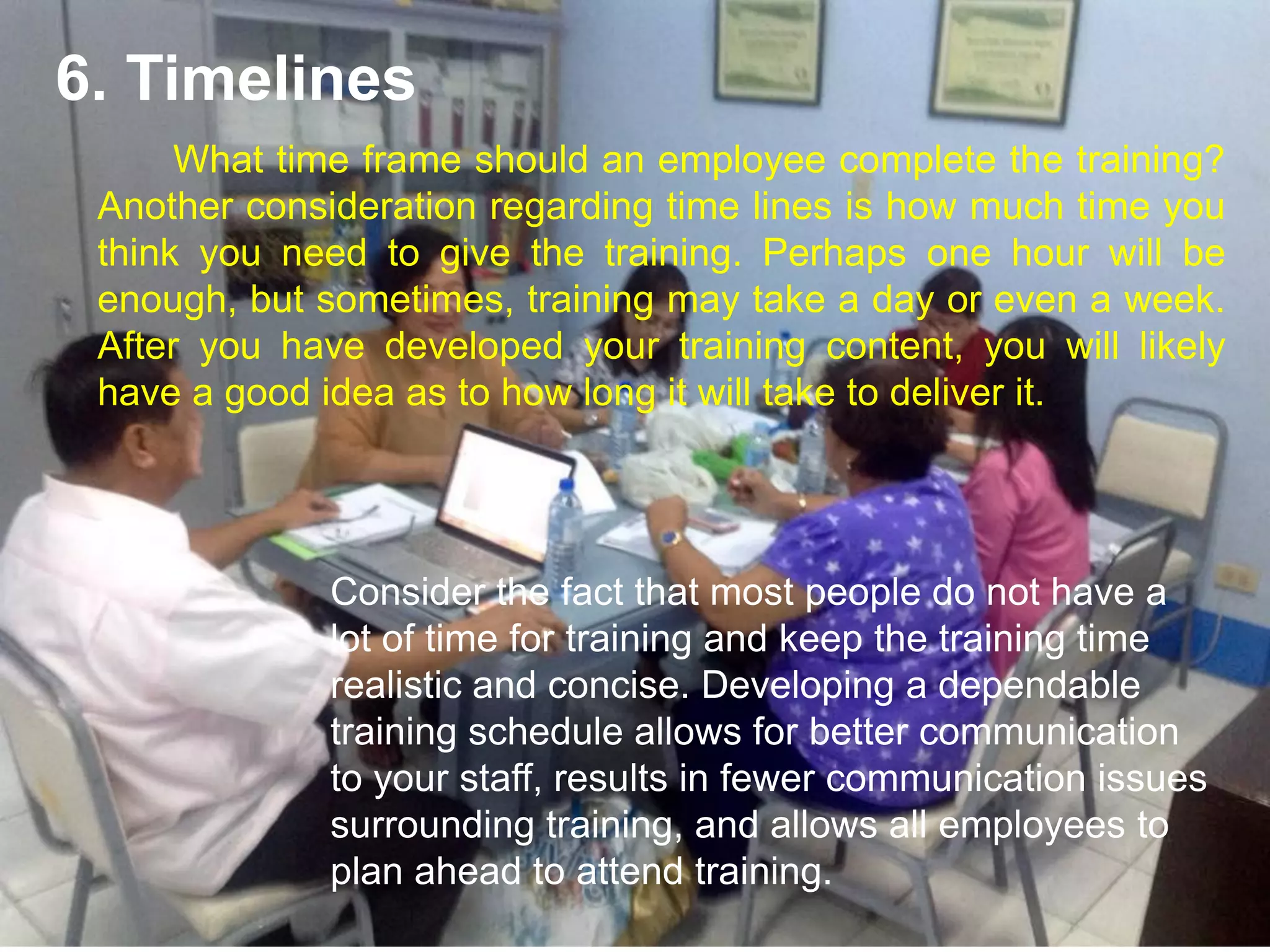
What time frame should an employee complete the training?
Another consideration regarding time lines is how much time you
think you need to give the training. Perhaps one hour will be
enough, but sometimes, training may take a day or even a week.
After you have developed your training content, you will likely
have a good idea as to how long it will take to deliver it.
6. Timelines
Consider the fact that most people do not have a
lot of time for training and keep the training time
realistic and concise. Developing a dependable
training schedule allows for better communication
to your staff, results in fewer communication issues
surrounding training, and allows all employees to
plan ahead to attend training.
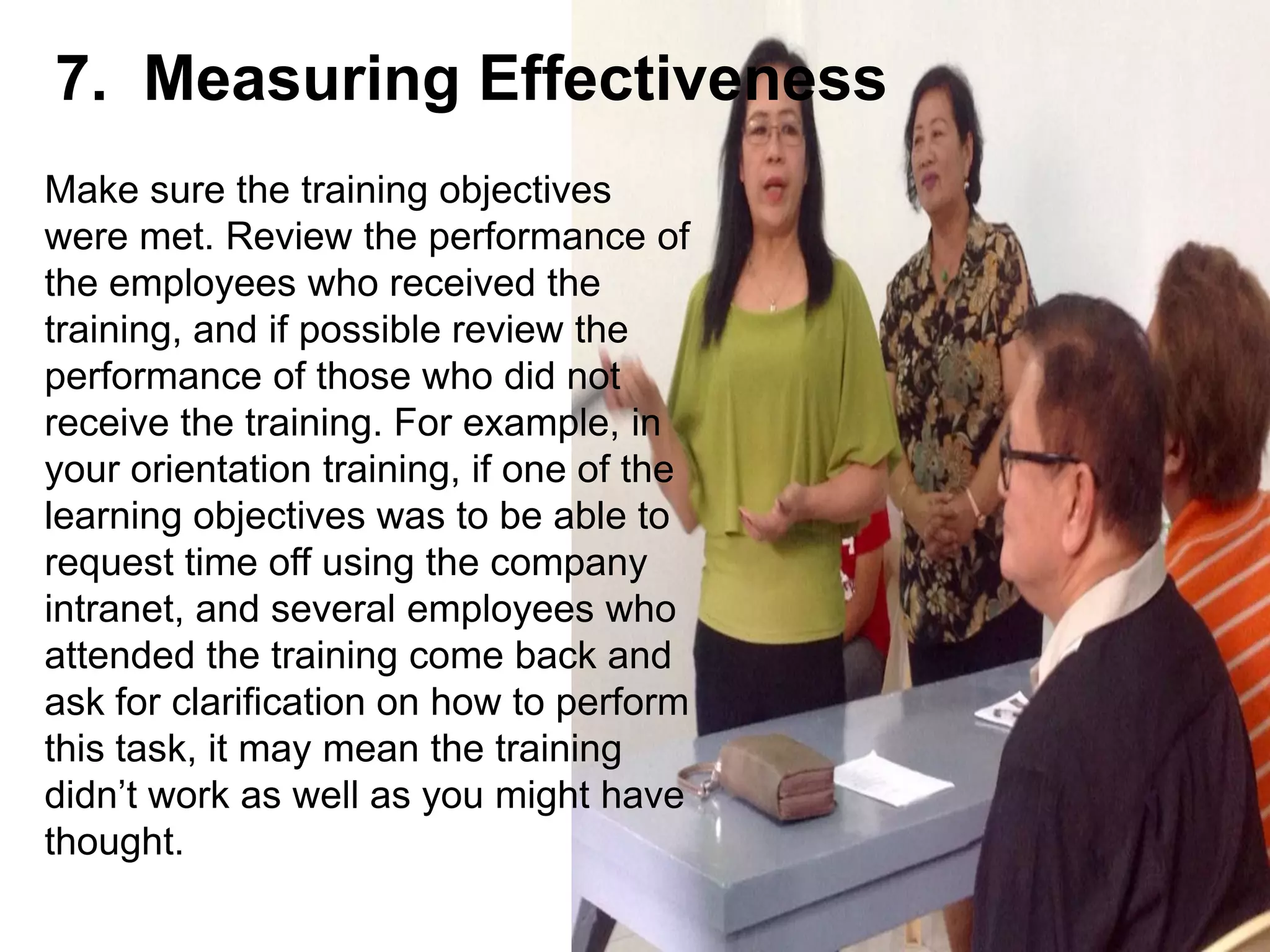
Make sure the training objectives
were met. Review the performance of
the employees who received the
training, and if possible review the
performance of those who did not
receive the training. For example, in
your orientation training, if one of the
learning objectives was to be able to
request time off using the company
intranet, and several employees who
attended the training come back and
ask for clarification on how to perform
this task, it may mean the training
didn’t work as well as you might have
thought.
7. Measuring Effectiveness
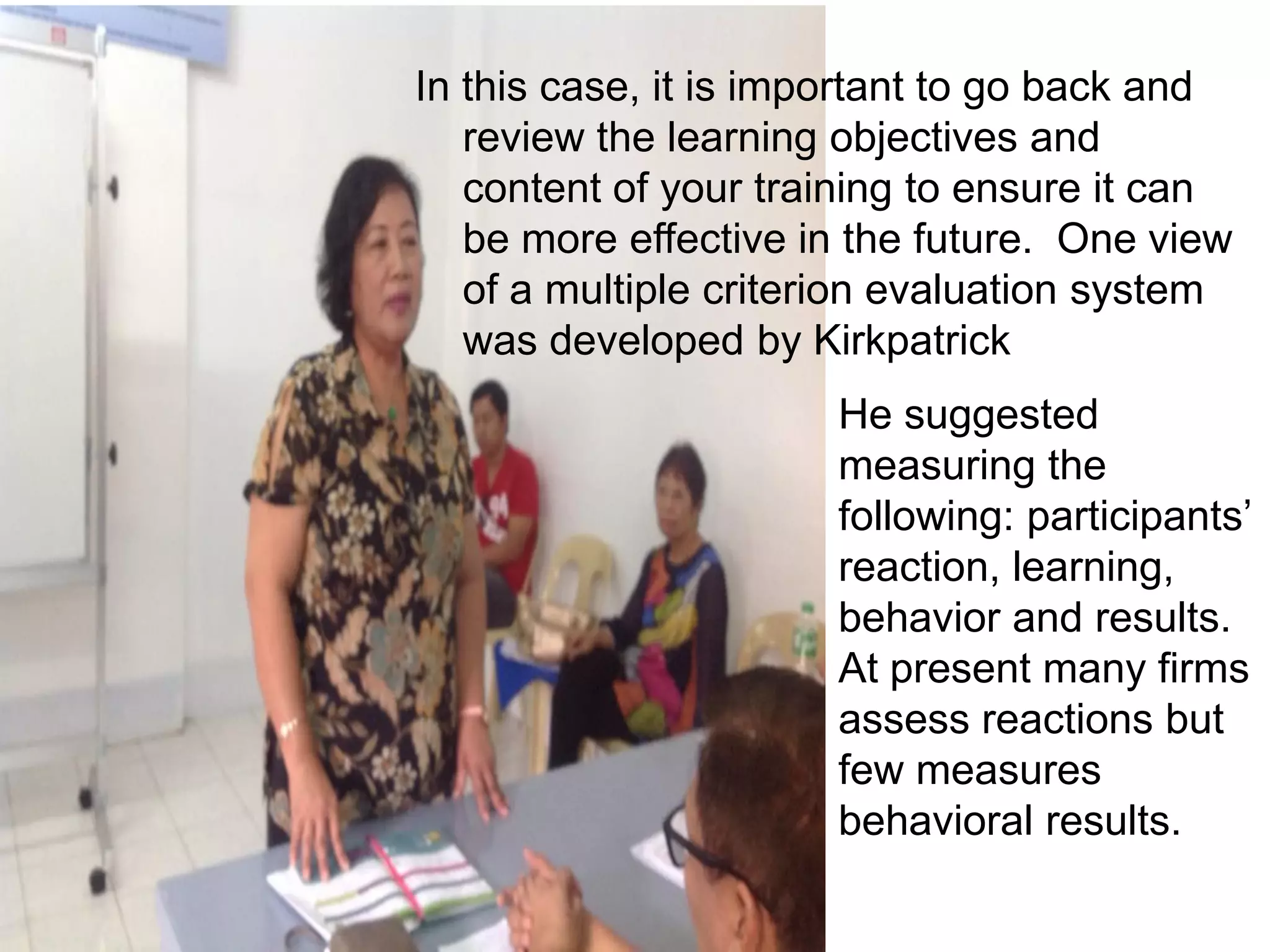
In this case, it is important to go back and
review the learning objectives and
content of your training to ensure it can
be more effective in the future. One view
of a multiple criterion evaluation system
was developed by Kirkpatrick
He suggested
measuring the
following: participants’
reaction, learning,
behavior and results.
At present many firms
assess reactions but
few measures
behavioral results.
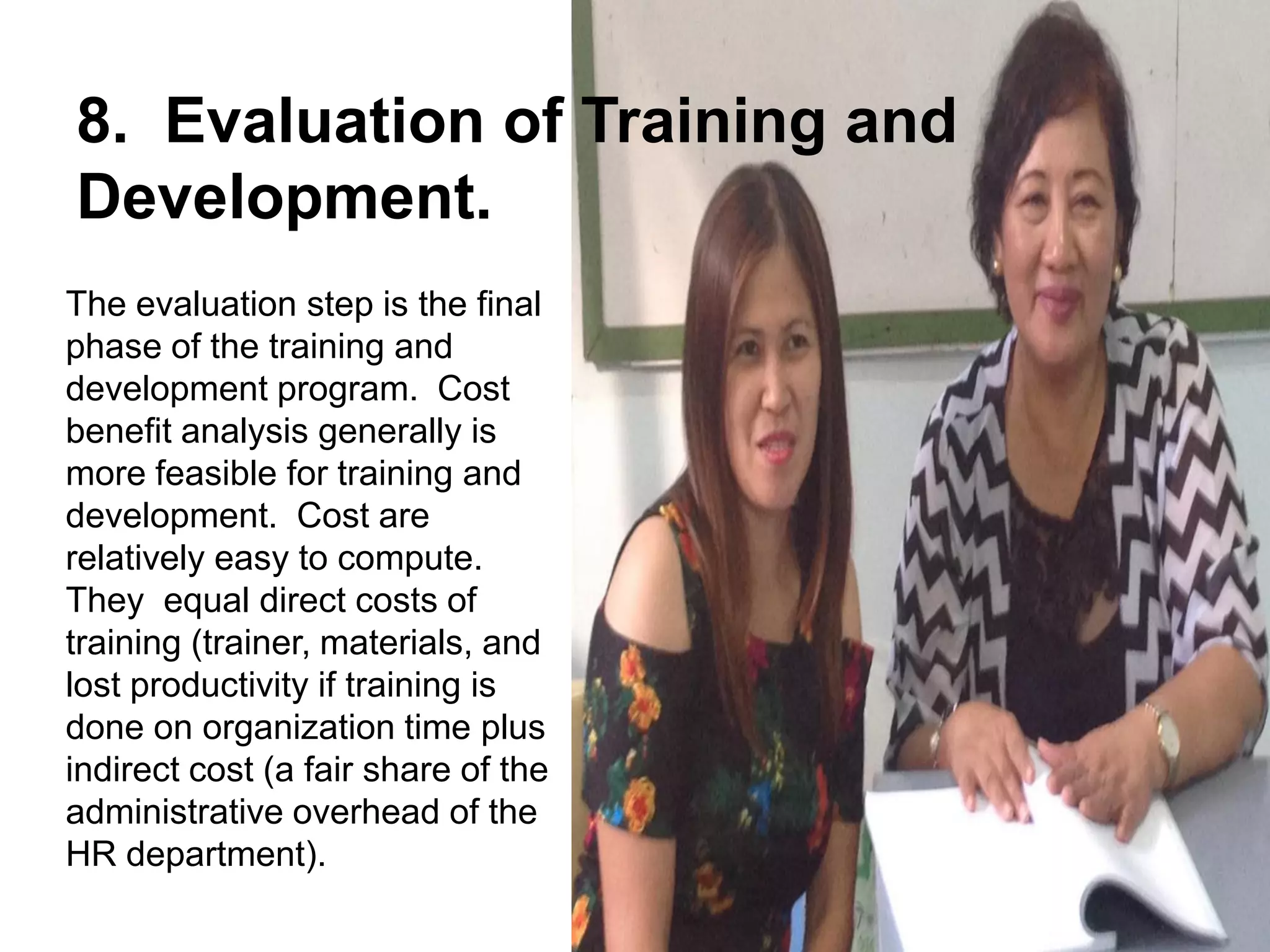
The evaluation step is the final
phase of the training and
development program. Cost
benefit analysis generally is
more feasible for training and
development. Cost are
relatively easy to compute.
They equal direct costs of
training (trainer, materials, and
lost productivity if training is
done on organization time plus
indirect cost (a fair share of the
administrative overhead of the
HR department).
8. Evaluation of Training and
Development.
Essentially, the evaluation
should be made by
comparing the results
(benefits) with the objective
of the training and
development program.
That were set in the
assessment phase. The
criteria used to evaluate
training and development
depend on the objectives of
the programs and who sets
the criteria: management,
the trainers or the trainees.
Reference
HRM John M.Ivancevich. (2007)
McGraw

Designing a Training Program

  • 1.
  • 2.
     To determinewhat the organization needs in terms of training. It involves analyzing the organization’s needs: the knowledge, skills and ability needed to perform the job; and the person or job holders needs.  The organizational needs assessment requires an examination of the long and short term objectives of the organization, the financial, social, human resource, growth and market objectives need to be matched with the organization’s human talent, structure, climate and efficiency.  Typically, objectives, ratios, organization charts, historical records on absenteeism, quality of production, efficiency and performance appraisal will be carefully reviewed. 1. Determining Needs and Objectives
  • 3.
    What are thetasks? What skills are needed to perform well? Data from current employees, supervisors and experts must be collected to complete this part of assessment.
  • 4.
    The employee’s needmust also be considered. Asking people what their needs are on the job and asking them to perform tasks can provide information and data. Examining the employee’s performance against a standard or compared with that of co-workers can help identify strengths, weaknesses and needs Determining if a person can do the job is an important step in improving the organization’s ability to match the person with the best job for him/her
  • 5.
    Focus on theperson’s need is especially important. It is at the individual or group level that training is conducted. Reviewing the HR strategic plan and various job analyses may help you see what kind of training should be developed for specific job titles in your organization. The process of analyzing needs and developing a training program can be accomplished by the organization’s trainers. HR specialist or hired consultants who reports to HR manager or other top managers are also used to perform needs analysis and to the conduct the training.
  • 6.
    Personal characteristics suchas ability to speak well, to write convincingly, to organize the work of others, to be inventive, and to inspire others to greater are important factors in the selection of trainers. Although formal training is performed by professional trainers. Often, managers may be the best trainers. Technically, especially, if a qualified trainer helps them prepare the material. 2. Choosing Trainers and Trainees The success of the training program depends on proper selection of the person who performs the training task
  • 7.
    Another planning factoris the selection of trainees who will participate in the programs. The program maybe designed to train particular new employees in certain skills. In some cases, the training program is designed to help attain goals, in others, those who will attend maybe provided or receive higher wages or salaries as a result
  • 8.
    a. On thejob training. Probably the most used method of raining (formal and informal). The employee is placed into the real work situation and shown the job by experienced employee or supervisor. Although the OJT is relatively simple and cost less. If it is not handled properly the cost can be high like: damaged machinery, unsatisfied customers, misfiled forms, and poor taught workers. 3. Selection of Content and Methods to be Used.
  • 9.
    b. Case method.Case method which uses a written description of a real decision making situation or a situation that occurred in another organization. Managers are asked to study the case to identify the problem, analyze the problem for their significance, propose solutions, choose the best solutions to implement. The instructor role is that of a catalyst and facilitator. A good facilitator is able to get everyone involved in solving the problem. With good instructors and good cases, the case method is a very effective device for improving and clarifying rational decision making.]
  • 10.
    This a crossbetween the case method and an attitude development program. Each person is assigned a role in a situation and asked to play the role and to react to other players’ role playing. Usually, a brief script is provided to participants. Sometimes the role playing is videotaped and reanalyzed as part of the development situation. Often, Role playing is done in a small group. The success of this method depends on the ability of the players to play the assigned roles believably. If done well, role playing can help a manager become more aware of and more sensitive to the feelings of others. c. Role Playing
  • 11.
    The participant isgiven materials that include typical items from a specific manager’s mail, email and telephone list. Important and pressing matters, such as out-of-stock positions, complaints of customers, and a demand of a report from a superior, are mixed in with routine business matters, such as request to speak at a dinner or a decision on the date of the company picnic for weeks hence. d. In basket technique. The trainee is analyzed and critiqued on the number of decisions made in the time allotted. The quality of decision and the priorities chosen for making them. In order to generate interest, the in basket materials must be realistic, job related, and not impossible to make decision on.
  • 12.
    e. Management Games Wheneach player on the team has made a decision, the interaction of these decisions are computed manually or by computer in accordance with such model. If price is literary related to volume, a decrease of a percent will affect the volume. Subject to general price levels. Players on the team reconcile their individual decisions with those on the other team. The result of the team’s profit, market share, are compared and the winner or best team performance is determined Essentially, management games describe the operating characteristics of a company, industry or enterprise. These descriptions take the form of equations that are manipulated after decision have been made. In a typical computerized management game procedure, teams of players are asked to make a series of operating for top management decisions. In one game, the players are asked to decide on the process of product, purchase of materials, production, scheduling, fund borrowing, marketing, and R & D expenditures.
  • 13.
    When each playeron the team has made a decision, the interaction of these decisions are computed manually or by computer in accordance with such model. If price is literary related to volume, a decrease of a percent will affect the volume. Subject to general price levels. Players on the team reconcile their individual decisions with those on the other team. The result of the team’s profit, market share, are compared and the winner or best team performance is determined.
  • 14.
    f. Outdoor –Oriented program. An increasingly popular form of development is outdoor or real life action oriented programs. Leadership, team work and risk taking are top priority on the outdoor oriented programs.
  • 15.
    The most frequentlyused training method is for the trainer to give a lecture and involve the trainee in a discussion of the materials to be learned. Effective classroom presentation supplements lecture with audio visual aids such as blackboards, slides and mock ups. g. Lecture Discussion Approach
  • 16.
    The nature ofcorporate training is changing. The trainer is quickly evolving into someone who facilitates, guides, and acts a mentor for employers and employees, helping them to find and use the best and most timely training available from SUCs, or training providers. h. Distance Training or Distance Learning
  • 17.
    E-learning is the processof acquiring knowledge and applying that information in potentially unanticipated ways. While training teaches employees protocol for specific situations, learning enables staff members to overcome non-specific issues that suddenly arise on their own. i. e-learning and e-training In essence, training may ready employees for expected situations, while learning prepares workers for the unexpected (e- learning, obviously, does this in an online setting
  • 18.
    E-training on theother hand, focuses on helping employees develop the skills they need to perform specific tasks. This includes providing information regarding certain processes and day- to-day operations. E-training does this in an online environment
  • 19.
  • 20.
    4. Learning Objectives Learningobjective is what you want the learner to be able to do, explain, or demonstrate at the end of the training period. Good learning objectives are performance based and clear, and the end result of the learning objective can be observable or measured in some way.
  • 22.
    5. Budget The typeof training performed will depend greatly on the budget. If you decide that web-based training is the right delivery mode, but you don’t have the budget to pay the user fee for the platform, this wouldn’t be the best option. Besides the actual cost of training, another cost consideration is people’s time. If employees are in training for two hours, what is the cost to the organization while they are not able to perform their job? A spreadsheet should be developed that lists the actual cost for materials, snacks, and other direct costs, but also the indirect costs, such as people’s time.
  • 23.
    What time frameshould an employee complete the training? Another consideration regarding time lines is how much time you think you need to give the training. Perhaps one hour will be enough, but sometimes, training may take a day or even a week. After you have developed your training content, you will likely have a good idea as to how long it will take to deliver it. 6. Timelines Consider the fact that most people do not have a lot of time for training and keep the training time realistic and concise. Developing a dependable training schedule allows for better communication to your staff, results in fewer communication issues surrounding training, and allows all employees to plan ahead to attend training.
  • 24.
    Make sure thetraining objectives were met. Review the performance of the employees who received the training, and if possible review the performance of those who did not receive the training. For example, in your orientation training, if one of the learning objectives was to be able to request time off using the company intranet, and several employees who attended the training come back and ask for clarification on how to perform this task, it may mean the training didn’t work as well as you might have thought. 7. Measuring Effectiveness
  • 25.
    In this case,it is important to go back and review the learning objectives and content of your training to ensure it can be more effective in the future. One view of a multiple criterion evaluation system was developed by Kirkpatrick He suggested measuring the following: participants’ reaction, learning, behavior and results. At present many firms assess reactions but few measures behavioral results.
  • 26.
    The evaluation stepis the final phase of the training and development program. Cost benefit analysis generally is more feasible for training and development. Cost are relatively easy to compute. They equal direct costs of training (trainer, materials, and lost productivity if training is done on organization time plus indirect cost (a fair share of the administrative overhead of the HR department). 8. Evaluation of Training and Development.
  • 27.
    Essentially, the evaluation shouldbe made by comparing the results (benefits) with the objective of the training and development program. That were set in the assessment phase. The criteria used to evaluate training and development depend on the objectives of the programs and who sets the criteria: management, the trainers or the trainees.
  • 28.