.Net Template Solution

      Diogo Cunha
Architecture should be
• Flexible to change, add and remove features
• Maintanable for many developers with different
  coding habits
• Sustainable for growth
• Understandable for code review and optimization
• Easy to add new features with few lines of code
  without losing structure
• Testable (unit and integration)

                 http://pt.linkedin.com/in/diogogcunha/   2
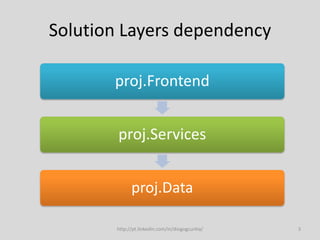
Solution Layers dependency

       proj.Frontend


        proj.Services


             proj.Data

       http://pt.linkedin.com/in/diogogcunha/   3
Data LayerprojName.Data.dll


This layer would be a new Project inside the solution and it is an abstraction for the data
that the system writes and reads from different data sources. It should only contain CRUD
logic and nothing else.
Repositories and entity objects should be here.


                                   proj.Data


                                http://pt.linkedin.com/in/diogogcunha/                  4
Entities/DTOsprojName.Data.Entities


• Entities are the raw domain objects that come from the data source. So if you are
integrating with and external platform such as Facebook or if you are writing on a XML
you should have that information in object classes so you have strongly typed entities.
• A lot of .Net developers will use EntityFramework to do most of the work writing to the
database. Using model first this is the place to put the .edmx file, using code first this is
where you’ll put your DbContext file and your entities.
• In order to be able to mock the DbContext or the ObjectContext you should do a
wrapper around it (or a partial class) use an interface and expose what you need.
• Avoid unecessary dependecies using different projects under the same namespace.

                 UserEntity            FileEntity                              PostEntity


            UserRepository         FileRepository                     FacebookPostRepository

                 UserEntity            FileEntity                              PostEntity


                                                                                                      5
                         projName.Data.dll                               projName.Data.Facebook.dll
Repositories
                                     projName.Data.Repositories


• Each entity should have it’s own repository. If the entity is read only so should be the
repository.
• All repositories must have their own interface and it might be useful to have abstract
repositories to decrease the amount of code to be written.
• Repository methods should be easily overriden for flexibility so we could make them
virtual but it’s not mandatory because C# let’s you override a method with the [new]
word on the function signature.


abstract class BaseRepository : IBaseRepository

abstract class ReadRepository<T> : BaseRepository, IReadRepository<T>
abstract class WriteRepository<T> : ReadRepository<T>, IWriteRepository<T>

WritableEntityRepository : WriteRepository<WritableEntity>, IWritableEntityRepository
ReadOnlyEntityRepository : ReadRepository<ReadOnlyEntity>, IReadOnlyEntityRepository


                                http://pt.linkedin.com/in/diogogcunha/                       6
Repositories
                             projName.Data.Repositories.ReadRepository


• Read repository is probably the most used one, so we should try to make it as powerfull
as possible. Also because LINQ is cool I’m copying some of it’s namings.


public interface IReadRepository<T> where T : class {

         T FirstOrDefault(Expression<Func<T, bool>> predicate);

         IEnumerable<T> GetAll(Expression<Func<T, bool>> predicate);
         IEnumerable<T> GetAll(Expression<Func<T, bool>> predicate,
                                Expression<Func<T, object>> orderBy,
                                bool descending = false);

         int Count(Expression<Func<T, bool>> predicate);
         bool Any(Expression<Func<T, bool>> predicate);
}


                               http://pt.linkedin.com/in/diogogcunha/                 7
Repositories
                              projName.Data.Repositories.WriteRepository


• Creating and updating entities is usualy a fairly simple operation and it should remain
so. No other kind of logic should be implemented in these classes except default values
like , for instance a CreationDate = DateTime.Now;
• In some situations the Update method is not necessary (if you use EntityFramework for
some of your data) so don’t feel that obligated to implement this method, just leave the
possibility there for other data sources that might need it.


public interface IWriteRepository<T> where T : class {

          T Add(T entity);
          T Update(T entity);
          T Remove(T entity);
}


                                http://pt.linkedin.com/in/diogogcunha/                      8
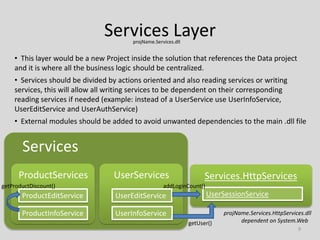
Services Layer
                                        projName.Services.dll


    • This layer would be a new Project inside the solution that references the Data project
    and it is where all the business logic should be centralized.
    • Services should be divided by actions oriented and also reading services or writing
    services, this will allow all writing services to be dependent on their corresponding
    reading services if needed (example: instead of a UserService use UserInfoService,
    UserEditService and UserAuthService)
    • External modules should be added to avoid unwanted dependencies to the main .dll file


       Services
      ProductServices             UserServices                        Services.HttpServices
getProductDiscount()                                 addLoginCount()
       ProductEditService          UserEditService                     UserSessionService

       ProductInfoService          UserInfoService                          projName.Services.HttpServices.dll
                                                                getUser()         dependent on System.Web
                                                                                                        9
Services Layer
                                     projName.Services


public class UserInfoService : UnitOfWorkService, IUserInfoService {
         public UserInfoService(IUnitOfWork unitOfWork) : base(unitOfWork) { }
}

public class UserEditService : UnitOfWorkService, IUserInfoService {
         IUserInfoService UserInfoService { get; set; }
         public UserEditService(IUnitOfWork unitOfWork, IUserInfoService userInfoSvc)
         : base(unitOfWork) {
                   UserInfoService = userInfoSvc;
         }
}

public class UserSessionService : BaseService, IUserSessionService {
         IUserInfoService UserInfoService { get; set; }
         IUserEditService UserEditService { get; set; }
         public UserSessionService(IUserInfoService userInfoSvc,
                                    IUserEditService userEditSvc) {
                   UserEditService = userEditService;
                   UserInfoService = userInfoService;
         }
}
                              http://pt.linkedin.com/in/diogogcunha/             10
Services Layer and Data Layer
                                  projName.Data.UnitOfWork.dll


• A service will use the Unit of Work to access the data layer (the Unit of Work pattern is a
class that has a reference to all the repositories and to the context in which these
repositories work giving only access to the repositories and a SaveChanges method that
commits the changes to the database). This doesn’t need to be a separate Project.
• This should be implemented on a different Project so that when you reference the
Services on the Frontend you don’t have access to the Unit of Work.
//namespace projName.Services
abstract class UnitOfWorkService : BaseService, IUnitOfWorkService {
         private IUnitOfWork UnitOfWork { get; set; }
         public UnitOfWorkService(IUnitOfWork unitOfWork){
                   UnitOfWork = unitOfWork;
         }
}

//namespace projName.Data.UnitOfWork
public interface IUnitOfWork {
         void SaveChanges();
         public IUserRepository UserRepository { get; set; }
         public IProductsRepository ProductsRepository { get; set; }
}
                                http://pt.linkedin.com/in/diogogcunha/                   11
Mapping Entity <-> ViewModel
                                 projName.Services.Mappings


• This is probably the most boring code to write because it’s simply transforming one
object to another one, so I usually use AutoMapper which is a very handy tool.
• There are several ways to do these mappings and I believe that the big concern here is
performance and easily understand to which ViewModels does a Entity map to and how
that mapping is processed, and the other way arround.


        UserEntity                                                      UserViewModel
        -ID                                                             -UserIdentityViewModel
        -Username                                                          -ID
                                                                           -Username
        -FirstName
        -LastName
                            Mapping engine                                 -Email
        -Email                                                          -UserInfoViewModel
        -Gender                                                            -FirstName
        -CreationDate                                                      -LastName
                                                                           -Gender


                               http://pt.linkedin.com/in/diogogcunha/                            12
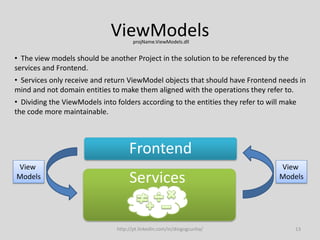
ViewModels
                                      projName.ViewModels.dll


• The view models should be another Project in the solution to be referenced by the
services and Frontend.
• Services only receive and return ViewModel objects that should have Frontend needs in
mind and not domain entities to make them aligned with the operations they refer to.
• Dividing the ViewModels into folders according to the entities they refer to will make
the code more maintainable.


                                    Frontend
View                                                                              View
Models                              Services                                      Models


                               http://pt.linkedin.com/in/diogogcunha/                  13
Inversion of Control
                                        projName.IoC.dll


• A separate Project should be made for the IoC (even if it only has one file with all the
class registrations) because it must reference the Services Layer and the Data Layer.
• Inversion of Control pattern can save you a lot of code lines, help you keep things
modular and improve performance.
• It’s not mandatory to use it for this architecture to work but it is as advantage.
• We can initialize a service in 3 different ways with this architecture:

public class UserController : Controller {
         private IUserInfoService _userInfoService { get; set; }

          public UserInfoService(IUserInfoService userInfoService)
          {

_userInfoService = userInfoservice;//with Dependency Injection
_userInfoService = new UserInfoService(IoC.Locator<IUnitOfWork>());//with Locator
_userInfoService = new UserInfoService(new UnitOfWork());//NO IoC

          }
}
                                 http://pt.linkedin.com/in/diogogcunha/                  14
Frontend layer
                                       projName.Frontend.dll


• Frontend layer is where your services actually get exposed in whatever way you want.
• It should be as easy to use a MVC.Net project on top of this architecture as it would be
to use WebForms, WinForms or a Mobile App.


                                      Services
                                http://pt.linkedin.com/in/diogogcunha/                  15

.Net template solution architecture

  • 1.
  • 2.
    Architecture should be •Flexible to change, add and remove features • Maintanable for many developers with different coding habits • Sustainable for growth • Understandable for code review and optimization • Easy to add new features with few lines of code without losing structure • Testable (unit and integration) http://pt.linkedin.com/in/diogogcunha/ 2
  • 3.
    Solution Layers dependency proj.Frontend proj.Services proj.Data http://pt.linkedin.com/in/diogogcunha/ 3
  • 4.
    Data LayerprojName.Data.dll This layerwould be a new Project inside the solution and it is an abstraction for the data that the system writes and reads from different data sources. It should only contain CRUD logic and nothing else. Repositories and entity objects should be here. proj.Data http://pt.linkedin.com/in/diogogcunha/ 4
  • 5.
    Entities/DTOsprojName.Data.Entities • Entities arethe raw domain objects that come from the data source. So if you are integrating with and external platform such as Facebook or if you are writing on a XML you should have that information in object classes so you have strongly typed entities. • A lot of .Net developers will use EntityFramework to do most of the work writing to the database. Using model first this is the place to put the .edmx file, using code first this is where you’ll put your DbContext file and your entities. • In order to be able to mock the DbContext or the ObjectContext you should do a wrapper around it (or a partial class) use an interface and expose what you need. • Avoid unecessary dependecies using different projects under the same namespace. UserEntity FileEntity PostEntity UserRepository FileRepository FacebookPostRepository UserEntity FileEntity PostEntity 5 projName.Data.dll projName.Data.Facebook.dll
  • 6.
    Repositories projName.Data.Repositories • Each entity should have it’s own repository. If the entity is read only so should be the repository. • All repositories must have their own interface and it might be useful to have abstract repositories to decrease the amount of code to be written. • Repository methods should be easily overriden for flexibility so we could make them virtual but it’s not mandatory because C# let’s you override a method with the [new] word on the function signature. abstract class BaseRepository : IBaseRepository abstract class ReadRepository<T> : BaseRepository, IReadRepository<T> abstract class WriteRepository<T> : ReadRepository<T>, IWriteRepository<T> WritableEntityRepository : WriteRepository<WritableEntity>, IWritableEntityRepository ReadOnlyEntityRepository : ReadRepository<ReadOnlyEntity>, IReadOnlyEntityRepository http://pt.linkedin.com/in/diogogcunha/ 6
  • 7.
    Repositories projName.Data.Repositories.ReadRepository • Read repository is probably the most used one, so we should try to make it as powerfull as possible. Also because LINQ is cool I’m copying some of it’s namings. public interface IReadRepository<T> where T : class { T FirstOrDefault(Expression<Func<T, bool>> predicate); IEnumerable<T> GetAll(Expression<Func<T, bool>> predicate); IEnumerable<T> GetAll(Expression<Func<T, bool>> predicate, Expression<Func<T, object>> orderBy, bool descending = false); int Count(Expression<Func<T, bool>> predicate); bool Any(Expression<Func<T, bool>> predicate); } http://pt.linkedin.com/in/diogogcunha/ 7
  • 8.
    Repositories projName.Data.Repositories.WriteRepository • Creating and updating entities is usualy a fairly simple operation and it should remain so. No other kind of logic should be implemented in these classes except default values like , for instance a CreationDate = DateTime.Now; • In some situations the Update method is not necessary (if you use EntityFramework for some of your data) so don’t feel that obligated to implement this method, just leave the possibility there for other data sources that might need it. public interface IWriteRepository<T> where T : class { T Add(T entity); T Update(T entity); T Remove(T entity); } http://pt.linkedin.com/in/diogogcunha/ 8
  • 9.
    Services Layer projName.Services.dll • This layer would be a new Project inside the solution that references the Data project and it is where all the business logic should be centralized. • Services should be divided by actions oriented and also reading services or writing services, this will allow all writing services to be dependent on their corresponding reading services if needed (example: instead of a UserService use UserInfoService, UserEditService and UserAuthService) • External modules should be added to avoid unwanted dependencies to the main .dll file Services ProductServices UserServices Services.HttpServices getProductDiscount() addLoginCount() ProductEditService UserEditService UserSessionService ProductInfoService UserInfoService projName.Services.HttpServices.dll getUser() dependent on System.Web 9
  • 10.
    Services Layer projName.Services public class UserInfoService : UnitOfWorkService, IUserInfoService { public UserInfoService(IUnitOfWork unitOfWork) : base(unitOfWork) { } } public class UserEditService : UnitOfWorkService, IUserInfoService { IUserInfoService UserInfoService { get; set; } public UserEditService(IUnitOfWork unitOfWork, IUserInfoService userInfoSvc) : base(unitOfWork) { UserInfoService = userInfoSvc; } } public class UserSessionService : BaseService, IUserSessionService { IUserInfoService UserInfoService { get; set; } IUserEditService UserEditService { get; set; } public UserSessionService(IUserInfoService userInfoSvc, IUserEditService userEditSvc) { UserEditService = userEditService; UserInfoService = userInfoService; } } http://pt.linkedin.com/in/diogogcunha/ 10
  • 11.
    Services Layer andData Layer projName.Data.UnitOfWork.dll • A service will use the Unit of Work to access the data layer (the Unit of Work pattern is a class that has a reference to all the repositories and to the context in which these repositories work giving only access to the repositories and a SaveChanges method that commits the changes to the database). This doesn’t need to be a separate Project. • This should be implemented on a different Project so that when you reference the Services on the Frontend you don’t have access to the Unit of Work. //namespace projName.Services abstract class UnitOfWorkService : BaseService, IUnitOfWorkService { private IUnitOfWork UnitOfWork { get; set; } public UnitOfWorkService(IUnitOfWork unitOfWork){ UnitOfWork = unitOfWork; } } //namespace projName.Data.UnitOfWork public interface IUnitOfWork { void SaveChanges(); public IUserRepository UserRepository { get; set; } public IProductsRepository ProductsRepository { get; set; } } http://pt.linkedin.com/in/diogogcunha/ 11
  • 12.
    Mapping Entity <->ViewModel projName.Services.Mappings • This is probably the most boring code to write because it’s simply transforming one object to another one, so I usually use AutoMapper which is a very handy tool. • There are several ways to do these mappings and I believe that the big concern here is performance and easily understand to which ViewModels does a Entity map to and how that mapping is processed, and the other way arround. UserEntity UserViewModel -ID -UserIdentityViewModel -Username -ID -Username -FirstName -LastName Mapping engine -Email -Email -UserInfoViewModel -Gender -FirstName -CreationDate -LastName -Gender http://pt.linkedin.com/in/diogogcunha/ 12
  • 13.
    ViewModels projName.ViewModels.dll • The view models should be another Project in the solution to be referenced by the services and Frontend. • Services only receive and return ViewModel objects that should have Frontend needs in mind and not domain entities to make them aligned with the operations they refer to. • Dividing the ViewModels into folders according to the entities they refer to will make the code more maintainable. Frontend View View Models Services Models http://pt.linkedin.com/in/diogogcunha/ 13
  • 14.
    Inversion of Control projName.IoC.dll • A separate Project should be made for the IoC (even if it only has one file with all the class registrations) because it must reference the Services Layer and the Data Layer. • Inversion of Control pattern can save you a lot of code lines, help you keep things modular and improve performance. • It’s not mandatory to use it for this architecture to work but it is as advantage. • We can initialize a service in 3 different ways with this architecture: public class UserController : Controller { private IUserInfoService _userInfoService { get; set; } public UserInfoService(IUserInfoService userInfoService) { _userInfoService = userInfoservice;//with Dependency Injection _userInfoService = new UserInfoService(IoC.Locator<IUnitOfWork>());//with Locator _userInfoService = new UserInfoService(new UnitOfWork());//NO IoC } } http://pt.linkedin.com/in/diogogcunha/ 14
  • 15.
    Frontend layer projName.Frontend.dll • Frontend layer is where your services actually get exposed in whatever way you want. • It should be as easy to use a MVC.Net project on top of this architecture as it would be to use WebForms, WinForms or a Mobile App. Services http://pt.linkedin.com/in/diogogcunha/ 15