PGDM
2021-23 Batch
By:
YAGBALA KAPIL
GL Bajaj Institute of
Management & Research
A systematic approach to
training
Peter Drucker said that the fastest growing industry would be training
and development as a result of replacement of industrial workers with
knowledge workers.
In United States, for example, according to one estimate technology
is de-skilling 75 % of the population.
In Japan for example, with increasing number of women joining
traditionally male jobs, training is required not only to impart
necessary job skills but also for preparing them for the physically
demanding jobs. They are trained in everything from sexual
harassment policies to the necessary job skills.
The need for Training and Development
Change
The word change encapsulates almost everything. It is one of the
biggest factors that contribute to the need of training and
development.
Change leads to the need for training and development and training
and development leads to individual and organisational change, and
the cycle goes on and on.
More specifically it is the technology that is driving the need;
changing the way how businesses function, compete and deliver.
Development.
Money is not the sole motivator at work and this is
especially very true for the 21st century.
People who work with organisations seek more than
just employment out of their work; they look at holistic
development of self.
Spirituality and self awareness for example are
gaining momentum world over. People seek
happiness at jobs which may not be possible unless
an individual is aware of the self.
TRAINING
● Training refers to the acquisition of knowledge,
skills, and competencies as a result of the
teaching of vocational or practical skills and
knowledge that relate to specific useful
competencies.
SHRM Yagbala Kapil
Training is given on four basic grounds:
● New candidates
● Existing employees
● Updation and amendments
● Promotion and career growth
SHRM Yagbala Kapil
TYPES OF TRAINING
● ON THE JOB
● OFF THE JOB
SHRM Prof.Yagbala Kapil
ON THE JOB TRAINING
● JIT: Plan, Present, Trial & Follow up
● COACHING
● MENTORING
● JOB ROTATION
● APPRENTICESHIP TRAINING
SHRM Prof.Yagbala Kapil
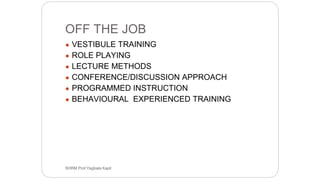
OFF THE JOB
● VESTIBULE TRAINING
● ROLE PLAYING
● LECTURE METHODS
● CONFERENCE/DISCUSSION APPROACH
● PROGRAMMED INSTRUCTION
● BEHAVIOURAL EXPERIENCED TRAINING
SHRM Prof.Yagbala Kapil
Training vs Development
Table 1 https://keydifferences.com/difference-between-training-and-development.html
BASIS FOR
COMPARISON
TRAINING DEVELOPMENT
Meaning Training is a learning process in which
employees get an opportunity to
develop skill, competency and
knowledge as per the job requirement.
Development is an educational process which is
concerned with the overall growth of the employees.
Term Short Term Long Term
Focus on Present Future
Orientation Job oriented Career oriented
Motivation Trainer Self
Objective To improve the work performances of
the employees.
To prepare employees for future challenges.
Number of
Individuals
Many Only one
Systems View of Training - Stages in a Training
Program
Development of a Training Program
Designing the Environment -
Every individual is unique. One style of learning may
not be applicable to each of the participants in a
training program.
Therefore ‘how do various individuals learn’ is what
should be kept in mind while designing the training
program.
Development of a Training Program
Establishing the Variables -
Trainability is one factor that must be taken into
consideration before developing any training program.
It is the duty of the trainer to ensure that the
employees are actually willing to sit and learn
something in the training program.
This is especially very true of sensitivity training that
is not viewed positively by many.
Designing and Developing Effective Training
Programs
Know Your Employees:
Know your employees well before you begin designing training
programs for them.
Let them come up with their problems and what all additional skills
would help them perform better.
It is essential for managers to know the strengths and weaknesses of
all his team members.
Design your training program accordingly.
Knowing employees well will help you figure out the skills you need to
teach them.
Designing and Developing Effective Training
Programs
Dividing Employees into Groups:
One cannot design similar training programs for each
and every employee.
Divide employees into groups where employees who
need to learn the same set of skills can be put into
one group.
You can also group employees as per their age, work
experience, departments, functional areas and so on.
Preparing the Information:
The next step is to prepare the content of the training
program.
Include diagrams, graphs, flow charts, pictures to
make your training program interesting so that
individuals do not lose interest in the middle of the
session.
The information needs to be relevant and authentic.
Presenting the Information:
Decide how would you like to present your
information?
It is absolutely up to the trainer to decide the software
which he/she would like to use.
Make sure there are no spelling errors.
Read your presentation twice or thrice and find out
whether it has covered entire information you wish to
convey or not?
Delivering Training Programs:
Select your trainers carefully. Remember, the right trainer
makes all the difference.
Training programs should not be a mere one way
communication.
Be loud and clear. Do not speak too fast.
The trainer needs to involve his/her audience and encourage
employees to come up with questions and doubts.
COST BENEFIT ANALYSIS FOR TRAINING
Utility Analysis
Utility itself is a function of the duration up to which the training leaves
an impact upon the trainee, the relative importance of the training
program, the importance of the position or profile that received
training and the cost of conducting the training.
For example leadership programs conducted for top and middle
management tend to be high on value where as sales training
programs for the front line sales staff tends to be low on value scale.
Utility analysis basically derives the effectiveness from analysing the
change in the behaviour of the trainee and the positive financial
implications of the same.
Let’s assume that the total costs incurred towards a
certain training is USD. 80,000/- all inclusive and the
benefits in terms of overall improvement in
productivity and quality are USD. 4,00,000/-.
Thus the ROI is 525 %, which means for each rupee
invested the return in USD. 5.25 over and above the
cost of the program.
TRAINING EVALUATION
The process of training evaluation has been defined
by A. C. Hamblin as “any attempt to obtain
information on the effects of training performance and
to assess the value of training in the light of that
information”
Why is the training evaluation required?
i. The evaluation enables the effectiveness of an investment in training
to be appraised which can help to justify expenditure on future
programmes.
ii. It allows the effectiveness of differing approaches to be compared.
iii. It provides feedback for the trainers about their performance and
methods.
iv. It enables improvements to be made, either on the next occasion, or
if the evaluation is ongoing, as the training proceeds
v. Recording learning achievements can be motivational for learners.
vi. The evaluation indicates to what extent the objectives have been met
and therefore whether any further training needs remain.
Training Evaluation – 3 Steps in the Process
of Evaluating Training: Before Training,
During Training and After Training
Training Evaluation - Benefits
▪Evaluation ensures accountability -
Training evaluation ensures that training programs
comply with the competency gaps and that the
deliverables are not compromised upon.
Check the Cost -
Evaluation ensures that the training programs are
effective in improving the work quality, employee
behaviour, attitude and development of new skills
within the employee within a certain budget.
Feedback to the Trainer / Training -
Evaluation also acts as a feedback to the trainer or
the facilitator and the entire training process.
Since evaluation accesses individuals at the level of
their work, it gets easier to understand the loopholes
of the training and the changes required in the
training methodology.
Training Evaluation – How to Evaluate
the Effectiveness of a Training
Programme?
1. Assessment of trainers’ comments and reactions to the training programme
after the training is over.
2. Observation of trainees during the training programme.
3. Comparing on-the-job performance of the trainees before and after training.
4. Collection of opinions and judgements of trainers, superiors and peers.
5. Giving oral and written tests to trainees to find out how far they have learnt
through the training programme.
6. Cost-benefit of the training programme.
7. Measurements of levels in employees’ absenteeism, turnover, productivity,
wastage or scrap of materials, accidents, breakage of machinery during pre-
training period and post-training period.
8. Evaluation of trainees’ skill level before and after training.
9. Collection of opinions of the trainees’ subordinates regarding their job
performance and behaviour.
10. Collection of information through evaluation forms duly filled up by the
trainees.
11. Knowing trainees’ expectations before training and collecting their views
regarding the attainment of the expectations after training.
3 Best Methods to Evaluate Training Effectiveness
2019.04.04 Jonathan Deller
The three approaches are:
The Phillips ROI Model
The CIPP Evaluation Model
The Kirkpatrick Taxonomy
The Phillips ROI Methodology
The Phillips ROI Methodology has five levels:
Level 1: Reaction
In common with the Kirkpatrick taxonomy, the Phillips methodology evaluates the participants’ reaction.
Level 2: Learning
The second level evaluates whether learning took place.
Level 3: Application and Implementation
The original Kirkpatrick taxonomy evaluated behavior in the workplace to see whether the learning
translated into on-the-job training. Phillips expanded this level to cover both application and
implementation.Phillips’ methodology makes it far easier to see why training does or doesn’t translate
into workplace changes. If there is a problem, did it lie with the application or the implementation? For
example, was the learning applied incorrectly? Or was the on-the-job training implemented ineffectively?
Level 4: Impact
While the fourth level of the Kirkpatrick taxonomy focuses purely on results,His level 4 – Impact –
helps identify whether factors other than training were responsible for delivering the outcomes.
Level 5: Return on investment (ROI)
Phillips’ methodology contains a fifth level specifically for measuring ‘return on investment’, ROI. This level
uses cost-benefit analysis to determine the value of training programs.
CIPP model: How it works
The CIPP model aims to link evaluation with the decision-making that goes into running a training course
or program. Each of the above four aspects of evaluation – context, input, process, and product – are
used provide an analytic basis for making the decisions that go into a program.
Using CIPP as formative assessment
To use the four areas of evaluation before the program, these are the types of questions you’d ask:
Context: What do we need to do?
Input: How should we approach training?
Process: Are we on the right track?
Product: Does this program have a successful track record?
These questions help improve the quality of the training provided and ensure that the stakeholders’ goals
are met.
Using CIPP as summative assessment
CIPP can also be used as a form of summative assessment, to identify what went right and wrong in a
training course or program. Here are some questions you may ask:
Context: Did the training address our needs?
Input: Was the training well designed?
Process: Did the training stay on the right track? Why? Why not?
Product: How successful was the program in meeting our goals?
What can a survey measure?
Surveys are a reliable and effective way of capturing participants’ reactions to
things like:
• The training course or program
• The training methods
• The course instructors or trainers
• The assessments methods
• The administration of the training
• The facilities
Kirkpatrick’s Model of Training Evaluation
Donald Kirkpatrick, professor emeritus, university
of Wisconsin began working on evaluating the
effectiveness of training very early in his life.
His early work on the same was published in the year
1959 in a journal of American Society of Training
Directors.
He laid out four levels for evaluation of any
training.
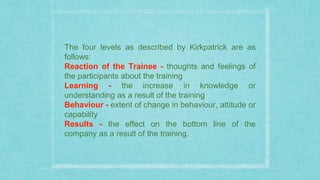
The four levels as described by Kirkpatrick are as
follows:
Reaction of the Trainee - thoughts and feelings of
the participants about the training
Learning - the increase in knowledge or
understanding as a result of the training
Behaviour - extent of change in behaviour, attitude or
capability
Results - the effect on the bottom line of the
company as a result of the training.
Reaction
Reaction implies how favourably the participants have
responded to the training.
evaluation is primarily quantitative in nature and is a
feedback to the training and the trainer.
The most common collection tool is the questionnaire
that analyses the content, methodology, facilities and
the course content.
Learning
At the level of learning the evaluation is done on the
basis of change in the ASK (Attitudes, skills and
knowledge) of the trainees.
The evaluation involves observation and analysis of
the voice, behaviour, text.
Other tools used apart from the observation are
interviews, surveys, pre and post tests etc.
Behaviour
Behaviour evaluation analyses the transfer of learning
from the training session to the work place.
Here the primary tool for evaluation is predominantly
the observation.
Apart from the observation, a combination of
questionnaires and 360 feedbacks are also used.
Results
The results stage makes evaluations towards the
bottom line of the organisation.
Here the definition of the results depends upon the
goal of the training program.
The evaluation is done by using a control group
allowing certain time for the results to be achieved.
Level 4 - Results
Was it worth it ?
Level 3 - Behaviour
KSA’s being used on the Job ?
Level 2 - Knowledge
Did they learn anything ?
Level 1 - Reaction
Was the environment suitable ?
Limitations of the Kirkpatrick Taxonomy
You may use the term ‘Kirkpatrick’ but not follow the full
taxonomy. Your organization may not require you to use
anything more than simple ‘Smile’ feedback sheets after each
training session.
You may have read and agreed with the taxonomy, but have
little idea about how to apply it beyond basic Level One
feedback forms given out after training.
For example, if a watchmaker runs a training program designed
to decrease customer wait times for repairs, yet the wait times
don’t decrease afterward, the Kirkpatrick taxonomy only tells us
that the training ‘didn’t work’; it doesn’t help to improve the
training.
Here’s how to apply the Kirkpatrick
model effectively:
• Decide what business results you are targeting; ie.
the results.
• Determine whether the training matches the
stakeholder’s expectations.
• Identify what on-the-job behavior or performance
changes you would need to look for to prove that
the trainees had met the end results.
• Define the learning objectives that will develop the
on-the-job behavior.
• Decide how to deliver the necessary instruction in
an engaging and appealing way.
Special Training Programs
Diversity Awareness Trainings -
Workforce diversity is one of the emerging challenges for organisations in the
21st century.
They face claims on from coloured workers, immigrants, older people, various
ethnic groups, gays and lesbians for harassment at the work place.
Also there is a need for addressing the values of various employee groups, for
example, the older generation lives by a different set of values and does the
younger lot.
This leads to a conflict which can only be resolved by providing appropriate
training intervention.
Diversity awareness training is necessary to increase the competitiveness and
the general competency of the organisation.
Special Training Programs
Sexual Harassment Training -
these trainings are mostly conducted in the developed nations and in
multinational corporations that function in various geographical locations. These
trainings are not very common in organisations in the developing world.
Almost all types of organisations, immaterial of what business they are into, what
industry they operate in and what kind of people they have hired receive sexual
harassment complaints at the workplace.
In developing economies they go unnoticed and unreported but in developed
economies where the workforce is empowered severely sexual harassment at
the workplace is reported, resulting in penal actions and thus the sexual
harassment training. Many organisation shave policies on sexual harassment but
often they are not communicated!
Special Training Programs
Creativity Training -
Many organisations use experiential learning,
brainstorming sessions to compel the employees
think ‘out of the box’ and thus bring out the latent
creativity in them.
Since we are working within a global economy, it might be necessary to
provide training to employees who are moving overseas or working
overseas. Up to 40 percent of international assignments are terminated
early because of a lack of international training(2020)- clusters
The following topics might be included in this type of training:
1. Cultural differences and similarities
2. Insight and daily living in the country
3. Social norms and etiquette
4. Communication training, such as language skills
Four Types of Cross-Cultural Training
EXPATS- If your expatriates fail to
adapt to the work style of the new
location as well as to the norms and
behaviors of their cultures, these
assignments are at risk: You will lose
business due to miscommunication and
you will miss out on international growth
opportunities.Cultural Training &
Coaching programs have helped clients
save millions in potential losses on failed
global assignments.
CROSS-BORDER BUSINESS-
Whether you are expanding your
business into new markets, or you are
importing/exporting to and from
abroad, or negotiating deals with foreign

partners – everybody should have the
relevant information about the countries
and cultures in order to be successful.
Four Types of Cross-Cultural Training
MULTICULTURAL TEAMS- Do you
work with employees who have diverse
cultural backgrounds? When
multicultural teams want to collaborate
efficiently, communication is hampered

by a lack of language skills and even
more so because of cultural
misunderstandings. People work better
together when they decipher cultures and
are aware of them in daily operations.
GLOBAL EXECUTIVES-GLOBAL
EXECUTIVES NEED TO LEARN HOW TO
INSPIRE AND MOTIVATE IN A FOREIGN
CULTURE. THEY NEED TO REDEFINE
WHAT EFFECTIVE COMMUNICATION
MEANS IN VARIOUS CULTURAL
CONTEXTS AND ADAPT TO DIFFERENT
WAYS OF BUILDING RELATIONSHIPS.
“T&D is the essential foundation for
companies to achieve their strategic goals.”
UNIT 4-Learning and Development.pptx is about

UNIT 4-Learning and Development.pptx is about

  • 1.
    PGDM 2021-23 Batch By: YAGBALA KAPIL GLBajaj Institute of Management & Research
  • 4.
    A systematic approachto training Peter Drucker said that the fastest growing industry would be training and development as a result of replacement of industrial workers with knowledge workers. In United States, for example, according to one estimate technology is de-skilling 75 % of the population. In Japan for example, with increasing number of women joining traditionally male jobs, training is required not only to impart necessary job skills but also for preparing them for the physically demanding jobs. They are trained in everything from sexual harassment policies to the necessary job skills.
  • 5.
    The need forTraining and Development Change The word change encapsulates almost everything. It is one of the biggest factors that contribute to the need of training and development. Change leads to the need for training and development and training and development leads to individual and organisational change, and the cycle goes on and on. More specifically it is the technology that is driving the need; changing the way how businesses function, compete and deliver.
  • 6.
    Development. Money is notthe sole motivator at work and this is especially very true for the 21st century. People who work with organisations seek more than just employment out of their work; they look at holistic development of self. Spirituality and self awareness for example are gaining momentum world over. People seek happiness at jobs which may not be possible unless an individual is aware of the self.
  • 7.
    TRAINING ● Training refersto the acquisition of knowledge, skills, and competencies as a result of the teaching of vocational or practical skills and knowledge that relate to specific useful competencies. SHRM Yagbala Kapil
  • 8.
    Training is givenon four basic grounds: ● New candidates ● Existing employees ● Updation and amendments ● Promotion and career growth SHRM Yagbala Kapil
  • 9.
    TYPES OF TRAINING ●ON THE JOB ● OFF THE JOB SHRM Prof.Yagbala Kapil
  • 10.
    ON THE JOBTRAINING ● JIT: Plan, Present, Trial & Follow up ● COACHING ● MENTORING ● JOB ROTATION ● APPRENTICESHIP TRAINING SHRM Prof.Yagbala Kapil
  • 11.
    OFF THE JOB ●VESTIBULE TRAINING ● ROLE PLAYING ● LECTURE METHODS ● CONFERENCE/DISCUSSION APPROACH ● PROGRAMMED INSTRUCTION ● BEHAVIOURAL EXPERIENCED TRAINING SHRM Prof.Yagbala Kapil
  • 12.
    Training vs Development Table1 https://keydifferences.com/difference-between-training-and-development.html BASIS FOR COMPARISON TRAINING DEVELOPMENT Meaning Training is a learning process in which employees get an opportunity to develop skill, competency and knowledge as per the job requirement. Development is an educational process which is concerned with the overall growth of the employees. Term Short Term Long Term Focus on Present Future Orientation Job oriented Career oriented Motivation Trainer Self Objective To improve the work performances of the employees. To prepare employees for future challenges. Number of Individuals Many Only one
  • 19.
    Systems View ofTraining - Stages in a Training Program
  • 20.
    Development of aTraining Program Designing the Environment - Every individual is unique. One style of learning may not be applicable to each of the participants in a training program. Therefore ‘how do various individuals learn’ is what should be kept in mind while designing the training program.
  • 21.
    Development of aTraining Program Establishing the Variables - Trainability is one factor that must be taken into consideration before developing any training program. It is the duty of the trainer to ensure that the employees are actually willing to sit and learn something in the training program. This is especially very true of sensitivity training that is not viewed positively by many.
  • 22.
    Designing and DevelopingEffective Training Programs Know Your Employees: Know your employees well before you begin designing training programs for them. Let them come up with their problems and what all additional skills would help them perform better. It is essential for managers to know the strengths and weaknesses of all his team members. Design your training program accordingly. Knowing employees well will help you figure out the skills you need to teach them.
  • 23.
    Designing and DevelopingEffective Training Programs Dividing Employees into Groups: One cannot design similar training programs for each and every employee. Divide employees into groups where employees who need to learn the same set of skills can be put into one group. You can also group employees as per their age, work experience, departments, functional areas and so on.
  • 24.
    Preparing the Information: Thenext step is to prepare the content of the training program. Include diagrams, graphs, flow charts, pictures to make your training program interesting so that individuals do not lose interest in the middle of the session. The information needs to be relevant and authentic.
  • 25.
    Presenting the Information: Decidehow would you like to present your information? It is absolutely up to the trainer to decide the software which he/she would like to use. Make sure there are no spelling errors. Read your presentation twice or thrice and find out whether it has covered entire information you wish to convey or not?
  • 26.
    Delivering Training Programs: Selectyour trainers carefully. Remember, the right trainer makes all the difference. Training programs should not be a mere one way communication. Be loud and clear. Do not speak too fast. The trainer needs to involve his/her audience and encourage employees to come up with questions and doubts.
  • 29.
    COST BENEFIT ANALYSISFOR TRAINING Utility Analysis Utility itself is a function of the duration up to which the training leaves an impact upon the trainee, the relative importance of the training program, the importance of the position or profile that received training and the cost of conducting the training. For example leadership programs conducted for top and middle management tend to be high on value where as sales training programs for the front line sales staff tends to be low on value scale. Utility analysis basically derives the effectiveness from analysing the change in the behaviour of the trainee and the positive financial implications of the same.
  • 30.
    Let’s assume thatthe total costs incurred towards a certain training is USD. 80,000/- all inclusive and the benefits in terms of overall improvement in productivity and quality are USD. 4,00,000/-. Thus the ROI is 525 %, which means for each rupee invested the return in USD. 5.25 over and above the cost of the program.
  • 31.
    TRAINING EVALUATION The processof training evaluation has been defined by A. C. Hamblin as “any attempt to obtain information on the effects of training performance and to assess the value of training in the light of that information”
  • 32.
    Why is thetraining evaluation required? i. The evaluation enables the effectiveness of an investment in training to be appraised which can help to justify expenditure on future programmes. ii. It allows the effectiveness of differing approaches to be compared. iii. It provides feedback for the trainers about their performance and methods. iv. It enables improvements to be made, either on the next occasion, or if the evaluation is ongoing, as the training proceeds v. Recording learning achievements can be motivational for learners. vi. The evaluation indicates to what extent the objectives have been met and therefore whether any further training needs remain.
  • 33.
    Training Evaluation –3 Steps in the Process of Evaluating Training: Before Training, During Training and After Training
  • 34.
    Training Evaluation -Benefits ▪Evaluation ensures accountability - Training evaluation ensures that training programs comply with the competency gaps and that the deliverables are not compromised upon.
  • 35.
    Check the Cost- Evaluation ensures that the training programs are effective in improving the work quality, employee behaviour, attitude and development of new skills within the employee within a certain budget.
  • 36.
    Feedback to theTrainer / Training - Evaluation also acts as a feedback to the trainer or the facilitator and the entire training process. Since evaluation accesses individuals at the level of their work, it gets easier to understand the loopholes of the training and the changes required in the training methodology.
  • 37.
    Training Evaluation –How to Evaluate the Effectiveness of a Training Programme? 1. Assessment of trainers’ comments and reactions to the training programme after the training is over. 2. Observation of trainees during the training programme. 3. Comparing on-the-job performance of the trainees before and after training. 4. Collection of opinions and judgements of trainers, superiors and peers. 5. Giving oral and written tests to trainees to find out how far they have learnt through the training programme. 6. Cost-benefit of the training programme.
  • 38.
    7. Measurements oflevels in employees’ absenteeism, turnover, productivity, wastage or scrap of materials, accidents, breakage of machinery during pre- training period and post-training period. 8. Evaluation of trainees’ skill level before and after training. 9. Collection of opinions of the trainees’ subordinates regarding their job performance and behaviour. 10. Collection of information through evaluation forms duly filled up by the trainees. 11. Knowing trainees’ expectations before training and collecting their views regarding the attainment of the expectations after training.
  • 39.
    3 Best Methodsto Evaluate Training Effectiveness 2019.04.04 Jonathan Deller
  • 40.
    The three approachesare: The Phillips ROI Model The CIPP Evaluation Model The Kirkpatrick Taxonomy
  • 41.
    The Phillips ROIMethodology The Phillips ROI Methodology has five levels: Level 1: Reaction In common with the Kirkpatrick taxonomy, the Phillips methodology evaluates the participants’ reaction. Level 2: Learning The second level evaluates whether learning took place. Level 3: Application and Implementation The original Kirkpatrick taxonomy evaluated behavior in the workplace to see whether the learning translated into on-the-job training. Phillips expanded this level to cover both application and implementation.Phillips’ methodology makes it far easier to see why training does or doesn’t translate into workplace changes. If there is a problem, did it lie with the application or the implementation? For example, was the learning applied incorrectly? Or was the on-the-job training implemented ineffectively? Level 4: Impact While the fourth level of the Kirkpatrick taxonomy focuses purely on results,His level 4 – Impact – helps identify whether factors other than training were responsible for delivering the outcomes. Level 5: Return on investment (ROI) Phillips’ methodology contains a fifth level specifically for measuring ‘return on investment’, ROI. This level uses cost-benefit analysis to determine the value of training programs.
  • 42.
    CIPP model: Howit works The CIPP model aims to link evaluation with the decision-making that goes into running a training course or program. Each of the above four aspects of evaluation – context, input, process, and product – are used provide an analytic basis for making the decisions that go into a program. Using CIPP as formative assessment To use the four areas of evaluation before the program, these are the types of questions you’d ask: Context: What do we need to do? Input: How should we approach training? Process: Are we on the right track? Product: Does this program have a successful track record? These questions help improve the quality of the training provided and ensure that the stakeholders’ goals are met. Using CIPP as summative assessment CIPP can also be used as a form of summative assessment, to identify what went right and wrong in a training course or program. Here are some questions you may ask: Context: Did the training address our needs? Input: Was the training well designed? Process: Did the training stay on the right track? Why? Why not? Product: How successful was the program in meeting our goals?
  • 43.
    What can asurvey measure? Surveys are a reliable and effective way of capturing participants’ reactions to things like: • The training course or program • The training methods • The course instructors or trainers • The assessments methods • The administration of the training • The facilities
  • 44.
    Kirkpatrick’s Model ofTraining Evaluation Donald Kirkpatrick, professor emeritus, university of Wisconsin began working on evaluating the effectiveness of training very early in his life. His early work on the same was published in the year 1959 in a journal of American Society of Training Directors. He laid out four levels for evaluation of any training.
  • 45.
    The four levelsas described by Kirkpatrick are as follows: Reaction of the Trainee - thoughts and feelings of the participants about the training Learning - the increase in knowledge or understanding as a result of the training Behaviour - extent of change in behaviour, attitude or capability Results - the effect on the bottom line of the company as a result of the training.
  • 46.
    Reaction Reaction implies howfavourably the participants have responded to the training. evaluation is primarily quantitative in nature and is a feedback to the training and the trainer. The most common collection tool is the questionnaire that analyses the content, methodology, facilities and the course content.
  • 47.
    Learning At the levelof learning the evaluation is done on the basis of change in the ASK (Attitudes, skills and knowledge) of the trainees. The evaluation involves observation and analysis of the voice, behaviour, text. Other tools used apart from the observation are interviews, surveys, pre and post tests etc.
  • 48.
    Behaviour Behaviour evaluation analysesthe transfer of learning from the training session to the work place. Here the primary tool for evaluation is predominantly the observation. Apart from the observation, a combination of questionnaires and 360 feedbacks are also used.
  • 49.
    Results The results stagemakes evaluations towards the bottom line of the organisation. Here the definition of the results depends upon the goal of the training program. The evaluation is done by using a control group allowing certain time for the results to be achieved.
  • 50.
    Level 4 -Results Was it worth it ? Level 3 - Behaviour KSA’s being used on the Job ? Level 2 - Knowledge Did they learn anything ? Level 1 - Reaction Was the environment suitable ?
  • 51.
    Limitations of theKirkpatrick Taxonomy You may use the term ‘Kirkpatrick’ but not follow the full taxonomy. Your organization may not require you to use anything more than simple ‘Smile’ feedback sheets after each training session. You may have read and agreed with the taxonomy, but have little idea about how to apply it beyond basic Level One feedback forms given out after training. For example, if a watchmaker runs a training program designed to decrease customer wait times for repairs, yet the wait times don’t decrease afterward, the Kirkpatrick taxonomy only tells us that the training ‘didn’t work’; it doesn’t help to improve the training.
  • 52.
    Here’s how toapply the Kirkpatrick model effectively: • Decide what business results you are targeting; ie. the results. • Determine whether the training matches the stakeholder’s expectations. • Identify what on-the-job behavior or performance changes you would need to look for to prove that the trainees had met the end results. • Define the learning objectives that will develop the on-the-job behavior. • Decide how to deliver the necessary instruction in an engaging and appealing way.
  • 53.
    Special Training Programs DiversityAwareness Trainings - Workforce diversity is one of the emerging challenges for organisations in the 21st century. They face claims on from coloured workers, immigrants, older people, various ethnic groups, gays and lesbians for harassment at the work place. Also there is a need for addressing the values of various employee groups, for example, the older generation lives by a different set of values and does the younger lot. This leads to a conflict which can only be resolved by providing appropriate training intervention. Diversity awareness training is necessary to increase the competitiveness and the general competency of the organisation.
  • 54.
    Special Training Programs SexualHarassment Training - these trainings are mostly conducted in the developed nations and in multinational corporations that function in various geographical locations. These trainings are not very common in organisations in the developing world. Almost all types of organisations, immaterial of what business they are into, what industry they operate in and what kind of people they have hired receive sexual harassment complaints at the workplace. In developing economies they go unnoticed and unreported but in developed economies where the workforce is empowered severely sexual harassment at the workplace is reported, resulting in penal actions and thus the sexual harassment training. Many organisation shave policies on sexual harassment but often they are not communicated!
  • 55.
    Special Training Programs CreativityTraining - Many organisations use experiential learning, brainstorming sessions to compel the employees think ‘out of the box’ and thus bring out the latent creativity in them.
  • 57.
    Since we areworking within a global economy, it might be necessary to provide training to employees who are moving overseas or working overseas. Up to 40 percent of international assignments are terminated early because of a lack of international training(2020)- clusters The following topics might be included in this type of training: 1. Cultural differences and similarities 2. Insight and daily living in the country 3. Social norms and etiquette 4. Communication training, such as language skills
  • 58.
    Four Types ofCross-Cultural Training EXPATS- If your expatriates fail to adapt to the work style of the new location as well as to the norms and behaviors of their cultures, these assignments are at risk: You will lose business due to miscommunication and you will miss out on international growth opportunities.Cultural Training & Coaching programs have helped clients save millions in potential losses on failed global assignments. CROSS-BORDER BUSINESS- Whether you are expanding your business into new markets, or you are importing/exporting to and from abroad, or negotiating deals with foreign partners – everybody should have the relevant information about the countries and cultures in order to be successful.
  • 59.
    Four Types ofCross-Cultural Training MULTICULTURAL TEAMS- Do you work with employees who have diverse cultural backgrounds? When multicultural teams want to collaborate efficiently, communication is hampered by a lack of language skills and even more so because of cultural misunderstandings. People work better together when they decipher cultures and are aware of them in daily operations. GLOBAL EXECUTIVES-GLOBAL EXECUTIVES NEED TO LEARN HOW TO INSPIRE AND MOTIVATE IN A FOREIGN CULTURE. THEY NEED TO REDEFINE WHAT EFFECTIVE COMMUNICATION MEANS IN VARIOUS CULTURAL CONTEXTS AND ADAPT TO DIFFERENT WAYS OF BUILDING RELATIONSHIPS.
  • 60.
    “T&D is theessential foundation for companies to achieve their strategic goals.”