JOB ORDER COST SYSTEM

PRESENTED TO:
C.VIJAY KUMAR.
FACULTY OF
COMMERCE DEPT.
UNIVERSITY OF MYSORE
Contents:
 Introduction
 Features

of job order cost system
 Objectives of job order cost system
 Pre-requisites of job order costing
 Advantages and disadvantages
 Procedure of job order cost system
 Conclusion
INTRODUCTION:
Job costing is that specific order costing which applies
where the work is undertaken as an identifiable unit such as:
•Manufactures of products to customers’ specific
requirements.
•Fabrication of certain materials where row materials are
supplied by the customers.
•Repairs are done within a factory or at customers’ premises.
•Manufacturing goods are not for stock purposes but for
immediate delivery, once these are completed in all respects.
•Internal capital expenditure jobs etc.
FEATURES OF JOB ORDER COSTING:
•The production is generally against customers’ order but
not for stock.
•Each job has its own characteristics and needs special
treatments.
•Each job is treated as a cost unit under this method of
costing.
•Each job is distinctively indentified by a production order
throughout the production stage.
•The cost of production of every job is ascertained after
the completion of the job.
•The work-in-progress differs from period to period
according to the number of jobs in hand.
OBJECTIVES OF JOB ORDER COSTING:
•It helps to find out the cost of production of every job or
order and to know the profit or loss made on its execution.
•It helps the management to make more accurate
estimates for costs of similar jobs to be executed in future
on the basis of past records.
•It helps the management to control the operational
inefficiency by making a comparison of actual costs with
estimated ones.
•It helps the management to provide a valuation of workin-progress.
PRE-REQUISITES FOR JOB ORDER COSTING:
•A sound system of production control.
•Comprehensive works documentation, typically this
includes: work order and/ or operation tickets, bills of
materials and/or materials requisitions, jig and tool
requisitions etc.
•An appropriate time booking system using either time
sheets or piece work tickets.
•A well organized basis to the costing system with clearly
defines cost centers, good labour analysis, appropriate
overhead absorption rates and a relevant issue pricing
system.
ADVANTAGES OF JOB ORDER COST SYSTEM:
•It records costs more accurately and facilitates cost
control by comparing actual with estimates.
•It enables the management to ascertain which of the jobs
are more profitable than the others, which are less
profitable and which are incurring losses.
•It provides a basis for estimating the cost of similar jobs
taken up in future and thus helps in future production
planning.
•Determination of predetermined overhead rates in job
costing necessitates the application of a system of
budgetary control of overheads with all its advantages.
•It is useful in quoting cost plus contract.
DISADVANTAGES OF JOB ORDER COST SYSTEM:
Following are the disadvantages of the job order cost
accounting:
•It involves a great deal of clerical work in recording daily
the cost of materials issued wages expanded and
overheads chargeable to each job or work order which
adds to the cost of cost accounting. Thus it is expensive.
•The scope of committing mistakes is enough as the cost of
one job may be wrongly posted to the cost of the other job.
•Cost comparison among different jobs becomes difficult
especially when drastic changes take place.
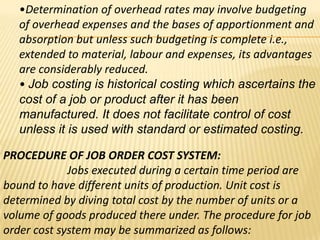
•Determination of overhead rates may involve budgeting
of overhead expenses and the bases of apportionment and
absorption but unless such budgeting is complete i.e.,
extended to material, labour and expenses, its advantages
are considerably reduced.
• Job costing is historical costing which ascertains the
cost of a job or product after it has been
manufactured. It does not facilitate control of cost
unless it is used with standard or estimated costing.
PROCEDURE OF JOB ORDER COST SYSTEM:
Jobs executed during a certain time period are
bound to have different units of production. Unit cost is
determined by diving total cost by the number of units or a
volume of goods produced there under. The procedure for job
order cost system may be summarized as follows:
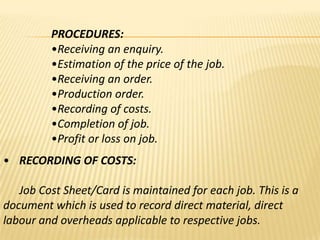
PROCEDURES:
•Receiving an enquiry.
•Estimation of the price of the job.
•Receiving an order.
•Production order.
•Recording of costs.
•Completion of job.
•Profit or loss on job.
• RECORDING OF COSTS:

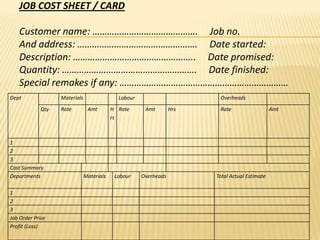
Job Cost Sheet/Card is maintained for each job. This is a
document which is used to record direct material, direct
labour and overheads applicable to respective jobs.
JOB COST SHEET / CARD
Customer name: ……………………………………. Job no.
And address: …………………………………………. Date started:
Description: ………………………………………….. Date promised:
Quantity: ………………………………………………. Date finished:
Special remakes if any: ……………………………………………………………
Dept

Materials
Qty

1
2
3
Cost Summary
Departments
1
2
3
Job Order Price
Profit (Loss)

Rate

Labour
Amt

Materials

H Rate
rs

Labour

Overheads
Amt

Overheads

Hrs

Rate

Total Actual Estimate

Amt
Discrepancies between actual and estimated costs are
explained below:
•………………………………………………………………..
•………………………………………………………………..
•………………………………………………………………..
CONCLUSION:
REFERENCE:

Job order cost system

  • 1.
    JOB ORDER COSTSYSTEM PRESENTED TO: C.VIJAY KUMAR. FACULTY OF COMMERCE DEPT. UNIVERSITY OF MYSORE
  • 2.
    Contents:  Introduction  Features ofjob order cost system  Objectives of job order cost system  Pre-requisites of job order costing  Advantages and disadvantages  Procedure of job order cost system  Conclusion
  • 3.
    INTRODUCTION: Job costing isthat specific order costing which applies where the work is undertaken as an identifiable unit such as: •Manufactures of products to customers’ specific requirements. •Fabrication of certain materials where row materials are supplied by the customers. •Repairs are done within a factory or at customers’ premises. •Manufacturing goods are not for stock purposes but for immediate delivery, once these are completed in all respects. •Internal capital expenditure jobs etc.
  • 4.
    FEATURES OF JOBORDER COSTING: •The production is generally against customers’ order but not for stock. •Each job has its own characteristics and needs special treatments. •Each job is treated as a cost unit under this method of costing. •Each job is distinctively indentified by a production order throughout the production stage. •The cost of production of every job is ascertained after the completion of the job. •The work-in-progress differs from period to period according to the number of jobs in hand.
  • 5.
    OBJECTIVES OF JOBORDER COSTING: •It helps to find out the cost of production of every job or order and to know the profit or loss made on its execution. •It helps the management to make more accurate estimates for costs of similar jobs to be executed in future on the basis of past records. •It helps the management to control the operational inefficiency by making a comparison of actual costs with estimated ones. •It helps the management to provide a valuation of workin-progress.
  • 6.
    PRE-REQUISITES FOR JOBORDER COSTING: •A sound system of production control. •Comprehensive works documentation, typically this includes: work order and/ or operation tickets, bills of materials and/or materials requisitions, jig and tool requisitions etc. •An appropriate time booking system using either time sheets or piece work tickets. •A well organized basis to the costing system with clearly defines cost centers, good labour analysis, appropriate overhead absorption rates and a relevant issue pricing system.
  • 7.
    ADVANTAGES OF JOBORDER COST SYSTEM: •It records costs more accurately and facilitates cost control by comparing actual with estimates. •It enables the management to ascertain which of the jobs are more profitable than the others, which are less profitable and which are incurring losses. •It provides a basis for estimating the cost of similar jobs taken up in future and thus helps in future production planning. •Determination of predetermined overhead rates in job costing necessitates the application of a system of budgetary control of overheads with all its advantages. •It is useful in quoting cost plus contract.
  • 8.
    DISADVANTAGES OF JOBORDER COST SYSTEM: Following are the disadvantages of the job order cost accounting: •It involves a great deal of clerical work in recording daily the cost of materials issued wages expanded and overheads chargeable to each job or work order which adds to the cost of cost accounting. Thus it is expensive. •The scope of committing mistakes is enough as the cost of one job may be wrongly posted to the cost of the other job. •Cost comparison among different jobs becomes difficult especially when drastic changes take place.
  • 9.
    •Determination of overheadrates may involve budgeting of overhead expenses and the bases of apportionment and absorption but unless such budgeting is complete i.e., extended to material, labour and expenses, its advantages are considerably reduced. • Job costing is historical costing which ascertains the cost of a job or product after it has been manufactured. It does not facilitate control of cost unless it is used with standard or estimated costing. PROCEDURE OF JOB ORDER COST SYSTEM: Jobs executed during a certain time period are bound to have different units of production. Unit cost is determined by diving total cost by the number of units or a volume of goods produced there under. The procedure for job order cost system may be summarized as follows:
  • 10.
    PROCEDURES: •Receiving an enquiry. •Estimationof the price of the job. •Receiving an order. •Production order. •Recording of costs. •Completion of job. •Profit or loss on job. • RECORDING OF COSTS: Job Cost Sheet/Card is maintained for each job. This is a document which is used to record direct material, direct labour and overheads applicable to respective jobs.
  • 11.
    JOB COST SHEET/ CARD Customer name: ……………………………………. Job no. And address: …………………………………………. Date started: Description: ………………………………………….. Date promised: Quantity: ………………………………………………. Date finished: Special remakes if any: …………………………………………………………… Dept Materials Qty 1 2 3 Cost Summary Departments 1 2 3 Job Order Price Profit (Loss) Rate Labour Amt Materials H Rate rs Labour Overheads Amt Overheads Hrs Rate Total Actual Estimate Amt
  • 12.
    Discrepancies between actualand estimated costs are explained below: •……………………………………………………………….. •……………………………………………………………….. •……………………………………………………………….. CONCLUSION:
  • 13.