CORPORATE TAX
A BRIEF OVERVIEW
CORPORATION DEFINED
• A corporation is a separate legal entity
that has been incorporated either
directly through legislation or through
a registration process established by
law.
CORPORATION DEFINED
• LEGAL ENTITY: As far as the law is
concerned, corporations, are legal
persons, and have many of the same
rights and responsibilities as natural
people do.
CORPORATION DEFINED
• Corporations can exercise human
rights against real individuals and the
state, and they can themselves be
responsible for human rights
violations.
• Corporations can even be convicted of
criminal offenses, such as fraud and
manslaughter.
CORPORATION DEFINED
LEGAL BENEFITS:
• Protection of personal assets.
• Transferable ownership.
• Raising funds through sale of stock.
• Durability.
TAX
• A tax is a financial charge or other levy
imposed upon a taxpayer (an individual
or legal entity) by a state or the
functional equivalent of a state such
that failure to pay is punishable by law.
TAX
• Functional equivalents (expenditures on
war, enforcement of law and public
order, protection of property, development of
economic infrastructure, subsidies)
• A nation's tax system is often a reflection of its
communal values and/or the values of those in
power.
PURPOSE AND EFFECTS
TAX
• Taxes in India are imposed by the Central Government
and the state governments. Some minor taxes are also
levied by the local authorities such as the Municipality.
• The Gross Collection of Corporate taxes from April to
October 2013-2014 financial year has increased by 8.23
percent and stood at 209622 crore rupees. But the Gross
Collection of Corporate taxes was 193679 crore rupees in
the same period of financial year 2012-13.
TAXATION IN INDIA
TAX
1. Taxes on income: Ex. Income tax, Capital gains
tax, Corporate tax.
2. Taxes on property: Ex. Property tax, Inheritance tax
3. Wealth(net worth) tax.
4. Taxes on goods and services:
Ex. Value added tax (Goods and services tax), Sales taxes,
Excises, Tariff.
5. Other Taxes: Ex. License fees , Poll tax.
KINDS OF TAXES
TAXATION OF CORPORATIONS
• Corporations may be taxed on their
incomes, property, or existence by
various jurisdictions. Most
jurisdictions tax corporations on
their income. Generally, this tax is
imposed at a specific rate or range
of rates on taxable income as
defined within the system
TAXATION OF CORPORATIONS
• Some systems have a separate
body of law or separate provisions
relating to corporate taxation. In
such cases, the law may apply only
to entities and not to individuals
operating a trade.
TAXABLE INCOME
• Taxable income can be
generally defined as the
gross income minus
allowable deductions.
• Most systems impose
income tax at a specified
rate of taxable income as
defined in the system.
• The allowable deductions
vary markedly from country
to country.
TAXABLE INCOME
• Most systems tax their
resident corporations
(generally those organized
within the country) on their
worldwide income, and
nonresident corporations
only on their income from
sources within the country.
Country of Tax Residency
CORPORATE TAX RATES
• Many systems have graduated tax rate
systems under which corporations
with lower levels of income pay a
lower rate of tax. (Ex: US)
• Some systems have near uniform tax
rates (Ex: India)
• Some countries have sub-country
level jurisdictions that also impose
corporate income tax. (Ex: Mass.)
THE DIRECT TAXES CODE, 2010
• It was unveiled on 12 August
2009 to replace the Income
Tax Act that dates from 1961
and became effective on 1
April 2012
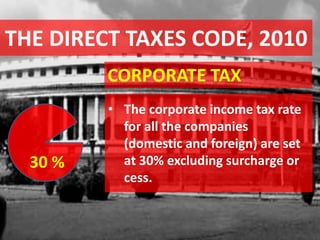
THE DIRECT TAXES CODE, 2010
CORPORATE TAX
• The corporate income tax rate
for all the companies
(domestic and foreign) are set
at 30% excluding surcharge or
cess.
30 %
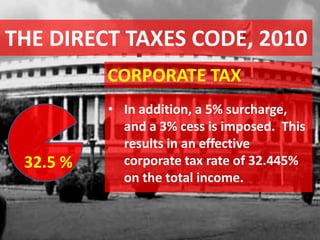
THE DIRECT TAXES CODE, 2010
CORPORATE TAX
• In addition, a 5% surcharge,
and a 3% cess is imposed. This
results in an effective
corporate tax rate of 32.445%
on the total income.
32.5 %
THE DIRECT TAXES CODE, 2010
BRANCH PROFIT TAX
• Besides the corporate tax,
Foreign companies will be also
liable to 15% branch profits
tax, regardless of whether the
income is repatriated
THE DIRECT TAXES CODE, 2010
MAT(Min. Alternate Tax)
• Companies will have to pay
MAT at a rate of 20% of
adjusted book profits when the
tax liability is less than 20% of
their book profits
THE DIRECT TAXES CODE, 2010
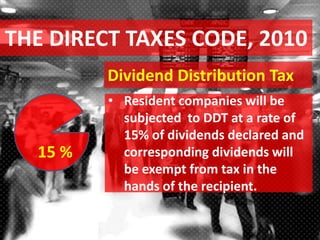
Dividend Distribution Tax
• Resident companies will be
subjected to DDT at a rate of
15% of dividends declared and
corresponding dividends will
be exempt from tax in the
hands of the recipient.
15 %
THE DIRECT TAXES CODE, 2010
TAX ON CAPITAL GAINS
• The Income Tax Act also
prescribes special tax rates for
taxation of capital gains.
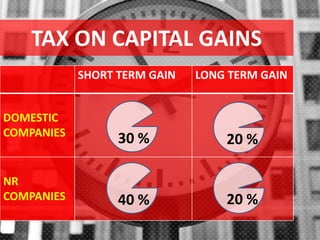
TAX ON CAPITAL GAINS
SHORT TERM GAIN LONG TERM GAIN
DOMESTIC
COMPANIES
NR
COMPANIES
30 %
40 %
20 %
20 %
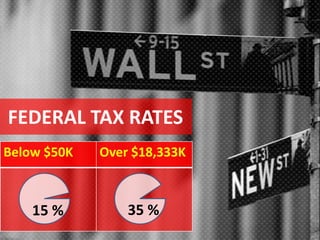
FEDERAL TAX RATES
Below $50K Over $18,333K
15 % 35 %
TAX RATES OVER THE WORLD
35 %
U.S.A
Federal Rate
TAX RATES OVER THE WORLD
15 %
CANADA
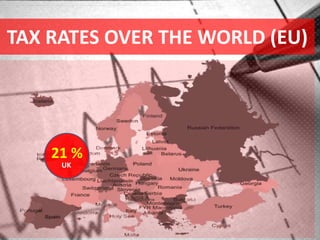
TAX RATES OVER THE WORLD (EU)
21 %
UK
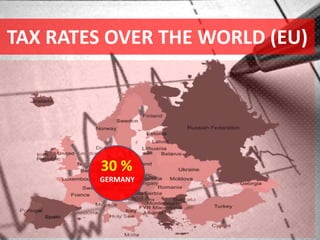
TAX RATES OVER THE WORLD (EU)
30 %
GERMANY
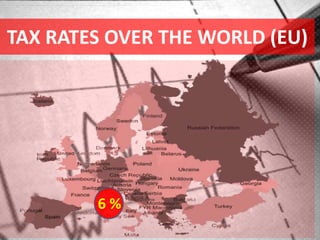
TAX RATES OVER THE WORLD (EU)
6 %
TAX RATES OVER THE WORLD
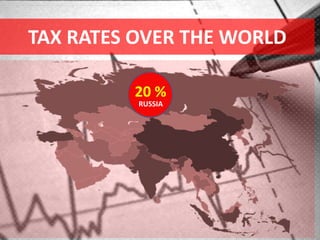
20 %
RUSSIA
TAX RATES OVER THE WORLD
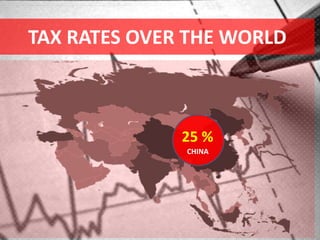
25 %
CHINA
TAX RATES OVER THE WORLD
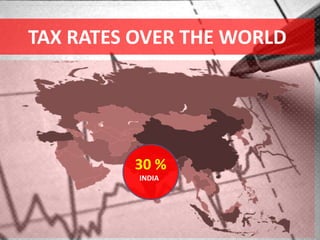
30 %
INDIA
TAX RATES OVER THE WORLD
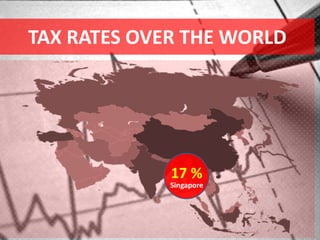
17 %
Singapore
CORPORATE TAX
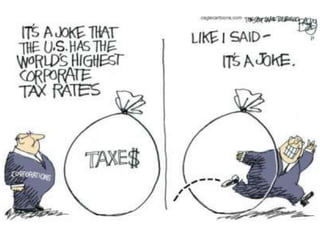
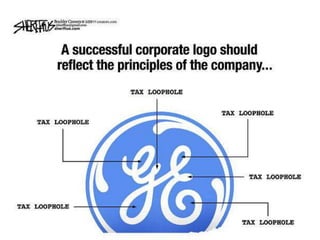
• Purpose of tax planning -
To discover how to
accomplish all of the
elements of a financial plan
in the most tax-efficient
manner possible.
TAX PLANNING
CORPORATE TAX
Benefits-
• Minimizes tax liability.
• A sources of working
capital.
• Increased distributable
profits.
• Enables to face competition
from Multinationals.
• Maximizes market value.
TAX PLANNING
TAX PLANNING
1. Accounting Methods
2. Inventory valuation
methods
3. Equipment Purchases
4. Benefits plans and
investments
General Areas
TAX PLANNING
Cash basis - Recognize income and expenses according to
real-time cash flow.
• It is possible to defer taxable income by delaying billing so
that payment is not received in the current year.
• It is possible to accelerate expenses by paying them as
soon as the bills are received, in advance of the due date.
Accounting Methods
TAX PLANNING
Accrual basis -Recognize income and expenses in the period
to which they apply
• Revenue is recorded when it is earned, rather than when
payment is received, and expenses recorded when they
are incurred, rather than when payment is made.
Advantage - More accurate picture long-term business than
cash basis method.
Disadvantage - More complex than the cash basis, and
income taxes may be owed on revenue before payment is
actually received.
Accounting Methods
TAX PLANNING
• Accrual basis of accounting is required for all businesses
that handle inventory.
• Other businesses generally can decide which accounting
method to use based on the relative tax savings it
provides.
.
Accounting Methods
TAX PLANNING
FIFO
• Items purchased the earliest are the first to be
removed from inventory.
• FIFO values the remaining inventory at the most
current cost.
• Preferred during periods of deflation or in
industries where inventory can tend to lose its
value rapidly.
INVENTORY VALUATION
METHODS
TAX PLANNING
LIFO
• Items purchased most recently are the first to be
removed from inventory
• LIFO values the remaining inventory at the earliest
cost paid that year.
• Preferred inventory valuation method during times
of rising costs
INVENTORY VALUATION
METHODS
TAX PLANNING
Inventory valuation is important because businesses are
required to reduce the amount they deduct for inventory
purchases over the course of a year by the amount remaining
in inventory at the end of the year
• For example, a business that purchased $10,000 in
inventory during the year but had $6,000 remaining in
inventory at the end of the year could only count $4,000
as an expense for inventory purchases, even though the
actual cash outlay was much larger.
INVENTORY VALUATION
METHODS
TAX PLANNING
Companies are allowed to file Form 970 and switch from FIFO
to LIFO at any time to take advantage of tax savings. However,
they must then either wait ten years or get permission from
the IRS to switch back to FIFO.
INVENTORY VALUATION
METHODS
TAX PLANNING
Businesses are allowed to deduct a certain amount in
equipment purchases during the year in which the purchases
are made.
Equipment Purchases
TAX PLANNING
• Employee benefit programs can provide a business with
tax deductions, such as contributions to life
insurance, health insurance, or retirement plans.
• Investments can shift tax liability to future periods, e.g.
treasury bills, bank certificates, savings bonds etc.
• Companies can avoid paying taxes during the current
period for income that is reinvested in such tax-
deferred instruments.
BENEFITS PLANS AND
INVESTMENTS
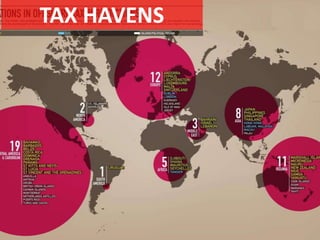
Baharin
Luxembour
g
Hong Kong
Singapore
Switzerlan
d
TAX HAVEN
• A tax haven is a state, country or
territory where certain taxes are
levied at a low rate or not at all.
• Individuals or corporate entities
can find it attractive to establish
shell subsidiaries or move
themselves to areas with
reduced or nil taxation levels
relative to typical international
taxation.
• This creates a situation of tax
competition among
governments.
TAX HAVENS
THANK YOU
SHOURYA DEEPAK

Corporate tax (India)

  • 1.
  • 2.
    CORPORATION DEFINED • Acorporation is a separate legal entity that has been incorporated either directly through legislation or through a registration process established by law.
  • 3.
    CORPORATION DEFINED • LEGALENTITY: As far as the law is concerned, corporations, are legal persons, and have many of the same rights and responsibilities as natural people do.
  • 4.
    CORPORATION DEFINED • Corporationscan exercise human rights against real individuals and the state, and they can themselves be responsible for human rights violations. • Corporations can even be convicted of criminal offenses, such as fraud and manslaughter.
  • 5.
    CORPORATION DEFINED LEGAL BENEFITS: •Protection of personal assets. • Transferable ownership. • Raising funds through sale of stock. • Durability.
  • 6.
    TAX • A taxis a financial charge or other levy imposed upon a taxpayer (an individual or legal entity) by a state or the functional equivalent of a state such that failure to pay is punishable by law.
  • 8.
    TAX • Functional equivalents(expenditures on war, enforcement of law and public order, protection of property, development of economic infrastructure, subsidies) • A nation's tax system is often a reflection of its communal values and/or the values of those in power. PURPOSE AND EFFECTS
  • 9.
    TAX • Taxes inIndia are imposed by the Central Government and the state governments. Some minor taxes are also levied by the local authorities such as the Municipality. • The Gross Collection of Corporate taxes from April to October 2013-2014 financial year has increased by 8.23 percent and stood at 209622 crore rupees. But the Gross Collection of Corporate taxes was 193679 crore rupees in the same period of financial year 2012-13. TAXATION IN INDIA
  • 10.
    TAX 1. Taxes onincome: Ex. Income tax, Capital gains tax, Corporate tax. 2. Taxes on property: Ex. Property tax, Inheritance tax 3. Wealth(net worth) tax. 4. Taxes on goods and services: Ex. Value added tax (Goods and services tax), Sales taxes, Excises, Tariff. 5. Other Taxes: Ex. License fees , Poll tax. KINDS OF TAXES
  • 11.
    TAXATION OF CORPORATIONS •Corporations may be taxed on their incomes, property, or existence by various jurisdictions. Most jurisdictions tax corporations on their income. Generally, this tax is imposed at a specific rate or range of rates on taxable income as defined within the system
  • 12.
    TAXATION OF CORPORATIONS •Some systems have a separate body of law or separate provisions relating to corporate taxation. In such cases, the law may apply only to entities and not to individuals operating a trade.
  • 13.
    TAXABLE INCOME • Taxableincome can be generally defined as the gross income minus allowable deductions. • Most systems impose income tax at a specified rate of taxable income as defined in the system. • The allowable deductions vary markedly from country to country.
  • 14.
    TAXABLE INCOME • Mostsystems tax their resident corporations (generally those organized within the country) on their worldwide income, and nonresident corporations only on their income from sources within the country. Country of Tax Residency
  • 15.
    CORPORATE TAX RATES •Many systems have graduated tax rate systems under which corporations with lower levels of income pay a lower rate of tax. (Ex: US) • Some systems have near uniform tax rates (Ex: India) • Some countries have sub-country level jurisdictions that also impose corporate income tax. (Ex: Mass.)
  • 16.
    THE DIRECT TAXESCODE, 2010 • It was unveiled on 12 August 2009 to replace the Income Tax Act that dates from 1961 and became effective on 1 April 2012
  • 17.
    THE DIRECT TAXESCODE, 2010 CORPORATE TAX • The corporate income tax rate for all the companies (domestic and foreign) are set at 30% excluding surcharge or cess. 30 %
  • 18.
    THE DIRECT TAXESCODE, 2010 CORPORATE TAX • In addition, a 5% surcharge, and a 3% cess is imposed. This results in an effective corporate tax rate of 32.445% on the total income. 32.5 %
  • 19.
    THE DIRECT TAXESCODE, 2010 BRANCH PROFIT TAX • Besides the corporate tax, Foreign companies will be also liable to 15% branch profits tax, regardless of whether the income is repatriated
  • 20.
    THE DIRECT TAXESCODE, 2010 MAT(Min. Alternate Tax) • Companies will have to pay MAT at a rate of 20% of adjusted book profits when the tax liability is less than 20% of their book profits
  • 21.
    THE DIRECT TAXESCODE, 2010 Dividend Distribution Tax • Resident companies will be subjected to DDT at a rate of 15% of dividends declared and corresponding dividends will be exempt from tax in the hands of the recipient. 15 %
  • 22.
    THE DIRECT TAXESCODE, 2010 TAX ON CAPITAL GAINS • The Income Tax Act also prescribes special tax rates for taxation of capital gains.
  • 23.
    TAX ON CAPITALGAINS SHORT TERM GAIN LONG TERM GAIN DOMESTIC COMPANIES NR COMPANIES 30 % 40 % 20 % 20 %
  • 24.
    FEDERAL TAX RATES Below$50K Over $18,333K 15 % 35 %
  • 25.
    TAX RATES OVERTHE WORLD 35 % U.S.A Federal Rate
  • 26.
    TAX RATES OVERTHE WORLD 15 % CANADA
  • 27.
    TAX RATES OVERTHE WORLD (EU) 21 % UK
  • 28.
    TAX RATES OVERTHE WORLD (EU) 30 % GERMANY
  • 29.
    TAX RATES OVERTHE WORLD (EU) 6 %
  • 30.
    TAX RATES OVERTHE WORLD 20 % RUSSIA
  • 31.
    TAX RATES OVERTHE WORLD 25 % CHINA
  • 32.
    TAX RATES OVERTHE WORLD 30 % INDIA
  • 33.
    TAX RATES OVERTHE WORLD 17 % Singapore
  • 36.
    CORPORATE TAX • Purposeof tax planning - To discover how to accomplish all of the elements of a financial plan in the most tax-efficient manner possible. TAX PLANNING
  • 37.
    CORPORATE TAX Benefits- • Minimizestax liability. • A sources of working capital. • Increased distributable profits. • Enables to face competition from Multinationals. • Maximizes market value. TAX PLANNING
  • 38.
    TAX PLANNING 1. AccountingMethods 2. Inventory valuation methods 3. Equipment Purchases 4. Benefits plans and investments General Areas
  • 39.
    TAX PLANNING Cash basis- Recognize income and expenses according to real-time cash flow. • It is possible to defer taxable income by delaying billing so that payment is not received in the current year. • It is possible to accelerate expenses by paying them as soon as the bills are received, in advance of the due date. Accounting Methods
  • 40.
    TAX PLANNING Accrual basis-Recognize income and expenses in the period to which they apply • Revenue is recorded when it is earned, rather than when payment is received, and expenses recorded when they are incurred, rather than when payment is made. Advantage - More accurate picture long-term business than cash basis method. Disadvantage - More complex than the cash basis, and income taxes may be owed on revenue before payment is actually received. Accounting Methods
  • 41.
    TAX PLANNING • Accrualbasis of accounting is required for all businesses that handle inventory. • Other businesses generally can decide which accounting method to use based on the relative tax savings it provides. . Accounting Methods
  • 42.
    TAX PLANNING FIFO • Itemspurchased the earliest are the first to be removed from inventory. • FIFO values the remaining inventory at the most current cost. • Preferred during periods of deflation or in industries where inventory can tend to lose its value rapidly. INVENTORY VALUATION METHODS
  • 43.
    TAX PLANNING LIFO • Itemspurchased most recently are the first to be removed from inventory • LIFO values the remaining inventory at the earliest cost paid that year. • Preferred inventory valuation method during times of rising costs INVENTORY VALUATION METHODS
  • 44.
    TAX PLANNING Inventory valuationis important because businesses are required to reduce the amount they deduct for inventory purchases over the course of a year by the amount remaining in inventory at the end of the year • For example, a business that purchased $10,000 in inventory during the year but had $6,000 remaining in inventory at the end of the year could only count $4,000 as an expense for inventory purchases, even though the actual cash outlay was much larger. INVENTORY VALUATION METHODS
  • 45.
    TAX PLANNING Companies areallowed to file Form 970 and switch from FIFO to LIFO at any time to take advantage of tax savings. However, they must then either wait ten years or get permission from the IRS to switch back to FIFO. INVENTORY VALUATION METHODS
  • 46.
    TAX PLANNING Businesses areallowed to deduct a certain amount in equipment purchases during the year in which the purchases are made. Equipment Purchases
  • 47.
    TAX PLANNING • Employeebenefit programs can provide a business with tax deductions, such as contributions to life insurance, health insurance, or retirement plans. • Investments can shift tax liability to future periods, e.g. treasury bills, bank certificates, savings bonds etc. • Companies can avoid paying taxes during the current period for income that is reinvested in such tax- deferred instruments. BENEFITS PLANS AND INVESTMENTS
  • 48.
  • 49.
  • 50.
  • 51.
  • 52.
  • 53.
    TAX HAVEN • Atax haven is a state, country or territory where certain taxes are levied at a low rate or not at all. • Individuals or corporate entities can find it attractive to establish shell subsidiaries or move themselves to areas with reduced or nil taxation levels relative to typical international taxation. • This creates a situation of tax competition among governments.
  • 54.
  • 56.