COST ACCOUNTING
TOPICS:
JOB COSTING, BATCH COSTING, CONTRACT
COSTING
JOB COSTING
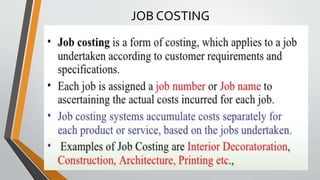
JOB COSTING
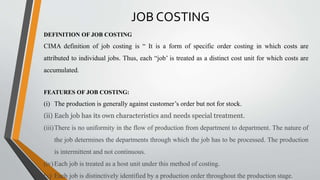
DEFINITION OF JOB COSTING
CIMA definition of job costing is “ It is a form of specific order costing in which costs are
attributed to individual jobs. Thus, each “job’ is treated as a distinct cost unit for which costs are
accumulated.
FEATURES OF JOB COSTING:
(i) The production is generally against customer’s order but not for stock.
(ii) Each job has its own characteristics and needs special treatment.
(iii)There is no uniformity in the flow of production from department to department. The nature of
the job determines the departments through which the job has to be processed. The production
is intermittent and not continuous.
(iv)Each job is treated as a host unit under this method of costing.
(v) Each job is distinctively identified by a production order throughout the production stage.
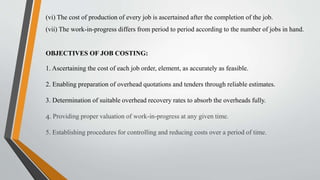
(vi) The cost of production of every job is ascertained after the completion of the job.
(vii) The work-in-progress differs from period to period according to the number of jobs in hand.
OBJECTIVES OF JOB COSTING:
1. Ascertaining the cost of each job order, element, as accurately as feasible.
2. Enabling preparation of overhead quotations and tenders through reliable estimates.
3. Determination of suitable overhead recovery rates to absorb the overheads fully.
4. Providing proper valuation of work-in-progress at any given time.
5. Establishing procedures for controlling and reducing costs over a period of time.
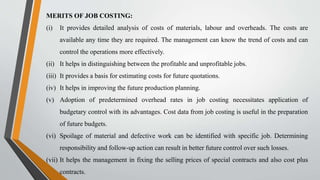
MERITS OF JOB COSTING:
(i) It provides detailed analysis of costs of materials, labour and overheads. The costs are
available any time they are required. The management can know the trend of costs and can
control the operations more effectively.
(ii) It helps in distinguishing between the profitable and unprofitable jobs.
(iii) It provides a basis for estimating costs for future quotations.
(iv) It helps in improving the future production planning.
(v) Adoption of predetermined overhead rates in job costing necessitates application of
budgetary control with its advantages. Cost data from job costing is useful in the preparation
of future budgets.
(vi) Spoilage of material and defective work can be identified with specific job. Determining
responsibility and follow-up action can result in better future control over such losses.
(vii) It helps the management in fixing the selling prices of special contracts and also cost plus
contracts.
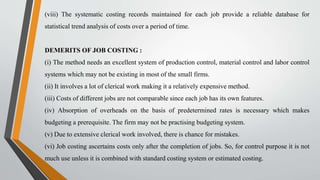
(viii) The systematic costing records maintained for each job provide a reliable database for
statistical trend analysis of costs over a period of time.
DEMERITS OF JOB COSTING :
(i) The method needs an excellent system of production control, material control and labor control
systems which may not be existing in most of the small firms.
(ii) It involves a lot of clerical work making it a relatively expensive method.
(iii) Costs of different jobs are not comparable since each job has its own features.
(iv) Absorption of overheads on the basis of predetermined rates is necessary which makes
budgeting a prerequisite. The firm may not be practising budgeting system.
(v) Due to extensive clerical work involved, there is chance for mistakes.
(vi) Job costing ascertains costs only after the completion of jobs. So, for control purpose it is not
much use unless it is combined with standard costing system or estimated costing.
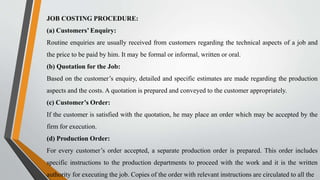
JOB COSTING PROCEDURE:
(a) Customers’ Enquiry:
Routine enquiries are usually received from customers regarding the technical aspects of a job and
the price to be paid by him. It may be formal or informal, written or oral.
(b) Quotation for the Job:
Based on the customer’s enquiry, detailed and specific estimates are made regarding the production
aspects and the costs. A quotation is prepared and conveyed to the customer appropriately.
(c) Customer’s Order:
If the customer is satisfied with the quotation, he may place an order which may be accepted by the
firm for execution.
(d) Production Order:
For every customer’s order accepted, a separate production order is prepared. This order includes
specific instructions to the production departments to proceed with the work and it is the written
authority for executing the job. Copies of the order with relevant instructions are circulated to all the
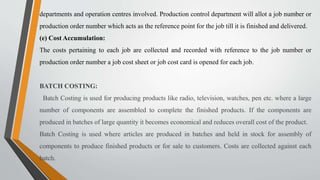
departments and operation centres involved. Production control department will allot a job number or
production order number which acts as the reference point for the job till it is finished and delivered.
(e) Cost Accumulation:
The costs pertaining to each job are collected and recorded with reference to the job number or
production order number a job cost sheet or job cost card is opened for each job.
BATCH COSTING:
Batch Costing is used for producing products like radio, television, watches, pen etc. where a large
number of components are assembled to complete the finished products. If the components are
produced in batches of large quantity it becomes economical and reduces overall cost of the product.
Batch Costing is used where articles are produced in batches and held in stock for assembly of
components to produce finished products or for sale to customers. Costs are collected against each
batch.
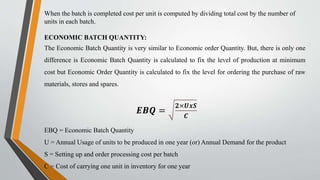
When the batch is completed cost per unit is computed by dividing total cost by the number of
units in each batch.
ECONOMIC BATCH QUANTITY:
The Economic Batch Quantity is very similar to Economic order Quantity. But, there is only one
difference is Economic Batch Quantity is calculated to fix the level of production at minimum
cost but Economic Order Quantity is calculated to fix the level for ordering the purchase of raw
materials, stores and spares.
𝑬𝑩𝑸 =
𝟐×𝑼𝒙𝑺
𝑪
EBQ = Economic Batch Quantity
U = Annual Usage of units to be produced in one year (or) Annual Demand for the product
S = Setting up and order processing cost per batch
C = Cost of carrying one unit in inventory for one year
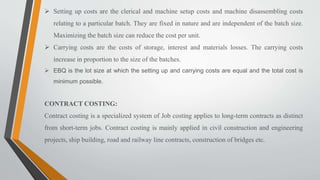
 Setting up costs are the clerical and machine setup costs and machine disassembling costs
relating to a particular batch. They are fixed in nature and are independent of the batch size.
Maximizing the batch size can reduce the cost per unit.
 Carrying costs are the costs of storage, interest and materials losses. The carrying costs
increase in proportion to the size of the batches.
 EBQ is the lot size at which the setting up and carrying costs are equal and the total cost is
minimum possible.
CONTRACT COSTING:
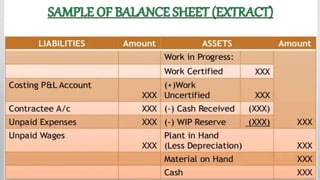
Contract costing is a specialized system of Job costing applies to long-term contracts as distinct
from short-term jobs. Contract costing is mainly applied in civil construction and engineering
projects, ship building, road and railway line contracts, construction of bridges etc.
CONTRACT COSTING:
Contract costing is a specialized system of Job costing applies to long-term contracts as distinct
from short-term jobs. Contract costing is mainly applied in civil construction and engineering
projects, ship building, road and railway line contracts, construction of bridges etc.
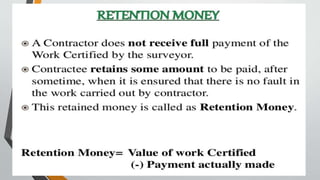
Contract costing is a form of Specific order costing. It is applied to contracts where substantial
time is taken to complete the contract and it falls into different accounting periods.
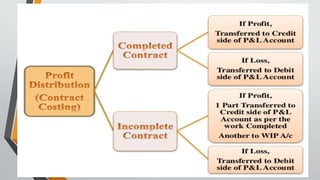
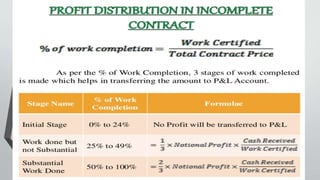
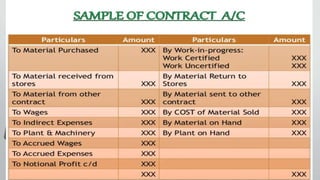
The objectives of contract costing is to ascertain the cost incurred and to show the profit earned or
loss suffered on each contract undertaken after its completion as also from time to time during the
period of its execution.
COST ACCOUNTING.pptx

COST ACCOUNTING.pptx

  • 1.
    COST ACCOUNTING TOPICS: JOB COSTING,BATCH COSTING, CONTRACT COSTING
  • 2.
  • 3.
    JOB COSTING DEFINITION OFJOB COSTING CIMA definition of job costing is “ It is a form of specific order costing in which costs are attributed to individual jobs. Thus, each “job’ is treated as a distinct cost unit for which costs are accumulated. FEATURES OF JOB COSTING: (i) The production is generally against customer’s order but not for stock. (ii) Each job has its own characteristics and needs special treatment. (iii)There is no uniformity in the flow of production from department to department. The nature of the job determines the departments through which the job has to be processed. The production is intermittent and not continuous. (iv)Each job is treated as a host unit under this method of costing. (v) Each job is distinctively identified by a production order throughout the production stage.
  • 4.
    (vi) The costof production of every job is ascertained after the completion of the job. (vii) The work-in-progress differs from period to period according to the number of jobs in hand. OBJECTIVES OF JOB COSTING: 1. Ascertaining the cost of each job order, element, as accurately as feasible. 2. Enabling preparation of overhead quotations and tenders through reliable estimates. 3. Determination of suitable overhead recovery rates to absorb the overheads fully. 4. Providing proper valuation of work-in-progress at any given time. 5. Establishing procedures for controlling and reducing costs over a period of time.
  • 5.
    MERITS OF JOBCOSTING: (i) It provides detailed analysis of costs of materials, labour and overheads. The costs are available any time they are required. The management can know the trend of costs and can control the operations more effectively. (ii) It helps in distinguishing between the profitable and unprofitable jobs. (iii) It provides a basis for estimating costs for future quotations. (iv) It helps in improving the future production planning. (v) Adoption of predetermined overhead rates in job costing necessitates application of budgetary control with its advantages. Cost data from job costing is useful in the preparation of future budgets. (vi) Spoilage of material and defective work can be identified with specific job. Determining responsibility and follow-up action can result in better future control over such losses. (vii) It helps the management in fixing the selling prices of special contracts and also cost plus contracts.
  • 6.
    (viii) The systematiccosting records maintained for each job provide a reliable database for statistical trend analysis of costs over a period of time. DEMERITS OF JOB COSTING : (i) The method needs an excellent system of production control, material control and labor control systems which may not be existing in most of the small firms. (ii) It involves a lot of clerical work making it a relatively expensive method. (iii) Costs of different jobs are not comparable since each job has its own features. (iv) Absorption of overheads on the basis of predetermined rates is necessary which makes budgeting a prerequisite. The firm may not be practising budgeting system. (v) Due to extensive clerical work involved, there is chance for mistakes. (vi) Job costing ascertains costs only after the completion of jobs. So, for control purpose it is not much use unless it is combined with standard costing system or estimated costing.
  • 7.
    JOB COSTING PROCEDURE: (a)Customers’ Enquiry: Routine enquiries are usually received from customers regarding the technical aspects of a job and the price to be paid by him. It may be formal or informal, written or oral. (b) Quotation for the Job: Based on the customer’s enquiry, detailed and specific estimates are made regarding the production aspects and the costs. A quotation is prepared and conveyed to the customer appropriately. (c) Customer’s Order: If the customer is satisfied with the quotation, he may place an order which may be accepted by the firm for execution. (d) Production Order: For every customer’s order accepted, a separate production order is prepared. This order includes specific instructions to the production departments to proceed with the work and it is the written authority for executing the job. Copies of the order with relevant instructions are circulated to all the
  • 8.
    departments and operationcentres involved. Production control department will allot a job number or production order number which acts as the reference point for the job till it is finished and delivered. (e) Cost Accumulation: The costs pertaining to each job are collected and recorded with reference to the job number or production order number a job cost sheet or job cost card is opened for each job. BATCH COSTING: Batch Costing is used for producing products like radio, television, watches, pen etc. where a large number of components are assembled to complete the finished products. If the components are produced in batches of large quantity it becomes economical and reduces overall cost of the product. Batch Costing is used where articles are produced in batches and held in stock for assembly of components to produce finished products or for sale to customers. Costs are collected against each batch.
  • 9.
    When the batchis completed cost per unit is computed by dividing total cost by the number of units in each batch. ECONOMIC BATCH QUANTITY: The Economic Batch Quantity is very similar to Economic order Quantity. But, there is only one difference is Economic Batch Quantity is calculated to fix the level of production at minimum cost but Economic Order Quantity is calculated to fix the level for ordering the purchase of raw materials, stores and spares. 𝑬𝑩𝑸 = 𝟐×𝑼𝒙𝑺 𝑪 EBQ = Economic Batch Quantity U = Annual Usage of units to be produced in one year (or) Annual Demand for the product S = Setting up and order processing cost per batch C = Cost of carrying one unit in inventory for one year
  • 10.
     Setting upcosts are the clerical and machine setup costs and machine disassembling costs relating to a particular batch. They are fixed in nature and are independent of the batch size. Maximizing the batch size can reduce the cost per unit.  Carrying costs are the costs of storage, interest and materials losses. The carrying costs increase in proportion to the size of the batches.  EBQ is the lot size at which the setting up and carrying costs are equal and the total cost is minimum possible. CONTRACT COSTING: Contract costing is a specialized system of Job costing applies to long-term contracts as distinct from short-term jobs. Contract costing is mainly applied in civil construction and engineering projects, ship building, road and railway line contracts, construction of bridges etc.
  • 11.
    CONTRACT COSTING: Contract costingis a specialized system of Job costing applies to long-term contracts as distinct from short-term jobs. Contract costing is mainly applied in civil construction and engineering projects, ship building, road and railway line contracts, construction of bridges etc. Contract costing is a form of Specific order costing. It is applied to contracts where substantial time is taken to complete the contract and it falls into different accounting periods. The objectives of contract costing is to ascertain the cost incurred and to show the profit earned or loss suffered on each contract undertaken after its completion as also from time to time during the period of its execution.