Chapter 2
Human ResourceManagement
1
• Meaning ,definition and evolution of HRM
• HRP
• Job analysis
• Recruitment ,
• Selection
• Performance appraisal;
• Wage and salary adjustments
2.
HRM Meaning andDefinition
Human Resource Management is concerned
with the people dimension in management.
Since every organisation is made up of people,
acquiring their services, developing their
skills, motivating them to higher levels of
performance and ensuring that they continue to
maintain their commitment to the organisation
are essential to achieving organisational
objectives.
This is true regardless of the type of
organisation – government, business,
education, health, recreation or social action.2
3.
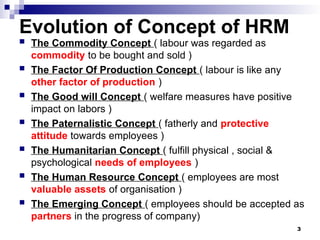
Evolution of Conceptof HRM
The Commodity Concept ( labour was regarded as
commodity to be bought and sold )
The Factor Of Production Concept ( labour is like any
other factor of production )
The Good will Concept ( welfare measures have positive
impact on labors )
The Paternalistic Concept ( fatherly and protective
attitude towards employees )
The Humanitarian Concept ( fulfill physical , social &
psychological needs of employees )
The Human Resource Concept ( employees are most
valuable assets of organisation )
The Emerging Concept ( employees should be accepted as
partners in the progress of company)
3
4.
Strategic HRM
1. Thehuman resources are major
source of competitive advantage ,
people can make or break organisation .
2. Successful organisational
performance depends on a close fit
between business and human resource
strategy
3. Individual HR strategy should cohere
by being linked to each other to offer
mutual support .
4
5.
Role of HRManager
“Human resource managers , now days ,
wear many hats . They perform mainly
three different types of roles while meeting
the requirement of employees and
customers , namely
1. administrative ,
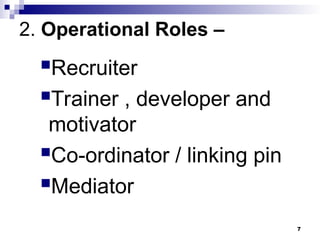
2. operational and
3. strategic .”
5
6.
1. Administrative Roles–
Plays major role of manager
Administrative expert
Welfare officer
Advisor
Counsellor
Policy maker
Legal consultant
6
3. Strategic Role–
The strategic role of HR management focuses
attention on how to enable ordinary employees
to turn out extra ordinary performance ,
taking care of their ever-changing expectations .
The key areas of attention include effective
management of key resources ( employees,
technology , work process ) while delivering
cost effective , value enhancing solutions .
Change agent
Strategic partner
8
HUMAN RESOURCE PLANNING
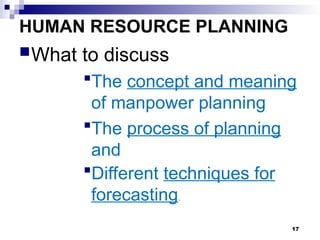
Whatto discuss
The concept and meaning
of manpower planning
The process of planning
and
Different techniques for
forecasting.
17
18.
HUMAN RESOURCE PLANNING
Human Resource Planning is the process of forecasting
a firm’s future demand for, and supply of, the right type
of people in the right number to achieve organizational
goals and objectives.
The process of determining manpower
requirements and the means of meeting those
requirements in order to carry out the
integrated plan of the organization
Without a clear cut planning, estimation of an
organization's human resource need is reduced
to mere guesswork.
18
19.
Steps of HRPProcess
Analyzing corporate and unit level strategies
Forecasting Demand based on organizational plan
Forecasting Supply based on human resource
market inventory
Estimating net human resources requirements
In case of future surplus – plan for redeployment,
retrenchment (cut with compens.) and layoff(temp)
In case of future deficit – forecast future supply
from all sources with reference to other
companies
Plan to modify or adjust organ. plan if future
supply is inadequate 19
20.
HR Demand Forecast
Demand forecasting is the process of
estimating the quantity and quality of
people required to meet future needs of
the organization.
Forecasting Techniques
Managerial judgments
Ratio trends analysis
Work study techniques (To fix length of time &
No of workers)
Delphi techniques
Regression analysis
20
21.
2. Ratio-trends analysis
This technique involves studying past ratios, say, between the
number of workers and sales (n/s) in an organization and
forecasting future ratios, making some allowance for changes in the
organization or its method.
Given sf nf=(np/sp)sf
21
1. Managerial judgement
Used for small-scale and unorganized industries (without data
bank of manpower and job analysis
In this all managers sit together, discuss and arrive at a figure
which would be the future demand for labor.
3. Work study techniques
Suitable when volume of work is easily measurable
Total production estimated, Man-hour required to
produce each unit of product calculated, then required
number of employees calculated with allowance for rest
and absenteeism
22.
Delphi technique
22
Itsolicits estimates of personnel needs from a group of
experts, usually managers (but no interaction among
experts ).
Summaries and surveys are repeated until the experts
opinion begin to agree.
Regression analysis
23.
JOB ANALYSIS
Jobmay be defined as “collection of tasks,
duties and responsibilities which as a whole, are
regarded as a regular assignment to individual
employees.”
Job Analysis is a formal and detailed study of
jobs. It refers a scientific and systematic
collecting and analyzing data relating a job.
A job can be analyzed only after it has been
designed and someone already performing, it
hence Job analysis is performed up on ongoing
jobs.
23
24.
Job analysis providesthe following information
Identify the job in terms of its title and code number
The operations and the task involved in the job including
their timing, sequence, complexity and sequence
Location, physical setting, hazards and discomforts,
supervision given and received
Duties involved in the job along with frequency of
occurrence of each duty
Materials, methods and equipment's used in performing
job
How the job is performed i.e. nature of operation
( Cleaning, feeding etc)
Relationship of the job with other jobs in the organization
Personal attributes required for performing the job
( Physical strength, education, mental skills, experience etc)
24
25.
Use of Jobanalysis
It helps proper placement of employees
( Matching job requirement and personnel cases
( Misfits reduced )
Helps to improve efficiency ( due to better
placement, suggests methods for improvement
Helps in improving job design and work methods
It provides bases for manpower planning,
recruitment and selection
Helps in devising the training and development
programmes
It facilitates job evaluation and performance
appraisal 25
26.
Steps of Jobanalysis
1. Collection of background information-
linkage b/n jobs and organizational goal) (To get overall picture)
2. Selection of representative job to be
analyzed
3. Understand the existing design (Job desc.,
Job spec., flow chart , procedure manual etc)
4. Collection of new job analysis data-
(data on characteristics, qualification and behavior
required to do job effectively)
5. Developing job Description
6. Developing job Specification
26
27.
Techniques of gatheringJob info
1. Personal observation
2. questionnaires
3. Maintenance of log records
4. Conducting personal interviews
27
28.
Job Description (TheJob)
A list of job’s duties, responsibilities,
reporting relationship, working conditions,
and supervisory responsibilities.
28
29.
Job Specification (ThePerson)
A list of job’s “human requirements” that is,
the requisite education, skills, personality
and so on.
29
30.
Job Evaluation (The Job)
A job evaluation is a systematic way of
determining the value/worth of a job in
relation to other jobs in an organization.
It tries to make a systematic comparison
between jobs to access their relative worth
for the purpose of establishing a rational
pay structure.
Job evaluation-(the job )
Performance appraisal –( The person)
30
31.
METHODS OF J/E
QualitativeMethod
1. Ranking or Job Comparison
2. Grading or Job Classification
Quantitative Method
1. Point Rating (JEG)
2. Factor Comparison
31
32.
1. RANKING METHOD
Simplest form
Each job as a whole is compared with
other and this comparison of jobs goes on
until all the jobs have been evaluated
and ranked.
All jobs are ranked in the order of their
importance from the simplest to the
hardest or from the highest to the
lowest.
32
33.
Techniques
1. Job description-prepared for each job and the
difference noticed
2. Paired comparisons- made
3. And Ranking made
Advantage – Simple and oldest- Less time consuming
–
Disadvantage – Doesn’t indicate degree of difference
– involves subjective judgment-need rater to have deep
knowledge of the job
33
34.
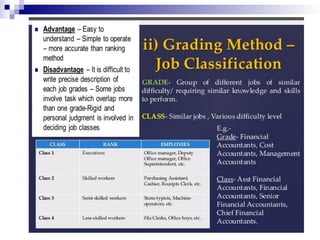
2. GRADING METHOD
Also known as classification method
A job grade is defined as a group of
different jobs of similar difficulty or
requiring similar skills to perform them.
Job grades are determined on the basis of
information derived from job analysis.
The grades or classes are created by
identifying some common denominator
such as skills, knowledge and
responsibilities.
34
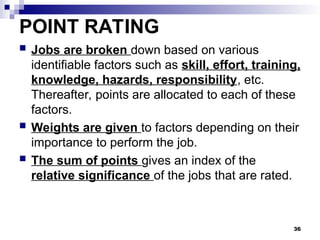
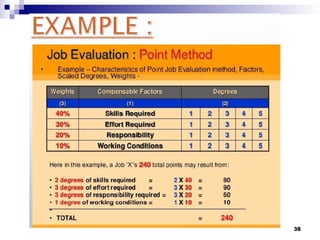
POINT RATING
Jobsare broken down based on various
identifiable factors such as skill, effort, training,
knowledge, hazards, responsibility, etc.
Thereafter, points are allocated to each of these
factors.
Weights are given to factors depending on their
importance to perform the job.
The sum of points gives an index of the
relative significance of the jobs that are rated.
36
37.
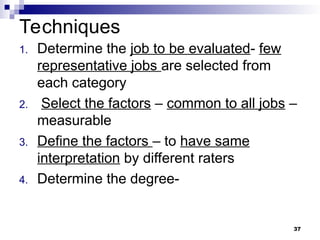
Techniques
1. Determine thejob to be evaluated- few
representative jobs are selected from
each category
2. Select the factors – common to all jobs –
measurable
3. Define the factors – to have same
interpretation by different raters
4. Determine the degree-
37
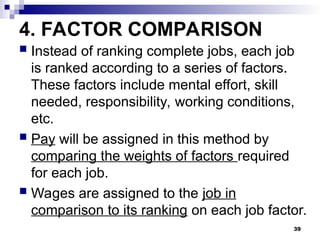
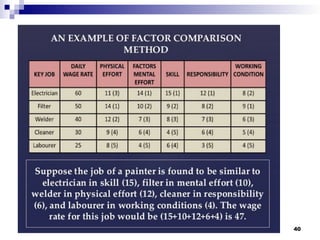
4. FACTOR COMPARISON
Instead of ranking complete jobs, each job
is ranked according to a series of factors.
These factors include mental effort, skill
needed, responsibility, working conditions,
etc.
Pay will be assigned in this method by
comparing the weights of factors required
for each job.
Wages are assigned to the job in
comparison to its ranking on each job factor.
39
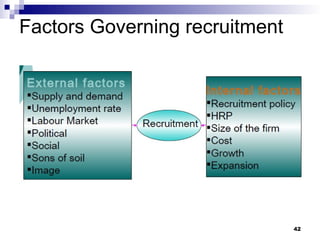
RECRUITMENT
the processof searching for prospective
employees and stimulating them to apply
for jobs in the organisation
It is the process of finding and attracting
capable applicants for employment. The
process begins when new recruits are
sought and ends when their
applications are submitted.
The result is pool of applicants from
which new employees are selected.
41
Recruitment methods
1. DirectMethod
SCOUTING –representatives of org. are sent universities or training institution to
stimulate new graduates to apply- campus interview
Manned exhibits- sending recruiters to seminar and conventions
Some organizations –use waiting list of candidates who have indicated their
interest in job in person or through telephone
2. Indirect Method
Advertisement in news papers, on radio and television are
used to publicize vacancy ( Appropriate to reach out large
target)
3. Third party method
Various agencies can be used
Public employment exchange, management consulting
firms, professional societies,
44
45.
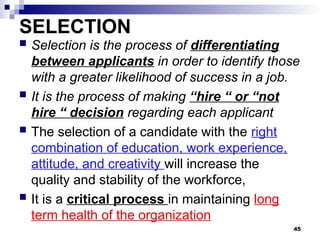
SELECTION
Selection isthe process of differentiating
between applicants in order to identify those
with a greater likelihood of success in a job.
It is the process of making “hire “ or “not
hire “ decision regarding each applicant
The selection of a candidate with the right
combination of education, work experience,
attitude, and creativity will increase the
quality and stability of the workforce,
It is a critical process in maintaining long
term health of the organization
45
46.
Selection criteria
1. abilityto perform the given task
2. The one who have that right attitude
(willingness ) to perform the job
3. they will make an adjustment to the
organizational culture and they
become good co-workers (Team
player ),
4. they will stay for a reasonable
period of time
46
47.
SELECTION PROCESS
1. ReceivingApplications
2. Screening of Application
After the applications are received, the screening committee
prepared a list of the candidates to take selection test and/or to be
interviewed.
3. Selection Tests
Employment tests are used to select persons for various jobs based on
ability, aptitude and personality .
Used to cut the number when large applicants are there
4. Employment Interview
The number of candidates called for interview is normally five to
seven times the number of posts to the filled up.
47
48.
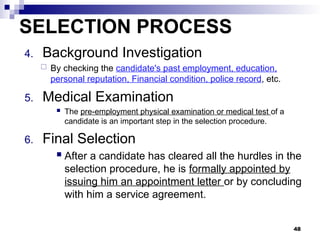
SELECTION PROCESS
4. BackgroundInvestigation
By checking the candidate's past employment, education,
personal reputation, Financial condition, police record, etc.
5. Medical Examination
The pre-employment physical examination or medical test of a
candidate is an important step in the selection procedure.
6. Final Selection
After a candidate has cleared all the hurdles in the
selection procedure, he is formally appointed by
issuing him an appointment letter or by concluding
with him a service agreement.
48
49.
Basic Testing Concepts
1.Aptitude Tests: Aptitude means the potential which an individual has for
learning the skills required to do a job efficiently, Aptitude tests measure an
applicant's capacity and his potential of development.
2. Proficiency Tests : Proficiency tests are designed to measure the
skills already acquired by the individuals. They are also known as
performance, occupational or trade tests. ( 60 words per minute)
3. Interest Tests : Interest tests identify patterns of interest in those
areas in which the individual shows special concern, fascination and
involvement.
4. Personality Tests : Personality tests probe for the qualities of the
personality as a whole, 5 personality dimensions like this Sociability,
emotional stability, the agreeableness, carefulness and the openness
to experience.
5. Interview : Although application blank and employment tests provide
a lot of valuable information about the candidate, yet they do not
provide the complete set of information required.
49
50.
Interviews
Formal, indepth conversation conducted
to evaluate the applicant’s acceptability.
Adapted to unskilled, skilled, managerial
and professional employees.
Two-way exchange of information, the
interviewers learn about the applicant, and
the applicant learns about the organization
50
51.
Objectives of Interview
Helps obtain additional information from
applicant
Facilitates giving general information to
applicant
Help build image of the organization
51
Shortcomings of interviews
Absence of reliability (Same for all )
Lack of validity ( Question Vs work r/n)
Biases
52.
Types of Interview
One to one Interview
Only two participants –
Interviewer
Candidate
Sequential Interview
Involves series of interviews
Candidates moves from room to room
Panel Interview
Two or more interviewers
Formal
52
53.
Induction/Orientation
Systematic andplanned introduction of
employees to their jobs, their co-workers
and the organization.
It is key for easy assimilation of the new
employee
About the company
About the department
About the superiors, sub-ordinates
Absence of induction usually in big organization
mostly leads new workers to adjustment problem
53
54.
Performance Appraisal (Evaluatingthe person)
The systematic, periodic and an
impartial rating of an employee’s
excellence in the matters pertaining
to::-
His present job
His potential for a better job
54
55.
Objectives of Performanceappraisal
Estimate gap between the actual and the
desired performance.
To motivate employees to do better and more
work
Feedback to the employees regarding their past
performance.
To prove the justification of different rate of wage
based on employees abilities
To reward more efficient workers
To determine a policy for promotion and transfer
To forecast the need for training
55
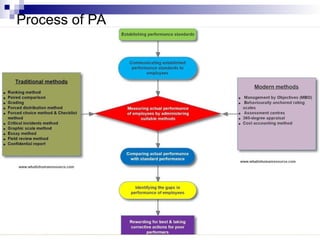
A. TRADITIONAL METHODS(Past)
1. Straight Ranking Method
The evaluator assigns relative ranks to all the employees
in the same work unit doing the same job from highest
to lowest on some overall criteria without analyzing
performance.
In this “how” and “why” are not questioned nor
answered
58
59.
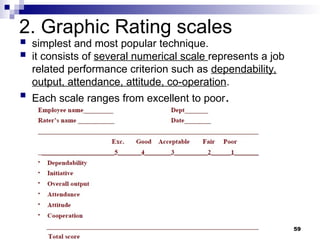
2. Graphic Ratingscales
simplest and most popular technique.
it consists of several numerical scale represents a job
related performance criterion such as dependability,
output, attendance, attitude, co-operation.
Each scale ranges from excellent to poor.
59
60.
3.Paired Comparisons Method
Each employee is compared will all the
others in pairs one at a time.
The number of times an employee is judged
better than the others determines his rank.
Comparison is made on the basis of overall
performance.
No. of comparisons is calculated by the
formula: N(N-1)/2
This method is not applicable when the
group is large 60
61.
4. Forced DistributionMethod
In this technique, the rater is required to distribute his
rating in the form of a normal frequency distribution.
The purpose is to eliminate the rater’s bias and follow
basis of central tendency.
61
62.
5. Checklist method
A checklist is a list of statements that describe
characteristics and performance of employee on
the job.
The performance of an employee is rated on the
basis of number of positive checks.
There are three types of checklist.
1. 1.Simple Checklist
2. 2. Forced Choice Block
3. 3. Weighted Checklist
62
6. Group AppraisalMethod
Under this method, a group of evaluators
assesses employees.
This group consists of the immediate supervisor
of the employee, other supervisor having close
contact with employee’s work, head of the
department and a personnel expert.
The group determines the standers of
performance for the job , measures actual
performance of an employee, analyses the
causes of poor performance and offers
suggestions for improvement in future.
65
66.
7. Confidential Report
This is a traditional form of appraisal used in
most government organization.
A confidential report is a report prepared by the
employee’s immediate superior.
It cover the strengths and weaknesses, main
achievements and failure, personality and
behavior of the employee’.
It is descriptive appraisal used for promotion
and transfers of employees.
66
67.
B. Modern Methods
1.Assessment Centre Method
An assessment center is a central location
where managers may come together to have
their participation in job-related exercises
evaluated by trained observers
These employees work together on an assignment
similar to the one they would be handling when
promoted.
This group evaluators evaluate all employees both
individually and collectively by using simulation
techniques like role playing, business games and in
basket exercises.
The evaluators observe and evaluate employees as
they perform jobs. 67
68.
2.Human Resource AccountingMethod
Under this method performance is judged in
terms of costs and contribution of
employees.
Costs of human resources consist of
expenditure on human resource planning,
recruitment, selection, induction, training,
compensation, etc.
Contribution of human resources is the money
value of labor productivity or value added by
human resources
68
69.
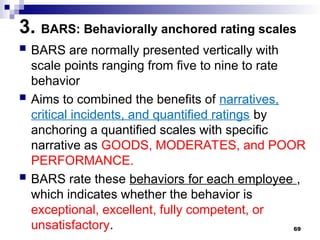
3. BARS: Behaviorallyanchored rating scales
BARS are normally presented vertically with
scale points ranging from five to nine to rate
behavior
Aims to combined the benefits of narratives,
critical incidents, and quantified ratings by
anchoring a quantified scales with specific
narrative as GOODS, MODERATES, and POOR
PERFORMANCE.
BARS rate these behaviors for each employee ,
which indicates whether the behavior is
exceptional, excellent, fully competent, or
unsatisfactory. 69
4.
4. 360 degree(Multisource Appraisal)
360 degree (Multisource Appraisal)
71
the feedback is collected from managers, peers,
subordinates, customers, team members etc
72.
5.Appraisal by Resultsor MBO
First step: MBO emphasizes collectively set goals that
are tangible, verifiable, and measurable
Second step: setting the performance standard for
the subordinates
Third step: the actual level of goal attainment is
compared with the goals agreed upon
Final step: involves establishing new goals and
possibly new strategies for goals not previously achieved
MBO is useful with managerial personnel
and employees who have a wide range of
flexibility and self control in their jobs.
72
73.
Problems of PerformanceAppraisal
Halo effect- It is a tendency to rate employee consistently
high or low on the basis of overall impression- One trait of
employee influences rater’s appraisal on all other traits ( eg. rated
high just b/se working late evening
Error of central tendency- assigning average
rating to all employees to avoid commitment or involvement
Leniency & strictness-
Personal prejudice- Just the rater dislikes an
employee ( Arise due to regional, religious belief or interpersonal
conflict )
Stereotyping- forming mental picture of a person
on the basis of age, sex, religion, caste
Spill over effect- when past performance affects
present assessment 73
W&S A Meaningand Definition
Wage : Paid to blue-collar workers- paid daily,
weekly or monthly- paid for the jobs which can
be measured in terms of money’s worth to some
extent (doing manual work)
Salary : Paid to white collar workers-paid
monthly- paid to employees whose contribution
cannot be easily measured
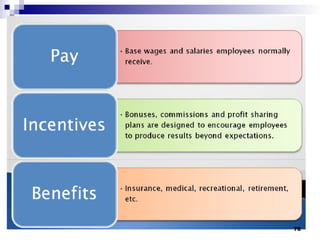
Compensation : is what employees receive
in exchange for their contribution to the
organization (Includes a). Pay or Guaranteed Pay b).
Incentives or Variable Pay c). Benefits.)
75
76.
Objectives
To establishfair and equal compensation
To attract competent personnel
To retain the present employees
To control labor and administrative cost
To improve motivation and morale of
employees
To project good image for the company
76
77.
Types of compensationand wages
Compensation
Base compensation : Payment made to
employees in the form of wage and salaries,
It is a fixed and non-incentive payment based
on the basis of time spent in the job
Supplementary compensation : Incentive
payment based on the actual performance of
employee
77
Wages
Minimum wage: Compulsory wage paid to
employees irrespective of the financial status of the
organization. It should be calculated based on the
minimum food requirements, cloth requirements, rent
to live in a particular area, standard of a working class
family and fuel, lighting and other needs
Fair wage : Wage above minimum and below living
wage. It is decided based on productivity of labor,
prevailing rates of wages, level of national income and
the capacity of employer to pay
Living wage : It provides basic needs of life. It should
meet medical, education and retirement needs and it
is paid according to the efficiency of worker
80
81.
Factors influencing wageand salary
Wage policy of the company
Job needs
Ability to pay
Cost of livings
Prevailing wage rates
Unions
State regulations
Demand and supply of labor
Economic conditions of the nation
81
82.
Methods of wagepayment
1. Time wage system :
The workers paid based on the time spend
on the work irrespective of the work done. It
may be based on hour, day, week or month
worked.
It is the oldest method of wage payment
It is issued in following kind of orgns
Quality is more important than quantity
Measurement of work is not easy
Work requires high degree of skill
When efficiency of work can be measured only
by close supervision 82
83.
Time wage system…
Merits
It is simple to understand and easy to operate
Workers are assured of guaranteed minimum wage
irrespective of output
Suitable for beginners
It is advocated by trade unions
Demerits
It do not make any differentiation between efficient and
inefficient workers
It does not have provision for offering incentives to efficient
workers
Management should spend more on supervision
The system is unfair as wage and productivity are not
correlated 83
84.
2.Piece rate system
The workers are paid at a stipulated rate for per
unit of output. Payment is based on speed
This method is applicable
Quality of work is not important
Work is of a repetitive nature
There is sufficient demand for output to guarantee
continuous work
Merits
It provides encouragement for high productivity
The workers will adopt better and more efficient
methods
Idle time will be reduced to minimum
The cost of supervision is less 84
85.
Types of piecerate system
a) Straight piece rate system : Paid
according to fixed amount per fixed units
produces irrespective of time taken
b) Piece rate with guaranteed time rate:
Workers are paid minimum on the basis of
time rate plus paid for number of units
produced
c) Differential piece rate system : The rate
per piece is increased as the output level
gets increased. The increase in rates may be
proportionate to the increases in output 85