POSTSCRIPT:  JOB ANALYSIS
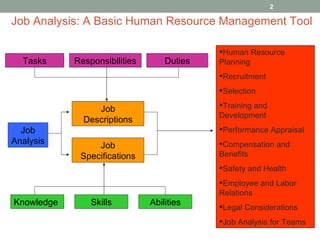
Job Analysis: A Basic Human Resource Management Tool Tasks Responsibilities Duties Job Analysis Job Descriptions Job Specifications Knowledge Skills Abilities Human Resource Planning Recruitment Selection Training and  Development Performance Appraisal Compensation and Benefits Safety and Health Employee and Labor Relations Legal Considerations Job Analysis for Teams
Timeliness of Job Analysis Rapid pace of technological change makes need for accurate job analysis even more important now and in the future.
STRATEGIC PLANNING The process by which top management determines overall organizational purposes and objectives and how they are to be achieved
HUMAN RESOURCE PLANNING The process of systematically reviewing HR requirements to ensure that the required number of employees, with the required skills, are available when they are needed
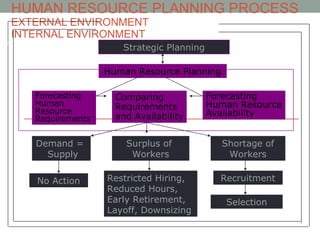
HUMAN RESOURCE PLANNING PROCESS EXTERNAL ENVIRONMENT INTERNAL ENVIRONMENT Strategic Planning Human Resource Planning Forecasting Human Resource Requirements Comparing Requirements and Availability Forecasting Human Resource Availability Surplus of  Workers Demand =  Supply No Action Restricted Hiring, Reduced Hours, Early Retirement, Layoff, Downsizing Shortage of Workers Recruitment Selection
Forecasting HR Requirements Estimate of numbers and kinds of employees the organization will need at future dates Demand for firm’s goods or services must be forecast Forecast is then converted into people requirements
Forecasting HR Availability Determining whether the firm will be able to secure employees with the necessary skills, and from what sources these individuals may be obtained Show whether the needed employees may be obtained from within the company, from outside the organization, or from a combination of the two sources
Surplus of Employees Restricted hiring – employees who leave are not replaced Reduced hours Early retirement Layoffs
Shortage of Workers Forecasted Creative recruiting Compensation incentives – premium pay is one method Training programs – prepare previously unemployable people for positions Different selection standards – alter current criteria
Human Resource Information Systems (HRIS) Virtually all HR management functions can be enhanced through the use of an HRIS – any organized approach for obtaining relevant and time information on which to base HR decisions
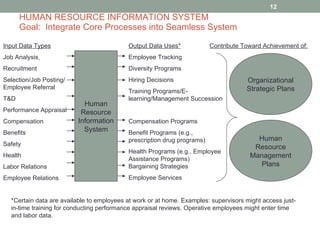
HUMAN RESOURCE INFORMATION SYSTEM Goal:  Integrate Core Processes into Seamless System Input Data Types Job Analysis   Recruitment Selection/Job Posting/ Employee Referral T&D Performance Appraisal Compensation Benefits Safety Health Labor Relations Employee Relations Output Data Uses* Employee Tracking Diversity Programs Hiring Decisions Training Programs/E-learning/Management Succession Compensation Programs Benefit Programs (e.g., prescription drug programs) Health Programs (e.g., Employee Assistance Programs)  Bargaining Strategies Employee Services Organizational Strategic Plans Human Resource Management Plans Contribute Toward Achievement of: Human Resource Information System *Certain data are available to employees at work or at home. Examples: supervisors might access just-in-time training for conducting performance appraisal reviews. Operative employees might enter time and labor data.
Job Design Process of determining the specific tasks to be performed, the methods used in performing these tasks, and how the job relates to other work in the organization Job enrichment  - Basic changes in the content and level of responsibility of a job, so as to provide greater challenge to the worker
Job Design Job enlargement  - Changes in the scope of a job to provide greater variety to the worker Reengineering  – Fundamental rethinking and radical redesign of business processes to achieve dramatic improvements in critical, contemporary measures of performance, such as cost, quality, service and speed

4 io postscript to job analysis

  • 1.
  • 2.
    Job Analysis: ABasic Human Resource Management Tool Tasks Responsibilities Duties Job Analysis Job Descriptions Job Specifications Knowledge Skills Abilities Human Resource Planning Recruitment Selection Training and Development Performance Appraisal Compensation and Benefits Safety and Health Employee and Labor Relations Legal Considerations Job Analysis for Teams
  • 3.
    Timeliness of JobAnalysis Rapid pace of technological change makes need for accurate job analysis even more important now and in the future.
  • 4.
    STRATEGIC PLANNING Theprocess by which top management determines overall organizational purposes and objectives and how they are to be achieved
  • 5.
    HUMAN RESOURCE PLANNINGThe process of systematically reviewing HR requirements to ensure that the required number of employees, with the required skills, are available when they are needed
  • 6.
    HUMAN RESOURCE PLANNINGPROCESS EXTERNAL ENVIRONMENT INTERNAL ENVIRONMENT Strategic Planning Human Resource Planning Forecasting Human Resource Requirements Comparing Requirements and Availability Forecasting Human Resource Availability Surplus of Workers Demand = Supply No Action Restricted Hiring, Reduced Hours, Early Retirement, Layoff, Downsizing Shortage of Workers Recruitment Selection
  • 7.
    Forecasting HR RequirementsEstimate of numbers and kinds of employees the organization will need at future dates Demand for firm’s goods or services must be forecast Forecast is then converted into people requirements
  • 8.
    Forecasting HR AvailabilityDetermining whether the firm will be able to secure employees with the necessary skills, and from what sources these individuals may be obtained Show whether the needed employees may be obtained from within the company, from outside the organization, or from a combination of the two sources
  • 9.
    Surplus of EmployeesRestricted hiring – employees who leave are not replaced Reduced hours Early retirement Layoffs
  • 10.
    Shortage of WorkersForecasted Creative recruiting Compensation incentives – premium pay is one method Training programs – prepare previously unemployable people for positions Different selection standards – alter current criteria
  • 11.
    Human Resource InformationSystems (HRIS) Virtually all HR management functions can be enhanced through the use of an HRIS – any organized approach for obtaining relevant and time information on which to base HR decisions
  • 12.
    HUMAN RESOURCE INFORMATIONSYSTEM Goal: Integrate Core Processes into Seamless System Input Data Types Job Analysis Recruitment Selection/Job Posting/ Employee Referral T&D Performance Appraisal Compensation Benefits Safety Health Labor Relations Employee Relations Output Data Uses* Employee Tracking Diversity Programs Hiring Decisions Training Programs/E-learning/Management Succession Compensation Programs Benefit Programs (e.g., prescription drug programs) Health Programs (e.g., Employee Assistance Programs) Bargaining Strategies Employee Services Organizational Strategic Plans Human Resource Management Plans Contribute Toward Achievement of: Human Resource Information System *Certain data are available to employees at work or at home. Examples: supervisors might access just-in-time training for conducting performance appraisal reviews. Operative employees might enter time and labor data.
  • 13.
    Job Design Processof determining the specific tasks to be performed, the methods used in performing these tasks, and how the job relates to other work in the organization Job enrichment - Basic changes in the content and level of responsibility of a job, so as to provide greater challenge to the worker
  • 14.
    Job Design Jobenlargement - Changes in the scope of a job to provide greater variety to the worker Reengineering – Fundamental rethinking and radical redesign of business processes to achieve dramatic improvements in critical, contemporary measures of performance, such as cost, quality, service and speed