
Dissertation presentation on
A study of undergraduate students’
satisfaction towards service quality of
Faculty of Management Studies and
Commerce–University of Jaffna
BAD 12168
Mr. Wickramarajasingam Parasuraman
Department of Human Resource Management
CONTENTS
 INTRODUCTION
 LITERATURE REVIEW
 RESEARCH METHODOLOGY
 DATA ANALYSIS AND INTERPRETATION
 CONCLUSIONS AND RECOMMENDATIONS
 BIBLIOGRAPHY
INTRODUCTION
 In the higher education sector, it is difficult to manage the institutions from the
marketing point of view, because the concept of customer has not been clearly defined.
 Students are the ‘customers’ of a university. Developing satisfied student should be a
primary goal of higher education.
 If a university achieves satisfaction in student, then it will facilitate the strategic
objectives of the university more effectively.
 Several researches have been conducted on service quality delivery and student
satisfaction in universities all around the world. This particular research is dealing with
the same problem with in Faculty of Management Studies and Commerce – University
of Jaffna.
RESEARCH PROBLEM
 Every educational institution needs to understand its internal strength and weakness,
and external opportunities and threats. In Faculty of Management Studies and
Commerce – University of Jaffna, graduate students come from different parts of Sri
Lanka with different cultural backgrounds. Thus, their expectation and perception of
satisfaction may differ.
 Satisfaction regarding service is one of the important factors enhancing value, and can
positively influence a college’s success. The student perception about satisfaction of
himself/ herself about the Faculty of Management Studies and Commerce – University
of Jaffna can act as an essential tool to enhance the university’s service quality.
RESEARCH OBJECTIVES
The objectives of the research was to measure “whether service quality
dimensions such as non-academic aspects, academic aspects, design
delivery and assessment, group size, program issues, reputation and
access and other demographic factors’s variation towards overall student
satisfaction in Faculty of Management Studies and Commerce – University
of Jaffna.”
RESEARCH QUESTIONS
 Do the service quality variables influence satisfaction among students of the
Faculty of Management Studies and Commerce – University of Jaffna?
 Do self-payment by students or funds provided to students influence satisfaction
level?
 Are there any differences in perception of satisfaction in terms of other
demographic factors?
RESEARCH HYPOTHESIS
H1- There is a significant relationship between non-academic aspects and overall
student satisfaction of the students of Faculty of Management Studies and Commerce
– University of Jaffna.
H2 - There is a significant relationship between academic aspects and overall student
satisfaction of the students of Faculty of Management Studies and Commerce –
University of Jaffna.
H3 - There is a significant relationship between design, delivery and assessment and overall
student satisfaction of the students of Faculty of Management Studies and Commerce
– University of Jaffna.
RESEARCH HYPOTHESIS
H4 - There is a significant relationship between group size and overall student satisfaction of
the students of Faculty of Management Studies and Commerce – University of Jaffna.
H5 - There is a significant relationship between reputation and overall student satisfaction of
the students of Faculty of Management Studies and Commerce – University of Jaffna.
H6 - There is a significant relationship between program issues overall student satisfaction of
the students of Faculty of Management Studies and Commerce – University of Jaffna.
H7 - There is a significant relationship between access and overall student satisfaction
of the students of Faculty of Management Studies and Commerce – University of Jaffna.
SCOPE & LIMITATIONS
 The target group of this research was the undergraduate students who were currently
studying in Faculty of Management Studies and Commerce – University of Jaffna
specially final year students.
 It does not represent the whole population of the students of Faculty of Management
Studies and Commerce - University of Jaffna.
 There may be other variables related to service quality which were not included in this
study.
LITERATURE REVIEW
Authors Related findings
Parasuraman et al., (1988) Service quality perceived by the customers is the result of comparing the
expectations about the service which they are going to receive and their
perceptions of the company’s actions to provide the service
Kaldenberg et al. (1998) In the college, student satisfaction was driven by evaluating the quality of
coursework and other curriculum activities and other factors related to the
university.
Firdaus (2005) Five factors such as non-academic, academic, reputation, access, and
program issues to be the determinants of service quality in higher
education. The SERVPERF and HEdPERF scales were compared and
concluded for the superiority of the new purposed measurement
LITERATURE REVIEW
Authors Related findings
Qi Huang (2009) The undergraduate student of Xiamen University of China was satisfied
with the quality service provided by the university. The main sub- variable
for the student satisfaction was the academic aspects followed by non-
academic aspects, cost, access, teaching methods, industry links, program
issues and reputation.
Afzal et al. (2010) Proposed eight dimensions of quality in higher education. The eight
dimensions of quality they proposed were Design, Delivery and
Assessment, Academic facilities, Non- academic facilities, Recognition,
Guidance, Student representation, Study opportunities and Group size.
Only two were newly added and others were overlapped.
RESEARCH METHODOLOGY
CONCEPTUAL FRAMEWORK
Non- academic
aspects
Academic
aspects
Program issues
Access
Overall student
satisfaction
Reputation
Design, Delivery
and Assessment
Group size
 This study was developed mainly based
on Firdaus “HEdPREF” (2005). He has
measured service quality in higher
education in five aspects.
 Two dimensions were adopted from the
study of Afjal et al. (2009)
RESEARCH METHODOLOGY
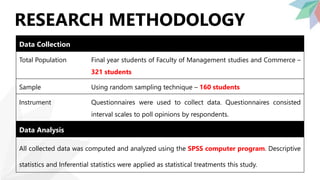
Data Collection
Total Population Final year students of Faculty of Management studies and Commerce –
321 students
Sample Using random sampling technique – 160 students
Instrument Questionnaires were used to collect data. Questionnaires consisted
interval scales to poll opinions by respondents.
Data Analysis
All collected data was computed and analyzed using the SPSS computer program. Descriptive
statistics and Inferential statistics were applied as statistical treatments this study.
DATA ANALYSIS AND
INTERPRETATION
RELIABILITY TESTING
Aspects Cronbach’s Alpha
Non- academic aspects .815
Academic aspects .797
Design, delivery and assessment .835
Group size .849
Program issues .848
Reputation .872
Access .868
Hypothesis Means Sig r Results
HI: There is a significant relationship between non-academic aspects and overall
student satisfaction of the students
4.03 .000 .737 Supported
H2: There is a significant relationship between academic aspects and overall
student satisfaction of the students
4.05 .000 .692 Supported
H3: There is a significant relationship between design, delivery and assessment and
overall student satisfaction of the students
3.99 .000 .517 Supported
H4: There is a significant relationship between group size and overall student
satisfaction of the students
4.06 .239 .094
Negatively
Supported
H5: There is a significant relationship between reputation and overall student
satisfaction of the students
3.97 .000 .755 Supported
H6: There is a significant relationship between programme issues and overall
student satisfaction of the students
4.04 .000 .389 Supported
H7: There is a significant relationship between access and overall student
satisfaction of the students
3.95 .214 .099
Negatively
Supported
TESTING HYPOTHESIS
REGRESSION ANALYSIS
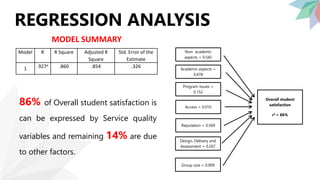
MODEL SUMMARY
Model R R Square Adjusted R
Square
Std. Error of the
Estimate
1 .927a .860 .854 .326
Non- academic
aspects = 0.542
Academic aspects =
0.478
Program issues =
0.152
Access = 0.010
Overall student
satisfaction
r2 = 86%
Reputation = 0.569
Design, Delivery and
Assessment = 0.267
Group size = 0.009
86% of Overall student satisfaction is
can be expressed by Service quality
variables and remaining 14% are due
to other factors.
ANOVA TESTING
DO SELF-PAYMENT BY STUDENTS OR FUNDS PROVIDED TO STUDENTS
INFLUENCE SATISFACTION LEVEL?
ANOVA – FINANCIAL SOURCE
Non
Academic
Aspects
Academic
Aspects
Design
Delivery and
Assessment
Group
Size
Program
me Issues
Reputation Access
Overall, I am
satisfied with
the university
University funding or
Mahapola or Any other
funds - Mean
40.39 36.40 19.81 12.00 15.74 12.19 11.61 4.24
I spend my own money -
Mean
40.27 36.15 19.89 12.15 15.77 11.69 11.89 4.00
Sig. .886 .699 .830 .627 .900 .063 .343 .306
ANOVA TESTING
ARE THERE ANY DIFFERENCES IN PERCEPTION OF SATISFACTION IN
TERMS OF OTHER DEMOGRAPHIC FACTORS?
ANOVA - GENDER
Non
Academic
Aspects
Academic
Aspects
Design
Delivery and
Assessment
Group
Size
Programme
Issues
Reputation Access
Overall, I am
satisfied with
the university
Males 40.20 36.21 19.65 12.15 15.64 11.88 11.56 4.08
Females 40.41 36.30 19.99 12.03 15.84 11.95 11.90 4.05
Sig. .790 .898 .372 .697 .489 .804 .241 .870
ANOVA TESTING
ANOVA - DEPARTMENT
Non
Academic
Aspects
Academic
Aspects
Design
Delivery and
Assessment
Group
Size
Program
me Issues
Reputat
ion
Access
Overall, I am
satisfied with
the university
Accounting 41.29 37.38 20.33 13.19 15.81 11.48 12.24 3.86
Financial Management 40.29 36.35 20.16 12.14 16.02 11.67 12.20 3.98
Human Resource Management 40.39 36.22 19.72 11.61 15.22 12.94 12.28 4.32
Marketing 39.64 35.53 19.13 11.66
15.51
11.98 11.11 4.06
Commerce 40.84 36.56 20.28 12.16 16.04 11.92 11.36 4.38
Sig.
.764 .537 .130 .029 .406 .058 .009 .417
ANOVA TESTING
ANOVA – ETHNIC GROUP
Non
Academic
Aspects
Academic
Aspects
Design
Delivery and
Assessment
Group Size
Programme
Issues
Reputation Access
Overall, I am
satisfied with
the university
Tamils 105 40.00 36.00 19.72 11.96 15.63 11.90 11.74 4.02
Sinhalese 46 40.98 36.83 20.09 12.20 16.02 11.93 11.83 4.27
Muslims 9 40.78 36.44 20.11 12.89 15.89 12.00 11.67 4.00
Sig.
.535 .526 .646 .336 .468 .984 .955 .577
CONCLUSIONS
 Five out of seven of the hypothesis were accepted because the significance was less
than 0.001 and two out of seven hypothesis were rejected because of lack of
significance.
 Rejected hypothesis had positive relationship towards overall satisfaction but lack of
significance.
 So, we can conclude that there is a relationship between the overall student
satisfaction and service quality variables among students in Faculty of Management
Studies and Commerce – University of Jaffna.
 Although there is a different among financial source and other demographic factors
regarding over all student satisfaction, the difference is not significant.
RECOMMENDATIONS
 Access and Programme Issues have space for improvement in Faculty of Management
Studies and Commerce – University of Jaffna.
 The university should also consider focusing on the other variables since other
variables like academic aspects, reputation and design delivery and assessment, as
they are important variables for influencing the satisfaction level.
 Group size and access had weak positive correlation with the satisfaction of the
students. So University has to improve its Students enrolment and reachability issues.
SUGGESTIONS FOR FURTHER
RESEARCH
 Not for only final year students can be extended to all students.
 By adding other service quality variables that influence student satisfaction.
 Expanding target population from undergraduate students to graduates or mix both
and compare.
 May be tested in other countries of Asia or outside Asia and try to find out if the
findings are similar.
BIBLIOGRAPHY
 Afzal, W., Akram A., Akram M.S. & Ijaz A. (2010). On students‟ perspective of quality in higher education. 3rd
International Conference. Assessing Quality in Higher Education, 417-418, 422.
 Firdaus, A. (2005). The development of HEdPERF: a new measuring instrument of service quality of higher
education sector. Paper presented at the Third Annual Discourse Power Resistance Conference: Global Issues Local
Solutions, 5-7.
 Kaldenberg, Browne, W. & Brown D. (1998). Student customer factors affecting satisfaction and assessments of
institutional quality. Journal of Marketing Management, 8 (3), 1-14.
 Parasuraman, A., Zeithaml, V.A, & Berry, L. L. (1985). A conceptual model of service quality and its implications for
future research. Journal of Retailling, 64 (Spring), 12-40.
 Huang, Q. (2009). The relationship between service quality and student satisfaction in higher education sector: A
case study on the undergraduate sector of Xiamen University of China. Thesis report submitted in partial fulfillment
of the requirement for the degree of: Masters of Business Administration, Assumption University, Thailand, 16-21, 30,
38- 60.
THANK YOU

Final Year Research

  • 1.
    Dissertation presentation on Astudy of undergraduate students’ satisfaction towards service quality of Faculty of Management Studies and Commerce–University of Jaffna BAD 12168 Mr. Wickramarajasingam Parasuraman Department of Human Resource Management
  • 2.
    CONTENTS  INTRODUCTION  LITERATUREREVIEW  RESEARCH METHODOLOGY  DATA ANALYSIS AND INTERPRETATION  CONCLUSIONS AND RECOMMENDATIONS  BIBLIOGRAPHY
  • 3.
    INTRODUCTION  In thehigher education sector, it is difficult to manage the institutions from the marketing point of view, because the concept of customer has not been clearly defined.  Students are the ‘customers’ of a university. Developing satisfied student should be a primary goal of higher education.  If a university achieves satisfaction in student, then it will facilitate the strategic objectives of the university more effectively.  Several researches have been conducted on service quality delivery and student satisfaction in universities all around the world. This particular research is dealing with the same problem with in Faculty of Management Studies and Commerce – University of Jaffna.
  • 4.
    RESEARCH PROBLEM  Everyeducational institution needs to understand its internal strength and weakness, and external opportunities and threats. In Faculty of Management Studies and Commerce – University of Jaffna, graduate students come from different parts of Sri Lanka with different cultural backgrounds. Thus, their expectation and perception of satisfaction may differ.  Satisfaction regarding service is one of the important factors enhancing value, and can positively influence a college’s success. The student perception about satisfaction of himself/ herself about the Faculty of Management Studies and Commerce – University of Jaffna can act as an essential tool to enhance the university’s service quality.
  • 5.
    RESEARCH OBJECTIVES The objectivesof the research was to measure “whether service quality dimensions such as non-academic aspects, academic aspects, design delivery and assessment, group size, program issues, reputation and access and other demographic factors’s variation towards overall student satisfaction in Faculty of Management Studies and Commerce – University of Jaffna.”
  • 6.
    RESEARCH QUESTIONS  Dothe service quality variables influence satisfaction among students of the Faculty of Management Studies and Commerce – University of Jaffna?  Do self-payment by students or funds provided to students influence satisfaction level?  Are there any differences in perception of satisfaction in terms of other demographic factors?
  • 7.
    RESEARCH HYPOTHESIS H1- Thereis a significant relationship between non-academic aspects and overall student satisfaction of the students of Faculty of Management Studies and Commerce – University of Jaffna. H2 - There is a significant relationship between academic aspects and overall student satisfaction of the students of Faculty of Management Studies and Commerce – University of Jaffna. H3 - There is a significant relationship between design, delivery and assessment and overall student satisfaction of the students of Faculty of Management Studies and Commerce – University of Jaffna.
  • 8.
    RESEARCH HYPOTHESIS H4 -There is a significant relationship between group size and overall student satisfaction of the students of Faculty of Management Studies and Commerce – University of Jaffna. H5 - There is a significant relationship between reputation and overall student satisfaction of the students of Faculty of Management Studies and Commerce – University of Jaffna. H6 - There is a significant relationship between program issues overall student satisfaction of the students of Faculty of Management Studies and Commerce – University of Jaffna. H7 - There is a significant relationship between access and overall student satisfaction of the students of Faculty of Management Studies and Commerce – University of Jaffna.
  • 9.
    SCOPE & LIMITATIONS The target group of this research was the undergraduate students who were currently studying in Faculty of Management Studies and Commerce – University of Jaffna specially final year students.  It does not represent the whole population of the students of Faculty of Management Studies and Commerce - University of Jaffna.  There may be other variables related to service quality which were not included in this study.
  • 10.
    LITERATURE REVIEW Authors Relatedfindings Parasuraman et al., (1988) Service quality perceived by the customers is the result of comparing the expectations about the service which they are going to receive and their perceptions of the company’s actions to provide the service Kaldenberg et al. (1998) In the college, student satisfaction was driven by evaluating the quality of coursework and other curriculum activities and other factors related to the university. Firdaus (2005) Five factors such as non-academic, academic, reputation, access, and program issues to be the determinants of service quality in higher education. The SERVPERF and HEdPERF scales were compared and concluded for the superiority of the new purposed measurement
  • 11.
    LITERATURE REVIEW Authors Relatedfindings Qi Huang (2009) The undergraduate student of Xiamen University of China was satisfied with the quality service provided by the university. The main sub- variable for the student satisfaction was the academic aspects followed by non- academic aspects, cost, access, teaching methods, industry links, program issues and reputation. Afzal et al. (2010) Proposed eight dimensions of quality in higher education. The eight dimensions of quality they proposed were Design, Delivery and Assessment, Academic facilities, Non- academic facilities, Recognition, Guidance, Student representation, Study opportunities and Group size. Only two were newly added and others were overlapped.
  • 12.
    RESEARCH METHODOLOGY CONCEPTUAL FRAMEWORK Non-academic aspects Academic aspects Program issues Access Overall student satisfaction Reputation Design, Delivery and Assessment Group size  This study was developed mainly based on Firdaus “HEdPREF” (2005). He has measured service quality in higher education in five aspects.  Two dimensions were adopted from the study of Afjal et al. (2009)
  • 13.
    RESEARCH METHODOLOGY Data Collection TotalPopulation Final year students of Faculty of Management studies and Commerce – 321 students Sample Using random sampling technique – 160 students Instrument Questionnaires were used to collect data. Questionnaires consisted interval scales to poll opinions by respondents. Data Analysis All collected data was computed and analyzed using the SPSS computer program. Descriptive statistics and Inferential statistics were applied as statistical treatments this study.
  • 14.
    DATA ANALYSIS AND INTERPRETATION RELIABILITYTESTING Aspects Cronbach’s Alpha Non- academic aspects .815 Academic aspects .797 Design, delivery and assessment .835 Group size .849 Program issues .848 Reputation .872 Access .868
  • 15.
    Hypothesis Means Sigr Results HI: There is a significant relationship between non-academic aspects and overall student satisfaction of the students 4.03 .000 .737 Supported H2: There is a significant relationship between academic aspects and overall student satisfaction of the students 4.05 .000 .692 Supported H3: There is a significant relationship between design, delivery and assessment and overall student satisfaction of the students 3.99 .000 .517 Supported H4: There is a significant relationship between group size and overall student satisfaction of the students 4.06 .239 .094 Negatively Supported H5: There is a significant relationship between reputation and overall student satisfaction of the students 3.97 .000 .755 Supported H6: There is a significant relationship between programme issues and overall student satisfaction of the students 4.04 .000 .389 Supported H7: There is a significant relationship between access and overall student satisfaction of the students 3.95 .214 .099 Negatively Supported TESTING HYPOTHESIS
  • 16.
    REGRESSION ANALYSIS MODEL SUMMARY ModelR R Square Adjusted R Square Std. Error of the Estimate 1 .927a .860 .854 .326 Non- academic aspects = 0.542 Academic aspects = 0.478 Program issues = 0.152 Access = 0.010 Overall student satisfaction r2 = 86% Reputation = 0.569 Design, Delivery and Assessment = 0.267 Group size = 0.009 86% of Overall student satisfaction is can be expressed by Service quality variables and remaining 14% are due to other factors.
  • 17.
    ANOVA TESTING DO SELF-PAYMENTBY STUDENTS OR FUNDS PROVIDED TO STUDENTS INFLUENCE SATISFACTION LEVEL? ANOVA – FINANCIAL SOURCE Non Academic Aspects Academic Aspects Design Delivery and Assessment Group Size Program me Issues Reputation Access Overall, I am satisfied with the university University funding or Mahapola or Any other funds - Mean 40.39 36.40 19.81 12.00 15.74 12.19 11.61 4.24 I spend my own money - Mean 40.27 36.15 19.89 12.15 15.77 11.69 11.89 4.00 Sig. .886 .699 .830 .627 .900 .063 .343 .306
  • 18.
    ANOVA TESTING ARE THEREANY DIFFERENCES IN PERCEPTION OF SATISFACTION IN TERMS OF OTHER DEMOGRAPHIC FACTORS? ANOVA - GENDER Non Academic Aspects Academic Aspects Design Delivery and Assessment Group Size Programme Issues Reputation Access Overall, I am satisfied with the university Males 40.20 36.21 19.65 12.15 15.64 11.88 11.56 4.08 Females 40.41 36.30 19.99 12.03 15.84 11.95 11.90 4.05 Sig. .790 .898 .372 .697 .489 .804 .241 .870
  • 19.
    ANOVA TESTING ANOVA -DEPARTMENT Non Academic Aspects Academic Aspects Design Delivery and Assessment Group Size Program me Issues Reputat ion Access Overall, I am satisfied with the university Accounting 41.29 37.38 20.33 13.19 15.81 11.48 12.24 3.86 Financial Management 40.29 36.35 20.16 12.14 16.02 11.67 12.20 3.98 Human Resource Management 40.39 36.22 19.72 11.61 15.22 12.94 12.28 4.32 Marketing 39.64 35.53 19.13 11.66 15.51 11.98 11.11 4.06 Commerce 40.84 36.56 20.28 12.16 16.04 11.92 11.36 4.38 Sig. .764 .537 .130 .029 .406 .058 .009 .417
  • 20.
    ANOVA TESTING ANOVA –ETHNIC GROUP Non Academic Aspects Academic Aspects Design Delivery and Assessment Group Size Programme Issues Reputation Access Overall, I am satisfied with the university Tamils 105 40.00 36.00 19.72 11.96 15.63 11.90 11.74 4.02 Sinhalese 46 40.98 36.83 20.09 12.20 16.02 11.93 11.83 4.27 Muslims 9 40.78 36.44 20.11 12.89 15.89 12.00 11.67 4.00 Sig. .535 .526 .646 .336 .468 .984 .955 .577
  • 21.
    CONCLUSIONS  Five outof seven of the hypothesis were accepted because the significance was less than 0.001 and two out of seven hypothesis were rejected because of lack of significance.  Rejected hypothesis had positive relationship towards overall satisfaction but lack of significance.  So, we can conclude that there is a relationship between the overall student satisfaction and service quality variables among students in Faculty of Management Studies and Commerce – University of Jaffna.  Although there is a different among financial source and other demographic factors regarding over all student satisfaction, the difference is not significant.
  • 22.
    RECOMMENDATIONS  Access andProgramme Issues have space for improvement in Faculty of Management Studies and Commerce – University of Jaffna.  The university should also consider focusing on the other variables since other variables like academic aspects, reputation and design delivery and assessment, as they are important variables for influencing the satisfaction level.  Group size and access had weak positive correlation with the satisfaction of the students. So University has to improve its Students enrolment and reachability issues.
  • 23.
    SUGGESTIONS FOR FURTHER RESEARCH Not for only final year students can be extended to all students.  By adding other service quality variables that influence student satisfaction.  Expanding target population from undergraduate students to graduates or mix both and compare.  May be tested in other countries of Asia or outside Asia and try to find out if the findings are similar.
  • 24.
    BIBLIOGRAPHY  Afzal, W.,Akram A., Akram M.S. & Ijaz A. (2010). On students‟ perspective of quality in higher education. 3rd International Conference. Assessing Quality in Higher Education, 417-418, 422.  Firdaus, A. (2005). The development of HEdPERF: a new measuring instrument of service quality of higher education sector. Paper presented at the Third Annual Discourse Power Resistance Conference: Global Issues Local Solutions, 5-7.  Kaldenberg, Browne, W. & Brown D. (1998). Student customer factors affecting satisfaction and assessments of institutional quality. Journal of Marketing Management, 8 (3), 1-14.  Parasuraman, A., Zeithaml, V.A, & Berry, L. L. (1985). A conceptual model of service quality and its implications for future research. Journal of Retailling, 64 (Spring), 12-40.  Huang, Q. (2009). The relationship between service quality and student satisfaction in higher education sector: A case study on the undergraduate sector of Xiamen University of China. Thesis report submitted in partial fulfillment of the requirement for the degree of: Masters of Business Administration, Assumption University, Thailand, 16-21, 30, 38- 60.
  • 25.