Selection Process (HRM)
Selection Process
In
Human Resource Management
Recruitment
 It is the process of
– attracting individuals
– on a timely basis,
– in sufficient numbers and
– with appropriate qualifications, and
– encouraging them to apply
Selection
 Selection is the process of choosing from a
group of applicants those individuals best suited
for a particular position.
 Personnel Selection is the methodical placement
of individuals into jobs.
 The process of making a “hire” or “no hire”
decision regarding each applicant for a job.
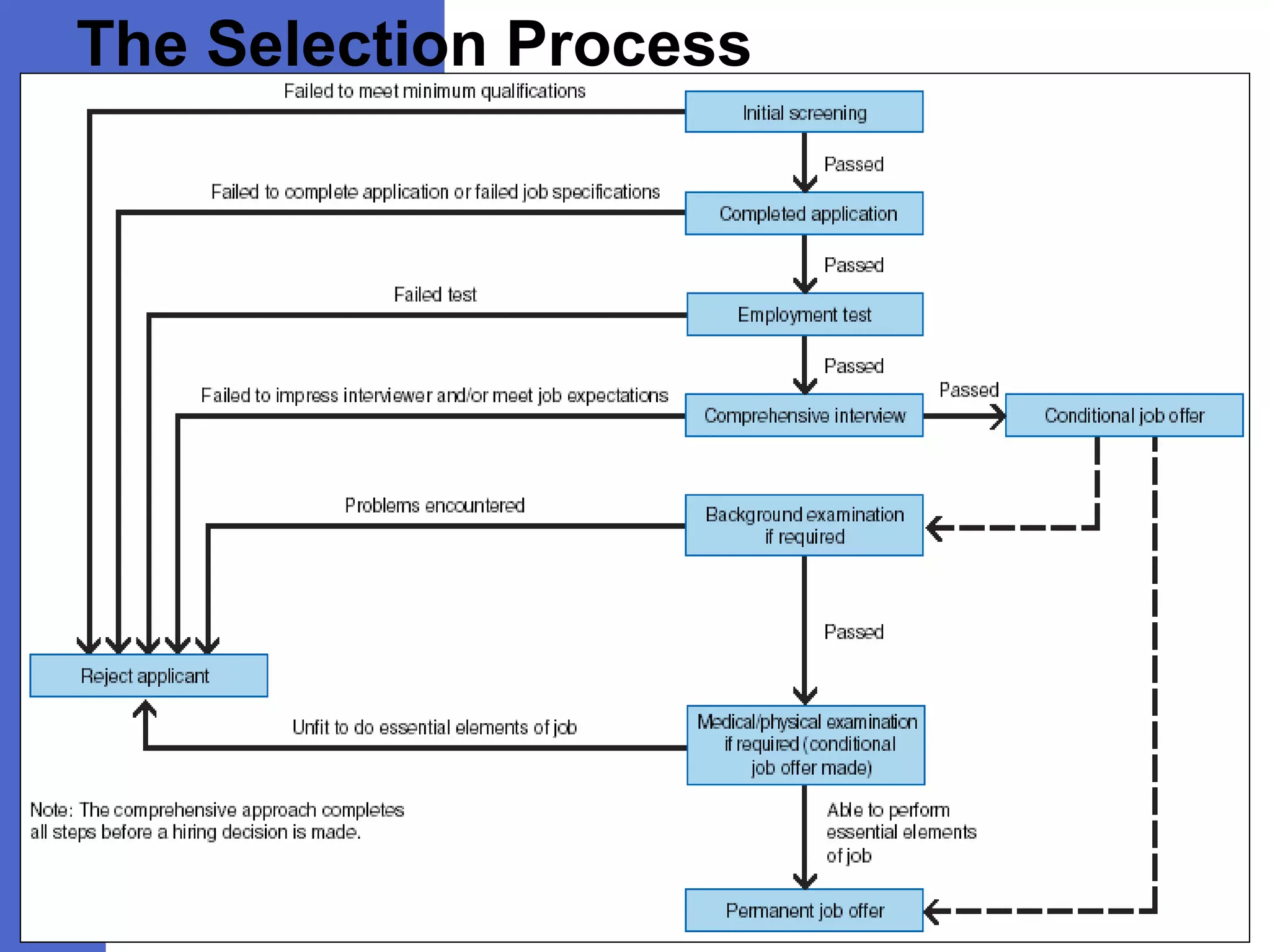
The Selection Process
Consists of eight steps:
1. Initial screening
2. Completion of the application form
3. Employment tests
 General Intelligence Tests, Aptitude Tests, Personality and Interest
Tests, Honesty Tests
1. Interviews
 Structured Interview, Unstructured Interview, Mixed Interview
1. Background investigation
2. Conditional job offer
3. Medical/Physical exam
4. Permanent job offer
The Selection Process
1. Initial Screening
– Involves screening of inquiries and screening/filtering
applications who DO NOT qualifie as per JDs and
JSs.
– Job description information is shared
along with a salary range.
The Selection Process
2. Completing the Application Form: Key Issues
– Gives a job-performance-related synopsis of what
applicants have been doing, their skills and
accomplishments.
– Weighted application forms
– Legal considerations
The Selection Process
Application Form: Key Issues
 Legal considerations
– Omit items which are not job-related; e.g., sex,
religion, age, national origin, race, color, and
disability.
– Includes statement giving employer the right to
dismiss an employee for falsifying information.
– Asks for permission to check work references.
– Typically includes “employment-at-will” statement.
The Selection Process
Application Form: Key Issues
 Weighted application forms
– Individual items of information are validated against
performance and turnover measures and given
appropriate weights.
– Data must be collected for each job to determine how
well a particular item (e.g., years of schooling, tenure
on last job) predicts success on target job.
The Selection Process
Application Form: Key Issues
 Successful applications
– Information collected on application forms can be
highly predictive of successful job performance.
– Forms must be validated and continuously reviewed
and updated.
– Data should be verified through background
investigations.
The Selection Process
3.Employment Tests
 Estimates say 60% of all organizations use
some type of employment tests.
– Performance simulation tests: requires the applicant
to engage in specific job behaviors necessary for
doing the job successfully.
– Work sampling: Job analysis is used to develop a
miniature replica of the job on which an applicant
demonstrates his/her skills.
The Selection Process
Employment Tests
– Assessment centers: A series of tests and exercises,
including individual and group simulation tests, is
used to assess managerial potential or other complex
sets of skills.
– Testing in a global arena: Selection practices must
be adapted to cultures and regulations of host
country.
Types of Employment Tests
1. Job Knowledge Tests to measure a knowledge of the
duties of the position for which being hired
2. Personality Tests are used to identify the personality
mostly in the presence of qualified psychologist
3. Cognitive Aptitude Tests: measures an individual’s
ability to learn, as well as to perform a job. Ex. verbal,
numerical, reasoning etc.
4. Psychomotor Abilities Tests is used to measure
strength, coordination, and dexterity.
5. Work-Sample Tests (Simulations) It identifies a task
or set of tasks that are representative of the job.
Types of Employment Tests
6. Vocational Interest Tests indicates the occupation in
which a person is most interested and is most likely to
receive satisfaction.
7. Drug and Alcohol Testing
8. Genetic Testing to test whether a person carries the
gene mutation for certain diseases, including heart
disease, cancer, etc
9. Honesty Test;
10.Internet, IT & Computer Tests
Characteristics of Selection Tests
 Reliability: Extent to which a selection test provides
consistent results. If a test has low reliability, its validity
as a predictor will also be low. To validate reliability, a
test must be verified.
 Validity: Extent to which test measures what it is made
to measure. If a test cannot indicate ability to perform the
job, it has no value as a predictor.
Validity
 Validity: The relationship between scores on a selection
tool and a relevant criterion, such as job performance.
Indicates how well a selection tool predicts job
performance.
– Content validity: The degree to which the content of
the test, as a sample, represents situations on the
job.
– Construct validity: The degree to which a particular
trait is related to successful performance on the job.
Validity
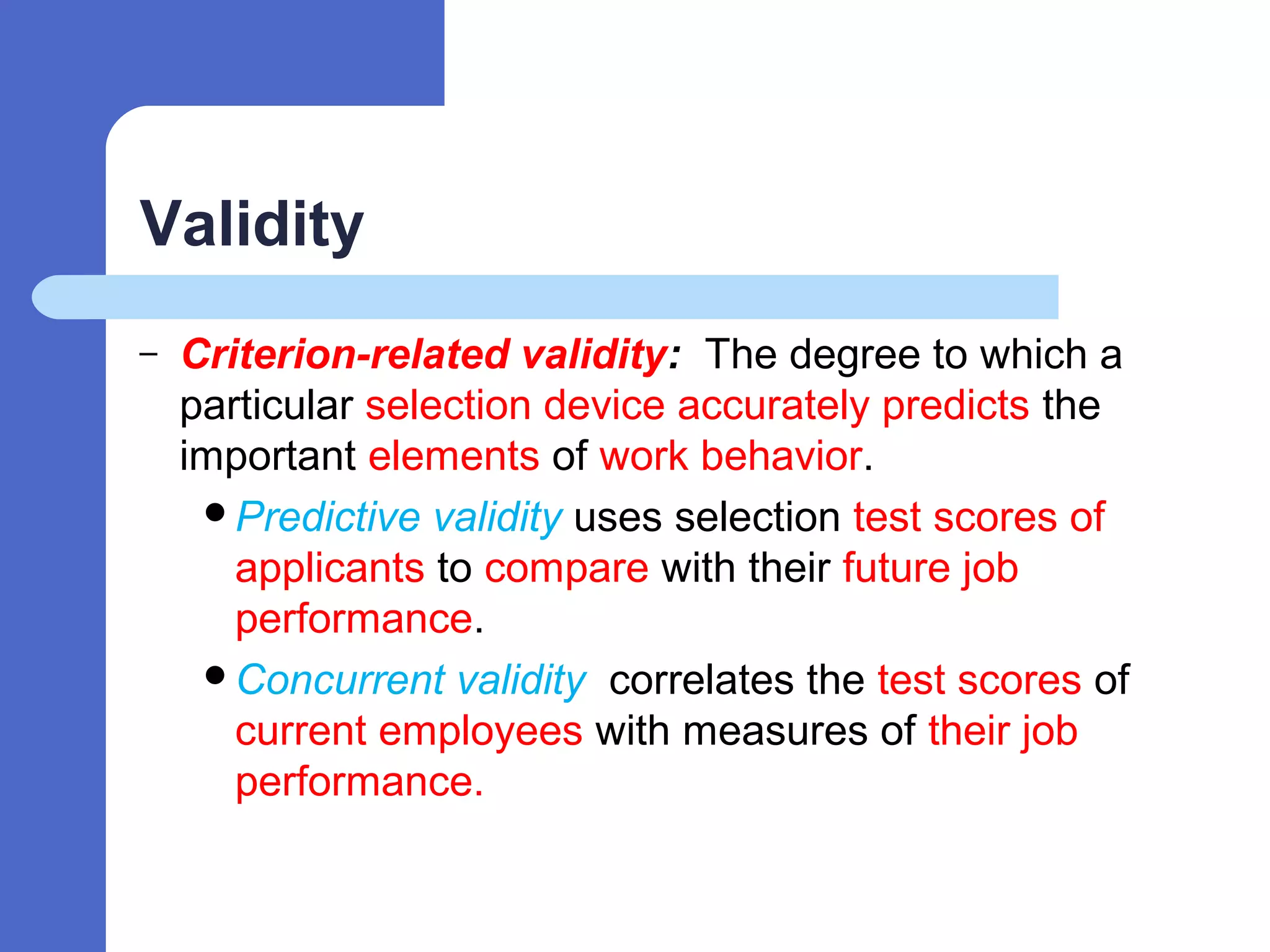
– Criterion-related validity: The degree to which a
particular selection device accurately predicts the
important elements of work behavior.
Predictive validity uses selection test scores of
applicants to compare with their future job
performance.
Concurrent validity correlates the test scores of
current employees with measures of their job
performance.
The Selection Process
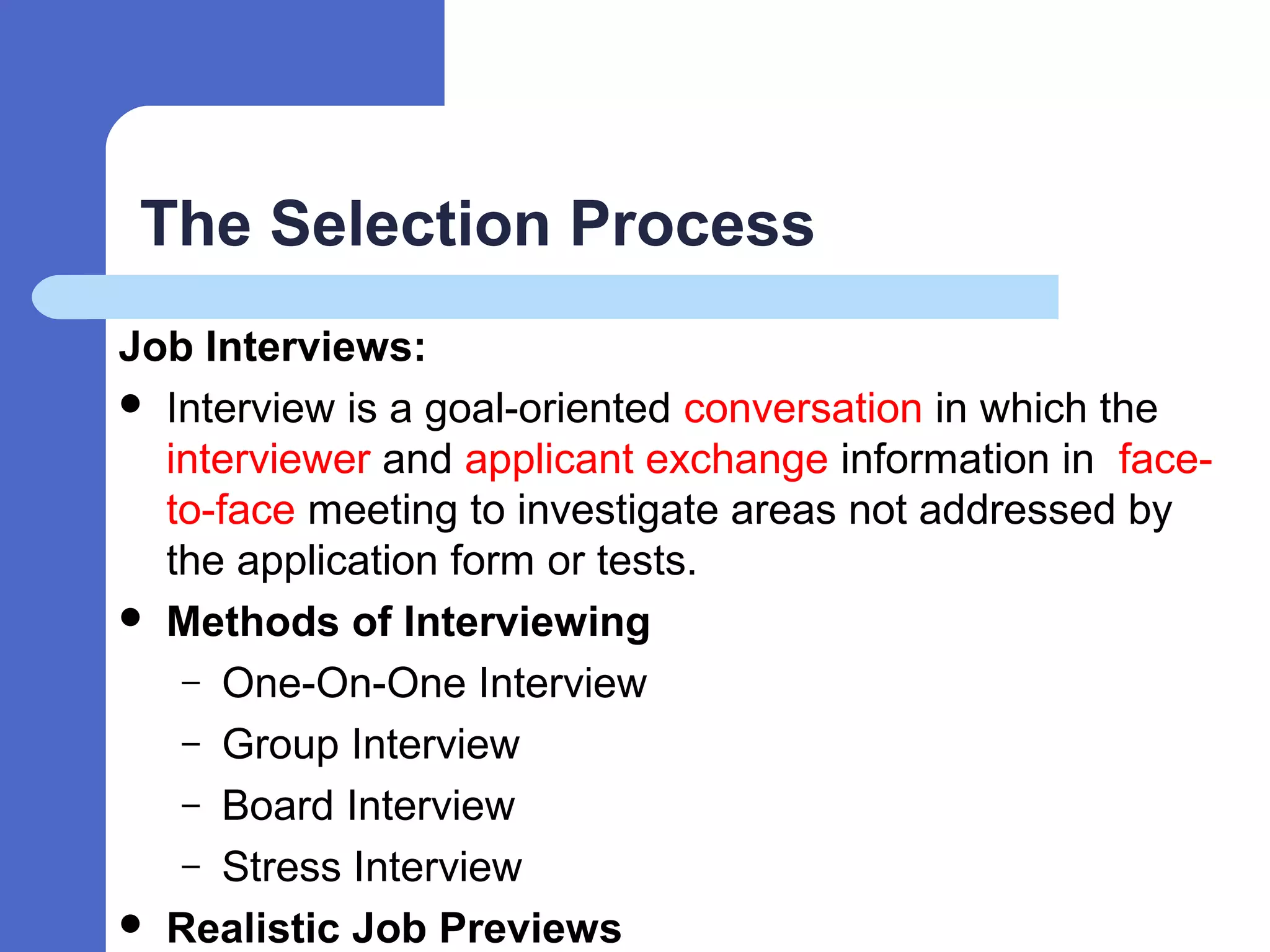
Job Interviews:
 Interview is a goal-oriented conversation in which the
interviewer and applicant exchange information in face-
to-face meeting to investigate areas not addressed by
the application form or tests.
 Methods of Interviewing
– One-On-One Interview
– Group Interview
– Board Interview
– Stress Interview
 Realistic Job Previews
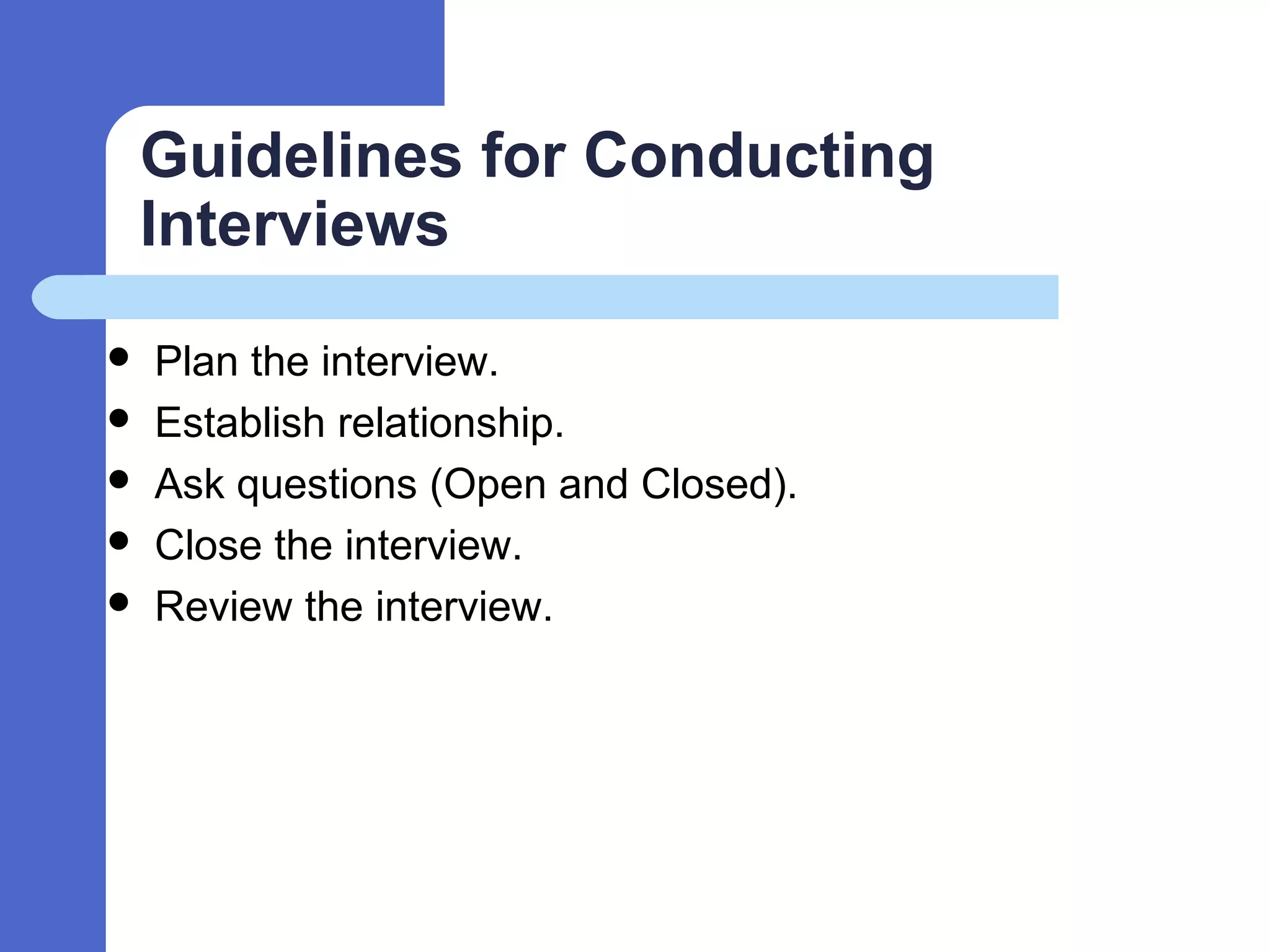
Guidelines for Conducting
Interviews
 Plan the interview.
 Establish relationship.
 Ask questions (Open and Closed).
 Close the interview.
 Review the interview.

Selection Process In Human Resource Management - HRM

  • 1.
    Selection Process (HRM) SelectionProcess In Human Resource Management
  • 2.
    Recruitment  It isthe process of – attracting individuals – on a timely basis, – in sufficient numbers and – with appropriate qualifications, and – encouraging them to apply
  • 3.
    Selection  Selection isthe process of choosing from a group of applicants those individuals best suited for a particular position.  Personnel Selection is the methodical placement of individuals into jobs.  The process of making a “hire” or “no hire” decision regarding each applicant for a job.
  • 4.
    The Selection Process Consistsof eight steps: 1. Initial screening 2. Completion of the application form 3. Employment tests  General Intelligence Tests, Aptitude Tests, Personality and Interest Tests, Honesty Tests 1. Interviews  Structured Interview, Unstructured Interview, Mixed Interview 1. Background investigation 2. Conditional job offer 3. Medical/Physical exam 4. Permanent job offer
  • 5.
  • 6.
    The Selection Process 1.Initial Screening – Involves screening of inquiries and screening/filtering applications who DO NOT qualifie as per JDs and JSs. – Job description information is shared along with a salary range.
  • 7.
    The Selection Process 2.Completing the Application Form: Key Issues – Gives a job-performance-related synopsis of what applicants have been doing, their skills and accomplishments. – Weighted application forms – Legal considerations
  • 8.
    The Selection Process ApplicationForm: Key Issues  Legal considerations – Omit items which are not job-related; e.g., sex, religion, age, national origin, race, color, and disability. – Includes statement giving employer the right to dismiss an employee for falsifying information. – Asks for permission to check work references. – Typically includes “employment-at-will” statement.
  • 9.
    The Selection Process ApplicationForm: Key Issues  Weighted application forms – Individual items of information are validated against performance and turnover measures and given appropriate weights. – Data must be collected for each job to determine how well a particular item (e.g., years of schooling, tenure on last job) predicts success on target job.
  • 10.
    The Selection Process ApplicationForm: Key Issues  Successful applications – Information collected on application forms can be highly predictive of successful job performance. – Forms must be validated and continuously reviewed and updated. – Data should be verified through background investigations.
  • 11.
    The Selection Process 3.EmploymentTests  Estimates say 60% of all organizations use some type of employment tests. – Performance simulation tests: requires the applicant to engage in specific job behaviors necessary for doing the job successfully. – Work sampling: Job analysis is used to develop a miniature replica of the job on which an applicant demonstrates his/her skills.
  • 12.
    The Selection Process EmploymentTests – Assessment centers: A series of tests and exercises, including individual and group simulation tests, is used to assess managerial potential or other complex sets of skills. – Testing in a global arena: Selection practices must be adapted to cultures and regulations of host country.
  • 13.
    Types of EmploymentTests 1. Job Knowledge Tests to measure a knowledge of the duties of the position for which being hired 2. Personality Tests are used to identify the personality mostly in the presence of qualified psychologist 3. Cognitive Aptitude Tests: measures an individual’s ability to learn, as well as to perform a job. Ex. verbal, numerical, reasoning etc. 4. Psychomotor Abilities Tests is used to measure strength, coordination, and dexterity. 5. Work-Sample Tests (Simulations) It identifies a task or set of tasks that are representative of the job.
  • 14.
    Types of EmploymentTests 6. Vocational Interest Tests indicates the occupation in which a person is most interested and is most likely to receive satisfaction. 7. Drug and Alcohol Testing 8. Genetic Testing to test whether a person carries the gene mutation for certain diseases, including heart disease, cancer, etc 9. Honesty Test; 10.Internet, IT & Computer Tests
  • 15.
    Characteristics of SelectionTests  Reliability: Extent to which a selection test provides consistent results. If a test has low reliability, its validity as a predictor will also be low. To validate reliability, a test must be verified.  Validity: Extent to which test measures what it is made to measure. If a test cannot indicate ability to perform the job, it has no value as a predictor.
  • 16.
    Validity  Validity: Therelationship between scores on a selection tool and a relevant criterion, such as job performance. Indicates how well a selection tool predicts job performance. – Content validity: The degree to which the content of the test, as a sample, represents situations on the job. – Construct validity: The degree to which a particular trait is related to successful performance on the job.
  • 17.
    Validity – Criterion-related validity:The degree to which a particular selection device accurately predicts the important elements of work behavior. Predictive validity uses selection test scores of applicants to compare with their future job performance. Concurrent validity correlates the test scores of current employees with measures of their job performance.
  • 18.
    The Selection Process JobInterviews:  Interview is a goal-oriented conversation in which the interviewer and applicant exchange information in face- to-face meeting to investigate areas not addressed by the application form or tests.  Methods of Interviewing – One-On-One Interview – Group Interview – Board Interview – Stress Interview  Realistic Job Previews
  • 19.
    Guidelines for Conducting Interviews Plan the interview.  Establish relationship.  Ask questions (Open and Closed).  Close the interview.  Review the interview.