
1
What is Credit Risk?
The risk that a counterparty to a transaction will
fail to perform according to
the terms and conditions of the contract due
to
•Problems such as
•Bankruptcy
•Illiquidity ,etc.
Lenders, Depositors, Borrowers and Suppliers
- all face credit risk
2
A More Formal Definition
Credit Risk is defined as the possibility
 that a borrower or counterparty will fail
to meet its obligations in accordance with
the agreed terms
Default triggers
a total or partial loss of any amount lent
to the counterparty
3
Credit Risk Components
 “Quantity” of Risk
 Outstanding balance lent to the borrower
 “Quality” of Risk
 Dependant on

Chances that the default occurs

Guarantees that reduce the loss in the event of
default
4
Credit Risk Components
Cont..
 Credit Risk or Loss Given Default (LGD)
Composed of
 Default Risk
 Exposure Risk
 Recovery Risk
5
Default Risk
 Possible definitions
 Missing a payment obligation- usually three
months
 Breaking a covenant – financial ratios
bands
 Entering a legal procedure
 Economic default- market value of assets
drops below that of liabilities
6
Exposure Risk
 Amortised debt- no exposure risk
 As repayment schedule known hence no
exposure risk
 Committed lines of credit like
 Overdraft
 All off balance sheet items like third party
guarantees
 Derivatives- if liquidation value is positive
then it remains if the counterparty defaults
7
Recovery Risk
 Dependent upon
 Collateral security
 Third party guarantee
 Legal framework
8
Credit Risk Management’s Importance
for Banks cont..
 New forms of financial transactions
emerging
 Securitisation
 Credit Derivatives
 CRAR( Capital to Risk-weighted Assets
Ratio) Framework
 Decreasing Govt. Support for bail outs
9
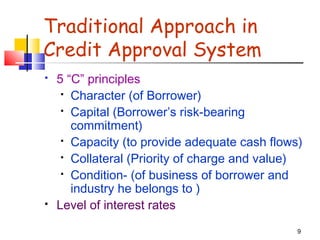
Traditional Approach in
Credit Approval System
 5 “C” principles
 Character (of Borrower)
 Capital (Borrower’s risk-bearing
commitment)
 Capacity (to provide adequate cash flows)
 Collateral (Priority of charge and value)
 Condition- (of business of borrower and
industry he belongs to )
 Level of interest rates
10
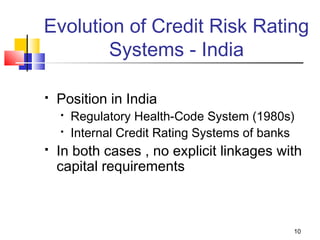
Evolution of Credit Risk Rating
Systems - India
 Position in India
 Regulatory Health-Code System (1980s)
 Internal Credit Rating Systems of banks
 In both cases , no explicit linkages with
capital requirements
11
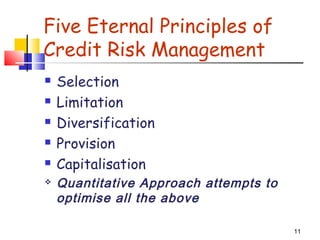
Five Eternal Principles of
Credit Risk Management
 Selection
 Limitation
 Diversification
 Provision
 Capitalisation
 Quantitative Approach attempts to
optimise all the above
12
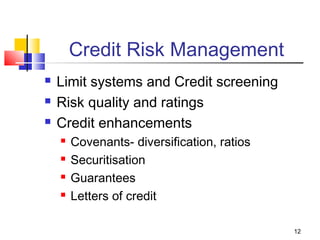
Credit Risk Management
 Limit systems and Credit screening
 Risk quality and ratings
 Credit enhancements
 Covenants- diversification, ratios
 Securitisation
 Guarantees
 Letters of credit
13
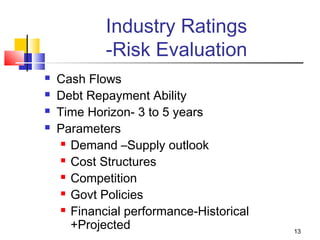
Industry Ratings
-Risk Evaluation
 Cash Flows
 Debt Repayment Ability
 Time Horizon- 3 to 5 years
 Parameters
 Demand –Supply outlook
 Cost Structures
 Competition
 Govt Policies
 Financial performance-Historical
+Projected
14
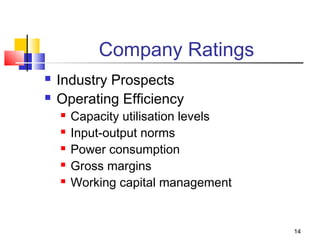
Company Ratings
 Industry Prospects
 Operating Efficiency
 Capacity utilisation levels
 Input-output norms
 Power consumption
 Gross margins
 Working capital management
15
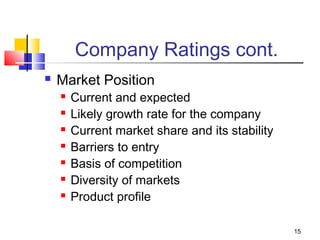
Company Ratings cont.
 Market Position
 Current and expected
 Likely growth rate for the company
 Current market share and its stability
 Barriers to entry
 Basis of competition
 Diversity of markets
 Product profile
16
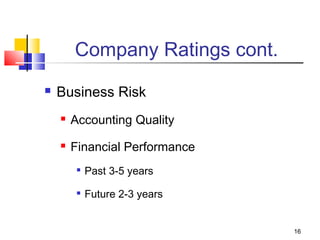
Company Ratings cont.
 Business Risk
 Accounting Quality
 Financial Performance

Past 3-5 years

Future 2-3 years
17
Company Ratings cont.
 Financial Flexibility

Company’s need for funds

Ability to raise it through
 Debt
 Equity
 GDR’s, ADR’s
 Internal accruals
 Liquidation of marketable securities
 Support from group companies
 Financial Risk

Financial performance

Ability to fund capital commitments

Service debt obligations
18
RBI Guidelines on Risk
Management
 RBI issued Guidelines to banks on Risk
Management in October, 1999.
 The Guidelines are aimed to make banks aware of
the risks and put in place proper risk
management system
 Emphasis placed on Board level overview and an
organisational structure and practices which
would enable proactive risk management
 Guidance Paper dated Sept.20, 2001 issued by
RBI on Credit Risk Management
19
Integrated Management
Inter-relationships between risk
categories
Capital Adequacy Norms
Capital Adequacy for Market Risk
Basle Committee’s proposal to prescribe
explicit capital charge for Operational Risk
also
20
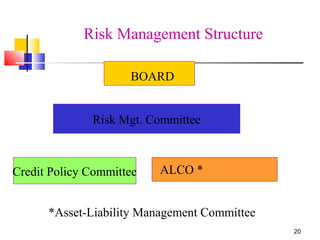
Risk Management Structure
Risk Mgt. Committee
Credit Policy Committee
BOARD
*Asset-Liability Management Committee
ALCO *
21
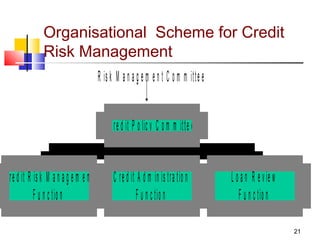
Organisational Scheme for Credit
Risk Management
R is k M a n a g e m e n t C o m m itte e
C re d it R is k M a n a g e m e n t
F u n c tio n
C re d it A d m in is tra tio n
F u n c tio n
L o a n R e vie w
F u n c tio n
C re d it P o lic y C o m m itte e
T.V.RAO
THANK YOU
22

Jntu credit risk-management

  • 1.
    1 What is CreditRisk? The risk that a counterparty to a transaction will fail to perform according to the terms and conditions of the contract due to •Problems such as •Bankruptcy •Illiquidity ,etc. Lenders, Depositors, Borrowers and Suppliers - all face credit risk
  • 2.
    2 A More FormalDefinition Credit Risk is defined as the possibility  that a borrower or counterparty will fail to meet its obligations in accordance with the agreed terms Default triggers a total or partial loss of any amount lent to the counterparty
  • 3.
    3 Credit Risk Components “Quantity” of Risk  Outstanding balance lent to the borrower  “Quality” of Risk  Dependant on  Chances that the default occurs  Guarantees that reduce the loss in the event of default
  • 4.
    4 Credit Risk Components Cont.. Credit Risk or Loss Given Default (LGD) Composed of  Default Risk  Exposure Risk  Recovery Risk
  • 5.
    5 Default Risk  Possibledefinitions  Missing a payment obligation- usually three months  Breaking a covenant – financial ratios bands  Entering a legal procedure  Economic default- market value of assets drops below that of liabilities
  • 6.
    6 Exposure Risk  Amortiseddebt- no exposure risk  As repayment schedule known hence no exposure risk  Committed lines of credit like  Overdraft  All off balance sheet items like third party guarantees  Derivatives- if liquidation value is positive then it remains if the counterparty defaults
  • 7.
    7 Recovery Risk  Dependentupon  Collateral security  Third party guarantee  Legal framework
  • 8.
    8 Credit Risk Management’sImportance for Banks cont..  New forms of financial transactions emerging  Securitisation  Credit Derivatives  CRAR( Capital to Risk-weighted Assets Ratio) Framework  Decreasing Govt. Support for bail outs
  • 9.
    9 Traditional Approach in CreditApproval System  5 “C” principles  Character (of Borrower)  Capital (Borrower’s risk-bearing commitment)  Capacity (to provide adequate cash flows)  Collateral (Priority of charge and value)  Condition- (of business of borrower and industry he belongs to )  Level of interest rates
  • 10.
    10 Evolution of CreditRisk Rating Systems - India  Position in India  Regulatory Health-Code System (1980s)  Internal Credit Rating Systems of banks  In both cases , no explicit linkages with capital requirements
  • 11.
    11 Five Eternal Principlesof Credit Risk Management  Selection  Limitation  Diversification  Provision  Capitalisation  Quantitative Approach attempts to optimise all the above
  • 12.
    12 Credit Risk Management Limit systems and Credit screening  Risk quality and ratings  Credit enhancements  Covenants- diversification, ratios  Securitisation  Guarantees  Letters of credit
  • 13.
    13 Industry Ratings -Risk Evaluation Cash Flows  Debt Repayment Ability  Time Horizon- 3 to 5 years  Parameters  Demand –Supply outlook  Cost Structures  Competition  Govt Policies  Financial performance-Historical +Projected
  • 14.
    14 Company Ratings  IndustryProspects  Operating Efficiency  Capacity utilisation levels  Input-output norms  Power consumption  Gross margins  Working capital management
  • 15.
    15 Company Ratings cont. Market Position  Current and expected  Likely growth rate for the company  Current market share and its stability  Barriers to entry  Basis of competition  Diversity of markets  Product profile
  • 16.
    16 Company Ratings cont. Business Risk  Accounting Quality  Financial Performance  Past 3-5 years  Future 2-3 years
  • 17.
    17 Company Ratings cont. Financial Flexibility  Company’s need for funds  Ability to raise it through  Debt  Equity  GDR’s, ADR’s  Internal accruals  Liquidation of marketable securities  Support from group companies  Financial Risk  Financial performance  Ability to fund capital commitments  Service debt obligations
  • 18.
    18 RBI Guidelines onRisk Management  RBI issued Guidelines to banks on Risk Management in October, 1999.  The Guidelines are aimed to make banks aware of the risks and put in place proper risk management system  Emphasis placed on Board level overview and an organisational structure and practices which would enable proactive risk management  Guidance Paper dated Sept.20, 2001 issued by RBI on Credit Risk Management
  • 19.
    19 Integrated Management Inter-relationships betweenrisk categories Capital Adequacy Norms Capital Adequacy for Market Risk Basle Committee’s proposal to prescribe explicit capital charge for Operational Risk also
  • 20.
    20 Risk Management Structure RiskMgt. Committee Credit Policy Committee BOARD *Asset-Liability Management Committee ALCO *
  • 21.
    21 Organisational Scheme forCredit Risk Management R is k M a n a g e m e n t C o m m itte e C re d it R is k M a n a g e m e n t F u n c tio n C re d it A d m in is tra tio n F u n c tio n L o a n R e vie w F u n c tio n C re d it P o lic y C o m m itte e
  • 22.