Postmodernism and Its Critics 
Daniel Salberg and Robert Stewart and Karla Wesley and Shannon Weiss 
(Note: authorship is arranged stratigraphically with the most recent author listed first) 
Basic Premises: 
As an intellectual movement postmodernism was born as a challenge to several modernist 
themes that were first articulated during the Enlightenment. These include scientific positivism, 
the inevitability of human progress, and the potential of human reason to address any essential 
truth of physical and social conditions and thereby make them amenable to rational control 
(Boyne and Rattansi 1990). The primary tenets of the postmodern movement include: (1) an 
elevation of text and language as the fundamental phenomena of existence, (2) the application of 
literary analysis to all phenomena, (3) a questioning of reality and representation, (4) a critique 
of metanarratives, (5) an argument against method and evaluation, (6) a focus upon power 
relations and hegemony, (7) and a general critique of Western institutions and knowledge 
(Kuznar 2008:78). For his part, Lawrence Kuznar labels postmodern anyone whose thinking 
includes most or all of these elements. Importantly, the term postmodernism refers to a broad 
range of artists, academic critics, philosophers, and social scientists that Christopher Butler 
(2003:2) has only half-jokingly alluded to as like “a loosely constituted and quarrelsome political 
party.” The anthropologist Melford Spiro defines postmodernism thusly: 
The postmodernist critique of science consists of two interrelated arguments, epistemological 
and ideological. Both are based on subjectivity. First, because of the subjectivity of the human 
object, anthropology, according to the epistemological argument cannot be a science; and in any 
event the subjectivity of the human subject precludes the possibility of science discovering 
objective truth. Second, since objectivity is an illusion, science according to the ideological 
argument, subverts oppressed groups, females, ethnics, third-world peoples. [Spiro 1996: 759] 
Postmodernism has its origins as an eclectic social movement originating in aesthetics, 
architecture and philosophy (Bishop 1996). In architecture and art, fields which are distinguished 
as the oldest claimants to the name, postmodernism originated in the reaction against abstraction 
in painting and the International Style in architecture (Callinicos 1990: 101). However, 
postmodern thinking arguably began in the nineteenth century with Nietzsche’s assertions 
regarding truth, language, and society, which opened the door for all later postmodern and late 
modern critiques about the foundations of knowledge (Kuznar 2008: 78). Nietzsche asserted that 
truth was simply: 
a mobile army of metaphors, metonyms, and anthropomorphisms – in short, a sum of human 
relations, which have been enhanced, transposed, and embellished poetically and rhetorically, 
and which after long use seem firm, canonical, and obligatory to a people: truths are illusions 
about which one has forgotten that this is what they are. [Nietzsche 1954: 46-47]
According to Kuznar, postmodernists trace this skepticism about truth and the resulting 
relativism it engenders from Nietzsche to Max Weber and Sigmund Freud, and finally to Jacques 
Derrida, Michel Foucault and other contemporary postmodernists (2008:78). 
Postmodernism and anthropology - Postmodern attacks on ethnography are generally based on 
the belief that there is no true objectivity and that therefore the authentic implementation of the 
scientific method is impossible. For instance, Isaac Reed (2010) conceptualizes the postmodern 
challenge to the objectivity of social research as skepticism over the anthropologist’s ability to 
integrate the context of investigation and the context of explanation. Reed defines the context of 
investigation as the social and intellectual context of the investigator – essentially her social 
identity, beliefs and memories. The context of explanation, on the other hand, refers to the reality 
that she wishes to investigate, and in particular the social actions she wishes to explain and the 
surrounding social environment, or context, that she explains them with. In the late 1970s and 
1980s some anthropologists, such as Crapanzano and Rabinow, began to express elaborate self-doubt 
concerning the validity of fieldwork. By the mid-1980s the critique about how 
anthropologists interpreted and explained the Other, essentially how they engaged in “writing 
culture,” had become a full-blown epistemic crisis that Reed refers to as the “postmodern” turn. 
The driving force behind the postmodern turn was a deep skepticism about whether the 
investigator could adequately, effectively, or honestly integrate the context of investigation into 
the context of explanation and, as a result, write true social knowledge. This concern was most 
prevalent in cultural and linguistic anthropology, less so in archaeology, and had the least effect 
on physical anthropology, which is generally the most scientific of the four subfields. 
Modernity first came into being with the Renaissance. Modernity implies “the progressive 
economic and administrative rationalization and differentiation of the social world” (Sarup 
1993). In essence this term emerged in the context of the development of the capitalist state. The 
fundamental act of modernity is to question the foundations of past knowledge, and Boyne and 
Rattansi characterize modernity as consisting of two sides: “the progressive union of scientific 
objectivity and politico-economic rationality . . . mirrored in disturbed visions of unalleviated 
existential despair” (1990: 5). 
Postmodernity is the state or condition of being postmodern. Logically postmodernism literally 
means “after modernity. It refers to the incipient or actual dissolution of those social forms 
associated with modernity" (Sarup 1993). The archaeologist Mathew Johnson has characterized 
postmodernity, or the postmodern condition, as disillusionment with Enlightenment ideals 
(Johnson 2010). Jean-Francois Lyotard, in his seminal work The Postmodern Condition (1984) 
defines it as an “incredulity toward metanarratives,” which is, somewhat ironically, a product of 
scientific progress (1984: xxiv). Postmodernity concentrates on the tensions of difference and 
similarity erupting from processes of globalization and capitalism: the accelerating circulation of 
people, the increasingly dense and frequent cross-cultural interactions, and the unavoidable 
intersections of local and global knowledge. 
Some social critics have attempted to explain the postmodern condition in terms of the historical 
and social milieu which spawned it. David Ashley (1990) suggests that “modern, overloaded 
individuals, desperately trying to maintain rootedness and integrity . . . ultimately are pushed to 
the point where there is little reason not to believe that all value-orientations are equally well-
founded. Therefore, increasingly, choice becomes meaningless.” Jean Baudrillard, one of the 
most radical postmodernists, writes that we must come to terms with the second revolut ion: “that 
of the Twentieth Century, of postmodernity, which is the immense process of the destruction of 
meaning equal to the earlier destruction of appearances. Whoever lives by meaning dies by 
meaning” ([Baudrillard 1984:38-39] in Ashley 1990). 
Modernization “is often used to refer to the stages of social development which are based upon 
industrialization. Modernization is a diverse unity of socio-economic changes generated by 
scientific and technological discoveries and innovations. . .” (Sarup 1993). 
Modernism should be considered distinct from the concept of “modernity.” . Although in its 
broadest definition modernism refers to modern thought, character or practice, the term is usually 
restricted to a set of artistic, musical, literary, and more generally aesthetic movements that 
emerged in Europe in the late nineteenth century and would become institutionalized in the 
academic institutions and art galleries of post-World War I Europe and America (Boyne and 
Rattansi 1990). Important figures include Matisse, Picasso, and Kandinsky in painting, Joyce and 
Kafka in literature, and Eliot and Pound in poetry. It can be characterized by self-consciousness, 
the alienation of the integrated subject, and reflexiveness, as well as by a general critique of 
modernity’s claims regarding the progressive capacity of science and the efficacy of 
metanarratives. These themes are very closely related to Postmodernism (Boyne and Rattansi 
1990: 6-8; Sarup 1993). 
Postmodernism - Sarup maintains that “There is a sense in which if one sees modernism as the 
culture of modernity, postmodernism is the culture of postmodernity” (1993). The term 
“postmodernism” is somewhat controversial since many doubt whether it can ever be dignified 
by conceptual coherence. For instance, it is difficult to reconcile postmodernist approaches in 
fields like art and music to certain postmodern trends in philosophy, sociology, and 
anthropology. However, it is in some sense unified by a commitment to a set of cultural projects 
privileging heterogeneity, fragmentation, and difference, as well as a relatively widespread mood 
in literary theory, philosophy, and the social sciences that question the possibility of impartiality, 
objectivity, or authoritative knowledge (Boyne and Rattansi 1990: 9-11). 
The following are some proposed differences between modern and postmodern thought: Contrast of Modern and 
Postmodern Thinking 
Modern Postmodern 
Reasoning From foundation upwards Multiple factors of multiple levels of 
reasoning. Web-oriented. 
Science Universal Optimism Realism of Limitations 
Part/Whole Parts comprise the whole The whole is more than the parts 
God Acts by violating "natural" laws" or by 
"immanence" in everything that is 
Top-Down causation 
Language Referential Meaning in social context through usage
Source: http://private.fuller.edu/~clameter/phd/postmodern.html (note: this link is no longer 
working as of 4/30/2012) 
Points of Reaction: 
"Modernity" takes its Latin origin from “modo,” which means “just now.” The Postmodern, 
then, literally means “after just now” (Appignanesi and Garratt 1995). Points of reaction from 
within postmodernism are associated with other “posts”: postcolonialism, poststructuralism, and 
postprocessualism. 
Postcolonialism 
Postcolonialism has been defined as: 
1. A description of institutional conditions in formerly colonial societies. 
2. An abstract representation of the global situation after the colonial period. 
3. A description of discourses informed by psychological and epistemological orientations. 
Edward Said’s Culture and Imperialism (1993) uses discourse analysis and postcolonial theory 
as tools for rethinking forms of knowledge and the social identities of postcolonial systems. An 
important feature of postcolonialist thought is its assertion that modernism and modernity are 
part of the colonial project of domination. 
Debates about postcolonialism are unresolved, yet issues raised in Said’s Orientalism (1978), a 
critique of Western descriptions of Non-Euro-American Others, suggest that colonialism as a 
discourse is based on the ability of Westerners to examine other societies in order to produce 
knowledge and use it as a form of power deployed against the very subjects of inquiry. As should 
be readily apparent, the issues of postcolonialism are uncomfortably relevant to contemporary 
anthropological investigations. 
Poststructuralism 
In reaction to the abstraction of cultural data characteristic of model building, cultural relativists 
argue that model building hindered understanding of thought and action. From this claim arose 
poststructuralist concepts such as developed in the work of Pierre Bourdieu (1972). He asserts 
that structural models should not be replaced but enriched. Poststructuralists like Bourdieu are 
concerned with reflexivity and the search for logical practice. By doing so, accounts of the 
participants' behavior and meanings are not objectified by the observer. (For definition of 
reflexivity, see key concepts). In general postructuralism expresses disenchantment with static, 
mechanistic, and controlling models of culture, instead privileging social process and agency. 
Postprocessualism 
Unlike postcolonialism and poststructuralism, which are trends among cultural anthropologists, 
postprocessualism is a trend among archaeologists. Postprocessualists “use deconstructionist
skeptical arguments to conclude that there is no objective past and that our representations of the 
past are only texts that we produce on the basis of our socio-political standpoints(Harris 1999). 
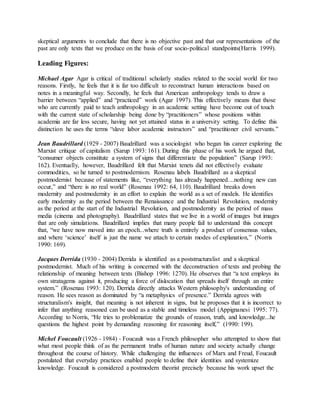
Leading Figures: 
Michael Agar Agar is critical of traditional scholarly studies related to the social world for two 
reasons. Firstly, he feels that it is far too difficult to reconstruct human interactions based on 
notes in a meaningful way. Secondly, he feels that American anthropology tends to draw a 
barrier between “applied” and “practiced” work (Agar 1997). This effectively means that those 
who are currently paid to teach anthropology in an academic setting have become out of touch 
with the current state of scholarship being done by “practitioners” whose positions within 
academia are far less secure, having not yet attained status in a university setting. To define this 
distinction he uses the terms “slave labor academic instructors” and “practitioner civil servants.” 
Jean Baudrillard (1929 - 2007) Baudrillard was a sociologist who began his career exploring the 
Marxist critique of capitalism (Sarup 1993: 161). During this phase of his work he argued that, 
“consumer objects constitute a system of signs that differentiate the population” (Sarup 1993: 
162). Eventually, however, Baudrillard felt that Marxist tenets did not effectively evaluate 
commodities, so he turned to postmodernism. Rosenau labels Baudrillard as a skeptical 
postmodernist because of statements like, “everything has already happened....nothing new can 
occur,” and “there is no real world” (Rosenau 1992: 64, 110). Baudrillard breaks down 
modernity and postmodernity in an effort to explain the world as a set of models. He identifies 
early modernity as the period between the Renaissance and the Industrial Revolution, modernity 
as the period at the start of the Industrial Revolution, and postmodernity as the period of mass 
media (cinema and photography). Baudrillard states that we live in a world of images but images 
that are only simulations. Baudrillard implies that many people fail to understand this concept 
that, “we have now moved into an epoch...where truth is entirely a product of consensus values, 
and where ‘science’ itself is just the name we attach to certain modes of explanation,” (Norris 
1990: 169). 
Jacques Derrida (1930 - 2004) Derrida is identified as a poststructuralist and a skeptical 
postmodernist. Much of his writing is concerned with the deconstruction of texts and probing the 
relationship of meaning between texts (Bishop 1996: 1270). He observes that “a text employs its 
own stratagems against it, producing a force of dislocation that spreads itself through an entire 
system.” (Rosenau 1993: 120). Derrida directly attacks Western philosophy's understanding of 
reason. He sees reason as dominated by “a metaphysics of presence.” Derrida agrees with 
structuralism's insight, that meaning is not inherent in signs, but he proposes that it is incorrect to 
infer that anything reasoned can be used as a stable and timeless model (Appignanesi 1995: 77). 
According to Norris, “He tries to problematize the grounds of reason, truth, and knowledge...he 
questions the highest point by demanding reasoning for reasoning itself,” (1990: 199). 
Michel Foucault (1926 - 1984) - Foucault was a French philosopher who attempted to show that 
what most people think of as the permanent truths of human nature and society actually change 
throughout the course of history. While challenging the influences of Marx and Freud, Foucault 
postulated that everyday practices enabled people to define their identities and systemize 
knowledge. Foucault is considered a postmodern theorist precisely because his work upset the
conventional understanding of history as a chronology of inevitable facts. Alternatively, he 
depicted history as existing under layers of suppressed and unconscious knowledge in and 
throughout history. These under layers are the codes and assumptions of order, the structures of 
exclusion that legitimate the epistemes by which societies achieve identities (Appignanesi 1995: 
83, http://www.connect.net/ron).In addition to these insights, Foucault’s study of power and its 
shifting patterns is one of the foundations of postmodernism. Foucault believed that power was 
inscribed in everyday life to the extent that many social roles and institutions bore the stamp of 
power, specifically as it could be used to regulate social hierarchies and structures. These could 
be regulated though control of the conditions in which “knowledge,” “truth,” and socially 
accepted “reality” were produced (Erikson and Murphy 2010: 272). 
Clifford Geertz (1926 - 2006) Geertz was a prominent anthropologist best known for his work 
with religion. He was somewhat ambivalent about Postmodernism. He divided it into two 
movements that both came to fruition in the 1980s. Geertz describes these as follows: 
The first led off into essentially literary matters: authorship, genre, style, narrative, metaphor, 
representation, discourse, fiction, figuration, persuasion; the second, into essentially political 
matters: the social foundations of anthropological authority, the modes of power inscribed in its 
practices, its ideological assumptions, its complicity with colonialism, racism, exploitation, and 
exoticism, its dependency on the master narratives of Westerns self-understanding. These 
interlinked critiques of anthropology, the one inward-looking and brooding, the other outward-looking 
and recriminatory, may not have produced the ‘fully dialectical ethnography acting 
powerfully in the postmodern world system,’ to quote that Writing Culture blast again, nor did 
they exactly go unresisted. But they did induce a certain self-awareness and a certain candor 
also, into a discipline not without need of them.. [Geertz 2002: 11] 
Ian Hodder (1948 - ) Hodder is one of the founders of postprocessualism and is generally 
considered one of the most influential archaeologists of the last thirty years. The postprocessual 
movement arose out of an attempt to apply insights gained from French Marxist anthropology to 
the study of material culture and was highly influenced by a postmodern epistemology. Working 
in sub-Sahara Africa, Hodder and his students documented how material culture was not merely 
a reflection of sociopolitical organization, but was also an active element that could be used to 
disguise, invert, and distort social relations. Bruce Trigger (2006:481) has argued that perhaps 
the most successful “law” developed in recent archaeology was this demonstration that material 
culture plays an active role in social strategies and hence can alter as well as reflect social reality. 
Nancy Scheper-Hughes (1944-) Scheper-Hughes is a professor of Anthropology at the 
University of California, Berkeley. In her work "Primacy of the Ethical" Scheper-Hughes argues 
that, "If we cannot begin to think about social institutions and practices in moral or ethical terms, 
then anthropology strikes me as quite weak and useless." (1995: 410). She advocates that 
ethnographies be used as tools for critical reflection and human liberation because she feels that 
"ethics" make culture possible. Since culture is preceded by ethics, therefore ethics cannot be 
culturally bound as argued by anthropologists in the past. These philosophies are evident in her 
other works such as, "Death Without Weeping." The crux of her postmodern perspective is that, 
"Anthropologists, no less than any other professionals, should be held accountable for how we 
have used and how we have failed to use anthropology as a critical tool at crucial historical
moments. It is the act of "witnessing" that lends our word its moral, at times almost theological, 
character." (1995: 419) 
Jean-Francois Lyotard (1924 – 1998) Lyotard was the author of a highly influential work on 
postmodern society called, The Postmodern Condition (1984). The work was a critique on the 
current state of knowledge among modern postindustrial nations such as those found in the 
United States and much of Western Europe. In it Lyotard made a number of notable arguments, 
one of which was that the postmodern world suffered from a crisis of “representation,” in which 
older modes of writing about the objects of artistic, philosophical, literary, and social scientific 
languages were no longer credible. Lyotard suggests that: 
The Postmodern would be that which in the modern invokes the unpresentable in presentation 
itself, that which refuses the consolation of correct forms, refuses the consensus of taste 
permitting a common experience of nostalgia for the impossible, and inquires into new 
presentations--not to take pleasure in them, but to better produce the feeling that there is 
something unpresentable.[Lyotard 1984] 
Lyotard also attacked modernist thought as epitomized by "Grand" Narratives or what he termed 
the Meta(master) narrative (Lyotard 1984). In contrast to the ethnographies written by 
anthropologists in the first half of the 20th Century, Lyotard states that an all-encompassing 
account of a culture cannot be accomplished. 
Key Works: 
 Baudrillard, Jean (1995) Simulacra and Simulation. Translated by Sheila Faria Glaser. 
Ann Arbor: University of Michigan Press. 
 Derrida, Jacques (1997) Of Grammatology. Corrected ed. Baltimore: Johns Hopkins 
University Press. 
 Foucault, Michel (1970) The Order of Things: An Archaeology of the Human Sciences. 
New York: Pantheon. 
 Jameson, Fredric (1991). Postmodernism, or, The Cultural Logic of Late Capitalism. 
Durham, NC: Duke University Press. 
 Lyotard, Jean-Francois (1984) The Postmodern Condition: A Report on Knowledge. 
Manchester: Manchester University Press. 
 Marcus, George E. and Michael M. J. Fischer (1986) Anthropology as Cultural Critique. 
An Experimental Moment in the Human Sciences. Chicago: University of Chicago Press. 
 Norris, Christopher (1979) Deconstruction: Theory and Practice. New York: Routledge. 
 Scheper-Hughes, Nancy (1993) Death without Weeping: The Violence of Everyday Life 
in Brazil. Berkeley: University of California Press. 
 Tyler, Stephen (1986) Post-Modern Ethnography: From Document of the Occult To 
Occult Document. In Writing Culture: The Poetics and Politics of Ethnography, ed. 
James Clifford and George E. Marcus. Berkeley: University of California Press. 
 Vattimo, Gianni (1988) The End of Modernity: Nihilism and Hermeneutics. In Post- 
Modern Critique. London: Polity. 
 Modernity: Nihilism and Hermeneutics. In Post-Modern Critique. London: Polity.
Principal Concepts: 
“Culture” in Peril - Aside from Foucault, other postmodernists felt that “Culture is becoming a 
dangerously unfocused term, increasingly lacking in scientific credentials” (Pasquinelli 
1996). The concept of Culture as a whole was tied not only to modernity, but to evolutio nary 
theory (and, implicitly, to euro centrism). In the postmodernist view, if “culture” existed it had 
to be totally relativistic without any suggestion of “progress.” While postmodernists did have a 
greater respect for later revisions of cultural theory by Franz Boas and his followers, who 
attempted to shift from a single path of human “culture” to many varied “cultures,” they found 
even this unsatisfactory because it still required the use of a Western concept to define non- 
Western people. 
Lament - Lament is a practice of ritualized weeping (Wilce 2005). In the view of Wilce, the 
traditional means of laments in many cultures were being forced out by modernity due to many 
claiming that ritualized displays of discontent, particularly discontent with the lost of traditional 
culture, was a “backwards” custom that needed to be stopped. 
Metanarrative Lawrence Kuznar describes metanarratives as grand narratives such as the 
Enlightenment, Marxism or the American dream. Postmodernists see metanarratives as unfairly 
totalizing or naturalizing in their generalizations about the state of humanity and historical 
process (2008:83). 
Polyvocality - Paralleling the generally relatativst and skeptical attitudes towards scientific 
authority, many postmodernists advocate polyvocality, which maintains that there exists 
multiple, legitimate versions of reality or truths as seen from different perspectives. 
Postmodernists construe Enlightenment rationalism and scientific positivism as an effort to 
impose hegemonic values and political control on the world. By challenging the authority of 
anthropologists and other Western intellectuals, postmodernists see themselves as defending the 
integrity of local cultures and helping weaker peoples to oppose their oppressors (Trigger 
2006:446-447). 
Power - Foucault was a prominent critic of the idea of “culture,” preferring instead to deal in the 
concept of “power” as the major focus of anthropological research (Barrett 2001). Foucault felt 
that it was through the dynamics of power that “a human being turns himself into a subject” 
(Foucault 1982). This is not only true of political power, but also includes people recognizing 
things such as sexuality as forces to which they are subject. “The exercise of power is not simply 
a relationship between partners, individual or collective; it is a way in which certain actions 
modify others. Which is to say, of course, that something called Power, with or without a capital 
letter, which is assumed to exist universally in a concentrated or diffused form, does not exist” 
(Foucault 1982: 788). 
Radical skepticism - The systematic skepticism of grounded theoretical perspectives and 
objective truths espoused by many postmodernists had a profound effect on anthropology. This 
skepticism has shifted focus from the observation of a particular society to a reflexive 
consideration of the (anthropological) observer (Bishop 1996). According to Rosenau (1992), 
postmodernists can be divided into two very broad camps, Skeptics and Affirmatives.
 Skeptical Postmodernists – They are extremely critical of the modern subject. They 
consider the subject to be a “linguistic convention” (Rosenau 1992:43). They also reject 
any understanding of time because for them the modern understanding of time is 
oppressive in that it controls and measures individuals. They reject Theory because 
theories are abundant, and no theory is considered more correct that any other. They feel 
that “theory conceals, distorts, and obfuscates, it is alienated, disparate, dissonant, it 
means to exclude, order, and control rival powers” (Rosenau 1992: 81). 
 Affirmative Postmodernists – Affirmatives also reject Theory by denying claims of truth. 
They do not, however, feel that Theory needs to be abolished but merely transformed. 
Affirmatives are less rigid than Skeptics. They support movements organized around 
peace, environment, and feminism (Rosenau 1993: 42). 
Realism - “...is the platonic doctrine that universals or abstractions have being independently of 
mind” (Gellner 1980: 60). Marcus and Fischer note that: “Realism is a mode of writing that 
seeks to represent the reality of the whole world or form of life. Realist ethnographies are written 
to allude to a whole by means of parts or foci of analytical attention which can constantly evoke 
a social and cultural totality (1986: 2323). 
Relativism – Relativism is the notion that different perspectives have no absolute truth or 
validity, but rather possess only relative, subjective value according to distinctions in perception 
and consideration. Gellner writes about the relativistic- functionalist view of thought that goes 
back to the Enlightenment: "The (unresolved) dilemma, which the thought of the Enlightenment 
faced, was between a relativistic-functionalist view of thought, and the absolutist claims of 
enlightened Reason. Viewing man as part of nature...requires (us) to see cognitive and evaluative 
activities as part of nature too, and hence varying from organism to organism and context to 
context. (Gellner in [Asad 1986: 147]). Anthropological theory of the 1960s may be best 
understood as the heir of relativism. Contemporary interpretative anthropology is the essence of 
relativism as a mode of inquiry about communication in and between cultures (Marcus & 
Fischer, 1986:32). 
Self-Reflexivity - In anthropology, self-reflexivity refers to the anthropologists in the process of 
question, both theoretically and practically, themselves and their work. Bishop notes that, “The 
scientific observer's objectification of structure as well as strategy was seen as placing the actors 
in a framework not of their own making but one produced by the observer, “ (1996: 1270). Self- 
Reflexivity therefore leads to a consciousness of the process of knowledge creation (1996: 995). 
There is an increased awareness of the collection of data and the limitation of methodological 
systems. This idea underlies the postmodernist affinity for studying the culture of anthropology 
and ethnography. 
Methodologies: 
One of the essential elements of Postmodernism is that it constitutes an attack against theory 
and methodology. In a sense proponents claim to relinquish all attempts to create new 
knowledge in a systematic fashion, instead substituting an “anti-rules” fashion of discourse 
(Rosenau 1993:117). Despite this claim, however, there are two methodologies characteristic of 
Postmodernism. These methodologies are interdependent in that interpretation is inherent in
Deconstruction. “Post-modern methodology is post-positivist or anti-positivist. As substitutes for 
the scientific method the affirmatives look to feelings and personal experience. . . the skeptical 
post modernists most of the substitutes for method because they argue we can never really know 
anything (Rosenau 1993:117). 
Deconstruction - Deconstruction emphasizes negative critical capacity. Deconstruction involves 
demystifying a text to reveal internal arbitrary hierarchies and presuppositions. By examining the 
margins of a text, the effort of deconstruction examines what it represses, what it does not say, 
and its incongruities. It does not solely unmask error, but redefines the text by undoing and 
reversing polar opposites. Deconstruction does not resolve inconsistencies, but rather exposes 
hierarchies involved for the distillation of information (Rosenau 1993). 
Rosenau’s Guidelines for Deconstruction Analysis: 
 Find an exception to a generalization in a text and push it to the limit so that this 
generalization appears absurd. Use the exception to undermine the principle. 
 Interpret the arguments in a text being deconstructed in their most extreme form. 
 Avoid absolute statements and cultivate intellectual excitement by making statements that 
are both startling and sensational. 
 Deny the legitimacy of dichotomies because there are always a few exceptions. 
 Nothing is to be accepted, nothing is to be rejected. It is extremely difficult to criticize a 
deconstructive argument if no clear viewpoint is expressed. 
 Write so as to permit the greatest number of interpretations possible.....Obscurity may 
“protect from serious scrutiny” (Ellis 1989: 148). The idea is “to create a text without 
finality or completion, one with which the reader can never be finished” (Wellberg, 1985: 
234). 
 Employ new and unusual terminology in order that “familiar positions may not seem too 
familiar and otherwise obvious scholarship may not seem so obviously relevant”(Ellis 
1989: 142). 
 “Never consent to a change of terminology and always insist that the wording of the 
deconstructive argument is sacrosanct.” More familiar formulations undermine any sense 
that the deconstructive position is unique (Ellis 1989: 145). (Rosenau 1993, p.121) 
Intuitive Interpretation - Rosenau notes that, “Postmodern interpretation is introspective and 
anti-objectivist which is a form of individualized understanding. It is more a vision than data 
observation. In anthropology interpretation gravitates toward narrative and centers on listening to 
and talking with the other, “(1993:119). For postmodernists there are an endless number of 
interpretations. Foucault argues that everything is interpretation (Dreyfus and Rabinow 1983: 
106). “There is no final meaning for any particular sign, no notion of unitary sense of text, no 
interpretation can be regarded as superior to any other” (Latour 1988: 182-3). Anti-positivists 
defend the notion that every interpretation is false. “Interpretative anthropology is a covering 
label for a diverse set of reflections upon the practice of ethnography and the concept of culture” 
(Marcus and Fisher 1986: 60). 
Accomplishments:
Critical Examination of Ethnographic Explanation - The unrelenting re-examination of the 
nature of ethnography inevitably leads to a questioning of ethnography itself as a mode of 
cultural analysis. Postmodernism adamantly insists that anthropologists must consider the role of 
their own culture in the explanation of the "other" cultures being studied. Postmodernist theory 
has led to a heightened sensitivity within anthropology to the collection of data. 
Demystification - Perhaps the greatest accomplishments of postmodernism is the focus upon 
uncovering and criticizing the epistemological and ideological motivations in the social sciences, 
as well as the increased attention to the factors contributing to the production of knowledge. 
Polyvocality – The self-reflexive regard for the ways in which social knowledge is produced, as 
well as a general skepticism regarding the objectivity and authority of scientific knowledge, has 
led to an increased appreciation for the voice of the anthropological Other. Even if we do not 
value all interpretations as equally valid for whatever reason, today it is generally recognized 
(although perhaps not always done in practice) that anthropologists must actively consider the 
perspectives and wellbeing of the people being studied. 
Criticisms: 
Roy D’Andrade (1931-) - In the article "Moral Models in Anthropology," D'Andrade critiques 
postmodernism's definition of objectivity and subjectivity by examining the moral nature of their 
models. He argues that these moral models are purely subjective. D'Andrade argues that despite 
the fact that utterly value-free objectivity is impossible, it is the goal of the anthropologist to get 
as close as possible to that ideal. He argues that there must be a separation between moral and 
objective models because “they are counterproductive in discovering how the world works.” 
(D’Andrade 1995: 402). From there he takes issue with the postmodernist attack on objectivity. 
He states that objectivity is in no way dehumanizing nor is objectivity impossible. He states, 
“Science works not because it produces unbiased accounts but because its accounts are objective 
enough to be proved or disproved no matter what anyone wants to be true.” (D’Andrade 1995: 
404). 
Ryan Bishop - “The Postmodernist genre of ethnography has been criticized for fostering a self-indulgent 
subjectivity, and for exaggerating the esoteric and unique aspects of a culture at the 
expense of more prosiac but significant questions.” (Bishop 1996: 58) 
Patricia M. Greenfield Greenfield believes that postmodernism’s complete lack of objectivity, 
and its tendency to push political agendas, makes it virtually useless in any scientific 
investigation (Greenfield 2005). Greenfield suggests using resources in the field of psychology 
to help Anthropologists gain a better grasp on cultural relativism, while still maintaining their 
objectivity. 
Bob McKinley - McKinley believes that Postmodernism is more of a religion than a science 
(McKinley 2000). He argues that the origin of Postmodernism is the Western emphasis on 
individualism, which makes Postmodernists reluctant to acknowledge the existence of distinct 
multi- individual cultures.
Christopher Norris - Norris believes that Lyotard, Foucault, and Baudrillard are too preoccupied 
in the idea of the primacy of moral judgments (Norris 1990: 50). 
Pauline Rosenau (1993) Rosenau identifies seven contradictions in Postmodernism: 
1. Its anti-theoretical position is essentially a theoretical stand. 
2. While Postmodernism stresses the irrational, instruments of reason are freely employed to 
advance its perspective. 
3. The Postmodern prescription to focus on the marginal is itself an evaluative emphasis of 
precisely the sort that it otherwise attacks. 
4. Postmodernism stress intertextuality but often treats text in isolation. 
5. By adamantly rejecting modern criteria for assessing theory, Postmodernists cannot argue 
that there are no valid criteria for judgment. 
6. Postmodernism criticizes the inconsistency of modernism, but refuses to be held to norms 
of consistency itself. 
7. Postmodernists contradict themselves by relinquishing truth claims in their own writings. 
Marshall Sahlins (1930 - )- Sahlins criticizes the postmodern preoccupation with power. "The 
current Foucauldian-Gramscian-Nietzschean obsession with power is the latest incarnation of 
anthropology's incurable functionalism. . . Now 'power' is the intellectual black hole into which 
all kinds of cultural contents get sucked, if before it was social solidarity or material advantage." 
(Sahlins, 1993: 15). 
Melford Spiro (1920 - ) - Spiro argues that postmodern anthropologists do not convincingly 
dismiss the scientific method (1996). Further, he suggests that if anthropology turns away from 
the scientific method then anthropology will become the study of meanings and not the discovery 
of causes that shape what it is to be human. Spiro further states that, “the causal account of 
culture refers to ecological niches, modes of production, subsistence techniques, and so forth, 
just as a causal account of mind refers to the firing of neurons, the secretions of hormones, the 
action of neurotransmitters . . .” (1996: 765). 
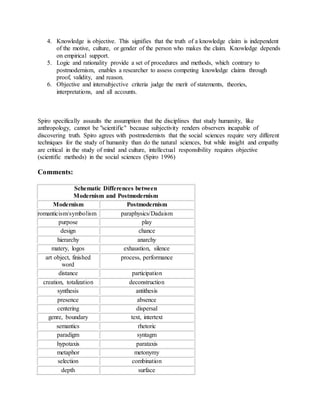
Spiro critically addresses six interrelated propositions from John Searle’s 1993 work, 
“Rationality and Realism": 
1. Reality exists independently of human representations. If this is true then, contrary to 
postmodernism, this postulate supports the existence of “mind- independent external 
reality” which is called “metaphysical realism”. 
2. Language communicates meanings but also refers to objects and situations in the world 
which exist independently of language. Contrary to postmodernism, this postulate 
supports the concept of language as have communicative and referential functions. 
3. Statements are true or false depending on whether the objects and situations to which 
they refer correspond to a greater or lesser degree to the statements. This 
“correspondence theory” of truth is to some extent the theory of truth for postmodernists, 
but this concept is rejected by many postmodernists as “essentialist.”
4. Knowledge is objective. This signifies that the truth of a knowledge claim is independent 
of the motive, culture, or gender of the person who makes the claim. Knowledge depends 
on empirical support. 
5. Logic and rationality provide a set of procedures and methods, which contrary to 
postmodernism, enables a researcher to assess competing knowledge claims through 
proof, validity, and reason. 
6. Objective and intersubjective criteria judge the merit of statements, theories, 
interpretations, and all accounts. 
Spiro specifically assaults the assumption that the disciplines that study humanity, like 
anthropology, cannot be "scientific" because subjectivity renders observers incapable of 
discovering truth. Spiro agrees with postmodernists that the social sciences require very different 
techniques for the study of humanity than do the natural sciences, but while insight and empathy 
are critical in the study of mind and culture, intellectual responsibility requires objective 
(scientific methods) in the social sciences (Spiro 1996) 
Comments: 
Schematic Differences between 
Modernism and Postmodernism 
Modernism Postmodernism 
romanticism/symbolism paraphysics/Dadaism 
purpose play 
design chance 
hierarchy anarchy 
matery, logos exhaustion, silence 
art object, finished 
word 
process, performance 
distance participation 
creation, totalization deconstruction 
synthesis antithesis 
presence absence 
centering dispersal 
genre, boundary text, intertext 
semantics rhetoric 
paradigm syntagm 
hypotaxis parataxis 
metaphor metonymy 
selection combination 
depth surface
interpretation against interpretation 
reading misreading 
signified signifier 
lisible (readerly) scriptible 
narrative anti-narrative 
grande histoire petite histoire 
master code idiolect 
symptom desire 
type mutant 
genital, phallic polymorphous 
paranoia schizophrenia 
origin, cause difference-difference 
God the Father The Holy Ghost 
Metaphysics irony 
determinacy indeterminacy 
transcendence immanence 
(SOURCE: Hassan "The Culture of Postmodernism" Theory, Culture, and Society, V 2 1985, 
123-4.) 
For more information on the foundational theories of Postmodernism, Phenomenology, 
Existentialism, and Marxism, you may wish to reference such philosophers as Heidegger, Hegel, 
Marx, and Kant. This information may be accessed easily from the this Web site, 
http://www.connect/net/ron 
Sources and Bibliography: 
 Agar, Michael (1997) The Postmodern link between academia and practice. * RSS Feed 
National Association for the Practice of Anthropology Bulletin, 17(1), 86-90. 
 Asad, Talal (1986) The Concept of Cultural Translation in British Social Anthropology. 
In James Cliford and George E. Marcus (eds), Writing Culture. The Poetics and Politics 
of Ethnography (pp. 141-164). Berkeley: University of California Press. 
 Ashley, David (1990) Habermas and the Project of Modernity. In Bryan Turner 
(ed),Theories of Modernity and Postmodernity. London: SAGE 
 Appignanesi, Richard and Chris Garratt (1995) Introducing Postmodernism. New York: 
Totem Books. 
 Barrett, S., Stokholm, S., & Burke, J. (2001) The Idea of power and the power of ideas: a 
review essay. American Anthropologist, 103(2), 468-480. 
 Bishop, Ryan (1996) Postmodernism. In David Levinson and Melvin Ember (eds.), 
Encyclopedia of Cultural Anthropology. New York: Henry Holt and Company. 
 Boyne, Roy and Ali Rattansi (1990) The Theory and Politics of Postmodernism: By Way 
of an Introduction. In Roy Boyne and Ali Rattansi (eds), Postmodernism and Society (pp. 
1-45). London: MacMillan Education LTD.
 Brown, Richard H. (1995) Postmodern Representations. Chicago: University of Illinois 
Press. 
 Butler, Christopher (2003) A Very Short Introduction to Postmodernism 
 Callinicos, Alex (1990) Reactionary Postmodernism? In Roy Boyne and Ali Rattansi 
(eds), Postmodernism and Society (pp. 97-118). London: MacMillan Education LTD. 
 Clifford, James and George E. Marcus (eds) (1986) Writing Culture. The Poetics and 
Politics of Ethnography. Berkeley: University of California Press. 
 D'Andrade, Roy (1995) Moral Models in Anthropology. Current Anthropology, 36(3): 
399-407. 
 Dreyfus, Hubert and Paul Rabinow (1983) Michel Foucault, Beyond Structuralism and 
Hermeneutics. 2nd. ed Chicago: University of Chicago Press. 
 Foucault, M. (1982) The Subject and Power. Critical Inquiry, 8(4), 777-795. 
 Erickson, Paul A. and Liam D. Murphy (eds) (2010). A History of Anthropological 
Theory. 3rd Ed. Toronton: University of Toronto Press. 
 Gellner, Ernest (1980) Society and Western Anthropology. New York: Columbia 
University Press. 
 Geertz, Clifford (1973) The Interpretations of Cultures. New York: Basic Books, Inc. 
(pp.15) 
 Geertz, Clifford (2002) The Anthropological life in interesting times. Annual Review of 
Anthropology, 31, 1-19. 
 Greenfield, P. (2000) What Psychology can do for anthropology, or why anthropology 
took postmodernism on the chin. American Anthropologist, 102(3), 564-576. 
 Hall, John A. and I. C. Jarive (eds) (1992) Transition to Modernity. Essays on power, 
wealth, and belief. Cambridge: Cambridge University Press. 
 Harris, Marvin. (1999) Theories of Culture in Postmodern Times. Walnut Creek, CA: 
Altamira. 
 Kuznar, Lawrence A. (2008) Reclaiming a Scientific Anthropology. Lanham, MD: 
Altamira. 
 Johnson, Matthew (2010) Archaeological Theory: An Introduction. 2nd Ed. Wiley- 
Blackwell. 
 Lash, Scott (1990) Sociology of Postmodernism. London: Routledge. 
Latour, Bruno (1988) The Pasteurization of France. Cambridge: Harvard. 
 Lyotard, Jean-Francois (1984) The Postmodern Condition: A Report on Knowledge. 
Manchester, UK: Manchester University Press. 
 Lyotard, Jean-Francois (1992) The Postmodern Explained. Sidney: Power Publications. 
 Marcus, George E. and Michael M. J. Fischer (1986) Anthropology as Cultural Critique. 
An Experimental Moment in the Human Sciences. Chicago: University of Chicago Press. 
 McKinley, B. (2000) Postmodernism certainly is not science, but could it be 
religion?CSAS Bulletin, 36(1), 16-18. 
 Nietzsche, Friedrich (1954) [1873] On Truth and Lie in an Extra-Moral Sense. In W. 
Kaufmann (ed and trans) The Portable Nietzsche (pp. 42-47). New York: Penguin. 
 Norris, Christopher (1990) What’s Wrong with Postmodernism. England: Harvester 
Wheatsheaf. 
 Pasquinelli, C. (1996) The Concept of culture between modernity and postmodernity. In 
V. Hubinger (ed), Grasping the Changing World (pp. 53-73). New York: Routledge.
 Reed, Isaac A. (2010) Epistemology Contextualized: Social-Scientific Knowledge in a 
Postpositivist Era. Sociological Theory, 28(1), 20-39. 
 Roseneau, Pauline (1993) Postmodernism and the Social Sciences 
 Sahlins, Marshall (1993) Waiting for Foucault. Cambridge: Prickly Pear Press. 
 Said, Edward (1978) Orientalism. New York: Routledge. 
 Sarup, Madan (1993) An Introductory Guide to Post-Structuralism and Postmodernism. 
Atlanta: University of Georgia Press. 
 Scheper-Hughes, Nancy (1995) The Primacy of the Ethical. Current 
Anthropology, 36(3): p.409-420. 
 Spiro, Melford E. (1992) Cultural Relativism and the Future of Anthropology. In George 
E. Marcus (ed), Rereading Cultural Anthropology (124-151). Durham: Duke University 
Press. 
 Spiro, Melford E. (1996) Postmodernist Anthropology, Subjectivity, and Science. A 
Modernist Critique. Comparative Studies in Society and History. 38(1), 759-780. 
 Tester, Keith (1993) The Life and Times of Postmodernity. London: Routledge. 
 Trigger, Bruce G. (2006) A History of Archaeological Thought. 2nd Ed. Cambridge: 
Cambridge University Press. 
 Turner, Bryan S. (1990) Theories of Modernity and Postmodernity. London: SAGE 
Publications. 
 Wilce, JM. (2005) Traditional laments and postmodern regrets. Journal of Linguistic 
Anthropology, 15(1), 60-71. 
 Winthrop, Robert H. (1991) Dictionary of Concepts in Cultural Anthropology. New 
York: Greenwood Press.

Postmodernism and its critics

  • 1.
    Postmodernism and ItsCritics Daniel Salberg and Robert Stewart and Karla Wesley and Shannon Weiss (Note: authorship is arranged stratigraphically with the most recent author listed first) Basic Premises: As an intellectual movement postmodernism was born as a challenge to several modernist themes that were first articulated during the Enlightenment. These include scientific positivism, the inevitability of human progress, and the potential of human reason to address any essential truth of physical and social conditions and thereby make them amenable to rational control (Boyne and Rattansi 1990). The primary tenets of the postmodern movement include: (1) an elevation of text and language as the fundamental phenomena of existence, (2) the application of literary analysis to all phenomena, (3) a questioning of reality and representation, (4) a critique of metanarratives, (5) an argument against method and evaluation, (6) a focus upon power relations and hegemony, (7) and a general critique of Western institutions and knowledge (Kuznar 2008:78). For his part, Lawrence Kuznar labels postmodern anyone whose thinking includes most or all of these elements. Importantly, the term postmodernism refers to a broad range of artists, academic critics, philosophers, and social scientists that Christopher Butler (2003:2) has only half-jokingly alluded to as like “a loosely constituted and quarrelsome political party.” The anthropologist Melford Spiro defines postmodernism thusly: The postmodernist critique of science consists of two interrelated arguments, epistemological and ideological. Both are based on subjectivity. First, because of the subjectivity of the human object, anthropology, according to the epistemological argument cannot be a science; and in any event the subjectivity of the human subject precludes the possibility of science discovering objective truth. Second, since objectivity is an illusion, science according to the ideological argument, subverts oppressed groups, females, ethnics, third-world peoples. [Spiro 1996: 759] Postmodernism has its origins as an eclectic social movement originating in aesthetics, architecture and philosophy (Bishop 1996). In architecture and art, fields which are distinguished as the oldest claimants to the name, postmodernism originated in the reaction against abstraction in painting and the International Style in architecture (Callinicos 1990: 101). However, postmodern thinking arguably began in the nineteenth century with Nietzsche’s assertions regarding truth, language, and society, which opened the door for all later postmodern and late modern critiques about the foundations of knowledge (Kuznar 2008: 78). Nietzsche asserted that truth was simply: a mobile army of metaphors, metonyms, and anthropomorphisms – in short, a sum of human relations, which have been enhanced, transposed, and embellished poetically and rhetorically, and which after long use seem firm, canonical, and obligatory to a people: truths are illusions about which one has forgotten that this is what they are. [Nietzsche 1954: 46-47]
  • 2.
    According to Kuznar,postmodernists trace this skepticism about truth and the resulting relativism it engenders from Nietzsche to Max Weber and Sigmund Freud, and finally to Jacques Derrida, Michel Foucault and other contemporary postmodernists (2008:78). Postmodernism and anthropology - Postmodern attacks on ethnography are generally based on the belief that there is no true objectivity and that therefore the authentic implementation of the scientific method is impossible. For instance, Isaac Reed (2010) conceptualizes the postmodern challenge to the objectivity of social research as skepticism over the anthropologist’s ability to integrate the context of investigation and the context of explanation. Reed defines the context of investigation as the social and intellectual context of the investigator – essentially her social identity, beliefs and memories. The context of explanation, on the other hand, refers to the reality that she wishes to investigate, and in particular the social actions she wishes to explain and the surrounding social environment, or context, that she explains them with. In the late 1970s and 1980s some anthropologists, such as Crapanzano and Rabinow, began to express elaborate self-doubt concerning the validity of fieldwork. By the mid-1980s the critique about how anthropologists interpreted and explained the Other, essentially how they engaged in “writing culture,” had become a full-blown epistemic crisis that Reed refers to as the “postmodern” turn. The driving force behind the postmodern turn was a deep skepticism about whether the investigator could adequately, effectively, or honestly integrate the context of investigation into the context of explanation and, as a result, write true social knowledge. This concern was most prevalent in cultural and linguistic anthropology, less so in archaeology, and had the least effect on physical anthropology, which is generally the most scientific of the four subfields. Modernity first came into being with the Renaissance. Modernity implies “the progressive economic and administrative rationalization and differentiation of the social world” (Sarup 1993). In essence this term emerged in the context of the development of the capitalist state. The fundamental act of modernity is to question the foundations of past knowledge, and Boyne and Rattansi characterize modernity as consisting of two sides: “the progressive union of scientific objectivity and politico-economic rationality . . . mirrored in disturbed visions of unalleviated existential despair” (1990: 5). Postmodernity is the state or condition of being postmodern. Logically postmodernism literally means “after modernity. It refers to the incipient or actual dissolution of those social forms associated with modernity" (Sarup 1993). The archaeologist Mathew Johnson has characterized postmodernity, or the postmodern condition, as disillusionment with Enlightenment ideals (Johnson 2010). Jean-Francois Lyotard, in his seminal work The Postmodern Condition (1984) defines it as an “incredulity toward metanarratives,” which is, somewhat ironically, a product of scientific progress (1984: xxiv). Postmodernity concentrates on the tensions of difference and similarity erupting from processes of globalization and capitalism: the accelerating circulation of people, the increasingly dense and frequent cross-cultural interactions, and the unavoidable intersections of local and global knowledge. Some social critics have attempted to explain the postmodern condition in terms of the historical and social milieu which spawned it. David Ashley (1990) suggests that “modern, overloaded individuals, desperately trying to maintain rootedness and integrity . . . ultimately are pushed to the point where there is little reason not to believe that all value-orientations are equally well-
  • 3.
    founded. Therefore, increasingly,choice becomes meaningless.” Jean Baudrillard, one of the most radical postmodernists, writes that we must come to terms with the second revolut ion: “that of the Twentieth Century, of postmodernity, which is the immense process of the destruction of meaning equal to the earlier destruction of appearances. Whoever lives by meaning dies by meaning” ([Baudrillard 1984:38-39] in Ashley 1990). Modernization “is often used to refer to the stages of social development which are based upon industrialization. Modernization is a diverse unity of socio-economic changes generated by scientific and technological discoveries and innovations. . .” (Sarup 1993). Modernism should be considered distinct from the concept of “modernity.” . Although in its broadest definition modernism refers to modern thought, character or practice, the term is usually restricted to a set of artistic, musical, literary, and more generally aesthetic movements that emerged in Europe in the late nineteenth century and would become institutionalized in the academic institutions and art galleries of post-World War I Europe and America (Boyne and Rattansi 1990). Important figures include Matisse, Picasso, and Kandinsky in painting, Joyce and Kafka in literature, and Eliot and Pound in poetry. It can be characterized by self-consciousness, the alienation of the integrated subject, and reflexiveness, as well as by a general critique of modernity’s claims regarding the progressive capacity of science and the efficacy of metanarratives. These themes are very closely related to Postmodernism (Boyne and Rattansi 1990: 6-8; Sarup 1993). Postmodernism - Sarup maintains that “There is a sense in which if one sees modernism as the culture of modernity, postmodernism is the culture of postmodernity” (1993). The term “postmodernism” is somewhat controversial since many doubt whether it can ever be dignified by conceptual coherence. For instance, it is difficult to reconcile postmodernist approaches in fields like art and music to certain postmodern trends in philosophy, sociology, and anthropology. However, it is in some sense unified by a commitment to a set of cultural projects privileging heterogeneity, fragmentation, and difference, as well as a relatively widespread mood in literary theory, philosophy, and the social sciences that question the possibility of impartiality, objectivity, or authoritative knowledge (Boyne and Rattansi 1990: 9-11). The following are some proposed differences between modern and postmodern thought: Contrast of Modern and Postmodern Thinking Modern Postmodern Reasoning From foundation upwards Multiple factors of multiple levels of reasoning. Web-oriented. Science Universal Optimism Realism of Limitations Part/Whole Parts comprise the whole The whole is more than the parts God Acts by violating "natural" laws" or by "immanence" in everything that is Top-Down causation Language Referential Meaning in social context through usage
  • 4.
    Source: http://private.fuller.edu/~clameter/phd/postmodern.html (note:this link is no longer working as of 4/30/2012) Points of Reaction: "Modernity" takes its Latin origin from “modo,” which means “just now.” The Postmodern, then, literally means “after just now” (Appignanesi and Garratt 1995). Points of reaction from within postmodernism are associated with other “posts”: postcolonialism, poststructuralism, and postprocessualism. Postcolonialism Postcolonialism has been defined as: 1. A description of institutional conditions in formerly colonial societies. 2. An abstract representation of the global situation after the colonial period. 3. A description of discourses informed by psychological and epistemological orientations. Edward Said’s Culture and Imperialism (1993) uses discourse analysis and postcolonial theory as tools for rethinking forms of knowledge and the social identities of postcolonial systems. An important feature of postcolonialist thought is its assertion that modernism and modernity are part of the colonial project of domination. Debates about postcolonialism are unresolved, yet issues raised in Said’s Orientalism (1978), a critique of Western descriptions of Non-Euro-American Others, suggest that colonialism as a discourse is based on the ability of Westerners to examine other societies in order to produce knowledge and use it as a form of power deployed against the very subjects of inquiry. As should be readily apparent, the issues of postcolonialism are uncomfortably relevant to contemporary anthropological investigations. Poststructuralism In reaction to the abstraction of cultural data characteristic of model building, cultural relativists argue that model building hindered understanding of thought and action. From this claim arose poststructuralist concepts such as developed in the work of Pierre Bourdieu (1972). He asserts that structural models should not be replaced but enriched. Poststructuralists like Bourdieu are concerned with reflexivity and the search for logical practice. By doing so, accounts of the participants' behavior and meanings are not objectified by the observer. (For definition of reflexivity, see key concepts). In general postructuralism expresses disenchantment with static, mechanistic, and controlling models of culture, instead privileging social process and agency. Postprocessualism Unlike postcolonialism and poststructuralism, which are trends among cultural anthropologists, postprocessualism is a trend among archaeologists. Postprocessualists “use deconstructionist
  • 5.
    skeptical arguments toconclude that there is no objective past and that our representations of the past are only texts that we produce on the basis of our socio-political standpoints(Harris 1999). Leading Figures: Michael Agar Agar is critical of traditional scholarly studies related to the social world for two reasons. Firstly, he feels that it is far too difficult to reconstruct human interactions based on notes in a meaningful way. Secondly, he feels that American anthropology tends to draw a barrier between “applied” and “practiced” work (Agar 1997). This effectively means that those who are currently paid to teach anthropology in an academic setting have become out of touch with the current state of scholarship being done by “practitioners” whose positions within academia are far less secure, having not yet attained status in a university setting. To define this distinction he uses the terms “slave labor academic instructors” and “practitioner civil servants.” Jean Baudrillard (1929 - 2007) Baudrillard was a sociologist who began his career exploring the Marxist critique of capitalism (Sarup 1993: 161). During this phase of his work he argued that, “consumer objects constitute a system of signs that differentiate the population” (Sarup 1993: 162). Eventually, however, Baudrillard felt that Marxist tenets did not effectively evaluate commodities, so he turned to postmodernism. Rosenau labels Baudrillard as a skeptical postmodernist because of statements like, “everything has already happened....nothing new can occur,” and “there is no real world” (Rosenau 1992: 64, 110). Baudrillard breaks down modernity and postmodernity in an effort to explain the world as a set of models. He identifies early modernity as the period between the Renaissance and the Industrial Revolution, modernity as the period at the start of the Industrial Revolution, and postmodernity as the period of mass media (cinema and photography). Baudrillard states that we live in a world of images but images that are only simulations. Baudrillard implies that many people fail to understand this concept that, “we have now moved into an epoch...where truth is entirely a product of consensus values, and where ‘science’ itself is just the name we attach to certain modes of explanation,” (Norris 1990: 169). Jacques Derrida (1930 - 2004) Derrida is identified as a poststructuralist and a skeptical postmodernist. Much of his writing is concerned with the deconstruction of texts and probing the relationship of meaning between texts (Bishop 1996: 1270). He observes that “a text employs its own stratagems against it, producing a force of dislocation that spreads itself through an entire system.” (Rosenau 1993: 120). Derrida directly attacks Western philosophy's understanding of reason. He sees reason as dominated by “a metaphysics of presence.” Derrida agrees with structuralism's insight, that meaning is not inherent in signs, but he proposes that it is incorrect to infer that anything reasoned can be used as a stable and timeless model (Appignanesi 1995: 77). According to Norris, “He tries to problematize the grounds of reason, truth, and knowledge...he questions the highest point by demanding reasoning for reasoning itself,” (1990: 199). Michel Foucault (1926 - 1984) - Foucault was a French philosopher who attempted to show that what most people think of as the permanent truths of human nature and society actually change throughout the course of history. While challenging the influences of Marx and Freud, Foucault postulated that everyday practices enabled people to define their identities and systemize knowledge. Foucault is considered a postmodern theorist precisely because his work upset the
  • 6.
    conventional understanding ofhistory as a chronology of inevitable facts. Alternatively, he depicted history as existing under layers of suppressed and unconscious knowledge in and throughout history. These under layers are the codes and assumptions of order, the structures of exclusion that legitimate the epistemes by which societies achieve identities (Appignanesi 1995: 83, http://www.connect.net/ron).In addition to these insights, Foucault’s study of power and its shifting patterns is one of the foundations of postmodernism. Foucault believed that power was inscribed in everyday life to the extent that many social roles and institutions bore the stamp of power, specifically as it could be used to regulate social hierarchies and structures. These could be regulated though control of the conditions in which “knowledge,” “truth,” and socially accepted “reality” were produced (Erikson and Murphy 2010: 272). Clifford Geertz (1926 - 2006) Geertz was a prominent anthropologist best known for his work with religion. He was somewhat ambivalent about Postmodernism. He divided it into two movements that both came to fruition in the 1980s. Geertz describes these as follows: The first led off into essentially literary matters: authorship, genre, style, narrative, metaphor, representation, discourse, fiction, figuration, persuasion; the second, into essentially political matters: the social foundations of anthropological authority, the modes of power inscribed in its practices, its ideological assumptions, its complicity with colonialism, racism, exploitation, and exoticism, its dependency on the master narratives of Westerns self-understanding. These interlinked critiques of anthropology, the one inward-looking and brooding, the other outward-looking and recriminatory, may not have produced the ‘fully dialectical ethnography acting powerfully in the postmodern world system,’ to quote that Writing Culture blast again, nor did they exactly go unresisted. But they did induce a certain self-awareness and a certain candor also, into a discipline not without need of them.. [Geertz 2002: 11] Ian Hodder (1948 - ) Hodder is one of the founders of postprocessualism and is generally considered one of the most influential archaeologists of the last thirty years. The postprocessual movement arose out of an attempt to apply insights gained from French Marxist anthropology to the study of material culture and was highly influenced by a postmodern epistemology. Working in sub-Sahara Africa, Hodder and his students documented how material culture was not merely a reflection of sociopolitical organization, but was also an active element that could be used to disguise, invert, and distort social relations. Bruce Trigger (2006:481) has argued that perhaps the most successful “law” developed in recent archaeology was this demonstration that material culture plays an active role in social strategies and hence can alter as well as reflect social reality. Nancy Scheper-Hughes (1944-) Scheper-Hughes is a professor of Anthropology at the University of California, Berkeley. In her work "Primacy of the Ethical" Scheper-Hughes argues that, "If we cannot begin to think about social institutions and practices in moral or ethical terms, then anthropology strikes me as quite weak and useless." (1995: 410). She advocates that ethnographies be used as tools for critical reflection and human liberation because she feels that "ethics" make culture possible. Since culture is preceded by ethics, therefore ethics cannot be culturally bound as argued by anthropologists in the past. These philosophies are evident in her other works such as, "Death Without Weeping." The crux of her postmodern perspective is that, "Anthropologists, no less than any other professionals, should be held accountable for how we have used and how we have failed to use anthropology as a critical tool at crucial historical
  • 7.
    moments. It isthe act of "witnessing" that lends our word its moral, at times almost theological, character." (1995: 419) Jean-Francois Lyotard (1924 – 1998) Lyotard was the author of a highly influential work on postmodern society called, The Postmodern Condition (1984). The work was a critique on the current state of knowledge among modern postindustrial nations such as those found in the United States and much of Western Europe. In it Lyotard made a number of notable arguments, one of which was that the postmodern world suffered from a crisis of “representation,” in which older modes of writing about the objects of artistic, philosophical, literary, and social scientific languages were no longer credible. Lyotard suggests that: The Postmodern would be that which in the modern invokes the unpresentable in presentation itself, that which refuses the consolation of correct forms, refuses the consensus of taste permitting a common experience of nostalgia for the impossible, and inquires into new presentations--not to take pleasure in them, but to better produce the feeling that there is something unpresentable.[Lyotard 1984] Lyotard also attacked modernist thought as epitomized by "Grand" Narratives or what he termed the Meta(master) narrative (Lyotard 1984). In contrast to the ethnographies written by anthropologists in the first half of the 20th Century, Lyotard states that an all-encompassing account of a culture cannot be accomplished. Key Works:  Baudrillard, Jean (1995) Simulacra and Simulation. Translated by Sheila Faria Glaser. Ann Arbor: University of Michigan Press.  Derrida, Jacques (1997) Of Grammatology. Corrected ed. Baltimore: Johns Hopkins University Press.  Foucault, Michel (1970) The Order of Things: An Archaeology of the Human Sciences. New York: Pantheon.  Jameson, Fredric (1991). Postmodernism, or, The Cultural Logic of Late Capitalism. Durham, NC: Duke University Press.  Lyotard, Jean-Francois (1984) The Postmodern Condition: A Report on Knowledge. Manchester: Manchester University Press.  Marcus, George E. and Michael M. J. Fischer (1986) Anthropology as Cultural Critique. An Experimental Moment in the Human Sciences. Chicago: University of Chicago Press.  Norris, Christopher (1979) Deconstruction: Theory and Practice. New York: Routledge.  Scheper-Hughes, Nancy (1993) Death without Weeping: The Violence of Everyday Life in Brazil. Berkeley: University of California Press.  Tyler, Stephen (1986) Post-Modern Ethnography: From Document of the Occult To Occult Document. In Writing Culture: The Poetics and Politics of Ethnography, ed. James Clifford and George E. Marcus. Berkeley: University of California Press.  Vattimo, Gianni (1988) The End of Modernity: Nihilism and Hermeneutics. In Post- Modern Critique. London: Polity.  Modernity: Nihilism and Hermeneutics. In Post-Modern Critique. London: Polity.
  • 8.
    Principal Concepts: “Culture”in Peril - Aside from Foucault, other postmodernists felt that “Culture is becoming a dangerously unfocused term, increasingly lacking in scientific credentials” (Pasquinelli 1996). The concept of Culture as a whole was tied not only to modernity, but to evolutio nary theory (and, implicitly, to euro centrism). In the postmodernist view, if “culture” existed it had to be totally relativistic without any suggestion of “progress.” While postmodernists did have a greater respect for later revisions of cultural theory by Franz Boas and his followers, who attempted to shift from a single path of human “culture” to many varied “cultures,” they found even this unsatisfactory because it still required the use of a Western concept to define non- Western people. Lament - Lament is a practice of ritualized weeping (Wilce 2005). In the view of Wilce, the traditional means of laments in many cultures were being forced out by modernity due to many claiming that ritualized displays of discontent, particularly discontent with the lost of traditional culture, was a “backwards” custom that needed to be stopped. Metanarrative Lawrence Kuznar describes metanarratives as grand narratives such as the Enlightenment, Marxism or the American dream. Postmodernists see metanarratives as unfairly totalizing or naturalizing in their generalizations about the state of humanity and historical process (2008:83). Polyvocality - Paralleling the generally relatativst and skeptical attitudes towards scientific authority, many postmodernists advocate polyvocality, which maintains that there exists multiple, legitimate versions of reality or truths as seen from different perspectives. Postmodernists construe Enlightenment rationalism and scientific positivism as an effort to impose hegemonic values and political control on the world. By challenging the authority of anthropologists and other Western intellectuals, postmodernists see themselves as defending the integrity of local cultures and helping weaker peoples to oppose their oppressors (Trigger 2006:446-447). Power - Foucault was a prominent critic of the idea of “culture,” preferring instead to deal in the concept of “power” as the major focus of anthropological research (Barrett 2001). Foucault felt that it was through the dynamics of power that “a human being turns himself into a subject” (Foucault 1982). This is not only true of political power, but also includes people recognizing things such as sexuality as forces to which they are subject. “The exercise of power is not simply a relationship between partners, individual or collective; it is a way in which certain actions modify others. Which is to say, of course, that something called Power, with or without a capital letter, which is assumed to exist universally in a concentrated or diffused form, does not exist” (Foucault 1982: 788). Radical skepticism - The systematic skepticism of grounded theoretical perspectives and objective truths espoused by many postmodernists had a profound effect on anthropology. This skepticism has shifted focus from the observation of a particular society to a reflexive consideration of the (anthropological) observer (Bishop 1996). According to Rosenau (1992), postmodernists can be divided into two very broad camps, Skeptics and Affirmatives.
  • 9.
     Skeptical Postmodernists– They are extremely critical of the modern subject. They consider the subject to be a “linguistic convention” (Rosenau 1992:43). They also reject any understanding of time because for them the modern understanding of time is oppressive in that it controls and measures individuals. They reject Theory because theories are abundant, and no theory is considered more correct that any other. They feel that “theory conceals, distorts, and obfuscates, it is alienated, disparate, dissonant, it means to exclude, order, and control rival powers” (Rosenau 1992: 81).  Affirmative Postmodernists – Affirmatives also reject Theory by denying claims of truth. They do not, however, feel that Theory needs to be abolished but merely transformed. Affirmatives are less rigid than Skeptics. They support movements organized around peace, environment, and feminism (Rosenau 1993: 42). Realism - “...is the platonic doctrine that universals or abstractions have being independently of mind” (Gellner 1980: 60). Marcus and Fischer note that: “Realism is a mode of writing that seeks to represent the reality of the whole world or form of life. Realist ethnographies are written to allude to a whole by means of parts or foci of analytical attention which can constantly evoke a social and cultural totality (1986: 2323). Relativism – Relativism is the notion that different perspectives have no absolute truth or validity, but rather possess only relative, subjective value according to distinctions in perception and consideration. Gellner writes about the relativistic- functionalist view of thought that goes back to the Enlightenment: "The (unresolved) dilemma, which the thought of the Enlightenment faced, was between a relativistic-functionalist view of thought, and the absolutist claims of enlightened Reason. Viewing man as part of nature...requires (us) to see cognitive and evaluative activities as part of nature too, and hence varying from organism to organism and context to context. (Gellner in [Asad 1986: 147]). Anthropological theory of the 1960s may be best understood as the heir of relativism. Contemporary interpretative anthropology is the essence of relativism as a mode of inquiry about communication in and between cultures (Marcus & Fischer, 1986:32). Self-Reflexivity - In anthropology, self-reflexivity refers to the anthropologists in the process of question, both theoretically and practically, themselves and their work. Bishop notes that, “The scientific observer's objectification of structure as well as strategy was seen as placing the actors in a framework not of their own making but one produced by the observer, “ (1996: 1270). Self- Reflexivity therefore leads to a consciousness of the process of knowledge creation (1996: 995). There is an increased awareness of the collection of data and the limitation of methodological systems. This idea underlies the postmodernist affinity for studying the culture of anthropology and ethnography. Methodologies: One of the essential elements of Postmodernism is that it constitutes an attack against theory and methodology. In a sense proponents claim to relinquish all attempts to create new knowledge in a systematic fashion, instead substituting an “anti-rules” fashion of discourse (Rosenau 1993:117). Despite this claim, however, there are two methodologies characteristic of Postmodernism. These methodologies are interdependent in that interpretation is inherent in
  • 10.
    Deconstruction. “Post-modern methodologyis post-positivist or anti-positivist. As substitutes for the scientific method the affirmatives look to feelings and personal experience. . . the skeptical post modernists most of the substitutes for method because they argue we can never really know anything (Rosenau 1993:117). Deconstruction - Deconstruction emphasizes negative critical capacity. Deconstruction involves demystifying a text to reveal internal arbitrary hierarchies and presuppositions. By examining the margins of a text, the effort of deconstruction examines what it represses, what it does not say, and its incongruities. It does not solely unmask error, but redefines the text by undoing and reversing polar opposites. Deconstruction does not resolve inconsistencies, but rather exposes hierarchies involved for the distillation of information (Rosenau 1993). Rosenau’s Guidelines for Deconstruction Analysis:  Find an exception to a generalization in a text and push it to the limit so that this generalization appears absurd. Use the exception to undermine the principle.  Interpret the arguments in a text being deconstructed in their most extreme form.  Avoid absolute statements and cultivate intellectual excitement by making statements that are both startling and sensational.  Deny the legitimacy of dichotomies because there are always a few exceptions.  Nothing is to be accepted, nothing is to be rejected. It is extremely difficult to criticize a deconstructive argument if no clear viewpoint is expressed.  Write so as to permit the greatest number of interpretations possible.....Obscurity may “protect from serious scrutiny” (Ellis 1989: 148). The idea is “to create a text without finality or completion, one with which the reader can never be finished” (Wellberg, 1985: 234).  Employ new and unusual terminology in order that “familiar positions may not seem too familiar and otherwise obvious scholarship may not seem so obviously relevant”(Ellis 1989: 142).  “Never consent to a change of terminology and always insist that the wording of the deconstructive argument is sacrosanct.” More familiar formulations undermine any sense that the deconstructive position is unique (Ellis 1989: 145). (Rosenau 1993, p.121) Intuitive Interpretation - Rosenau notes that, “Postmodern interpretation is introspective and anti-objectivist which is a form of individualized understanding. It is more a vision than data observation. In anthropology interpretation gravitates toward narrative and centers on listening to and talking with the other, “(1993:119). For postmodernists there are an endless number of interpretations. Foucault argues that everything is interpretation (Dreyfus and Rabinow 1983: 106). “There is no final meaning for any particular sign, no notion of unitary sense of text, no interpretation can be regarded as superior to any other” (Latour 1988: 182-3). Anti-positivists defend the notion that every interpretation is false. “Interpretative anthropology is a covering label for a diverse set of reflections upon the practice of ethnography and the concept of culture” (Marcus and Fisher 1986: 60). Accomplishments:
  • 11.
    Critical Examination ofEthnographic Explanation - The unrelenting re-examination of the nature of ethnography inevitably leads to a questioning of ethnography itself as a mode of cultural analysis. Postmodernism adamantly insists that anthropologists must consider the role of their own culture in the explanation of the "other" cultures being studied. Postmodernist theory has led to a heightened sensitivity within anthropology to the collection of data. Demystification - Perhaps the greatest accomplishments of postmodernism is the focus upon uncovering and criticizing the epistemological and ideological motivations in the social sciences, as well as the increased attention to the factors contributing to the production of knowledge. Polyvocality – The self-reflexive regard for the ways in which social knowledge is produced, as well as a general skepticism regarding the objectivity and authority of scientific knowledge, has led to an increased appreciation for the voice of the anthropological Other. Even if we do not value all interpretations as equally valid for whatever reason, today it is generally recognized (although perhaps not always done in practice) that anthropologists must actively consider the perspectives and wellbeing of the people being studied. Criticisms: Roy D’Andrade (1931-) - In the article "Moral Models in Anthropology," D'Andrade critiques postmodernism's definition of objectivity and subjectivity by examining the moral nature of their models. He argues that these moral models are purely subjective. D'Andrade argues that despite the fact that utterly value-free objectivity is impossible, it is the goal of the anthropologist to get as close as possible to that ideal. He argues that there must be a separation between moral and objective models because “they are counterproductive in discovering how the world works.” (D’Andrade 1995: 402). From there he takes issue with the postmodernist attack on objectivity. He states that objectivity is in no way dehumanizing nor is objectivity impossible. He states, “Science works not because it produces unbiased accounts but because its accounts are objective enough to be proved or disproved no matter what anyone wants to be true.” (D’Andrade 1995: 404). Ryan Bishop - “The Postmodernist genre of ethnography has been criticized for fostering a self-indulgent subjectivity, and for exaggerating the esoteric and unique aspects of a culture at the expense of more prosiac but significant questions.” (Bishop 1996: 58) Patricia M. Greenfield Greenfield believes that postmodernism’s complete lack of objectivity, and its tendency to push political agendas, makes it virtually useless in any scientific investigation (Greenfield 2005). Greenfield suggests using resources in the field of psychology to help Anthropologists gain a better grasp on cultural relativism, while still maintaining their objectivity. Bob McKinley - McKinley believes that Postmodernism is more of a religion than a science (McKinley 2000). He argues that the origin of Postmodernism is the Western emphasis on individualism, which makes Postmodernists reluctant to acknowledge the existence of distinct multi- individual cultures.
  • 12.
    Christopher Norris -Norris believes that Lyotard, Foucault, and Baudrillard are too preoccupied in the idea of the primacy of moral judgments (Norris 1990: 50). Pauline Rosenau (1993) Rosenau identifies seven contradictions in Postmodernism: 1. Its anti-theoretical position is essentially a theoretical stand. 2. While Postmodernism stresses the irrational, instruments of reason are freely employed to advance its perspective. 3. The Postmodern prescription to focus on the marginal is itself an evaluative emphasis of precisely the sort that it otherwise attacks. 4. Postmodernism stress intertextuality but often treats text in isolation. 5. By adamantly rejecting modern criteria for assessing theory, Postmodernists cannot argue that there are no valid criteria for judgment. 6. Postmodernism criticizes the inconsistency of modernism, but refuses to be held to norms of consistency itself. 7. Postmodernists contradict themselves by relinquishing truth claims in their own writings. Marshall Sahlins (1930 - )- Sahlins criticizes the postmodern preoccupation with power. "The current Foucauldian-Gramscian-Nietzschean obsession with power is the latest incarnation of anthropology's incurable functionalism. . . Now 'power' is the intellectual black hole into which all kinds of cultural contents get sucked, if before it was social solidarity or material advantage." (Sahlins, 1993: 15). Melford Spiro (1920 - ) - Spiro argues that postmodern anthropologists do not convincingly dismiss the scientific method (1996). Further, he suggests that if anthropology turns away from the scientific method then anthropology will become the study of meanings and not the discovery of causes that shape what it is to be human. Spiro further states that, “the causal account of culture refers to ecological niches, modes of production, subsistence techniques, and so forth, just as a causal account of mind refers to the firing of neurons, the secretions of hormones, the action of neurotransmitters . . .” (1996: 765). Spiro critically addresses six interrelated propositions from John Searle’s 1993 work, “Rationality and Realism": 1. Reality exists independently of human representations. If this is true then, contrary to postmodernism, this postulate supports the existence of “mind- independent external reality” which is called “metaphysical realism”. 2. Language communicates meanings but also refers to objects and situations in the world which exist independently of language. Contrary to postmodernism, this postulate supports the concept of language as have communicative and referential functions. 3. Statements are true or false depending on whether the objects and situations to which they refer correspond to a greater or lesser degree to the statements. This “correspondence theory” of truth is to some extent the theory of truth for postmodernists, but this concept is rejected by many postmodernists as “essentialist.”
  • 13.
    4. Knowledge isobjective. This signifies that the truth of a knowledge claim is independent of the motive, culture, or gender of the person who makes the claim. Knowledge depends on empirical support. 5. Logic and rationality provide a set of procedures and methods, which contrary to postmodernism, enables a researcher to assess competing knowledge claims through proof, validity, and reason. 6. Objective and intersubjective criteria judge the merit of statements, theories, interpretations, and all accounts. Spiro specifically assaults the assumption that the disciplines that study humanity, like anthropology, cannot be "scientific" because subjectivity renders observers incapable of discovering truth. Spiro agrees with postmodernists that the social sciences require very different techniques for the study of humanity than do the natural sciences, but while insight and empathy are critical in the study of mind and culture, intellectual responsibility requires objective (scientific methods) in the social sciences (Spiro 1996) Comments: Schematic Differences between Modernism and Postmodernism Modernism Postmodernism romanticism/symbolism paraphysics/Dadaism purpose play design chance hierarchy anarchy matery, logos exhaustion, silence art object, finished word process, performance distance participation creation, totalization deconstruction synthesis antithesis presence absence centering dispersal genre, boundary text, intertext semantics rhetoric paradigm syntagm hypotaxis parataxis metaphor metonymy selection combination depth surface
  • 14.
    interpretation against interpretation reading misreading signified signifier lisible (readerly) scriptible narrative anti-narrative grande histoire petite histoire master code idiolect symptom desire type mutant genital, phallic polymorphous paranoia schizophrenia origin, cause difference-difference God the Father The Holy Ghost Metaphysics irony determinacy indeterminacy transcendence immanence (SOURCE: Hassan "The Culture of Postmodernism" Theory, Culture, and Society, V 2 1985, 123-4.) For more information on the foundational theories of Postmodernism, Phenomenology, Existentialism, and Marxism, you may wish to reference such philosophers as Heidegger, Hegel, Marx, and Kant. This information may be accessed easily from the this Web site, http://www.connect/net/ron Sources and Bibliography:  Agar, Michael (1997) The Postmodern link between academia and practice. * RSS Feed National Association for the Practice of Anthropology Bulletin, 17(1), 86-90.  Asad, Talal (1986) The Concept of Cultural Translation in British Social Anthropology. In James Cliford and George E. Marcus (eds), Writing Culture. The Poetics and Politics of Ethnography (pp. 141-164). Berkeley: University of California Press.  Ashley, David (1990) Habermas and the Project of Modernity. In Bryan Turner (ed),Theories of Modernity and Postmodernity. London: SAGE  Appignanesi, Richard and Chris Garratt (1995) Introducing Postmodernism. New York: Totem Books.  Barrett, S., Stokholm, S., & Burke, J. (2001) The Idea of power and the power of ideas: a review essay. American Anthropologist, 103(2), 468-480.  Bishop, Ryan (1996) Postmodernism. In David Levinson and Melvin Ember (eds.), Encyclopedia of Cultural Anthropology. New York: Henry Holt and Company.  Boyne, Roy and Ali Rattansi (1990) The Theory and Politics of Postmodernism: By Way of an Introduction. In Roy Boyne and Ali Rattansi (eds), Postmodernism and Society (pp. 1-45). London: MacMillan Education LTD.
  • 15.
     Brown, RichardH. (1995) Postmodern Representations. Chicago: University of Illinois Press.  Butler, Christopher (2003) A Very Short Introduction to Postmodernism  Callinicos, Alex (1990) Reactionary Postmodernism? In Roy Boyne and Ali Rattansi (eds), Postmodernism and Society (pp. 97-118). London: MacMillan Education LTD.  Clifford, James and George E. Marcus (eds) (1986) Writing Culture. The Poetics and Politics of Ethnography. Berkeley: University of California Press.  D'Andrade, Roy (1995) Moral Models in Anthropology. Current Anthropology, 36(3): 399-407.  Dreyfus, Hubert and Paul Rabinow (1983) Michel Foucault, Beyond Structuralism and Hermeneutics. 2nd. ed Chicago: University of Chicago Press.  Foucault, M. (1982) The Subject and Power. Critical Inquiry, 8(4), 777-795.  Erickson, Paul A. and Liam D. Murphy (eds) (2010). A History of Anthropological Theory. 3rd Ed. Toronton: University of Toronto Press.  Gellner, Ernest (1980) Society and Western Anthropology. New York: Columbia University Press.  Geertz, Clifford (1973) The Interpretations of Cultures. New York: Basic Books, Inc. (pp.15)  Geertz, Clifford (2002) The Anthropological life in interesting times. Annual Review of Anthropology, 31, 1-19.  Greenfield, P. (2000) What Psychology can do for anthropology, or why anthropology took postmodernism on the chin. American Anthropologist, 102(3), 564-576.  Hall, John A. and I. C. Jarive (eds) (1992) Transition to Modernity. Essays on power, wealth, and belief. Cambridge: Cambridge University Press.  Harris, Marvin. (1999) Theories of Culture in Postmodern Times. Walnut Creek, CA: Altamira.  Kuznar, Lawrence A. (2008) Reclaiming a Scientific Anthropology. Lanham, MD: Altamira.  Johnson, Matthew (2010) Archaeological Theory: An Introduction. 2nd Ed. Wiley- Blackwell.  Lash, Scott (1990) Sociology of Postmodernism. London: Routledge. Latour, Bruno (1988) The Pasteurization of France. Cambridge: Harvard.  Lyotard, Jean-Francois (1984) The Postmodern Condition: A Report on Knowledge. Manchester, UK: Manchester University Press.  Lyotard, Jean-Francois (1992) The Postmodern Explained. Sidney: Power Publications.  Marcus, George E. and Michael M. J. Fischer (1986) Anthropology as Cultural Critique. An Experimental Moment in the Human Sciences. Chicago: University of Chicago Press.  McKinley, B. (2000) Postmodernism certainly is not science, but could it be religion?CSAS Bulletin, 36(1), 16-18.  Nietzsche, Friedrich (1954) [1873] On Truth and Lie in an Extra-Moral Sense. In W. Kaufmann (ed and trans) The Portable Nietzsche (pp. 42-47). New York: Penguin.  Norris, Christopher (1990) What’s Wrong with Postmodernism. England: Harvester Wheatsheaf.  Pasquinelli, C. (1996) The Concept of culture between modernity and postmodernity. In V. Hubinger (ed), Grasping the Changing World (pp. 53-73). New York: Routledge.
  • 16.
     Reed, IsaacA. (2010) Epistemology Contextualized: Social-Scientific Knowledge in a Postpositivist Era. Sociological Theory, 28(1), 20-39.  Roseneau, Pauline (1993) Postmodernism and the Social Sciences  Sahlins, Marshall (1993) Waiting for Foucault. Cambridge: Prickly Pear Press.  Said, Edward (1978) Orientalism. New York: Routledge.  Sarup, Madan (1993) An Introductory Guide to Post-Structuralism and Postmodernism. Atlanta: University of Georgia Press.  Scheper-Hughes, Nancy (1995) The Primacy of the Ethical. Current Anthropology, 36(3): p.409-420.  Spiro, Melford E. (1992) Cultural Relativism and the Future of Anthropology. In George E. Marcus (ed), Rereading Cultural Anthropology (124-151). Durham: Duke University Press.  Spiro, Melford E. (1996) Postmodernist Anthropology, Subjectivity, and Science. A Modernist Critique. Comparative Studies in Society and History. 38(1), 759-780.  Tester, Keith (1993) The Life and Times of Postmodernity. London: Routledge.  Trigger, Bruce G. (2006) A History of Archaeological Thought. 2nd Ed. Cambridge: Cambridge University Press.  Turner, Bryan S. (1990) Theories of Modernity and Postmodernity. London: SAGE Publications.  Wilce, JM. (2005) Traditional laments and postmodern regrets. Journal of Linguistic Anthropology, 15(1), 60-71.  Winthrop, Robert H. (1991) Dictionary of Concepts in Cultural Anthropology. New York: Greenwood Press.